FTX creditors in China, please note: your compensation could be reduced to zero
TechFlow Selected TechFlow Selected
FTX creditors in China, please note: your compensation could be reduced to zero
FTX Recovery Trust's "Restricted Jurisdiction Program" appears to be compliant on the surface, but is in fact a structural exclusion mechanism.
 Navigating Web3 tides with focused insights
Author: Daii
A global plunder disguised as procedure is quietly beginning.
In early July 2025, a motion filed with the U.S. Bankruptcy Court for the District of Delaware struck like muffled thunder among the most silent group of FTX creditors worldwide.
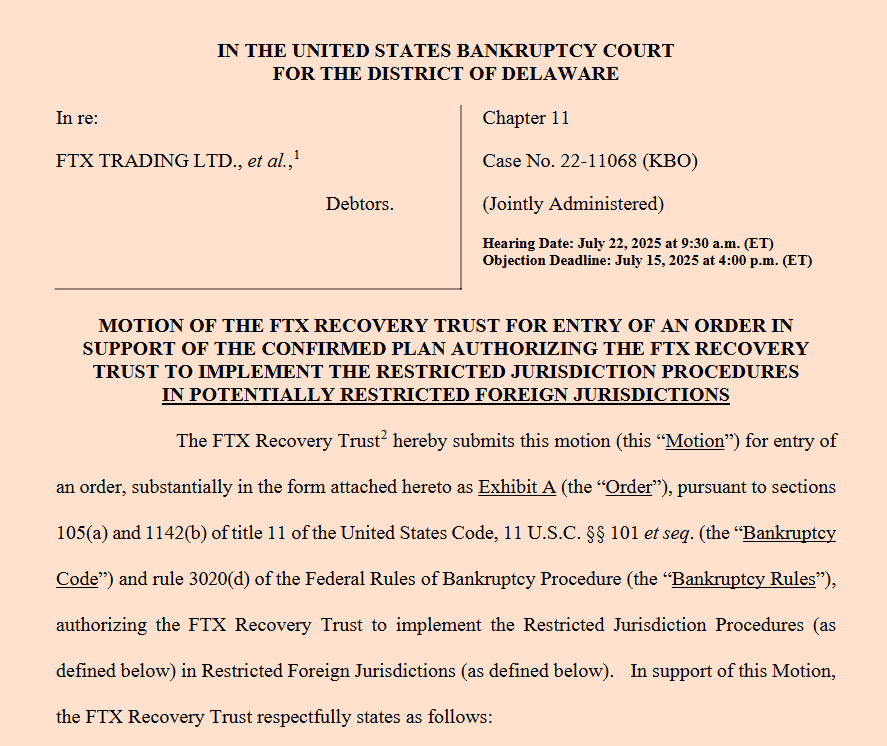
This seemingly rational and concise motion seeks court approval for the "Restricted Jurisdictions Procedures." Once initiated, this process could prevent creditors from 49 countries and regions—including China—from receiving any compensation.
From Mt. Gox to Celsius, from Voyager to Genesis, we've seen lengthy procedures and slow payouts, but never a bankruptcy settlement that openly establishes a "prove you're innocent or automatically forfeit" checkpoint for creditors in 49 nations.
This isn't a claim process—it's more like a rehearsal for "default confiscation."
We must recognize: This is not merely a legal battle, but a clash of systems—globalized internet assets versus localized financial regulation. If this motion passes in Delaware, other bankruptcy trusts will use it as a template.
You may still be watching, but the process has already begun.
This time, we must fight on two fronts:
-
First, before the July 22 court hearing, do everything possible to block the motion itself and ensure judges hear the voices of restricted creditors;
-
Second, if the procedure passes, launch collective litigation to hold the FTX Recovery Trust accountable for both breach of contract and infringement, making the "cost of confiscation" far exceed "fair payout."
Justice should not be inverted by procedure. This should be the awakening moment for FTX creditors across 49 countries.
Prior to this, we need to understand the origins and implications of this motion.
1. Why does this motion exist?—Viewed from the perspective of the FTX Recovery Trust
Opening the motion filed with the Delaware Bankruptcy Court on July 2, 2025, we find this opening statement:
FTX's infamous prepetition business activities violated cryptocurrency-related laws and regulations in various countries around the world, often flagrantly. Today, certain creditors of the FTX Recovery Trust reside in jurisdictions that continue to have laws and regulations that restrict cryptocurrency transactions.
"FTX's prior operations blatantly violated digital asset regulations globally; now some creditors reside in jurisdictions banning crypto transactions."
This sentence acts like a mirror, reflecting the sharp conflict between "paying out" and "breaking local laws"—a dilemma the recovery trust must navigate.
1.1 Risky
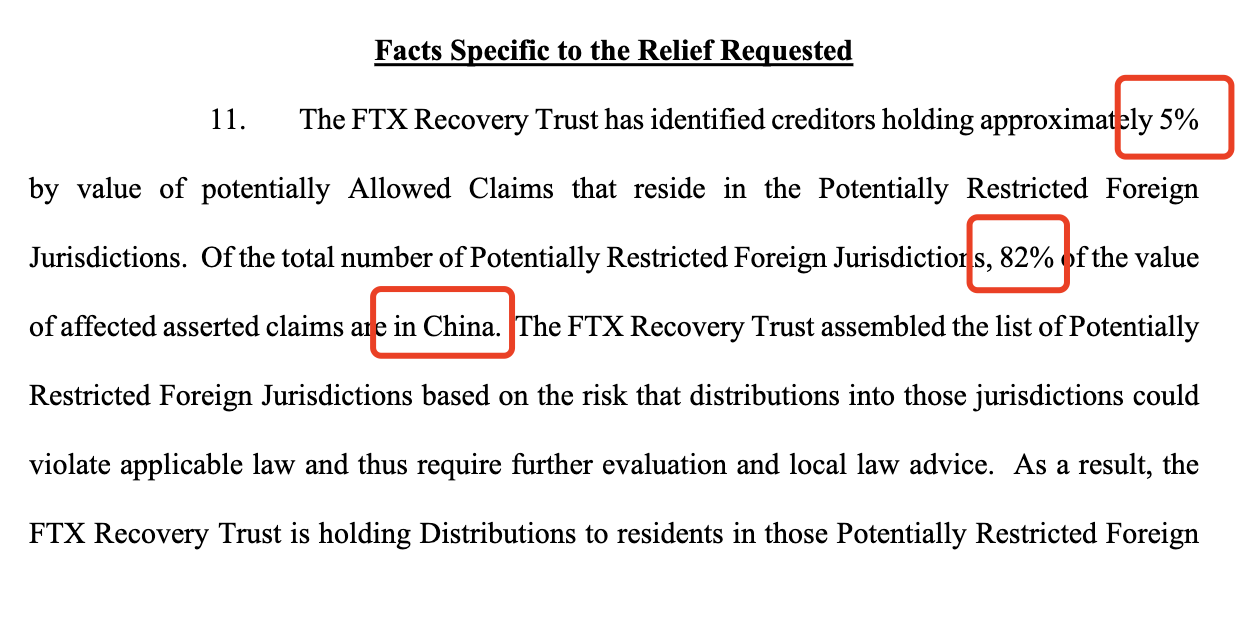
Appendix B of the motion lists 49 "potentially restricted jurisdictions," whose combined claims account for about 5% of total recognized debt. Chinese creditors represent 82% of this value (Cointelegraph).
Among these regions, at least 16 countries ban crypto payments outright, while nine criminalize digital asset transactions—carrying penalties up to ten years imprisonment (Cointelegraph). Tunisia offers one example: its central bank issued a blanket ban in 2018, and in 2021, a 17-year-old was arrested and prosecuted for using cryptocurrency under charges of "illegal foreign exchange trading" (AInvest). In such environments, cross-border compensation payments could trigger local criminal law enforcement, judicial assistance requests, or even extraterritorial prosecution.
1.2 Not Worth It
No matter how cold the numbers seem, arithmetic remains: The recovery trust can smoothly distribute approximately 95% of eligible claims, leaving only about 5% in the "disputed pool" (technext24.com). Spending time and resources on just 5% would incur legal fees and risk delaying payouts to already-approved creditors. This effectively deducts a portion from all creditors' distributions—nobody wants to pay this "time tax."
Under Chapter 11 bankruptcy rules in the U.S., trustees are bound by the "Prudent Person Rule," meaning they must act within "reasonable caution." Prioritizing the majority of creditors is therefore legally justified. The motion includes three "safety gates":
-
A "favorable opinion" from local counsel;
-
A 45-day objection window;
-
Final determination by the court on whether the "restricted jurisdiction" designation is valid.
This structure shows respect for creditor procedural rights while ensuring systemic operability, allowing judges to "secure first, assess later" and giving creditors ample opportunity to submit compliance evidence.
1.3 Summary
From the standpoint of the FTX Recovery Trust, this motion isn't an arbitrary barrier but a serious exercise in "risk pricing"—an attempt to balance compliance obligations against payout duties within manageable limits, categorically managing areas that might lead to criminal liability or major delays.
However, note that although the motion doesn’t take substantive action yet, merely setting up a procedure—the Restricted Jurisdictions Procedure—its ultimate effect would be that creditors from the 49 shortlisted countries and regions receive zero compensation.
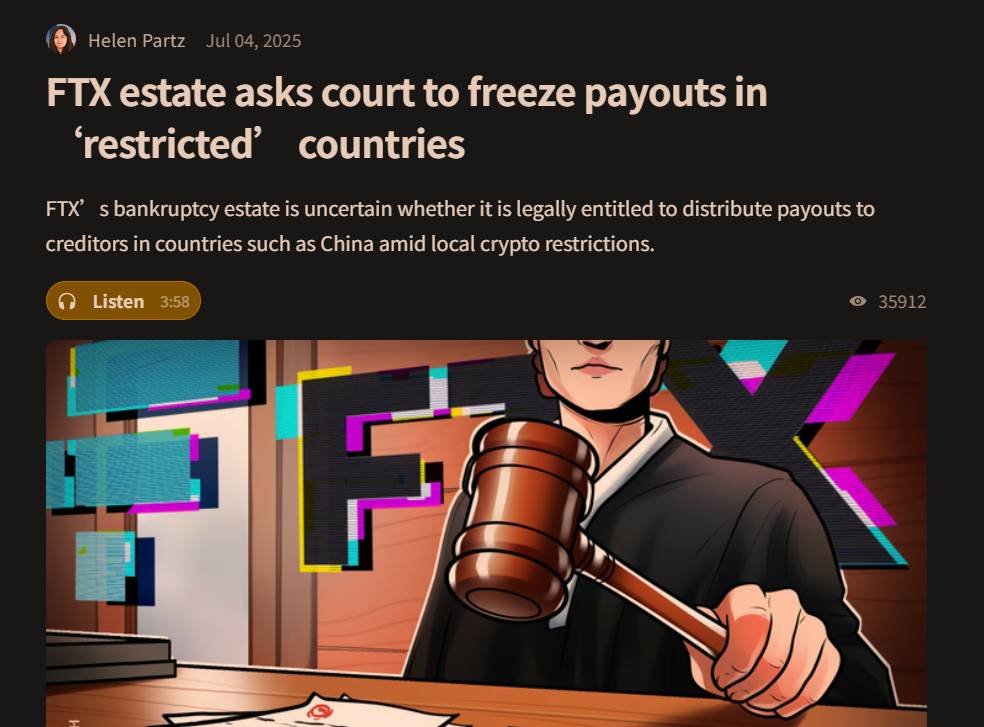
2. How exactly does the Restricted Jurisdictions Procedure work?—Examining the mechanisms behind each step
This fifteen-page motion reads like a maze filled with hidden traps. Each procedural design appears reasonable and rule-abiding, yet risks pushing legitimate creditors into automatic invalidation without their awareness.
2.1 First Gate: Legal Opinion
Upon initiation, the recovery trust will hire "one qualified lawyer" per listed country or region to issue a legal opinion determining whether disbursement conflicts with local laws. The motion explicitly states: Only when the lawyer confirms payment legality "without exception and without condition" can creditors in that jurisdiction unlock eligibility for payouts.
The problem lies precisely in those six words—"without exception and without condition." In many countries where digital asset policies are ambiguous and laws unclear, which lawyer dares endorse an uncertain position unconditionally? Refusing reservations may endanger their license; issuing them leads the trust to deem the opinion "unacceptable." This gate effectively shifts the default from "presumed lawful" to "presumed non-compliant."
Thus, the typical outcome of this compliance test becomes a carefully worded, heavily caveated "unacceptable opinion," advancing the process to the next stage.
2.2 Second Gate: 45-Day Objection Window
After a country receives an "unacceptable opinion," the trust sends affected creditors a Restricted Jurisdiction Notice warning their claims may be voided. At this point, you have only 45 days to file an objection—and must simultaneously submit an affidavit waiving future notice rights and accepting exclusive jurisdiction of the Delaware Bankruptcy Court.
On the surface, this seems like a fair appeal opportunity—but it actually sets two "invisible barriers":
First, delivery issues. Many creditors used temporary emails or overseas accounts when registering with FTX, so notices may never reach them. If you fail to notice this "fate-determining notice" within 45 days, the system treats it as "no objections filed"—the door closes.
Second, legal costs. Within just six weeks, you must locate a local attorney familiar with crypto regulations and pay for a positive legal opinion. In many countries, this means spending thousands to tens of thousands of dollars. For small claimants with modest amounts, this is akin to "buying your own redemption ticket with the very compensation owed."
2.3 Third Gate: Judicial Ruling
If no objections are raised—or if objections don't meet standards—the trust files a brief motion requesting formal designation of the jurisdiction as a Restricted Foreign Jurisdiction. This step is almost certainly approved, as U.S. courts tend—intentionally or not—to defer to the trustee’s duty of prudence.
With a single signature, starting from the next Distribution Record Date—even if you’ve completed claim registration, even if your status previously showed “Allowed Claimant”—your claim quietly changes in the backend to: FORFEITED (voided).
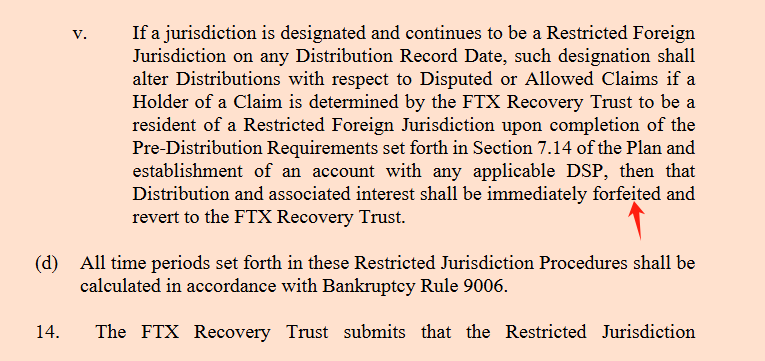
The motion is crystal clear: "Once the Court enters such an order, all affected claims shall be deemed automatically disallowed and expunged as of the next Distribution Record Date."
2.4 Summary: Seemingly fair procedures, actually layered obstacles
On the surface, this motion is just a technical risk management arrangement—legal opinions, appeal windows, judicial rulings—each step appearing proper, compliant, even "procedurally just" to the extreme.
But upon closer inspection, the entire process resembles a cleverly woven "legal trap": Every step appears to offer you a chance, yet collectively forms a slow countdown toward automatic forfeiture.
3. Why the "Restricted Jurisdictions Procedure" is essentially a "legal" confiscation mechanism?
To see through this, translate the motion’s "procedural language" into "asset fate language." On paper, it never says "confiscate"; but connecting the full sequence reveals that every move aims to legally, quietly, and irreversibly return certain regional creditors’ entitled distributions back into the recovery trust pool under the guise of law.
3.1 Triggering the procedure = moving from "payable" to "disputed pool"
As long as a jurisdiction fails to obtain an unconditional, exception-free legal opinion permitting payment, the trust may classify all claims from that area as "Disputed Claims." The motion text makes this explicit: After receiving an "Unacceptable Opinion," the trust is "authorized to treat claims from these jurisdictions as disputed until resolution" (CryptoSlate).
In other words, you were once an "Allowed Claimant," but due to legal ambiguity in your country, you get instantly downgraded. The system places you in a "waiting room," where the likely outcome isn't payment—but disappearance.
3.2 Notification + 45 days of silence = "deemed abandonment"
Next comes the "45-day objection window" we just analyzed. The motion authorizes the trust to send a Restricted Jurisdiction Notice to the last known address/email in its records, satisfying its "commercially reasonable delivery obligation" (CryptoSlate).
The truly harsh logic: The procedure assumes you saw the email; if you didn’t, that’s your fault. No objection within the deadline equals presumed consent to exclusion from distribution. Cointelegraph highlights this key point: The trust seeks court approval to "pause payouts to 49 potentially restricted jurisdictions" and warns that inaction results in loss of distribution rights (Cointelegraph, Cointelegraph).
3.3 Judge’s signature = local legal shield, global confiscation gate
Once the objection period ends, the trust petitions the court to formally designate the jurisdiction as a Restricted Foreign Jurisdiction. Upon approval, Paragraph 6 of the motion delivers a severe blow: Starting from the next Distribution Record Date, related claims are "automatically disallowed and expunged," with corresponding funds and interest "reverting to the FTX Recovery Trust."
This is the critical act of "legal" confiscation—not direct seizure, but judicial erasure of your claim status before the record date, followed by legitimate transfer of those funds back into the trust pool.
CryptoSlate summarizes plainly: Frozen amounts and accrued earnings from claims failing timely objection or having objections rejected "flow back to the estate" (CryptoSlate).
3.4 "Duty of care" serves as the procedure’s shield—and creditors’ passive disenfranchisement knife
Why would courts approve this? Because the motion invokes Bankruptcy Code Sections 105(a) and 1142(b), Bankruptcy Rule 3020(d), and cites Paragraph 135 of the Confirmation Order: Courts may issue any order "necessary or appropriate" to implement the plan.
Within this framework, the trust argues it merely fulfills its duty of prudence: Avoid reckless payments in prohibited zones, protect directors and officers from criminal exposure, and prevent wasting assets on foreign compliance. (Motion preamble + Paragraphs 17, 20; Cointelegraph also cites risks of fines, personal liability, and imprisonment.) (Cointelegraph)
Don’t forget real data: The 49 listed jurisdictions represent only ~5% of total payable claims but could delay disbursements to the remaining ~95%; 82% of impacted value is concentrated in China, making it the single largest source of uncertainty. (Cointelegraph, CryptoSlate)
From the judge’s perspective, supporting the trust’s "lock first, review later" approach seems protective of the majority—but the actual effect pushes minorities onto a procedural slope, sliding helplessly into confiscation unless someone intervenes in time.
3.5 The global regulatory paradox: "Can do, can’t say"
The examples cited in the motion aren’t arbitrary: A 17-year-old in Tunisia was arrested over a single online crypto transaction, prompting the finance minister to publicly consider "decriminalization"—indicating that in some countries, "people do it, but officials won’t call it legal." (CoinDesk)
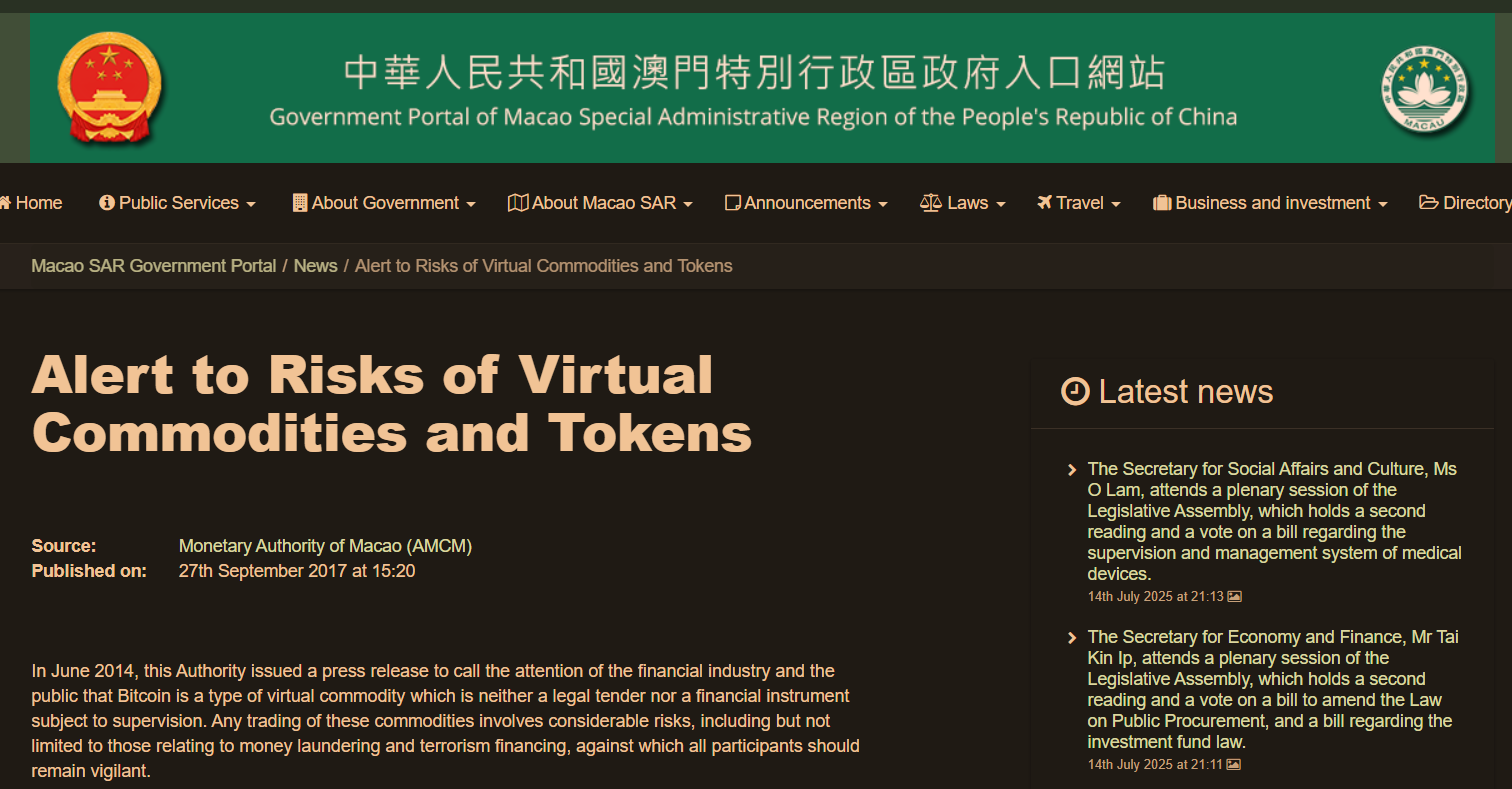
Macau’s Monetary Authority warned local banks in 2017 not to "directly or indirectly provide financial services for token-related activities," suggesting that platform payments to residents could be treated as违规金融服务. (Government Portal of Macao SAR)
In mainland China, a 2021 joint announcement by the central bank and multiple ministries declared virtual currency-related business illegal; overseas exchanges serving domestic investors are banned. Reuters reported the same year: Financial and payment institutions must not offer crypto-related services. (Reuters, Reuters)
Imagine living in a jurisdiction where something is "usable but unspeakable," then asking a local lawyer to sign off saying "completely legal, no reservations whatsoever"—this nearly demands they gamble their license on an uncertain future. The lawyer’s rational choice is a conservative opinion; conservative opinions equal "unqualified" under the procedure; unqualified means entering the confiscation track. By this point, the logical loop is complete.
3.6 Summary: So why does it resemble confiscation?
Because it follows a structure of suspend → prove → rule → reclaim:
-
Presume risk;
-
Require creditor proof;
-
No proof → loss of rights;
-
Funds revert to pool, legally redistributed.
The "Restricted Jurisdictions Procedure" proposed doesn’t say "take your money" outright, but paves every path so your funds silently migrate via "lack of proof," "missed deadlines," and "court orders." Formally legal, substantively剥夺—this is "legal confiscation."
Of course, not all entities behave this way. FTX isn’t the first bankrupt firm attempting creditor compensation. Comparing other cases reveals how unscrupulous the FTX Recovery Trust truly is.
4. Three cases showing how unscrupulous the FTX Recovery Trust really is
Certainly, the "Restricted Jurisdictions Procedure" proposed by the FTX Trust isn't as reasonable as it appears. To make this process seem "compliant," it must hide a key assumption: That globally, blanket bans and automatic nullification of claims from "gray zone" countries are accepted—even standard—practices.
But the opposite is true.
Whether looking at the larger, more complex Mt. Gox collapse, or contemporaries like Celsius and Voyager during the crypto exchange bankruptcy wave, none adopted such an aggressive, one-size-fits-all model. Their guiding principle was: Despite compliance complexity, maximum effort must be made to safeguard creditor assets—even if payouts are slow, "confiscation by procedure" cannot be allowed.
Let’s examine these three landmark cases to see how others chose to stand with creditors amid genuinely complex global legal landscapes—unlike the FTX Trust, which uses compliance as a shield and procedure as scissors. Chinese creditors, please pay special attention to the final OKEx case—it should offer insights.
4.1 Mt. Gox: A decade-long restructuring, yet "no proof = confiscation" was never the default

Mt. Gox’s Japanese bankruptcy restructuring took a decade: From the 2014 hack losing about 850,000 BTC, to gradual asset recovery, entry into civil rehabilitation, and finally starting phased BTC/BCH disbursements via multiple custodial platforms in 2024.
Despite vastly differing global regulations and creditors scattered worldwide (~127,000 people), rehabilitation trustee Nobuaki Kobayashi adopted a "multi-track parallel" model—allowing creditors to choose receipt methods across several cooperating channels: cryptocurrency (via Kraken, Bitstamp, Bitbank, SBI VC Trade), bank wire transfers/money services, or combinations of lump-sum and staged options.
Official notices repeatedly stressed: Creditors failing to complete "method selection + recipient info registration" would face delayed or blocked payouts—but this meant "you won’t get paid if you don’t register," not "your country’s non-compliance returns your money to the pool." (Cointelegraph, CoinDesk)
More crucially: Even when certain partners couldn’t serve specific countries due to their own regulatory commitments (Bitstamp’s Mt. Gox support page clearly lists many restricted areas, including China), the trustee preserved alternative viable payment routes (e.g., bank wires, other custodian exchanges), refusing to convert regulatory hurdles into "claim extinction."
This stands in stark contrast to FTX’s one-way slope of "no unconditional opinion → 45-day silence → judicial ruling → claim reverts to trust." (CoinDesk, The Bitstamp Blog by Robinhood)
At execution level: Kraken announced completion of its batch of Mt. Gox BTC/BCH distributions; Bitstamp subsequently began disbursing. Market fears of massive sell pressure did not coincide with large-scale abandonment due to forced inability to collect.
This proves that even in complex cross-border, multi-jurisdiction environments, "multiple channels + extended preparation periods + fallback options" can reduce friction—without shifting risk directly onto creditors via "procedural confiscation." (Cointelegraph, CoinDesk)
4.2 Celsius: Distributing across 165+ countries, 250,000+ creditors—complexity managed

Celsius collapsed in 2022, entering proceedings in the Southern District of New York Bankruptcy Court; officially exited bankruptcy protection and launched distribution on January 31, 2024. Total plan value: Over $3 billion (crypto + fiat), plus shares in restructured mining company Ionic Digital; the restructuring plan received 98% support from voting account holders. (Business Wire)
Progress: As of the first status report in August 2024, the plan administrator had paid $2.53 billion (valued as of 2024-01-16, including liquid crypto and cash) to over 251,000 creditors—covering roughly two-thirds of eligible accounts and 93% of total claim value.
Bigger picture: Celsius’ distribution system serves ~375,000 creditors across more than 165 countries; its inherent complexity—"pre-collapse non-compliance plus ongoing investigations in multiple nations"—was described in official documents as "perhaps one of the most complex and ambitious distribution processes in Chapter 11 history." (CoinDesk)
Celsius operated under the logic of "find a way to get money into your hands," not "if no path exists, give up." Official/court-appointed agent Stretto maintains a full online support ticket system: Lost original email? Need to change payment method? Multilingual guidance? All covered in FAQs and support docs, clearly stating "incomplete info → delayed," not automatic confiscation. (Celsius Distributions, CoinDesk)
Distribution wasn’t limited to "all-crypto or all-cash"—adjustments were made based on asset pools and regulatory feedback. For instance, altcoins that couldn’t be returned natively were consolidated into BTC/ETH to simplify global distribution (adding nearly $250 million in distributable crypto assets), paired with Ionic Digital shares. These flexible combinations aimed to maximize recovery across different legal constraints—not exploit uncertainty to cut claims. (Business Wire, CoinDesk)
4.3 OKEx withdrawal suspension incident: "Freeze first, fully reopen later" in a regulatory gray zone

In October 2020, OKEx (now OKX) suddenly suspended all crypto withdrawals, citing "a private key holder cooperating with police investigation and temporarily unreachable"; occurring amid China’s strict regulation and exchange "going global," this triggered panic, especially among Chinese users. (Reuters, Nasdaq)
The freeze lasted about five weeks. Amid market concerns over liquidity and legal risks, OKEx repeatedly assured users of asset safety and maintained trading functionality. On November 20, it announced resolution and full resumption of withdrawals by November 27, introducing compensation/loyalty rewards to retain customers; emphasizing "maintained 100% reserves throughout, unlimited withdrawals post-unlock." (fintechfutures.com, Nasdaq)
Multiple reports and follow-ups indicate: The investigation stemmed from Chinese law enforcement context. Yet OKEx chose "short-term freeze for compliance verification, then let users withdraw fully," rather than leveraging regulation for prolonged detention or confiscation.
Even in a market labeled a "regulatory gray zone"—where actions are tolerated but not endorsed—the platform used resumed withdrawals plus compensation campaigns to retain users—sharply contrasting FTX Recovery Trust’s immediate push toward "unprovable = automatically voided" upon regulatory uncertainty. (Nasdaq, fintechfutures.com)
4.4 Summary: Others navigated minefields; FTX draws minefields as "surrender zones"
Comparing these three cases reveals the true divide isn’t about how strict regulations are, but whether managers choose to "solve problems" or "make the problem your fault":
-
Mt. Gox: Regulatory fragmentation → multiple payment tracks + long registration period; channel restrictions ≠ claim invalidation. (Cointelegraph, CoinDesk)
-
Celsius: Complex KYC across 165 countries → online support, flexible asset bundles, continuous info update windows; over $2.5 billion distributed globally. (CoinDesk, Celsius Distributions)
-
OKEx: Hit by Chinese enforcement → short-term security freeze, then full withdrawal resumption with user compensation; avoided transferring gray-zone regulation into permanent customer loss. (fintechfutures.com, Nasdaq)
By contrast, FTX Recovery Trust: Demands "exception-free, unconditional" legal opinions—rare in reality; presumes abandonment after 45 days of email silence—overwhelming for small cross-border creditors; one judicial signature "automatically expunges" claims, returning funds to the trust pool for redistribution. The process appears compliant on the surface, but实质更接近“合法外衣下的默认没收”. (Cointelegraph, DL News, BitDegree)
5. Dual-front battle map for Chinese creditors
The FTX "Restricted Jurisdictions" motion is like a silent net descending over creditors in 49 countries and regions. Now caught within it, we have only two paths: One is to stop the net from being formally deployed; the other is to rise up and fight back if it lands.
Call it strategy, or survival instinct—we cannot wait for others to decide our fate.
5.1 Frontline: Block the motion before the trap is complete
Procedurally, the hearing on the recovery trust’s motion is scheduled for July 22, 2025, at 9:30 AM Eastern Time. Although the official deadline for filing oppositions passed on July 15, arguments based on "defective service" or "delayed awareness" may still allow late submissions. Time is short, but we still have fighting chances.
The key to blocking this motion lies here: material modification.
The motion materially alters the original confirmed plan—originally promising payouts upon KYC completion, now adding "must have unconditional legal confirmation of compliance," effectively changing rules mid-game.
Beyond pointing out flaws, we must propose solutions. Like Mt. Gox offering alternative multi-channel payment methods—some countries unable to receive direct transfers could get fiat or offline redemption; Celsius allowed mixed-denomination withdrawals. We can demand similar mechanisms instead of "no proof = confiscation."
If we can persuade the judge to add a clause when approving the motion—that even if payments are paused, funds must remain escrowed and cannot revert to the trust pool—then even if immediate payout isn’t achieved, our claims at least stay alive.
This is our first front—a defensive sprint. Winning is ideal, but even partial resistance buys precious time for preparing the second front.
Fortunately, Will has already submitted an objection before July 15.
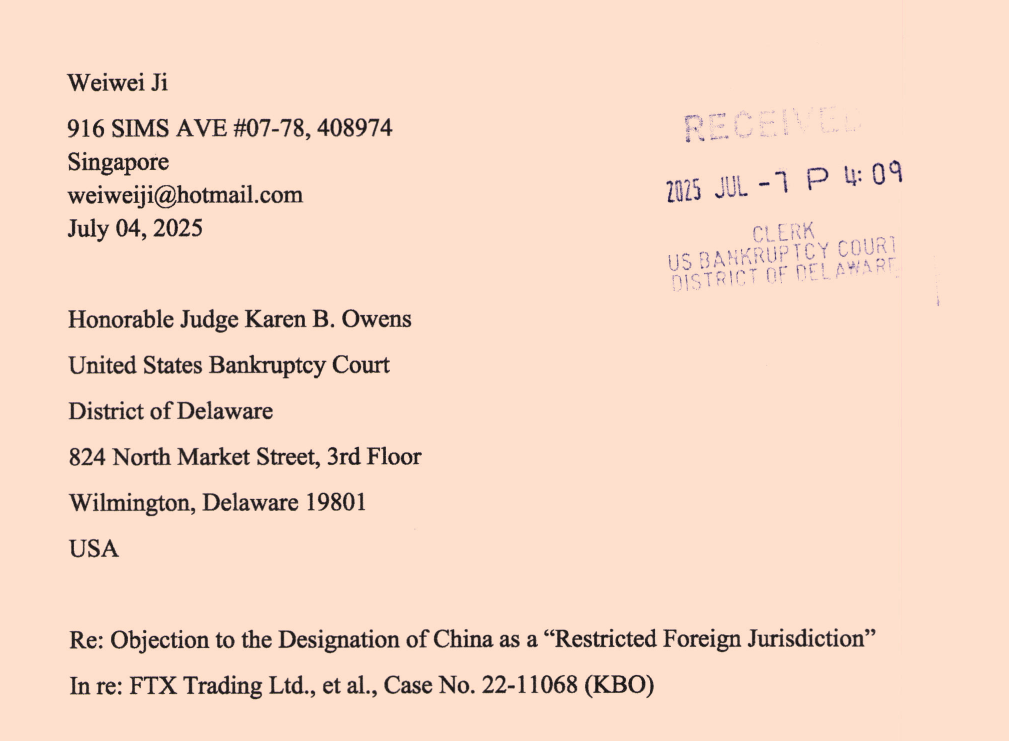
5.2 Second Front: Strike first, make "confiscation" too costly to bear
If the July 22 hearing concludes with the motion approved, the recovery trust will immediately activate the next phase of the "restricted procedure": 45-day objection window, legal opinion gate, confiscation clauses—all ready.
Under these conditions, relying solely on individual objections is not only expensive but highly likely to fail. The truly effective response is launching a proactive class action lawsuit, suing the FTX Recovery Trust for breach of contract and tort, placing them squarely in the defendant’s seat.
This isn’t emotional venting—it’s a counterattack grounded in solid legal basis.
First, breach of the confirmed plan. The court-approved "Confirmation Order" dated October 8, 2024, clearly grants distribution rights to all KYC-completed creditors. The current motion attempts to terminate this obligation based on "failure to obtain satisfactory legal opinion," without following the amendment procedures required under Section 1127 of the U.S. Bankruptcy Code. This constitutes illegal plan modification.
Second, violation of fiduciary duty. The essence of a recovery trust is to maximize recoveries for all creditors—not just serve those in "low-risk" jurisdictions. It must remain neutral and cannot create procedural traps designed to automatically invalidate claims from certain countries.
Third, civil tort. After the motion passes, if a jurisdiction’s claims are system-marked as "FORFEITED" (deemed abandoned) due to "unsatisfactory opinion," the funds directly "revert" to the trust for its own use. This isn’t just blatant unjust enrichment—it may constitute "conversion," an unlawful appropriation of another’s property.
5.2.1 Jurisdiction and practical execution: Not just talk, but action
Some may ask: Can we sue them in U.S. courts? The answer is yes.
The main battlefield remains the Delaware Bankruptcy Court, but we can concurrently file independent lawsuits in New York or other jurisdictions with competent authority, citing "tort" or "contract breach" to bypass limitations within the bankruptcy framework.
Rule 23 of the U.S. Federal Rules of Civil Procedure allows formation of a class action with just five or more creditors, representing all similarly situated harmed parties. This means—we don’t need everyone present; assembling a representative "plaintiff group" is enough to initiate litigation.
5.2.2 Freeze trust assets: Show them we’re no longer passive
This lawsuit isn’t just about "theoretical victory"—we can employ practical tactics during proceedings, such as applying to the court for "pre-judgment attachment."
A common tool in cross-border financial disputes, once approved, this allows temporary freezing of FTX Recovery Trust’s U.S. bank accounts, third-party recoveries, and other assets before trial, halting further distributions to "compliant" creditors.
Similar measures were used in the Wirecard (German payment giant) case, freezing London-based assets to ensure smooth compensation negotiations.
This isn’t to prevent others from getting paid—it’s to signal to the trust: If you choose favoritism, we have ways to make you pay the price.
5.2.3 Public opinion and diplomacy: Restoring fairness to the "rules game"
Beyond legal tools, we must wage "public opinion war" and "diplomatic campaign."
Currently, Reuters and Bloomberg have reported the motion highlighting "possible confiscation of $380 million owed to Chinese creditors," gaining us global attention. Next, amplify this through influential outlets like BBC and AFP, stressing this isn’t a U.S.-China issue but a global procedural discrimination problem.
Meanwhile, creditors from affected nations can channel comments through their domestic financial regulators or diplomatic missions to the U.S. Department of Treasury (OFAC) or U.S. Trustee Program. Such "national-level interventions" aren’t unprecedented—for example, Brazil’s Foreign Ministry intervened in the TelexFree telecom fraud case, ultimately securing a joint compensation agreement from U.S. authorities.
5.3 Immediate Action: From group to battle-ready force
Once the motion is approved, we must immediately establish the "FTX Restricted Jurisdictions Creditors Committee," publishing multilingual online recruitment forms.
-
Select a U.S. bankruptcy law firm experienced in class actions;
-
Concurrently initiate breach-of-contract and tort lawsuits in Delaware and New York;
-
Apply to court for a Temporary Restraining Order (TRO) to halt redistribution of "restricted funds" to compliant-jurisdiction creditors.

Simultaneously, suggest the current维权core group launch a donation drive to fund litigation. I myself and the "Airdrop Reference" project will each donate 1,000 USDC.
5.4 China’s pivotal role: Not just for ourselves, but for everyone
We must clearly realize that Chinese creditors indeed face the highest barriers. Lawyers hesitate to issue "unreserved opinions," and regulatory policy remains highly uncertain. This is unfortunate—but it also means: Once Chinese creditors secure an "alternative pathway" or "delayed escrow" arrangement, the other 48 countries naturally benefit.
We’re not fighting for national privilege, but to open a new possibility for the world.
Because once the $380 million "ice block" from China is broken through, the other 1–2% share countries left passively on hold lose any justification for being ignored by the trust.
From a cost perspective, this is even better for the trust: Rather than risking lawsuits, asset freezes, and media backlash, settling via agreement costs less.
5.5 Final reminder: Don’t let procedure obscure justice’s face
The FTX Recovery Trust isn’t devoid of risk logic—it may even be a textbook example of "acting according to law"—but that’s precisely what’s terrifying.
Because it’s these seemingly perfect procedures that quietly turn our rightful claims into targets of "systematic confiscation." Once the process starts, your silence equals surrender.
Blocking the motion is a race against time; litigation is a marathon of endurance and wisdom. But as long as we act, unite, and organize, we can make the cost of this "automatic forfeiture" game far exceed their budget.
This is the Chinese creditors’ version of a "Robin Hood operation."

Conclusion | Justice must not be inverted by procedure
The FTX Recovery Trust’s "Restricted Jurisdictions Procedure" wears a compliance facade but functions as a structural exclusion mechanism: Under the reality of global asset flows clashing with fragmented local laws, it turns procedure into a barrier, not a bridge.
If this "no legal opinion = automatic forfeiture" model is upheld in Delaware, it ceases to be just a liquidation experiment—it becomes the blueprint for systematic deprivation of cross-border creditors in future crypto bankruptcies.
This isn’t compliance—it’s "presuming you guilty"; not legal procedure, but "legalized confiscation."
Don’t forget: All this rests upon the fog of global regulatory ambiguity. For instance: China’s 2021 joint regulatory notice bans financial institutions from participating in virtual currency business, but never explicitly prohibits individuals from holding or trading; Macau warns of token transaction risks but lacks criminal penalties; Tunisia has isolated enforcement cases but no unified judicial interpretation.
For such countries, "usable but unspeakable" has become the de facto reality.
In these gray zones, expecting an "exception-free, unconditional" legal opinion is essentially wishful thinking.
Procedure was meant to be a sword protecting law, now it’s become a veil hiding injustice. When procedure turns into a filter excluding the vulnerable from justice, it ceases to be rule—it becomes a tool. Today it affects a minority in 49 countries; tomorrow it could target any of our assets.
I’ve outlined two resistance paths:
-
Line A: Block the motion, demand escrow or alternative payout;
-
Line B: Immediately countersue if motion passes, freeze trust assets, force renegotiation.
This isn’t emotional confrontation, but institutional counterattack. It’s also a wake-up call for cross-border creditors: If we stay silent now, this template will be copied again and again; but if we speak up now, it could become the first global anti-procedural-discrimination precedent written by creditors.
Because:
Procedure exists to protect justice, not to filter it out.
Join TechFlow official community to stay tuned
Telegram:https://t.me/TechFlowDaily
X (Twitter):https://x.com/TechFlowPost
X (Twitter) EN:https://x.com/BlockFlow_News
 @yzdxs8