








The Queen's Investment Game: Heavy Bet on Tesla, Wagering on Bitcoin, Known as the Female Buffett
TechFlow Selected TechFlow Selected
The Queen's Investment Game: Heavy Bet on Tesla, Wagering on Bitcoin, Known as the Female Buffett
Heavy bets on Tesla, investments in Bitcoin (GBTC)... this year's wealth trends seem to be right within the investment strategy of ARK Invest founder Catherine Wood.
 Navigating Web3 tides with focused insights
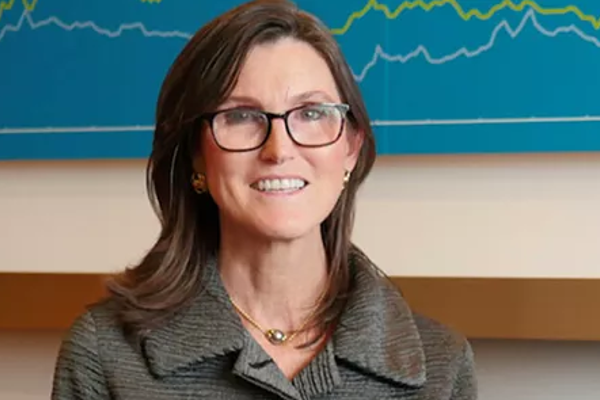
Heavily betting on Tesla, investing in Bitcoin (GBTC)... This year's wealth风口 seems to be right within the investment strategy of Cathie Wood, founder of ARK Invest, whom Wall Street hails as the "female Buffett" and "goddess of tech stocks."
According to SeekingAlpha, among the top 10 best-performing ETFs this year, three actively managed ETFs from ARK made the list—ARKG is up 147% year-to-date, ARKK up 125%—significantly outperforming SPY (S&P 500) over the same period.
In 2015, when many were still wondering what Bitcoin was, ARKW, a fund under ARK Invest, directly invested in GBTC issued by Grayscale Investments. At that time, Bitcoin was priced at just $250.
Today, ARK remains a major holder of the Grayscale Bitcoin Trust, with a cumulative holding of $240 million in GBTC.
In 2016, when Tesla’s stock price plummeted and nearly every analyst turned bearish, ARK doubled down and took a massive long position, becoming Tesla’s biggest cheerleader. Now, ARK holds Tesla shares valued at $3.847 billion.
How did Cathie Wood apply her “disruptive innovation” investment philosophy to successfully bet on Tesla and Bitcoin? And what can we learn from it? TechFlow analyzes the queen’s investment playbook.
The Woman Behind Tesla
On August 8, 2018, Tesla CEO Elon Musk sent an internal email stating he was "considering taking Tesla private at $420 per share, valuing the company at $71.3 billion," and claimed sufficient funding had already been secured.
The email caused public uproar. Media backlash flooded in like a tide—Tesla’s board, investors, and even the SEC piled on—but Musk seemed determined: for a company with such a long-term mission, being publicly traded was too restrictive.
If approved, Tesla would become a private company again—free from stock price pressures, short-seller attacks, and quarterly financial disclosures—granting greater operational freedom.
However, an unexpected open letter forced Musk to reconsider.
This letter came from Cathie Wood, founder of ARK Invest (referred to as ARK).
In the letter, Cathie Wood strongly opposed Tesla going private, insisting Tesla remained a highly valuable stock and declaring "$4,000 is the appropriate target price for Tesla."
She argued that Musk’s proposed $420 per-share privatization price severely undervalued Tesla, depriving many investors of the chance to participate in the company’s success.
Musk later stated that reading Cathie Wood’s letter influenced his decision. Under mounting pressure, Musk officially announced on Tesla’s website that Tesla would abandon its privatization plan.
Cathie Wood’s words certainly deserved Musk’s attention.
Since ARK’s inception in 2014, it has been a staunch supporter of Tesla, ranking Tesla fifth among its holdings.
Throughout its investment in Tesla, ARK largely ignored other analysts’ ratings, relying solely on its own judgment.
In 2016, when Tesla’s stock dropped 11% and nearly all analysts downgraded it, ARK tripled its Tesla position.
In 2017, despite Tesla surging 46%, 68% of analysts still maintained bearish views, while ARK increased its holdings by at least 13 times.
As Tesla’s biggest bull, one of Cathie Wood’s annual rituals has been drawing an extremely ambitious price target for Tesla.
Cathie Wood has repeatedly voiced bullish sentiments about Tesla in public.
In February 2018, when Tesla’s stock was hovering around $270, Cathie Wood stated: “Tesla’s five-year target price is $4,000 per share.”
In January 2020, Cathie Wood said on CNBC that she believed Tesla’s stock could exceed $6,000 within five years. She expressed confidence because she believed Tesla would not lose its dominant position in the electric vehicle market.
A week later, ARK released an updated valuation of Tesla—this time even more aggressive: forecasting Tesla’s stock value to reach $7,000 by 2024, and in a bull market scenario, potentially reaching or exceeding $15,000. By the end of 2020, Tesla’s stock would surpass $1,500.
At the time, many mocked Cathie Wood for blind optimism, but reality slapped them hard.
On December 1, 2020, Tesla’s stock closed at $584—equivalent to $2,920 pre-split (1:5)—up 598% year-to-date. In hindsight, Cathie Wood’s imagination may have actually fallen short of Tesla’s meteoric rise.
Why Is Cathie Wood So Bullish on Tesla?
Contrary to common perception, Cathie Wood sees Tesla not merely as an electric car manufacturer, but as an autonomous driving platform provider. These represent two entirely different valuation models.
“Tesla is far more software-centric than most realize, and in-demand software engineers want to work at Tesla,” she said.
In a CNBC interview, she elaborated three key reasons for her continued long-term bullishness on Tesla:
-
Battery costs
Wood believes Tesla is following the cost curve of smartphones and laptops—achieving more efficient batteries at continually declining costs, which further reduces EV production expenses.
-
Artificial intelligence chips
In 2019, Tesla launched its own in-house AI chip designed for autonomous driving with redundancy features.
Cathie Wood mentioned collaborating with a former NVIDIA analyst who stated Tesla’s AI chip was four years ahead of anything NVIDIA could put into cars.
-
Autonomous driving data
While true autonomous vehicles don’t yet exist, Cathie Wood believes Tesla will dominate this emerging field because its existing fleet of nearly 700,000 vehicles is already collecting real-world driving data—amassing between 10 and 12 billion miles so far.
“To win in autonomous platforms and AI, you need the largest volume of highest-quality data—and Tesla is that company,” Wood stated.
As of December 2, ARK Investment Fund and its three funds—ARKK, ARKW, ARKQ—held Tesla stocks valued at $1.952 billion, $1.352 billion, $410 million, and $133 million respectively, totaling $3.847 billion in Tesla market value.
Reviewing Cathie Wood’s investment strategy in Tesla, it’s clear her unwavering support for disruptive innovation. But in this queen’s investment portfolio, another shining piece stands out—Bitcoin.
The Queen’s Bitcoin
In 2020, Grayscale Investments became the standard-bearer of the Bitcoin bull run. Scanning the shareholder list of Grayscale Bitcoin Trust (GBTC), ARK’s name appears prominently.
ARK Investment Fund and its “Next Generation Internet ETF” together hold 10.11 million shares of GBTC, worth $240 million.
For Grayscale, Cathie Wood and ARK are longtime allies.
In March 2015, Grayscale’s Bitcoin Trust debuted on the OTCQX over-the-counter market (ticker: GBTC). Six months later, ARKW, a fund under ARK, announced its investment in GBTC, becoming the first publicly traded fund manager to invest in Bitcoin—when Bitcoin was only $250.
In 2017, during Bitcoin’s bull run, ARK’s 6% GBTC position surged 16-fold, contributing 25.84% to ARKK’s fund returns.
Afterward, as Bitcoin peaked and crashed, Cathie Wood sold all her GBTC holdings, successfully timing the exit.
Cathie Wood began studying Bitcoin earlier than most.
“We’ve been watching Bitcoin for a long time. In fact, we started paying attention shortly after Satoshi Nakamoto created Bitcoin. Now that Bitcoin has stabilized, we’re choosing to invest in it,” she said.
In 2017, Cathie Wood publicly declared: “Bitcoin is a bigger idea than Apple.”
In capital markets, the best way to show belief in an industry or company is to invest. Grayscale’s GBTC provided Cathie Wood and ARK with a compliant investment channel.
Michael Sonnenreich, then Grayscale’s head of sales, explained that ARK cannot directly hold Bitcoin because the IRS treats it as property, but ARK can hold shares in a Bitcoin trust (GBTC).
Why does Cathie Wood believe in Bitcoin? How does this queen research Bitcoin? We might find clues in ARK’s investment strategy reports.
In ARK’s 2020 investment outlook report, *ARK’s Big Ideas 2020*, Bitcoin was described as “an evolution of the monetary system,” taking center stage at the end.
The report noted that before Bitcoin, a non-government-backed monetary system seemed both unfeasible and unimaginable:
-
Monetary issuance has always been deeply tied to nation-states.
-
Absence of a free market for money.
-
State exploitation of physical assets.
-
Limitations of non-sovereign currencies like gold.
With Bitcoin’s emergence, a Cambrian explosion of money occurred:
-
Private sector begins injecting capital.
-
Rise of digital-native, non-sovereign monetary systems.
-
Feasible forms of self-custody and sovereign wealth ownership enabled by public-key cryptography.
Because of Bitcoin, the world is witnessing a global war between sovereign and non-sovereign monetary systems.
ARK believes cryptocurrencies controlled by open-source networks are offering new paradigms for storing and transferring value in the monetary system.
As an open, neutral, permissionless, and state-independent global monetary system, Bitcoin holds a strong strategic advantage in this battle.
For Bitcoin’s future valuation, ARK applied three narrative frameworks:
First: Denationalization of Money.
As a potential medium of exchange and catalyst for monetary disintermediation, Bitcoin could rapidly gain traction in emerging markets.
Excluding the four strongest economies, the remaining countries’ M2 (broad money supply) totals $40 trillion. If Bitcoin captures 5% of that, its market cap would reach $1.1 trillion.
Second: Digital Gold.
Bitcoin improves upon gold’s limitations as a store of value—offering high portability, strict scarcity, and public auditability.
Gold’s total market cap is $9 trillion (as of February 2020). If Bitcoin replaces 15% of that, its market cap would reach $800 billion.
Third: Asset Protection.
The rational allocation of Bitcoin as protection against asset seizure should align with the lifetime probability of such seizure.
Globally, high-net-worth individuals hold $46 trillion in wealth. Allocating 5%—based on a 50-year risk of asset freeze—at Bitcoin exposure would imply a $1.3 trillion market cap.
Just as Cathie Wood loves painting ever-larger price targets for Tesla, in November, during a media interview, she drew an even bolder picture for Bitcoin:
“Institutional investor participation could push Bitcoin’s price to $500,000.”
The Making of a Queen
Cathie Wood’s entire career seems to have prepared her to build a firm like ARK.
In 1981, Cathie Wood graduated with honors from the University of Southern California with a bachelor’s degree in finance, then joined Jennison Associates as an equity research analyst.
“The analysts there were lifetime employees—they wouldn’t give up any of their established thinking,” she recalled. “So I had to go out and find my own path, eventually discovering overlooked companies.”
She shifted focus to emerging internet stocks and wireless communications, witnessing how leapfrog innovation quietly transformed emerging markets.
“I learned that when analysts and portfolio managers dismiss something as too small or incompatible with portfolios, that’s often where the real upside surprises happen.”
Within the firm, her independent research and investment style earned her a reputation as an “outsider.” In 1981, she correctly predicted inflation and interest rates had peaked—a view dismissed by her superiors.
That experience left a lasting impression: defying consensus could unlock enormous potential, and going against the grain often leads to great success.
Today, she focuses on uncovering overlooked and misunderstood stocks across five innovation sectors: DNA sequencing, new energy, artificial intelligence, robotics, and blockchain technology.
Now, “disruptive innovation” is a trendy term, but Cathie Wood grasped its essence long before it became mainstream.
In 2001, she joined AllianceBernstein as CIO, managing a $5 billion portfolio—finally able to fully practice her “disruptive innovation” investment philosophy.
In 2002, Amazon had 40 million users globally, trading around $15–$20 per share—still recovering from the dot-com bust. Most capital markets remained skeptical of internet firms. Yet Cathie Wood, seeing its “rule-breaking” potential, went against the tide and invested. Today, Amazon trades above $3,200—over 100x her entry price.
Unlike traditional investors fixated on past financials, Wood insists: “No innovation, no investment.” She firmly rejects old-economy models and wholeheartedly embraces the new economy.
ARK’s subsequent portfolio reflects this philosophy:
Tesla disrupted traditional auto; Square changed payments, lending, and investing; 2U transformed online education access; Zillow revolutionized home search, rental, and transactions; Zoom redefined meeting participation...
In 2014, after 12 years at AllianceBernstein, she decided to leave and start her own firm focused on innovative companies disrupting the status quo—though friends strongly opposed the move.
“Many of my friends thought I’d fail,” Wood recalled, “but I never saw it that way—because there was a huge unmet demand, and that’s the best reason to start a business.”
Active Research Knowledge—that’s what Cathie Wood named her company: ARK Invest, dedicated to investing in rule-breaking, disruptive innovators.
Unlike secretive, elitist investment firms, ARK has always embraced democratization:
(1) Publishing research reports freely;
(2) Discussing investments with professionals on Twitter, Facebook, and social platforms;
(3) Opening Friday afternoon research meetings to outsiders;
(4) Publishing real-time trade logs;
Wood believes ARK’s success owes much to social media: “When we do research, we invite innovators in that field to join the conversation—‘Have you considered this?’ or ‘You’re wrong.’”
ARK publishes daily holdings and changes, freely allowing investors to “copy its homework,” while investors in turn enrich ARK’s insights.
Wealth and fame have flowed to Cathie Wood, aided by Bitcoin and tech stocks—especially notable in a male-dominated investment world, where Wood stands out as exceptional.
Wood is acutely aware of the challenges women face in male-dominated industries and hopes to inspire the next generation to break through glass ceilings. She established a training center at her alma mater in Los Angeles to educate and encourage young women in tech innovation.
“You have to handle difficulties very calmly,” Wood said. “I didn’t feel too many setbacks—or perhaps I chose not to remember them—because I focus on the future and achieving my dreams.”
“I love being a woman in this industry.” Hailed by Wall Street as the “female Buffett” for delivering outsized returns, we know there’s only one Buffett—but Cathie Wood, too, is truly one of a kind.
*TechFlow reminds all investors to beware of chasing high-flying assets. The views expressed herein do not constitute investment advice.
Join TechFlow official community to stay tuned
Telegram:https://t.me/TechFlowDaily
X (Twitter):https://x.com/TechFlowPost
X (Twitter) EN:https://x.com/BlockFlow_News






