Huobi Growth Academy | TradFi In-Depth Report: The Convergence Wave of Crypto and Traditional Finance
TechFlow Selected TechFlow Selected
Huobi Growth Academy | TradFi In-Depth Report: The Convergence Wave of Crypto and Traditional Finance
TradFi’s cryptoization is reshaping the boundaries of the crypto industry.
 Navigating Web3 tides with focused insights
Executive Summary
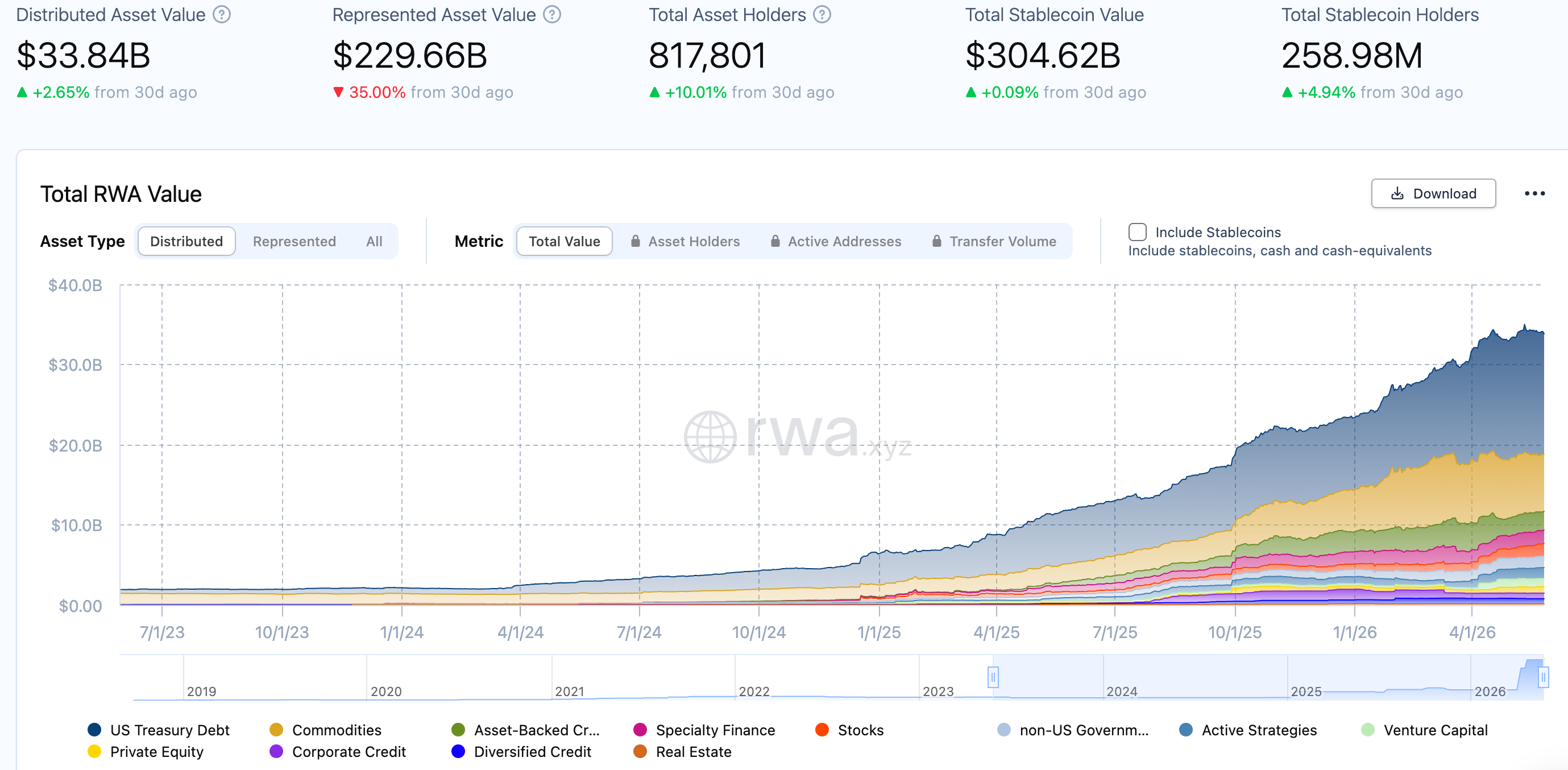
In 2026, the cryptocurrency industry is undergoing a profound, infrastructure-level transformation—TradFi assets are migrating on-chain at an unprecedented pace. According to CoinGecko’s Q1 2026 report, the total value locked (TVL) in tokenized real-world assets (RWA) has surpassed $31 billion—nearly quadrupling from $7.8 billion at the start of 2025—with a market capitalization of $19.3 billion. Tokenized equities’ market cap surged from $2 million to $486 million; their Q1 spot trading volume reached $15.1 billion—exceeding the entire second half of 2025. RWA perpetual contract trading volume in Q1 2026 soared to $524.8 billion, far surpassing the full-year 2025 figure of $313 billion. Meanwhile, BlackRock’s BUIDL fund has grown to $2.3 billion in assets under management (AUM), and the firm has filed for two new tokenized funds—marking a strategic shift from pilot initiatives to a diversified product family. As a core participant in the crypto exchange赛道, HTX officially launched TradFi perpetual contracts—including NVDA, AAPL, MSFT, META, and SPY—in 2026, enabling crypto-native users to trade key U.S. equities 24/7. Boston Consulting Group forecasts that global tokenized asset markets could reach $16 trillion by 2030; McKinsey offers a more conservative estimate of approximately $2 trillion. The on-chain migration of TradFi assets is no longer a “future narrative”—it is an unfolding structural transformation. Crypto exchanges are evolving from single-asset platforms into “full-asset-class trading infrastructures.”
I. Defining TradFi and the Evolutionary Logic of Crypto
TradFi—short for Traditional Finance—refers, within the crypto context, to the introduction of traditional financial assets—including equities, bonds, commodities, foreign exchange, and ETFs—into crypto markets via tokenization or synthetic asset mechanisms. Though this concept predates 2026, its development has unfolded across three distinct phases. Phase I (2020–2022) was the “Synthetic Asset Experimentation Era.” Mirror Protocol and Synthetix pioneered on-chain synthetic U.S. equities, while FTX and Binance partnered with licensed brokers to offer tokenized stock trading. However, the collapse of FTX in 2022—amplified by tightening global crypto regulation—forced most tokenized equity services offline, concluding this phase with broad industry consolidation. Phase II (2023–2024) was the “Treasury-First Era.” Amid aggressive Federal Reserve rate hikes, DeFi protocols like MakerDAO began using U.S. Treasuries as underlying RWAs. In March 2024, BlackRock launched the BUIDL fund with an initial seed capital of $100 million; it crossed $1 billion in AUM within months, signaling formal entry by Wall Street’s largest institutions.
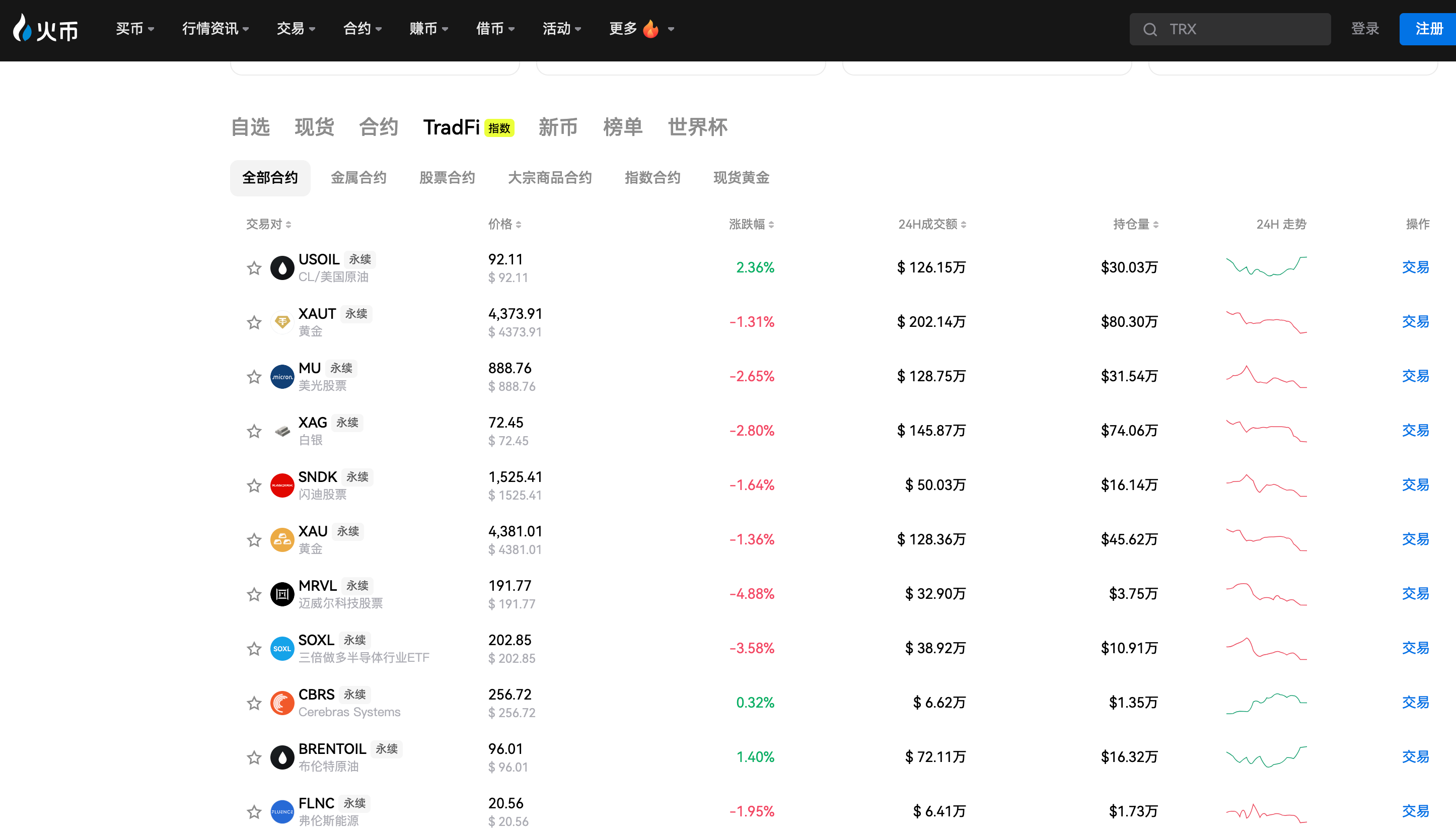
Phase III—the “Full-Asset Acceleration Era”—began in H2 2025 and continues today. Tokenized equities re-entered growth trajectories: MyStonks completed SEC-compliant Security Token Offering (STO) registration; Backed Finance issued xStocks backed by real assets across nine blockchains; and traditional custodians such as Fidelity and UBS joined the ecosystem. Crucially, crypto exchanges have moved beyond simply listing tokenized assets—they now directly launch TradFi perpetual contracts, bringing U.S. equities, gold, and Treasuries into the 24/7 on-chain derivatives ecosystem. As a seasoned player in the crypto industry, HTX spearheaded this phase by launching its TradFi perpetual contract suite—centered on core U.S. equities including NVDA, AAPL, MSFT, META, and SPY—offering users a seamless path to trade global benchmark assets without leaving the on-chain environment. The underlying logic is clear: crypto markets need fresh capital and new user cohorts—and TradFi assets represent the most effective bridge to the world’s $75 trillion equity and $130 trillion bond markets. For HTX, integrating TradFi assets signifies a strategic upgrade—from a crypto-native platform to a full-asset-class trading platform.
II. Market Structure and Competitive Landscape
The current TradFi-on-crypto market features three parallel, co-evolving赛道. The first is “Tokenized Real Assets,” led by BlackRock BUIDL, Ondo Finance, Backed Finance, and MyStonks. Here, assets exist on-chain as ERC-20 tokens, backed 1:1 by real-world equivalents and held by licensed custodians. BlackRock BUIDL commands dominant leadership in the tokenized Treasury segment, with $2.3 billion in AUM—accounting for roughly 25%–30% of that submarket. Ondo Finance’s OUSG has scaled into the multi-billion-dollar range. Backed Finance’s xStocks operate across nine chains, requiring whitelisting but no KYC. The second赛道 is “TradFi Perpetual Derivatives”—the fastest-growing segment in 2026. Coinbase launched U.S. equity perpetuals in March 2026, targeting non-U.S. users and supporting individual stocks (e.g., Apple, Microsoft, NVIDIA, Tesla) and ETFs (e.g., SPY, QQQ), with up to 10× leverage on stocks and 20× on ETFs, settled in USDC and traded 24/7. HTX has similarly launched NVDA, AAPL, MSFT, META, and SPY perpetuals, offering globally accessible U.S. equity derivatives settled in USDT. Hyperliquid captures 28.6% of the RWA perpetual contract market via its HIP-3 protocol. RWA perpetual contract trading volume hit $524.8 billion in Q1 2026—already exceeding the full-year 2025 volume of $313 billion.
The third赛道 is “Integrated TradFi Trading Infrastructure,” aiming to unify traditional and crypto asset trading interfaces. Some leading platforms integrate CFDs via third-party systems such as MT5; others develop proprietary index-based perpetual contracts bundling multiple traditional assets. Market data shows that tokenized RWA TVL reached $31–34 billion in May 2026—nearly tripling from ~$11 billion a year earlier. Tokenized gold rose from $1.43 billion to $5.55 billion (+289%); tokenized equities jumped from $2 million to $486 million (+over 200×). BCG projects the global tokenized asset market could reach $16 trillion by 2030—roughly 10% of global GDP—while McKinsey’s conservative estimate stands at ~$2 trillion. Whether optimistic or cautious, both projections indicate tens- to hundreds-of-fold growth potential between current scale and long-term targets.
III. Core Risk Analysis
Although TradFi-on-crypto holds immense promise, it carries equally significant risks—potential pitfalls for investors and critical operational challenges for platform operators. First is regulatory and compliance risk—the greatest current uncertainty. Tokenized securities are, by nature, securities offerings subject to national securities laws. The U.S. SEC’s stance on on-chain securities remains ambiguous: Coinbase’s U.S. equity perpetuals are explicitly restricted to non-U.S. users—a direct reflection of regulatory complexity. Fragmented cross-border regulation means identical tokenized assets may face divergent compliance requirements across jurisdictions, imposing persistent compliance burdens on globally operating crypto exchanges. HTX, too, must navigate varying regional regulatory demands when rolling out TradFi perpetuals. Second is liquidity risk. Although RWA perpetual contract trading volume reached $524.8 billion in Q1 2026, the market cap of tokenized spot equities remains just $486 million—revealing a pronounced structural imbalance between spot and derivatives liquidity. This mismatch may trigger extreme price deviations during volatile conditions, increasing liquidation risk for traders. Moreover, misalignment between U.S. equity market hours and crypto’s 24/7 model may impair price discovery outside regular trading hours—raising slippage and abnormal volatility risks. Third is smart contract and technical risk. Tokenized assets rely on precise smart contract execution; any vulnerability can cause irreversible asset loss. While institutional-grade products like BlackRock BUIDL receive technical support from compliant platforms such as Securitize, DeFi-native tokenized assets still face risks like insufficient audit coverage and oracle manipulation. Fourth is custody and settlement risk. Tokenized real assets require reliable custodians as foundational anchors; if a custodian suffers credit failure (e.g., a repeat of the FTX collapse), token holders may be unable to redeem underlying assets. Though mainstream solutions now use traditional custodians like Fidelity and UBS, the legal correspondence between on-chain tokens and off-chain assets lacks definitive precedent in many jurisdictions. Fifth is FX and interest rate risk. TradFi perpetuals are typically settled in USDT or USDC—but their underlying assets are dollar-denominated. FX fluctuations may erode real returns for non-USD users. Simultaneously, shifts in Fed monetary policy directly influence U.S. equity performance—and thus propagate into TradFi perpetual pricing.
IV. Innovation Trends and赛道 Opportunities
Four innovation trends are emerging in the TradFi-on-crypto赛道—each presenting strategic growth opportunities for HTX and other crypto exchanges. Trend One is rapid expansion of the perpetual contract product matrix. Following Coinbase’s pioneering launch of U.S. equity perpetuals, more crypto exchanges are adding them—expanding underlying assets beyond the initial five-to-ten blue-chip stocks to include semiconductor ETFs, crypto-themed equities, and sector-specific ETFs. HTX has already launched NVDA, AAPL, MSFT, META, and SPY contracts and is well-positioned to broaden coverage across additional TradFi assets—building a comprehensive U.S. equity core-asset trading matrix. From a competitive perspective, exchanges that first establish complete TradFi product suites will gain early-mover advantages in user acquisition and trading fee revenue. Trend Two is maturation of institutional-grade infrastructure. BlackRock BUIDL’s explosive growth—from $100 million seed capital to $2.3 billion AUM—and its filing for two new tokenized funds signal Wall Street’s top-tier commitment to tokenization as a long-term strategy. Participation by traditional custodians like Fidelity and UBS, alongside compliant platforms such as Securitize—which provide end-to-end KYC, whitelisting, on-chain issuance, and redemption services—is lowering institutional entry barriers. Franklin Templeton’s Benji Fund, live since 2021, and Ondo Finance’s OUSG—now in the multi-billion-dollar range—demonstrate that institutional tokenized product lines are taking shape. This institutionalization signals a shift from “fringe experimentation” to “mainstream allocation,” elevating the strategic value of crypto exchanges as gateways linking institutional capital and on-chain assets. Trend Three is the rise of Permissioned DeFi Pools. This is the most consequential structural innovation in the RWA space in 2026. Institutions deploy KYC/AML-whitelisted DeFi liquidity pools on public blockchains—enabling qualified participants to trade tokenized Treasuries 24/7 while embedding automated compliance checks directly into smart contracts. This model preserves DeFi’s composability and efficiency while satisfying regulators’ investor suitability requirements—making it a pivotal bridge for large-scale institutional adoption. Trend Four is gradual clarification of regulatory frameworks. The EU’s MiCA regulation entered full force in July 2026; the U.S. GENIUS Act was enacted in March 2025. Globally, 72 jurisdictions have established crypto asset regulatory frameworks, and 58 countries have adopted the FATF Travel Rule. Regulatory certainty is shifting from “gray zones” toward “clear rules”—providing institutional scaffolding for the long-term evolution of TradFi-on-crypto. For HTX, clearer regulation enables confident investment in TradFi product development—without fear of sudden policy reversals disrupting operations.
V. Participation Strategies and Investment Logic
For investors, the TradFi-on-crypto赛道 offers multi-layered participation pathways. Layer One is direct trading of TradFi perpetual contracts. Platforms like HTX have launched U.S. equity perpetuals, enabling investors to trade NVDA, AAPL, SPY, etc., with USDT margin—24/7, without opening a traditional brokerage account. Advantages include low entry barriers and immediate access to global benchmark assets; however, investors must carefully monitor funding rate volatility and forced liquidation risks—especially given the time-zone misalignment between U.S. equity hours and crypto’s 24/7 model, which may impair price discovery during off-hours and amplify trading risk. Layer Two is investing in RWA protocol tokens. Ondo Finance (ONDO), the leader in tokenized Treasuries, exhibits strong positive correlation between its token valuation and on-chain Treasury scale growth. Other RWA infrastructure protocols—such as Centrifuge—are also worth monitoring. Layer Three is allocating to crypto exchanges providing TradFi trading infrastructure. With explosive growth in TradFi perpetual trading volume—$524.8 billion in Q1 2026—exchanges launching these products directly benefit from surging trading fee revenues. By launching U.S. equity perpetuals, HTX is tapping into the $75 trillion U.S. equity market—an opportunity with structural implications for its platform revenue and user growth. Notably, investors should prioritize exchanges’ regulatory compliance credentials and risk management capabilities. As a Nasdaq-listed company, Coinbase enjoys inherent compliance advantages; other exchanges mitigate direct regulatory conflict by serving non-U.S. users exclusively. Risk disclosures: TradFi-on-crypto remains in its early stages. Liquidity depth for tokenized assets pales in comparison to traditional markets, and price discovery mechanisms remain immature. Investors should strictly manage position sizing, prioritize tokenized products backed by real assets, and avoid high-leverage synthetic assets lacking robust compliance foundations. They should also monitor FX impacts on non-USD users and Fed policy transmission effects on U.S. equity valuations.
VI. Conclusion and Outlook
TradFi-on-crypto is redrawing the boundaries of the crypto industry. From synthetic asset experiments in 2020, to BlackRock BUIDL’s institutional-scale entry in 2024, to the full-fledged rollout of U.S. equity perpetuals by Coinbase, HTX, and others in 2026—the赛道has traversed six years of evolution from “proof-of-concept” to “product-matrix maturity.” Today’s headline figures are already striking: RWA TVL exceeds $31 billion; RWA perpetual quarterly volume surpasses $500 billion; tokenized equity market cap grew over 200× in one year; and Wall Street giants like BlackRock have embedded tokenization into their core product strategies. At the mid-2026 inflection point, we assess TradFi-on-crypto as being in the “early acceleration phase” of its growth curve. Though BCG’s $16 trillion long-term projection and McKinsey’s $2 trillion conservative estimate differ significantly, even the latter implies tens-of-fold growth potential from current levels. Near-term catalysts include: expansion of the U.S. equity perpetual product matrix; institutional deployment of permissioned DeFi pools; and full implementation of regulatory frameworks like MiCA. HTX—by launching NVDA, AAPL, MSFT, META, and SPY perpetuals—has secured a strong foothold in this赛道. Looking ahead, once on-chain TradFi assets achieve trading depth and user experience parity with traditional brokers, crypto exchanges will truly evolve from “crypto-asset platforms” into “full-asset-class trading infrastructures.” This is not merely a technological upgrade—it is a foundational paradigm shift in financial infrastructure. For HTX users, it heralds the dawn of an era where a single account grants seamless access to both crypto-native and global traditional benchmark assets.
Join TechFlow official community to stay tuned
Telegram:https://t.me/TechFlowDaily
X (Twitter):https://x.com/TechFlowPost
X (Twitter) EN:https://x.com/BlockFlow_News
 @HTXAcademy
![[Beginner’s Anti-Scam Guide] Breaking Free from TradFi Yield-Mindset: The Right Approach to Web3 Wealth Management and Asset Allocation Logic](https://upload.techflowpost.com/upload/images/20260514/20260514121206644491.png?x-oss-process=image/resize,p_50/quality,q_80)