Stablecoin Startups Go Their Separate Ways: Choosing TradFi or DeFi?
TechFlow Selected TechFlow Selected
Stablecoin Startups Go Their Separate Ways: Choosing TradFi or DeFi?
One type of stablecoin startup aims to become a partner for traditional financial participants, while the other prefers to build fully decentralized stablecoin infrastructure.
 Navigating Web3 tides with focused insights
Author: YB
Translation: Luffy, Foresight News
In May 2021, Byrne Hobart wrote an excellent article titled "Stripe and the Solid-State Economy," in which he made a key point:
Cars, Excel spreadsheets, vacuum tube computers, poorly implemented recursive programs, and attempts to win real-time strategy games—all tend to fail for the same reason: they have too many moving parts. The more moving parts, the higher the chance of failure.
He noted that Stripe is valuable because it seamlessly integrates numerous functions required for online payments.
However, the problem is that Stripe's utility is limited to e-commerce and constrained by institutional frameworks within the global financial system.
It turns out there isn't actually a single global payment system. Some countries have multiple systems, with partial overlaps, and participation requires government approvals, banking permissions, technical development, and ongoing compliance and maintenance costs.
In other words, global payments are difficult because network effects between currencies are weak. Everyone in crypto knows this is precisely one of DeFi’s core value propositions.
So why am I bringing this up? Because Twitter is now flooded with excitement over Stripe’s $1.1 billion acquisition of Bridge.
The celebration is warranted… This is a win for crypto! The Collison brothers are betting on the crypto industry, sending a strong signal to other fintech players.
This marks the largest acquisition in crypto history, surpassing Coinbase’s $475 million purchase of Bison Trails in 2021 and Binance’s $400 million acquisition of Coinmarketcap in 2020.
What caught me off guard wasn’t the acquisition itself, but rather my complete lack of awareness that the stablecoin ecosystem extends far beyond the usual names like Circle (USDC) and Bitfinex (USDT).
For the most part, Bridge wasn’t even on people’s radar. For the past 2.5 years, they’ve been quietly exploring the stablecoin space, trying to find where they could best add value.
Bridge co-founders Zach and Sean ultimately landed on Stablecoin Orchestration—a fancy way of saying their API suite simplifies conversions between stablecoins and fiat currencies, and vice versa.
So why is this acquisition a natural fit for Stripe? Because Bridge allows them to eliminate excessive moving parts and streamline their payment processes.
But what does this mean? And how will this acquisition impact other traditional finance and stablecoin startups?
Traditional Finance Enters the Arena
When using Stripe, most users don’t realize the product manages complex workflows across various stakeholders: banks, payment networks, SWIFT for cross-border transfers, and more.
Yet, as Byrne pointed out, Stripe only makes online payments feasible—it doesn’t solve all underlying inefficiencies.
Stripe belongs to a category of unique value creators: companies that enable processes to work exactly as you imagined, even if you've never tried them before.
However, these intermediaries not only introduce delays in transfer and settlement, reducing Stripe’s efficiency, but also extract fees from the value chain.
This isn’t unique to Stripe—PayPal faces similar challenges, which may be a primary reason they launched their own stablecoin, PYUSD, in August last year.
By integrating stablecoins, fintech firms take another step toward capturing the entire online payment value chain.
As mentioned earlier, payment companies like PayPal and Stripe currently rely on partner banks to custody user funds. But by leveraging stablecoins, they gain greater autonomy over the value transacting on their networks.
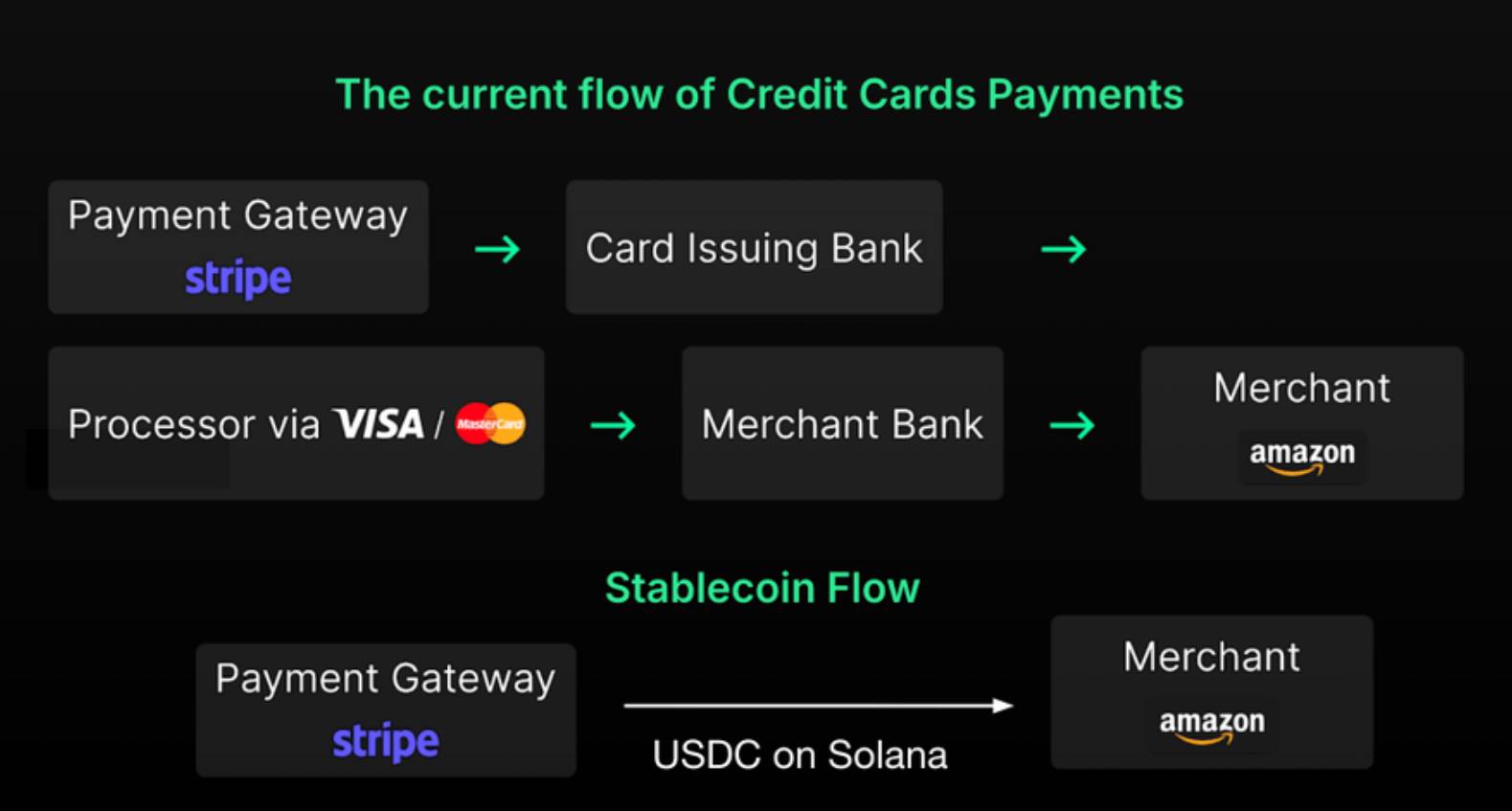
A passage from Delphi Digital’s report on crypto product moats explains the financial incentives:
“…by enabling users to hold pyUSD through PayPal’s payment frontends (e.g., Venmo), PayPal effectively becomes a bank. PayPal can then receive user funds, deposit them into its treasury, and earn yield. This allows PayPal not only to compress payment fees down to zero but even pay users rebates or a share of the interest earned on idle pyUSD balances. This is a crushing advantage over other Web2 payment app competitors.”
Becoming their own bank is the primary motivation for fintech giants. From a business standpoint, this may matter more than faster transaction and settlement speeds.
An interesting distinction worth noting is that PayPal and Stripe have adopted different approaches.
PayPal chose to issue its own stablecoin, signaling a focus on fund management. Stripe, by contrast, bet on the conversion layer, indicating a focus on stablecoin infrastructure. They picked their paths based on their existing tech stacks.
At a higher level, Stripe is a payments API company, and Bridge fits perfectly into that vision. Stripe simply needs to integrate Bridge’s stablecoin APIs into its developer documentation.
PayPal thrives through front-end services like Venmo and its massive retail user base. Thus, it’s natural their crypto team focuses on optimizing user balance management and capital utilization. Launching PYUSD enables PayPal to manage funds more efficiently.
In my view, both companies are inevitably moving toward vertical integration across the entire stablecoin stack. Internally developing tools for stablecoin issuance, treasury management, debit cards, and crypto wallets is critical. It seems obvious—owning a full internal stack allows companies to deliver superior user experiences and capture a larger share of the payment value chain.
In short, don’t be surprised if Stripe launches its own smart wallet and crypto debit card soon.

Moreover, it’s important to note that token issuance is a cash cow for stablecoins. For example, Tether generated more profit in Q4 2022 than BlackRock did. As Stripe explores the stablecoin landscape alongside its users, they will likely launch their own stablecoin to help merchants onboard quickly and incentivize usage of their native ecosystem token.
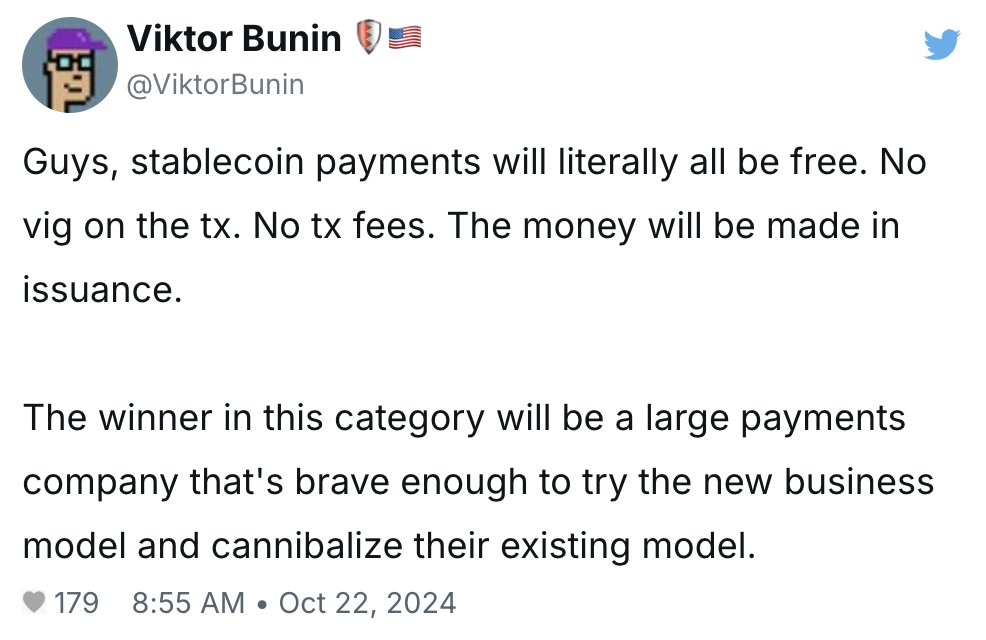
Both Stripe and PayPal possess vast global reach and will seek to embed stablecoin infrastructure into their existing networks. As Viktor mentioned above, over the next five years, companies that move early to “eat the existing model” will benefit disproportionately.
Now you might be thinking: If Stripe and PayPal fully commit to stablecoin strategies, isn’t that a major threat to payment networks like Visa and Mastercard?
Absolutely. That’s exactly why Visa and Mastercard are already writing their own scripts to avoid missing the stablecoin revolution. For instance, Visa became the first payment network to accept USDC back in 2020, while Mastercard launched its own crypto credit card service.
But I suspect Stripe’s acquisition of Bridge has accelerated the stablecoin strategies of crypto teams within these large traditional finance/fintech companies.
What about banks? Honestly, I’m not sure what their response will be. Clearly, stablecoins undermine their role as facilitators of international payments and custodians of user deposits. But their strength lies in regulatory compliance—they may lean into the rise of CBDCs?
For example, the BRICS nations recently announced they’re launching their own digital currencies to reduce reliance on the U.S. dollar. Clearly, banks will seize the opportunity to develop CBDC strategies and compete for this new market share.
No matter how different traditional financial stakeholders respond, the overarching theme remains consistent: stablecoins have entered the financial mainstream.
The question now is: which major institutions will warmly embrace this new member of the financial system and rapidly become allies with stablecoins?
In many ways, various participants in traditional finance are starting to look increasingly similar, as they all aim to use stablecoins to offer full-stack financial services (payments, banking, card services, etc.).
We’ve now discussed the impact of stablecoins on all fintech players—but what about the new breed of crypto-native stablecoin startups?
TradFi or DeFi: Choose One
Based on my prior research, founders in the stablecoin vertical must choose who they serve:
-
Traditional finance / Web3 tech enterprises
-
On-chain crypto adopters
The first group is clearly targeted by Stripe’s acquisition of Bridge; the second implies the long tail of upcoming DeFi-native stablecoin infrastructure. But what exactly distinguishes these two?
The scale of the stablecoin ecosystem goes far beyond replacing fintech payment services. As I outlined in my article on stablecoin adoption, it's a two-pronged approach: one focused on improving existing financial rails, the other on enhancing crypto products using stablecoins—such as Polymarket, Bountycaster, Uniswap, Aave, and others.
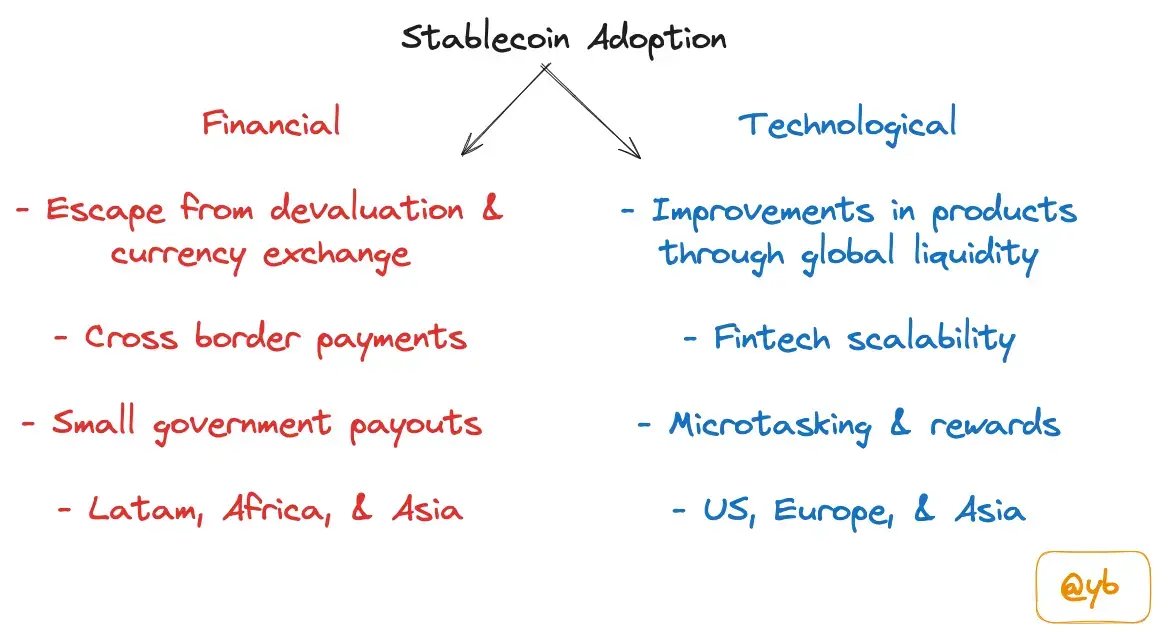
One category of startups aims to become plug-ins for traditional finance players, seeking stronger partnerships. Examples include Paxos, Ondo Finance, Brale, Agora, Coinflow, and Sphere.
The other category leans toward fully decentralized stablecoin infrastructure stacks, including Prerna, Gnosis Pay, Based App, and Picnic. These companies aim to directly compete with Stripe, PayPal, and similar platforms. They cater to a crypto-first audience and enhance on-chain experiences through stablecoin-powered applications.
That said, I believe founders should consider a barbell strategy for stablecoins. Are we serving traditional finance companies that will inevitably enter the stablecoin space? Or are we building stablecoin infrastructure for DeFi apps, experimenting with novel use cases that make no sense for Stripe and PayPal?
In my opinion, companies attempting to serve both sides risk being crushed—either by traditional finance players with distribution moats or by DeFi players optimized for unique on-chain functionality.
This post shares my initial thoughts after hearing about the Bridge acquisition, but I still haven’t found meaningful answers to the following questions:
-
Where are the moats in the stablecoin stack?
-
How will other Web2 fintech players respond?
-
If another acquisition happens, who will be next?
In the coming months, developments in the stablecoin space will become increasingly fascinating.
Join TechFlow official community to stay tuned
Telegram:https://t.me/TechFlowDaily
X (Twitter):https://x.com/TechFlowPost
X (Twitter) EN:https://x.com/BlockFlow_News