Coinbase CEO Admits Base Content Token Strategy Failed, ZORA Down 95%, "Turning the Page" to Shift to Trading and AI
TechFlow Selected TechFlow Selected
Coinbase CEO Admits Base Content Token Strategy Failed, ZORA Down 95%, "Turning the Page" to Shift to Trading and AI
Mistakes can be admitted, but going to zero won't rebound.
 Navigating Web3 tides with focused insights
Author: Claude, TechFlow
TechFlow Editor's Note: Coinbase CEO Brian Armstrong publicly admitted on the X platform that Base's strategy of pushing content coins (content coins) for over the past year has failed, stating, "We messed up, it's time to move on." The core vehicle of this strategy, the ZORA token, has plummeted approximately 95% from its high last August, causing significant losses for many participants. Base completed its pivot early this year, with current resource priorities being trading, payments, and AI agents in that order.
Coinbase CEO Brian Armstrong rarely admits fault.
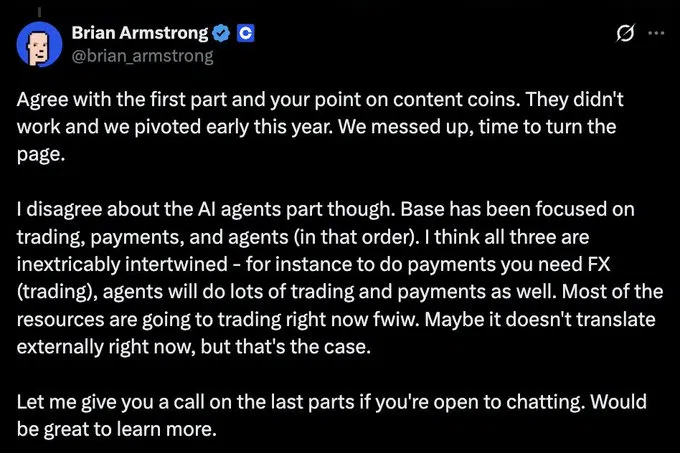
On July 13, Armstrong responded to criticism from community user @smileyXBT on the X platform, stating: "I agree with your point about content coins. They didn't succeed, we already pivoted early this year. We messed up, it's time to move on."
This is a rare case in recent years where a top executive in the crypto industry publicly admitted the failure of a core strategy. This statement puts a period to the content coin narrative that Base has built around the Zora platform over the past year or more.
One Year of Promotion Exchanges for 95% Plunge, Community Criticism Points Directly to Resource Misallocation
What triggered Armstrong's response was a sharp criticism from X user @smileyXBT. The user pointed out that Base spent over a year vigorously promoting Zora's creator token platform, but failed to build a real user moat, instead tilting more resources towards projects founded by former Coinbase employees, "many people got burned in this process."
According to The Defiant, the critic Armstrong responded to mentioned that tokens promoted by Base included creator tokens from investors like Balaji Srinivasan and Base lead Jesse Pollak, with the critic stating "many people were left holding the bag."
The price trend of the ZORA token, the core vehicle of the content coin strategy, is the most intuitive footnote to the failure of this experiment. According to CoinMarketCap data, ZORA touched an all-time high of $0.1471 on August 11, 2025, and has fallen to approximately $0.0067 as of press time, a drop of about 95.4%.
From Official Token Launch Failure to Creator Token Chain Collapse
Looking back at the timeline, Base's content coin experiment was controversial from the start.
In April 2025, the official Base X account posted on the Zora platform, which automatically generated an ERC-20 token according to Zora's mechanism. Since the post came from the official Base account, many users mistook it for an official token, pushing the market cap to briefly surge to over $17 million, before plummeting more than 99% within hours.
Despite this, Coinbase doubled down. In July 2025, Coinbase rebranded its wallet as the Base App and integrated Zora's token tools into the social feed. The daily number of created tokens surged, and Base once surpassed Solana to become the chain with the largest new token issuance.
But the hype did not last. By December 2025, even staunch supporters of the Base community began to abandon content coins. Journalist Nick Shirley's creator token plummeted about 80% within two days of launch, becoming a landmark event that crushed confidence. In February 2026, Zora deployed its latest product "Attention Markets" to Solana instead of Base, which some community members interpreted as a signal of retreat.
Armstrong Refutes AI Agent Criticism, Insists on Three-Pronged Approach
While admitting fault, Armstrong also drew a line.
The latter part of @smileyXBT's criticism pointed to Base's current emphasis on AI agents, believing this was repeating the old habit of chasing trends. Armstrong clearly disagreed with this. He responded that Base's focus has always been "trading, payments, and agents (in that order)," the three are "inseparable," and currently most resources are concentrated on trading infrastructure construction.
Base's 2026 roadmap was released in March, confirming trading, payments, stablecoins, and AI agents as core priorities. At the product level, Coinbase has launched the x402 payment protocol (developed and open-sourced in collaboration with Microsoft, Google, and Mastercard), as well as the "Coinbase for Agents" platform launched in June, allowing AI assistants to connect user accounts for trading and payments. The majority of x402 transaction volume is settled on Base.
The pivot signal appeared earlier in January. Jesse Pollak publicly stated at the time that the Base App was already "too much like a traditional web2 application," and the team needed to pull the focus back to trading.
Base Remains the Largest L2, but Whether Trading Pivot Can Win Back Users is Unknown
Base's TVL slid from about $5.3 billion in January this year to about $3.9 billion in mid-February, evaporating about $1.4 billion. According to CoinGecko data, Base's current TVL is about $4.58 billion, still the largest among all Layer 2s.
Coinbase's revenue in the previous quarter decreased 31% year-over-year to $1.41 billion, with spot trading volume down 37%. Whether Base can re-attract users hurt by content coins after the trading pivot is the core question to be verified in the next earnings cycle. Coinbase is expected to release Q2 results in the coming weeks.
From a broader perspective, Armstrong's admission of fault itself has signal significance. The crypto industry is accustomed to silently pivoting after experimental failures, and there are few top companies that publicly admit "we messed up." But for ZORA holders, this statement came too late; mistakes can be admitted, but the token will not rebound.
Join TechFlow official community to stay tuned
Telegram:https://t.me/TechFlowDaily
X (Twitter):https://x.com/TechFlowPost
X (Twitter) EN:https://x.com/BlockFlow_News
 深潮TechFlow