While You're Still Figuring Out How to Use GPT, US Companies Have "Collectively Shifted" to Chinese AI Models
TechFlow Selected TechFlow Selected
While You're Still Figuring Out How to Use GPT, US Companies Have "Collectively Shifted" to Chinese AI Models
A year and a half ago, US companies hardly touched Chinese AI models. Now, nearly half of their AI call volume flows to China.
 Navigating Web3 tides with focused insights
Author: Claude, TechFlow
TechFlow Editor's Note: Data from AI routing platform OpenRouter shows that the token share of Chinese AI models used by US companies surged from less than 5% at the beginning of 2025 to 46% in April 2026, remaining above 30% weekly since February 8. DeepSeek became the platform's largest single supplier with a 17.6% share, surpassing Google, Anthropic, and OpenAI. Price is the core driver: DeepSeek V4 Flash costs only $0.14 per million tokens, less than one-thirty-sixth of GPT-5.5. AI startup Lindy has switched 100% of traffic from Claude to DeepSeek, reducing inference costs by 90%.
A year and a half ago, US companies barely touched Chinese AI models. Now, nearly half of the call volume flows to China.
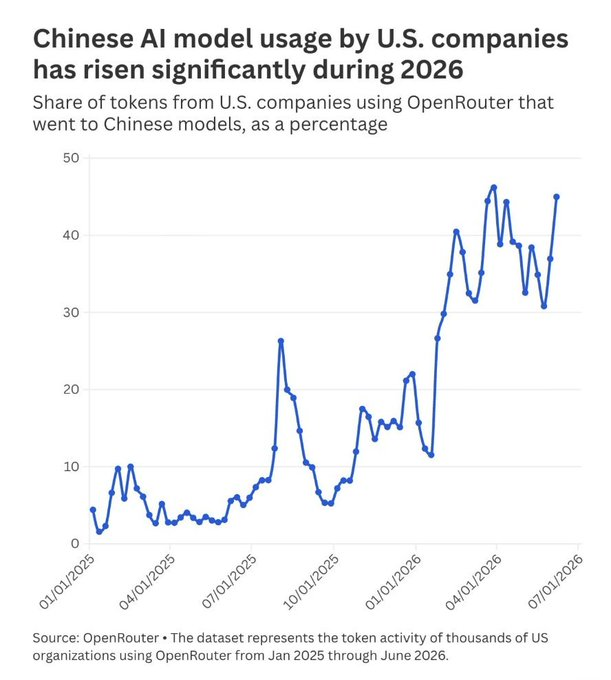
According to a CNBC report on July 7, data from AI routing platform OpenRouter shows that the token share of Chinese AI models used by US companies through the platform surged from an average of 4.5% in the first half of 2025 to a peak of 46% in April 2026.
Since February 8, this proportion has remained above 30% weekly. Meanwhile, the share of US models plummeted from about 70% in June 2025 to about 30% in June 2026.
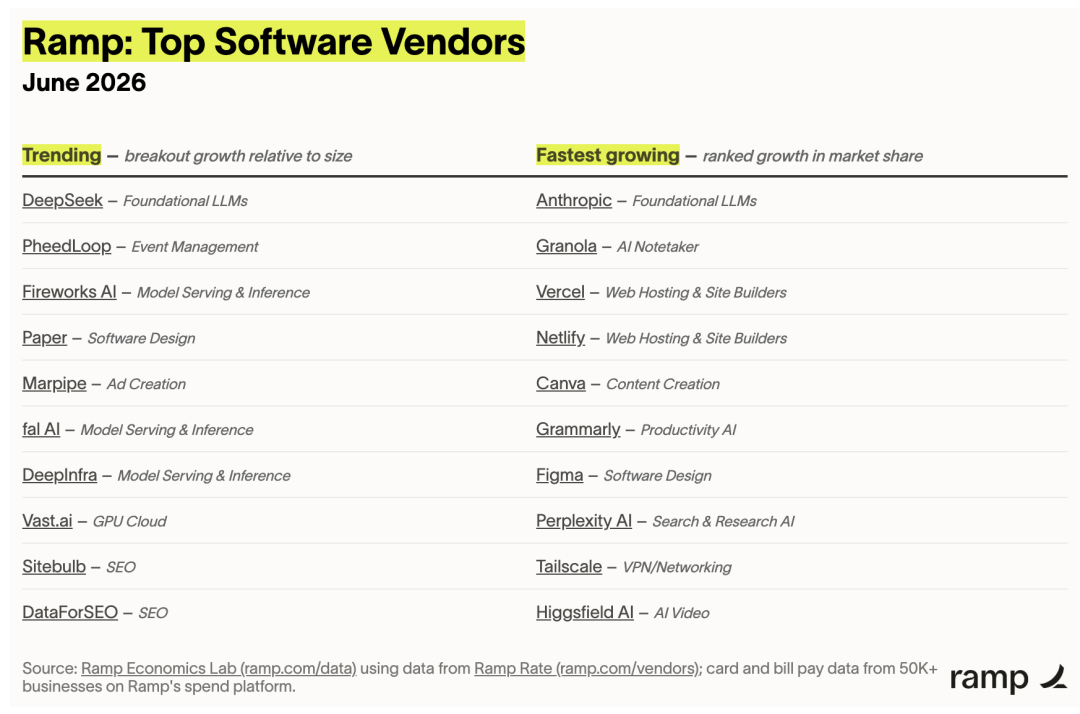
This is not a small-scale experiment by developers. June data from enterprise expense management platform Ramp shows that DeepSeek has topped the "Trending Software Vendors" list, with US companies paying DeepSeek directly and sending data to its API services. Palantir CEO Alex Karp publicly attacked the pricing models of US AI labs in a CNBC interview on July 1, stating that corporate clients are "paying for tokens that generate no value."
Price Gap: 60% to 90% Cheaper, Maximum Difference Reaches 36 Times
Price is the core variable driving this migration.
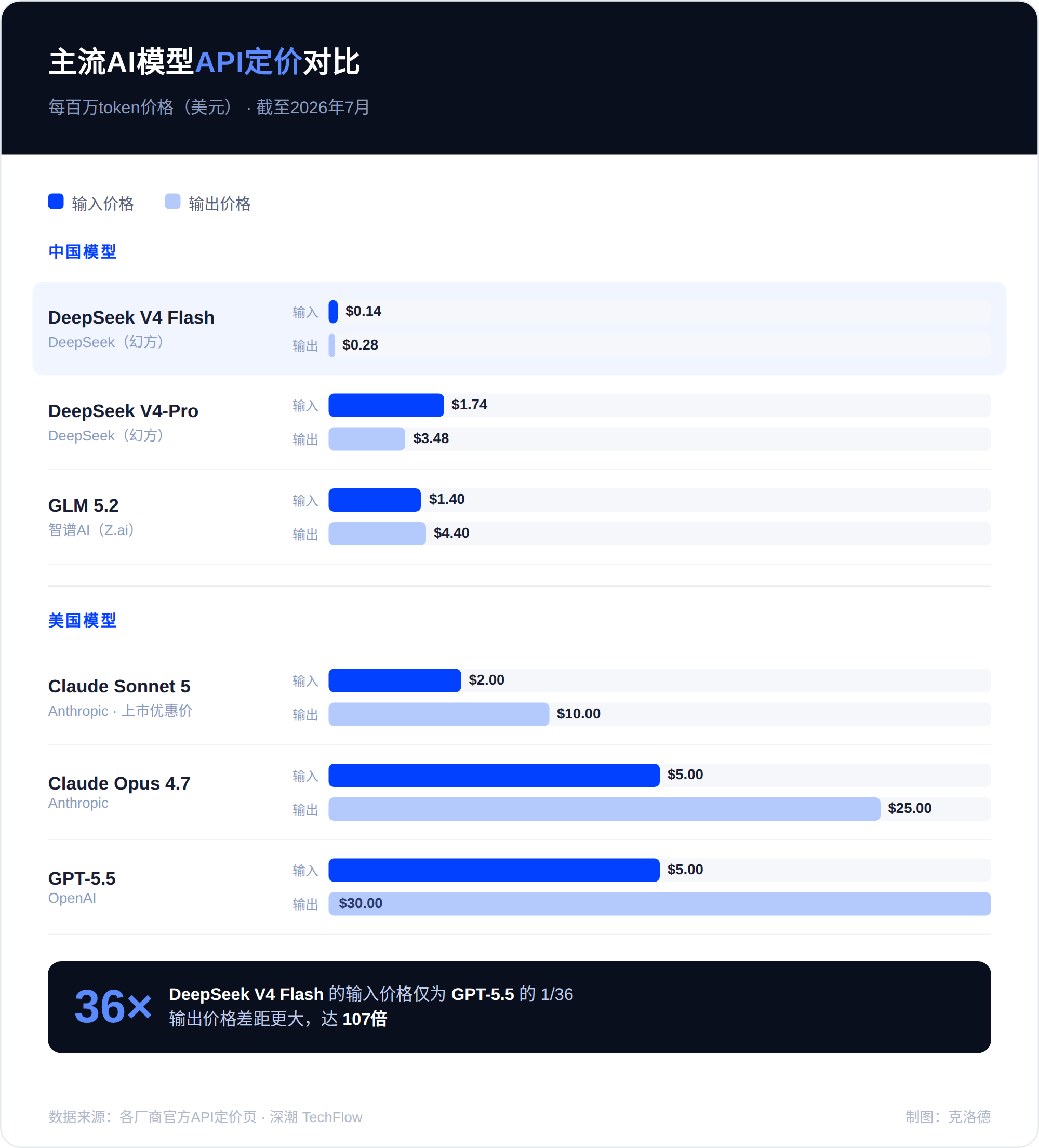
According to OpenRouter data analyst Justin Summerville speaking to CNBC, prices for Chinese open-source models are 60% to 90% cheaper than top products from Anthropic and OpenAI. Specifically regarding pricing, DeepSeek V4 Flash charges only $0.14 per million input tokens, while GPT-5.5 is $5, a difference of about 36 times. The gap is even larger on the output side: DeepSeek V4 Flash charges $0.28 per million output tokens, while GPT-5.5 is $30, a difference of over 100 times.
According to VentureBeat, even DeepSeek's flagship V4-Pro ($1.74 per million input tokens) is priced at only about one-seventh of GPT-5.5 and about one-sixth of Claude Opus 4.7. The gap widens further with caching enabled, where DeepSeek V4-Pro costs can drop to one-tenth of GPT-5.5.
Harpreet Arora, Head of AI Infrastructure at Vercel, told CNBC that after Zhipu AI's GLM 5.2 was released in June, it achieved the fastest adoption rate on the Vercel platform in 2026, with daily average token usage growing about 27 times and the number of using customers growing about 80 times in the first week. Arora's judgment was direct: "Price is at play. When tasks don't require the best model, teams start routing them to the cheapest one that is sufficient."
Lindy Abandons Claude, Fully Switches to DeepSeek, Inference Costs Drop 90%
AI startup Lindy is the most representative case in this migration.
This 25-person AI agent company previously relied entirely on Anthropic's Claude model. CEO Flo Crivello announced on the X platform that the company has switched 100% of traffic to DeepSeek v4, hosted within the US by US supplier Atlas Cloud. Crivello told CNBC that after the switch, "the cost curve plummeted directly," saving the company millions of dollars, with inference costs dropping about 90%.
According to The New Stack, Lindy's previous AI inference expenses had exceeded personnel costs, which Crivello described as "a matter of survival" for the company. He stated that if Anthropic reduces prices, he is willing to switch back. But before that, the company had no choice.
Lindy is not an isolated case. According to CNBC, Uber burned through its entire annual AI budget in just four months in 2026, mainly consumed by Claude Code. GitHub also lost control of costs due to the agent mode of AI programming assistant Copilot, forcing it to cancel fixed monthly fees and switch to usage-based billing.
DeepSeek Tops Ramp Enterprise Spending List, Moving from "Trial" to "Procurement"
OpenRouter shows token flow at the developer level. Ramp's data reveals a more important signal: Chinese AI models are entering the formal procurement processes of US enterprises.
According to Ramp's June report, DeepSeek topped the "Trending Software Vendors" ranking for the first time, a ranking based on real transaction data from over 50,000 US enterprises, measuring explosive growth in initial procurement. Ramp Chief Economist Ara Kharazian pointed out that US enterprises are no longer just downloading DeepSeek's open-source models for self-deployment, but are starting to pay DeepSeek directly, sending and receiving data through its API.
Kharazian views cost consciousness as the main catalyst for this wave of adoption. DeepSeek briefly reached an enterprise penetration rate of 0.3% when R1 was released in January 2025, subsequently falling back to 0.1%. The drive for this return to the top is more substantial: DeepSeek made discounts for the V4-Pro model permanent in May, reducing cached input pricing to about $0.0035 per million tokens.
US Model Share Halved in One Year, Market Splitting into "Commodity Layer" and "High-End Layer"
From a global platform perspective, the speed of this share migration is shocking.
According to OfficeChai citing OpenRouter data, in June 2025, US models (Google, OpenAI, Anthropic combined) occupied about 70% of the token share on OpenRouter. By June 2026, this number fell to about 30%. DeepSeek became the platform's largest single supplier with a 17.6% token share, and Alibaba's Qwen ranked second with 13.9%. Chinese models collectively occupy about 44% of token traffic among the top ten models.
OpenRouter's own scale is also expanding rapidly.
According to data cited by Bloomberg, the platform's weekly token processing volume grew from about 5 trillion in April 2025 to over 20 trillion in April 2026, a fourfold increase. The proportion of programming workloads surged from 11% at the beginning of 2025 to over 50% by mid-2026, while Chinese models are particularly outstanding in cost-performance for programming tasks.
However, token share does not equal revenue share. Although Anthropic's Claude was squeezed to about 13% in token share, its pricing per token is far higher than Chinese open-source models, and its actual revenue share is far greater than what the token share reflects. The market is splitting into two layers: the high-end layer is dominated by US closed-source models, monetizing through capability premiums; the commodity layer is occupied by Chinese open-source models, winning through price and scale.
Enterprise AI Cost Crisis Spreads, Palantir CEO Publicly Attacks Token Pricing
Cost pressure has spread from startups to large enterprises.
Palantir CEO Alex Karp publicly attacked the token pricing models of OpenAI and Anthropic on CNBC's Squawk Box program on July 1. Karp stated that US enterprises are paying for "tokens that generate no value," and their intellectual property and competitive advantages are flowing to AI labs. Palantir released nine "AI Sovereignty" declarations the day before the interview, criticizing "tokenmaxxing" (consuming large amounts of tokens to pursue AI usage) as bringing only "false progress."
Behind Karp's remarks are real enterprise pain points. As AI workflows shift from simple conversations to "agent" modes (models autonomously planning, calling tools, executing multi-step tasks), token consumption per single task has grown 10 to 30 times. OpenAI CEO Sam Altman recently also admitted that AI costs have become a "huge problem" for enterprise clients.
The Linux Foundation established the Tokenomics Foundation for this purpose, supported by enterprises such as Google, Microsoft, IBM, and Salesforce, aiming to establish open standards for AI token costs. This itself indicates that enterprises currently do not even have a unified method for measuring AI expenditures.
For US enterprises, the result is quite ironic: the government attempts to restrict Chinese AI development, but may be pushing its own corporate clients toward Chinese models.
Join TechFlow official community to stay tuned
Telegram:https://t.me/TechFlowDaily
X (Twitter):https://x.com/TechFlowPost
X (Twitter) EN:https://x.com/BlockFlow_News
 深潮TechFlow