Apple Files Lawsuit, Musk and Altman Argue Again
TechFlow Selected TechFlow Selected
Apple Files Lawsuit, Musk and Altman Argue Again
The personal feud between Musk and Altman has lasted for many years. This quarrel has still been given new meaning.
 Navigating Web3 tides with focused insights
By: Li Hailun
Editor: Xu Qingyang
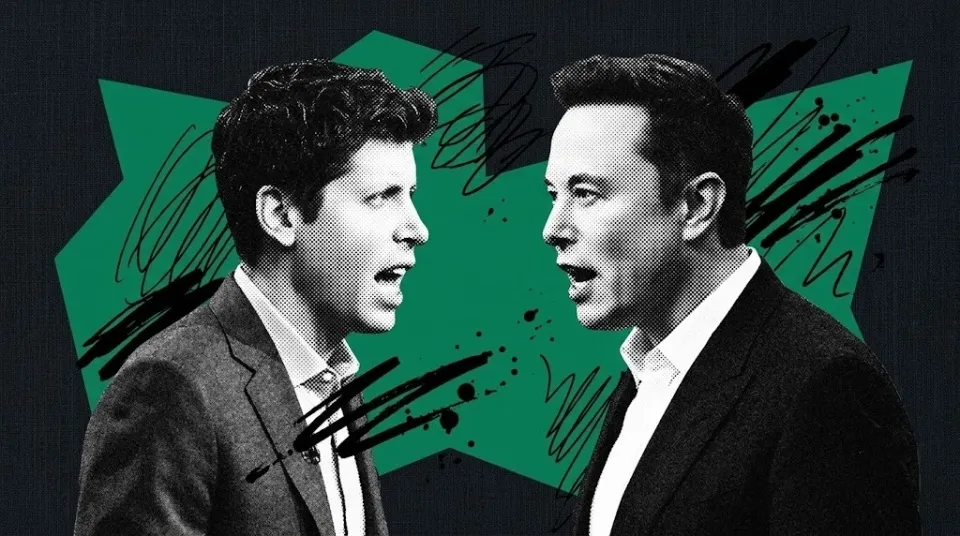
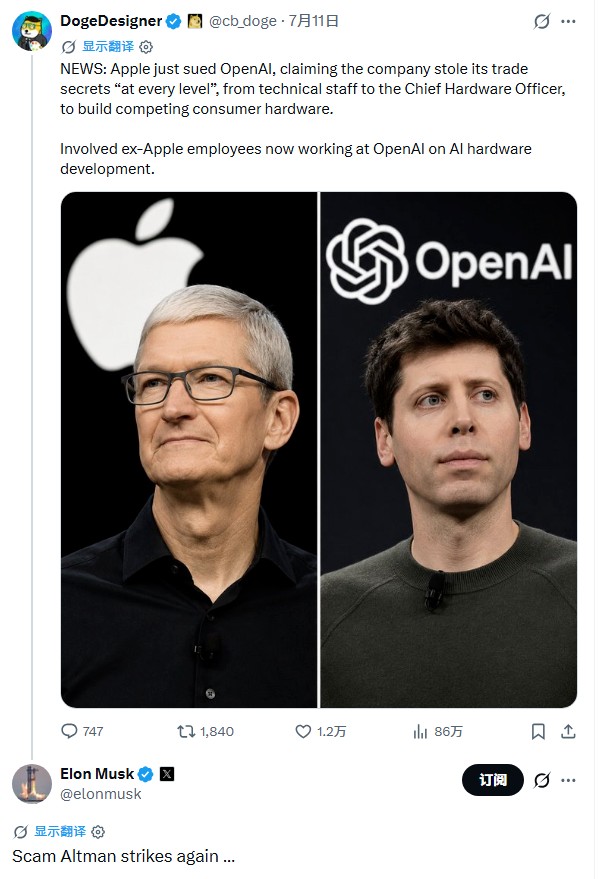
Musk and Altman are arguing on X again. Musk bluntly stated, "Scam Altman is at it again."
This time, it was Apple that ignited the conflict.
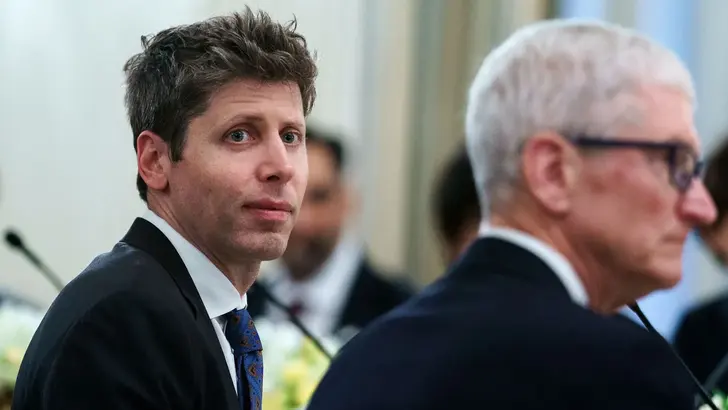
On July 10 local time in the US, Apple sued OpenAI, OpenAI's hardware company io Products, and two former Apple employees in California Federal Court, accusing them of stealing trade secrets to assist OpenAI in developing consumer-grade AI hardware.
OpenAI responded that the company is still reviewing the lawsuit documents, has no interest in other companies' trade secrets, and will continue to focus on developing innovative technologies. Apple stated that it will continue to protect employees' achievements and the company's innovative assets.
The case has not yet entered substantive trial, but Musk has already joined the battle first.
01 Apple Sues OpenAI, Musk Uses the Opportunity to Attack
In the lawsuit, Apple described a picture far more serious than ordinary job-hopping, and specifically mentioned two former Apple employees who have already joined OpenAI.
One of them is Tang Tan. He had long participated in the design of products such as iPhone, Apple Watch, and iPod. After leaving Apple, he joined io Products founded by former Apple Chief Design Officer Jony Ive, and currently serves as OpenAI's Chief Hardware Officer.
The other is former Apple electrical engineer Chang Liu. Apple claimed that he had participated in highly confidential product R&D projects, and after leaving to join OpenAI, he still accessed and downloaded hardware-related files through an unreturned Apple device.
Apple also made more serious allegations in the lawsuit: during the process of recruiting Apple employees, OpenAI allegedly required job seekers to discuss Apple internal projects, display physical components, and guided some employees to evade exit reviews.
This case quickly caught Musk's attention.
He reposted related news on X and wrote: "Scam Altman is at it again..." Subsequently, he posted consecutively stating that Altman "has elevated scamming to a whole new level," and even "loves scamming more than anyone else."
Musk also posted a photo of Altman with the text "I'm doing this because I love it" written on it. Musk added that what Altman loves "is scamming."
The "it" here refers to AI. In May 2023, Altman attended a hearing at the US Senate. When asked about compensation, he answered that his annual salary was only enough to pay for health insurance, he had no equity in OpenAI, and said this sentence: "I'm doing this because I love it."
"Scam Altman," i.e., "Scammer Altman," has become a term Musk repeatedly uses when attacking Altman.
Then, Altman quickly fought back.
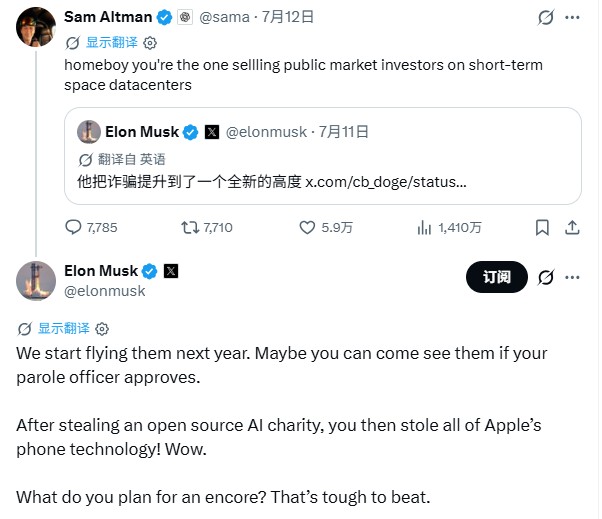
He aimed his spearhead at the space data center plan SpaceX was promoting to investors: "Bro, you're the one pitching short-term space data centers to public market investors."
Musk responded that SpaceX would begin launching related facilities next year, and sarcastically said to Altman: "If your parole officer approves, maybe you can come over and take a look."
Musk's subtext was comparing Altman to a criminal currently serving a sentence or on parole. Because he "stole" the open-source AI charity, and "stole" Apple's mobile phone technology, so he should be locked up in prison.
Altman subsequently linked this quarrel to the GPT-5.6 Sol just released by OpenAI.
He wrote that many benchmarks show GPT-5.6 Sol might be the strongest performing model globally currently, "but the most reliable way to judge is that Elon has started obsessing over attacking me again."
OpenAI calls GPT-5.6 Sol its currently most capable model, focusing on improving programming, long-chain agent tasks, biological research, and cybersecurity capabilities; Musk's SpaceX AI also released Grok 4.5 during the same period, focusing on programming, agent tasks, and knowledge work.
A legal dispute surrounding trade secrets ultimately evolved into a model release battle and personal attacks between the heads of two AI companies.
This scene looks absurd, but fits the way Musk and Altman have gotten along over the past few years.
The two co-founded OpenAI in 2015. As OpenAI expanded financing needs and established a for-profit structure, the two diverged around control, funding, and development routes. Musk left OpenAI in 2018, subsequently founded xAI, and engaged in direct competition with OpenAI.
Since then, the conflict between the two moved from the boardroom to the court, and then spread from the court to X.
In May 2026, the jury made a ruling unfavorable to Musk in the lawsuit filed by Musk against OpenAI and Altman. Musk stated he would appeal.
Apple's lawsuit against OpenAI this time gave him just the opportunity to attack Altman again.
02 A War of Words Brings Out Three New Fronts in AI Competition
The personal feud between Musk and Altman has lasted for many years. This quarrel is still endowed with new meaning.
Apple, OpenAI, and SpaceX AI are competing for the same batch of resources: top engineers, consumer-grade entry points, developer ecosystems, computing infrastructure, and capital market trust in the next-generation AI platform.
This war of words simultaneously brings out three "new fronts" forming in the AI industry:
The first front is AI hardware.
OpenAI has mainly relied on ChatGPT and API to reach users in the past few years, but software entry points have always been constrained by platform companies like Apple, Google, and Microsoft.
On mobile phones, OpenAI needs to go through Apple and Google's app stores; in the office and enterprise market, OpenAI highly relies on Microsoft's products and cloud computing system; when entering personal life scenarios, ChatGPT still runs on phones, computers, and operating systems produced by others.
This is also the direct motivation for OpenAI to enter the hardware field.
In July 2025, OpenAI acquired io Products founded by Ive at a price close to $6.5 billion, hoping to create a new type of AI device distinct from smartphones and traditional screens. OpenAI Chief Financial Officer Sarah Friar stated in April this year that the company plans to launch consumer-grade hardware by the end of 2026.
Apple and OpenAI were originally partners.
At the Apple Worldwide Developers Conference in June 2024, Apple announced integrating ChatGPT into the iPhone. When Siri cannot complete some complex requests, users can call OpenAI's model to get answers.
As OpenAI began recruiting Apple's hardware executives and engineers, and publicly pushed forward AI devices, the relationship between the two sides changed rapidly. The partner that once helped Apple complement large model capabilities is now trying to manufacture new products that may change the way mobile phones are used.
Apple filing a lawsuit at this time has protecting trade secrets as one direct reason; stopping competitors from quickly replicating its accumulated hardware capabilities also relates to control over the next-generation computing entry point.
OpenAI wants AI to change from an app inside a mobile phone into an independent device that can accompany users at any time. Once this product forms scale, the status of smartphones as the core entry point of the internet may be affected.
The second front is capital narrative.
Musk attacking Altman as "scamming," and Altman fighting back with "space data center," this choice is not accidental.
SpaceX completed its IPO in June this year, data cited by CNBC shows, the company raised $75 billion, and market cap approached $2 trillion after the first day's close. As xAI was merged into SpaceX, what investors are buying is already a business story composed of rockets, satellite internet, AI models, social platforms, and computing infrastructure together.
The space data center is the most imaginative and also most controversial link in this story.
Musk hopes to use SpaceX's low-cost launch capabilities and Starlink network to deploy AI computing facilities into orbit, alleviating power, land, and cooling limitations faced by ground data centers. SpaceX proposed deploying up to 1 million computing satellites, with the single satellite peak power of the first batch of AI1 satellites reaching up to 150 kilowatts.
This plan currently still lacks large-scale engineering verification. Orbital heat dissipation, equipment maintenance, chip lifespan, launch costs, and data backhaul efficiency may all affect its commercial feasibility.
Altman choosing to attack the space data center is actually questioning SpaceX's most important new growth story after listing: for a company valued close to $2 trillion, exactly how much value comes from already mature rocket and satellite business, and how much value is bet on unverified AI infrastructure?
OpenAI faces similar problems.
As the company explores listing, its valuation needs to be built on multiple expectations such as ChatGPT continuous growth, enterprise market expansion, model capability leadership, and new hardware success. Apple's lawsuit may affect OpenAI hardware product launch timing, and may also bring new doubts to investors regarding intellectual property, corporate governance, and team stability.
Therefore, the mutual attacks between the two both point to the other's most vulnerable parts.
Musk questions OpenAI's business ethics and transformation process; Altman questions whether SpaceX's commitments to future technologies can be fulfilled.
The third front is the boundaries of AI companies.
Early large model competition mainly revolved around parameter scale, training computing power, and benchmark results. Nowadays, the expansion scope of leading companies has obviously expanded.
OpenAI is simultaneously entering search, browsers, programming tools, office collaboration, enterprise agents, and consumer hardware. Musk is gradually integrating models, X platform, Cursor ecosystem, Starlink, and SpaceX's infrastructure together.
Large models are becoming underlying capabilities; what truly determines the company's long-term position also includes how many products the model can enter, how many user relationships it masters, how much computing power it calls, and whether it can establish a platform independent of Apple and Google.
What Apple's lawsuit protects this time also far exceeds a few hardware drawings.
Over the past twenty years, Apple has built a complete consumer electronics system relying on chips, industrial design, operating systems, supply chains, and app stores. OpenAI is trying to turn natural language and agents into new operating interfaces, reducing users' reliance on traditional screens, app icons, and touch operations.
Musk hopes to embed AI models into social platforms, cars, robots, satellite networks, and space infrastructure.
The three companies chose different paths, but are competing for the answer to the same question: In the AI era, who can master the first-layer entry point between users and the digital world?
Apple's answer is still devices and operating systems, OpenAI is betting on models and new AI terminals, Musk hopes to establish a vertical system from chips, data centers to networks, models, and applications.
Against this background, the mutual scolding between Musk and Altman has a special communication value.
It can help the two mobilize their respective supporters, amplify attention on new models, and can also compress complex technical competition into personal conflict between two entrepreneurs.
However, a war of words ultimately cannot answer the real questions.
Apple needs to prove it can continue to hold the consumer electronics entry point in the AI era; OpenAI needs to prove its hardware products possess independent value, and the R&D process can withstand legal scrutiny; Musk also needs to prove that grand plans like space data centers can move from capital market stories to real engineering.
The next round of quarrel between the two may start at any time.
Join TechFlow official community to stay tuned
Telegram:https://t.me/TechFlowDaily
X (Twitter):https://x.com/TechFlowPost
X (Twitter) EN:https://x.com/BlockFlow_News