








Coinbase Tokenized Stocks Face Scrutiny: Is the Promoted “Real Equity” Merely a Gimmick?
TechFlow Selected TechFlow Selected
Coinbase Tokenized Stocks Face Scrutiny: Is the Promoted “Real Equity” Merely a Gimmick?
Galaxy’s Head of Research Warns of Fatal Flaws in Coinbase’s Token U.S. Equity Listing; SpaceX’s Past Setback Still Fresh in Memory.
 Navigating Web3 tides with focused insights
By Alex Thorn, Head of Research at Galaxy Digital
Translated by Saoirse, Foresight News
Coinbase announced its tokenized stock initiative this week—but without disclosing the underlying legal architecture. This architecture is critically important for regulatory compliance, user experience, and industry competition.
At its “System Update” launch event on June 16, Coinbase unveiled 21 new products and features spanning trading, lending, payments, and onchain infrastructure. Of these, tokenized equities drew our strongest attention. Coinbase stated it will roll out tokenized U.S. equities to non-U.S. users next month, with assets fully backed on a 1:1 basis. The platform claims these tokens grant holders full shareholder rights—including dividends—as well as the ability to lend tokens for yield or use them as collateral. U.S. residents are excluded from this service.
Although Coinbase describes these tokens as representing “true equity ownership,” it has not disclosed the legal structure underpinning that claim. Accompanying this product launch is the B20 token standard deployed on Base—a layered, policy-driven compliance toolkit comparable in functionality to Uniswap v4 hooks—but Coinbase has not clarified how the B20 standard will be integrated into its tokenized stock framework.
Another major highlight of this release is Coinbase Advisor, an AI-powered investment tool embedded directly in the Coinbase app. It has registered with the SEC as a Registered Investment Advisor (RIA) and with the U.S. National Futures Association as a Commodity Trading Advisor. Initially, access is limited to U.S.-based Coinbase One members. Other newly launched offerings include crypto and equity options trading; perpetual futures on real-world assets (RWAs) and pre-IPO assets (with SpaceX as the first underlying asset); Base Privacy—a privacy-focused onchain trading platform designed for enterprise compliance; and a Bitcoin-backed lending product developed jointly with Better.
Our View
A genuine convergence between traditional finance and the crypto industry is now underway.
Like other native crypto exchanges, Coinbase has a clear strategic intent to expand into traditional financial products—just as traditional financial institutions continue building out their crypto capabilities. These two ecosystems are simultaneously integrating and competing for each other’s customer bases. Coinbase isn’t merely adding stock trading to its app; the company plans to introduce options and perpetual futures across all asset classes. It is highly likely that tokenized equities themselves will soon have corresponding options and perpetual futures.
On the topic of tokenized equities specifically, we’ve published extensive analysis and commentary previously. Our assessment is that Coinbase most likely employs a third-party issuer “wrapper” model—and operates exclusively offshore, serving only non-U.S. users. This architecture closely mirrors xStocks: underlying equities are held within a third-party investment vehicle, whose shares are then tokenized. The resulting tokens can trade on offshore venues and be withdrawn to self-custodied wallets for use across DeFi applications. This contrasts sharply with the direct-issuer model championed by Galaxy and Superstate. Below is our best-effort industry map of tokenized equity issuers as of February (note: the space has continued expanding since—e.g., GLXY is now accepted as collateral on Kamino, and Backpack launched its tokenized stock offering earlier this month—but this map remains highly informative).
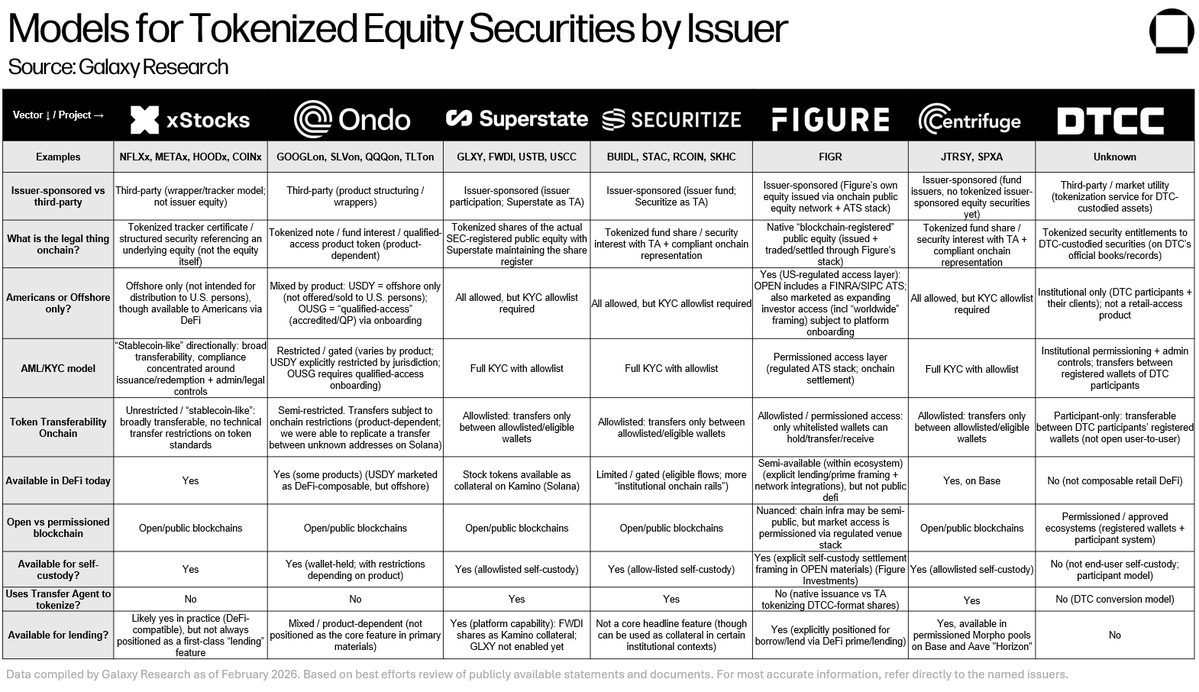
Note: This chart was compiled in February; facts and data may have changed since then. All information is drawn from publicly available sources and represents our best efforts at consolidation. For precise details, please consult individual issuers directly.
It is precisely this wrapper model that renders Coinbase’s claim of “true equity ownership” contradictory. If a third-party wrapper entity sits between the token holder and the underlying stock, dividend rights and voting rights are not conferred by the issuing company itself—but rather governed solely by the service agreement between the token holder and the wrapper provider. Fundamentally, token holders lack any direct legal relationship with the underlying issuer. There is currently no mature hybrid solution balancing the direct-issuer and third-party wrapper models—perhaps a novel equity rights mechanism could achieve such balance? Yet Coinbase has still not disclosed the critical architectural details.
The third-party wrapper model has recently exposed operational risks multiple times—the recent SpaceX primary-share incident being a textbook example. Several platforms—including Binance Wallet, Bybit, and Bitget—listed SpaceX IPO-preemptive shares sourced via xStocks, only to cancel all orders and issue refunds when underlying shares failed to settle. Bybit informed users that xStocks could not deliver the underlying assets, and the platform had received no SpaceX shares whatsoever; Kraken and xStocks’ own users likewise received only minimal allocations. Minting tokens is technically trivial—the real challenge lies in aggregating, custodizing, and onchain attesting to the underlying assets. This is the inherent structural risk of all third-party wrapper products: without official cooperation from the issuing company, there is no guarantee that intermediaries hold the requisite quantity of authentic shares.
All these initiatives operate against the backdrop of two unresolved regulatory developments:
The SEC’s proposed “Innovation Exemption” for tokenized stocks has been delayed. Reports indicate the core disagreement centers on whether the exemption should cover third-party wrapper tokens—or only direct-issuer tokens. A key point of contention is a provision permitting trading of third-party tokens whose digital representations of equity were issued without notice to or consent from the underlying issuer. SEC Commissioner Hester Peirce has publicly stated her view that the exemption should apply only to natively digitized secondary-market equity—not synthetic assets.
The CLARITY Act remains stalled in the U.S. Senate, with no progress over the past two weeks—and the remaining congressional window for consideration continues to narrow. The core value proposition of Coinbase’s offering hinges entirely on whether third-party wrapper entities can achieve regulatory equivalence to direct-issuer equity holdings—but regulators have yet to issue any definitive guidance on this matter.
Join TechFlow official community to stay tuned
Telegram:https://t.me/TechFlowDaily
X (Twitter):https://x.com/TechFlowPost
X (Twitter) EN:https://x.com/BlockFlow_News
 @galaxyhq


