After Futu Securities Was Banned, Will On-Chain Stock Purchases Be the New Cure?
TechFlow Selected TechFlow Selected
After Futu Securities Was Banned, Will On-Chain Stock Purchases Be the New Cure?
It is an ongoing infrastructure experiment, not a well-established investment shortcut.
 Navigating Web3 tides with focused insights
By Attorney Liu Honglin
Over the past two days, many investors who previously traded Hong Kong and U.S. stocks have been sharing the same news story.
On May 22, 2026, the China Securities Regulatory Commission (CSRC) announced it had initiated an investigation into Tiger Brokers, Futu Securities, and Changqiao Securities—as well as related domestic and overseas entities—for illegally operating securities businesses within mainland China, and issued a preliminary administrative penalty notice. Note one important detail upfront: this is not yet a final penalty decision; parties involved retain the right to make statements, present defenses, and request a hearing.
On the same day, the CSRC and seven other government departments jointly released the Implementation Plan for Comprehensive Rectification of Illegal Cross-Border Securities, Futures, and Fund Business Activities. The focus of this plan is not simply penalizing individual internet brokers, but rather systematically tackling the entire chain of cross-border securities, futures, and fund operations conducted by overseas institutions without regulatory approval—specifically targeting activities directed at mainland Chinese investors. As outlined in the plan, regulators will address both direct actions—including marketing, account opening, order receipt and execution, and fund transfers—and indirect support services provided by domestic entities, such as website development, trading software operation, and customer service. The plan also establishes a two-year concentrated rectification period, during which existing business arrangements are generally permitted only for one-way selling and fund withdrawal.
Many ordinary users previously understood this issue through the lens of “Which app should I use to buy Hong Kong or U.S. stocks?” But regulators’ primary concern is not which trading app appears on your smartphone—it’s whether that app delivers securities services within mainland China without proper authorization. Once user acquisition, order processing, system operations, customer support, and fund flows collectively form a de facto operational loop inside China, the matter ceases to be about a generic internet product and becomes a regulated financial activity.
So after the news broke, some people immediately asked me: “If the traditional cross-border brokerage route is narrowing, can we instead trade Hong Kong and U.S. stocks on-chain?”
This question didn’t surprise me.
Last year, while in Singapore, I spoke with several investor friends. One friend, who previously held little interest in cryptocurrencies, began paying close attention to Web3 last year—not because Bitcoin surged again, nor because another public blockchain unveiled a new narrative—but because of on-chain U.S. equities. His reasoning was straightforward: if assets like Apple, NVIDIA, Tesla, and S&P ETFs could be held, transferred, settled, and even integrated into DeFi portfolios via on-chain accounts, then blockchain would no longer be just an internal game among crypto-native participants—it could evolve into a new interface for global financial assets.
This is a fascinating phenomenon.
On-chain U.S. equities help traditional investors grasp Web3 more easily—not by asking them to believe in unfamiliar new assets, but by placing familiar instruments like stocks, ETFs, and indices into the context of wallets, stablecoin settlement, and smart contracts. For many investors, this is far more intuitive than listening to endless explanations about blockchain performance, consensus mechanisms, or ecosystem incentives.
But this isn’t as simple as it may appear. For mainland Chinese investors, on-chain U.S. equities are not a regulatory “loophole.” If someone merely replaces their previous process—opening an account, depositing funds, executing trades, and holding positions via a cross-border broker’s app—with a wallet, USDT, and on-chain tokens, the underlying risks likely won’t diminish.
A more precise framing is this: On-chain U.S. equities solve the problem of *how traditional assets go on-chain* and *how qualified users access U.S. equity exposure via on-chain methods*—but they do *not* solve the question of *whether mainland residents can bypass securities, foreign exchange, and virtual currency regulations to purchase U.S. equities.*
For compliant institutions and technology service providers, this represents a promising infrastructure opportunity worth serious attention. For retail investors merely seeking a new loophole, however, caution is advised.
Where Does Demand for On-Chain U.S. Equities Come From?
Why do on-chain U.S. equities exist? Traditional securities markets are highly mature—but for many non-U.S. investors, buying U.S. stocks isn’t as simple as clicking “buy” on a webpage. Preparing account-opening documents, moving funds across borders, handling tax filings, and resolving account freezes with customer support—all these steps are routine for professional institutions but involve multiple touchpoints with banks, brokers, and compliance systems for ordinary users. When the experience feels clunky, markets naturally seek new entry points.
The contrast is even starker for crypto-native users. They’re accustomed to wallet-based transfers, on-chain settlement, and 24/7 liquidity. Yet once they want to allocate capital to equities or ETFs, they must revert to bank accounts, broker accounts, and legacy clearing systems. On-chain and traditional assets aren’t technically incompatible—but the user experience remains fragmented.
This is where on-chain U.S. equities become compelling: they aim to represent economic exposure to U.S. stocks or ETFs via on-chain tokens. Users see a stock token—for example, an on-chain version of a specific U.S. stock or ETF—while behind the scenes lies a constellation of actors: issuers, brokers, custodians, market makers, oracles, smart contracts, and distribution platforms. Products with fuller disclosures and higher compliance standards typically emphasize underlying asset backing, segregated custody, qualified investor restrictions, redemption terms, and legal documentation.
We can view this in two layers: what’s visible on-chain includes accounts, tokens, and trading interfaces; what truly determines safety and legitimacy occurs off-chain—underlying assets, custody arrangements, legal documentation, user eligibility, and exit pathways.
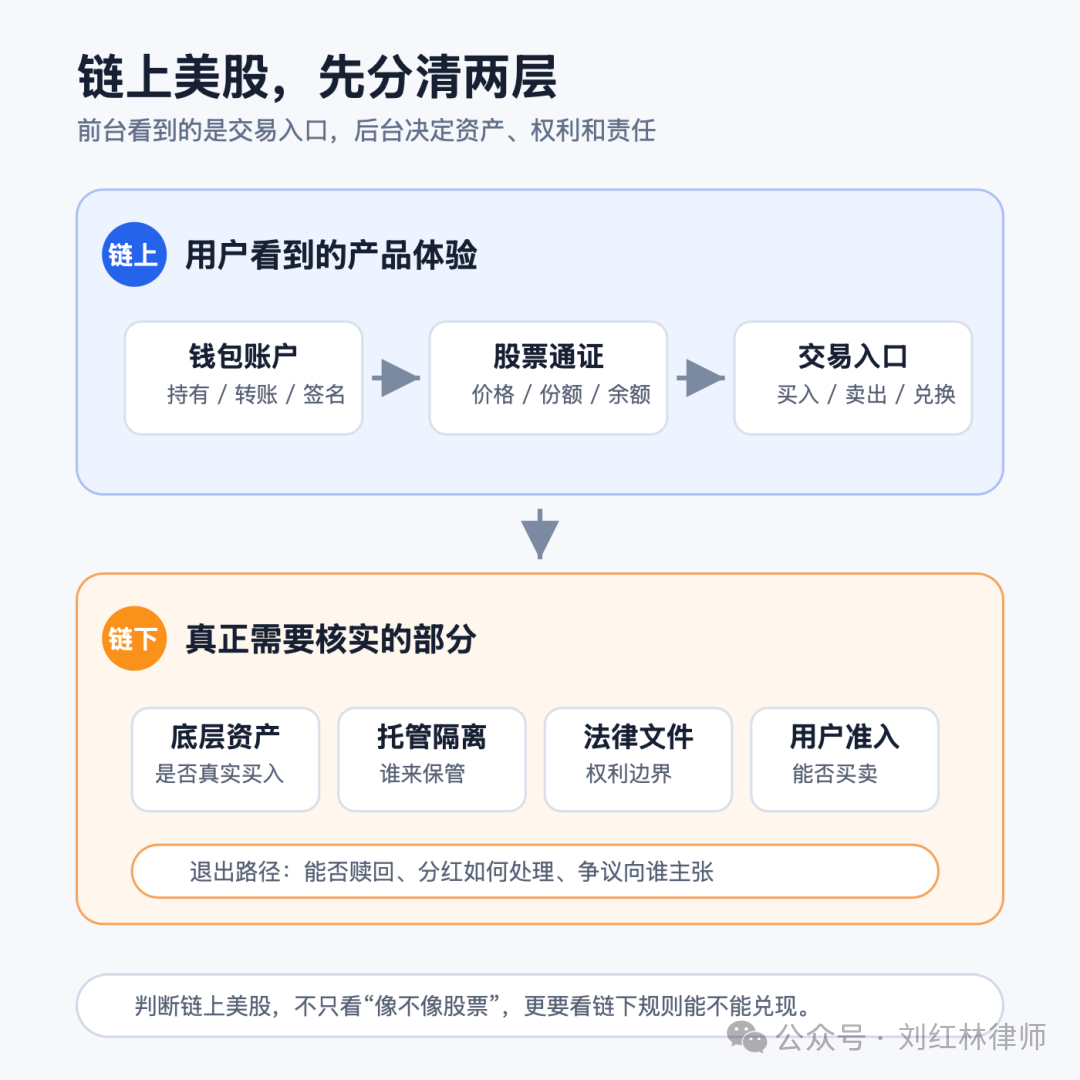
Structure of On-Chain U.S. Equity Products: On-Chain Interface vs. Off-Chain Rules
Evaluating an on-chain stock product requires looking beyond whether its name mentions Apple, NVIDIA, or Tesla. You must trace downward: Was the underlying stock or ETF actually purchased? Who holds custody? What does the issuance document say? Does the user qualify to purchase? Can the token be redeemed, sold, or rights enforced?
This is where on-chain stocks are most commonly misunderstood. Holding such a token does not necessarily mean you directly own shares of a U.S.-listed company.
Currently, the industry broadly reflects two distinct approaches.
One path involves issuers transforming underlying stocks or ETFs into on-chain financial instruments. For example, Backed’s xStocks line is legally described as an on-chain transferable security—a structured product known as a “tracking certificate,” designed to mirror the price of publicly listed stocks or ETFs on a 1:1 basis. Each xStock is fully collateralized by corresponding underlying assets, but holders explicitly do *not* acquire voting rights or shareholder privileges. In short, you hold a financial instrument backed by real assets—not direct ownership in the issuing company.
The second approach sees major platforms using stock tokens as investment gateways tailored for specific regional users. For instance, Robinhood launched U.S. stock and ETF tokens for EU users in 2025, focusing on delivering U.S. equity exposure within its app—including dividend entitlements and extended trading hours. Similarly, Ondo Global Markets went live in 2025 offering over 100 U.S. stocks and ETFs on-chain, specifically targeting non-U.S. qualified investors. Their shared characteristic is not “anyone can buy,” but rather deliberate placement within defined, compliant distribution frameworks.
The on-chain stock market is also growing. According to CoinGecko’s 2026 RWA Report, the market capitalization of on-chain stocks rose from approximately $2.09 million as of June 30, 2025, to roughly $487 million as of March 31, 2026; Q1 2026 spot trading volume reached around $15.1 billion—surpassing the combined total for H2 2025.
However, this growth shouldn’t be misread as “on-chain U.S. equities replacing traditional brokers.” The same report cautions that—even though top on-chain stock tokens are now listed on multiple centralized exchanges—their trading volumes remain tiny relative to actual U.S. equity markets. This direction is expanding rapidly, but it is still far from mainstream securities markets themselves.
I prefer to view it as an ongoing infrastructure experiment—not a ready-made investment shortcut.
What Should Investors Watch Out For?
For individual investors, the greatest risk posed by on-chain U.S. equities lies not in technical jargon, but in the illusion created by front-end interfaces that “look like stocks.” Many products prominently display stock tickers, real-time prices, price changes, and buy/sell buttons—making it easy for users to mistake them for traditional U.S. stock trading. Legally, however, what you’ve purchased might be an asset-backed certificate, a structured product, a synthetic instrument, or even just a price exposure recorded internally on a platform’s ledger.
First, examine your rights. Do you have redemption rights? How are dividends handled? Do you possess voting rights? What happens to underlying assets if the issuer goes bankrupt? Who do you contact if the custodian fails? These questions aren’t answered in the token’s name—they reside in legal documentation and product structure. If a project emphasizes only “tradability” and “price tracking,” while remaining vague about underlying assets, custody, and exit arrangements, investors should proceed with extreme caution.
Second, scrutinize identity and geographic restrictions. Among currently available on-chain U.S. equity products with relatively transparent documentation, all clearly specify which jurisdictions may access them, which are excluded, and what identity verification or qualified investor checks apply. Many products target non-U.S. users—but “non-U.S.” does *not* mean “available worldwide,” nor does it imply “mainland Chinese residents may freely purchase via wallets.” Attempting to bypass platform restrictions using false identities, nominee accounts, VPNs, or overseas phone numbers may grant short-term access, but often leads to two major complications: platforms may freeze, restrict, or forcibly liquidate accounts upon discovery; and in disputes, users cannot reliably invoke legal protections based on an inherently non-compliant access method.
Third, assess the source of funds. Mainland individuals’ foreign exchange purchases require genuine, lawful transactional foundations. The Personal Foreign Exchange Application Form explicitly prohibits use for overseas property purchases, securities investments, and other capital account items not yet open to individuals. If someone previously lacked compliant access to buy overseas stocks using personal FX quotas, switching to first converting RMB into stablecoins and then purchasing on-chain U.S. equities does *not* render the fund usage compliant—simply adding a wallet layer doesn’t change the underlying purpose.
China’s regulation of virtual currencies continues tightening. On February 6, 2026, the People’s Bank of China and seven other departments issued the Notice on Further Preventing and Addressing Risks Related to Virtual Currencies and Other Matters (Yinfa [2026] No. 42). It reaffirms that virtual currencies lack legal status equivalent to fiat money. Within mainland China, activities including fiat-to-crypto exchanges, crypto-to-crypto exchanges, token issuance financing, and trading of crypto-related financial products constitute illegal financial activities subject to strict prohibition and lawful dismantling. Overseas entities and individuals are likewise prohibited from providing virtual currency–related services to mainland entities in any form. The notice further incorporates real-world asset tokenization into its regulatory scope, clarifying that domestic provision of related activities—or intermediary, IT, or other supporting services—without specific regulatory approval carries risks of being deemed illegal financial activity. In the context of on-chain U.S. equities, a mainland user purchasing overseas stock tokens using stablecoins faces layered risks—not merely “buying an overseas asset,” but potentially overlapping exposures across securities investment, foreign exchange usage, virtual currency transactions, anti-money laundering (AML), and cross-border disputes.
Beyond the above considerations, investors should also pay attention to several additional issues associated with on-chain U.S. equities.
First is pricing and liquidity. Traditional U.S. equities operate under defined market hours, centralized auctions, market-making, regulatory oversight, and clearing systems. While on-chain tokens enable 24/7 transferability, underlying stock markets are not open round-the-clock. How is pricing anchored outside trading hours? Who acts as market maker? At what degree of price deviation does it become unacceptable? During periods of extreme volatility, can redemption and arbitrage mechanisms function effectively? If these elements remain unaddressed, users may end up holding not a stable U.S. equity exposure—but rather an on-chain trading instrument whose price merely resembles U.S. equities.
Stocks generate numerous back-office events: dividends, stock splits, mergers, delistings, tender offers, and tax withholding. Traditional brokers typically handle these automatically for users. A properly designed on-chain U.S. equity product must answer the same questions: How are dividends distributed? How are splits adjusted? What happens to tokens upon delisting? Who provides tax documentation? Must users fulfill additional reporting obligations? Without clear answers, users may discover—only when corporate actions occur—that their rights are ambiguous and poorly defined.
Then there’s dispute resolution. On-chain transfers appear unambiguous, but legal relationships may not be. The issuer may be domiciled in one jurisdiction, the custodian in another, the distribution platform in a third—and the user may reside in mainland China. When problems arise, which country’s laws apply? Where can litigation be pursued? Can users obtain verifiable asset proofs? Can they recover assets held in custody? None of these questions can be resolved by blockchain explorers alone.
Thus, the blockchain serves only as the front-end interface; true security hinges on the full suite of off-chain rules—underlying assets, custody arrangements, issuance documents, user eligibility criteria, redemption mechanisms, audit disclosures, and dispute resolution protocols. Without this foundation, even the most compelling narrative of “securitizing stocks on-chain” struggles to attract serious buyers.
What Should Web3 Founders Pay Attention To?
For founders, on-chain U.S. equities certainly merit attention—but should not be misconstrued as “traditional brokers face regulatory pressure, so on-chain opportunities have opened up.”
The most critical takeaway from the recent crackdown on cross-border brokers isn’t merely that Futu, Tiger, and Changqiao were named—but rather the holistic targeting of illegal cross-border operations. Overseas institutions are indeed regulatory targets, but so too are domestic affiliates, partners, illegal intermediaries, internet platforms, social media accounts, tutorial content, community forums, marketing campaigns, trading software providers, customer service teams, and fund transfer facilitators.
This sends a direct warning to founders building on-chain U.S. equity solutions: If you promote such products to mainland investors, guide them through account setup, instruct them on funding, run referral programs, offer Chinese-language customer support, organize community-based investment advisory groups, assist with order execution, or provide trading software, website operations, customer service, or marketing support for overseas platforms—even if the entry point shifts from a broker app to a wallet and the settlement currency shifts from USD to stablecoins—the fundamental nature of the risk remains unchanged.
A more pragmatic entrepreneurial position isn’t building “a new channel for retail investors to buy U.S. stocks,” but rather occupying a B2B, infrastructure-oriented, compliance-focused niche.
Issuers need underlying asset custody and proof-of-assets, independent audits and reserve disclosures, KYC/AML and sanctions screening, on-chain address risk scoring, oracles, transaction monitoring, abnormal price alerts, corporate action handling systems, tax reporting tools, and user reconciliation utilities. Trading platforms and wallets similarly require compliant distribution capabilities—for example, how to display products across different regions, how to assess user eligibility, which assets warrant enhanced risk disclosures, which actions trigger suspicious transaction monitoring, and which on-chain addresses must be blocked.
These tasks may sound less exciting than “buying U.S. stocks on-chain,” but they represent sustainable, long-term business opportunities.
If an overseas licensed broker, asset manager, custodian, or fund platform wishes to explore security tokenization, it may lack expertise in on-chain wallets, smart contracts, security audits, on-chain data, cross-chain bridges, asset attestation, or stablecoin settlement. A startup team that delivers clearly defined technical modules—while avoiding custody of user funds, refraining from trade matching, abstaining from marketing to mainland retail users, and making no yield guarantees—will enjoy significantly broader compliance latitude than those directly launching C2C trading channels.
On-Chain Is Not a Panacea
Returning to the original question: Are on-chain stocks a new panacea?
If the “panacea” implies finding a new path for mainland investors to circumvent cross-border securities regulation, foreign exchange controls, and virtual currency oversight, the answer is unequivocally no. Not only is it *not* a solution—it may compound a single securities account issue into overlapping exposures spanning securities, foreign exchange, virtual currencies, AML, and cross-border disputes.
Yet viewed differently, could on-chain U.S. equities become a pivotal gateway for global financial assets going on-chain? I believe yes.
Demand is real. Global users seek lower-friction access to U.S. assets; crypto users want stablecoins to serve purposes beyond payments and trading; traditional financial institutions pursue more efficient issuance, clearing, and distribution methods. U.S. stocks and ETFs are among the world’s most widely recognized assets—and turning them into on-chain interfaces is far more intuitive for average investors than inventing entirely new tokens from scratch.
The watershed moment lies not in *whether* assets go on-chain, but *why*. If the goal is to bypass KYC, foreign exchange controls, securities licensing, or investor suitability requirements, that path won’t endure. If, however, the objective is to make compliant asset issuance, custody, transfer, auditing, settlement, and risk management more transparent, automated, and globally accessible—then it represents infrastructure worthy of sustained investment.
For retail investors, the key is not mistaking “looks like a stock” for “is a stock,” nor assuming “on-chain” means “unregulated.” For founders, opportunity lies not in “helping retail investors circumvent rules to buy U.S. stocks,” but in delivering commercial services—including legal fund sources, qualified users, compliant issuance, transparent custody, verifiable reserves, restricted distribution, risk disclosures, transaction monitoring, corporate action handling, and tax reporting.
Market demand won’t vanish because of regulatory documents—but neither does demand automatically translate into compliant business models.
On-chain U.S. equities hold value—but they are not new escape hatches for old problems. What they truly test is whether technological innovation can re-synchronize with financial regulation once real-world financial assets enter the blockchain.
If built carefully, they may become a landmark milestone in bringing financial assets on-chain; if treated as shortcuts, they’ll become the next risk hotspot.
Join TechFlow official community to stay tuned
Telegram:https://t.me/TechFlowDaily
X (Twitter):https://x.com/TechFlowPost
X (Twitter) EN:https://x.com/BlockFlow_News