a16z: 7 Charts to Understand the Tokenization Boom
TechFlow Selected TechFlow Selected
a16z: 7 Charts to Understand the Tokenization Boom
Multiple institutions forecast that the tokenized asset market size will grow more than 100-fold by around 2030, with the highest projection exceeding $30 trillion.
 Navigating Web3 tides with focused insights
By Robert Hackett, a16z
Translated by Saoirse, Foresight News
The tokenized assets market—often referred to as the real-world assets (RWA) market—surpassed $30 billion last month and has since stabilized around $34 billion, excluding stablecoins. This scale is roughly equivalent to that of a regional bank or the endowment fund of a top-tier university: large enough to exert market influence, yet minuscule relative to the global financial system.
As recently as mid-2024, the tokenized assets market was still under $3 billion. Since then, industry growth has accelerated dramatically: the U.S. GENIUS Act clarified stablecoin regulation; institutional-grade onchain infrastructure matured; and numerous financial institutions completed blockchain pilots and launched production systems. Although stablecoins were excluded from this analysis, their seamless onchain payments and settlement capabilities have significantly accelerated overall market growth. In less than two years, the tokenized assets market has surged tenfold.
The Rise of Tokenization
U.S. Treasury securities have been the primary driver behind recent market expansion.
Their appeal is clear: investors gain access to stable-yielding assets in a more efficient, flexible digital format; financial institutions benefit from optimized settlement and collateral transfer processes, better integrating with diverse digital trading venues.
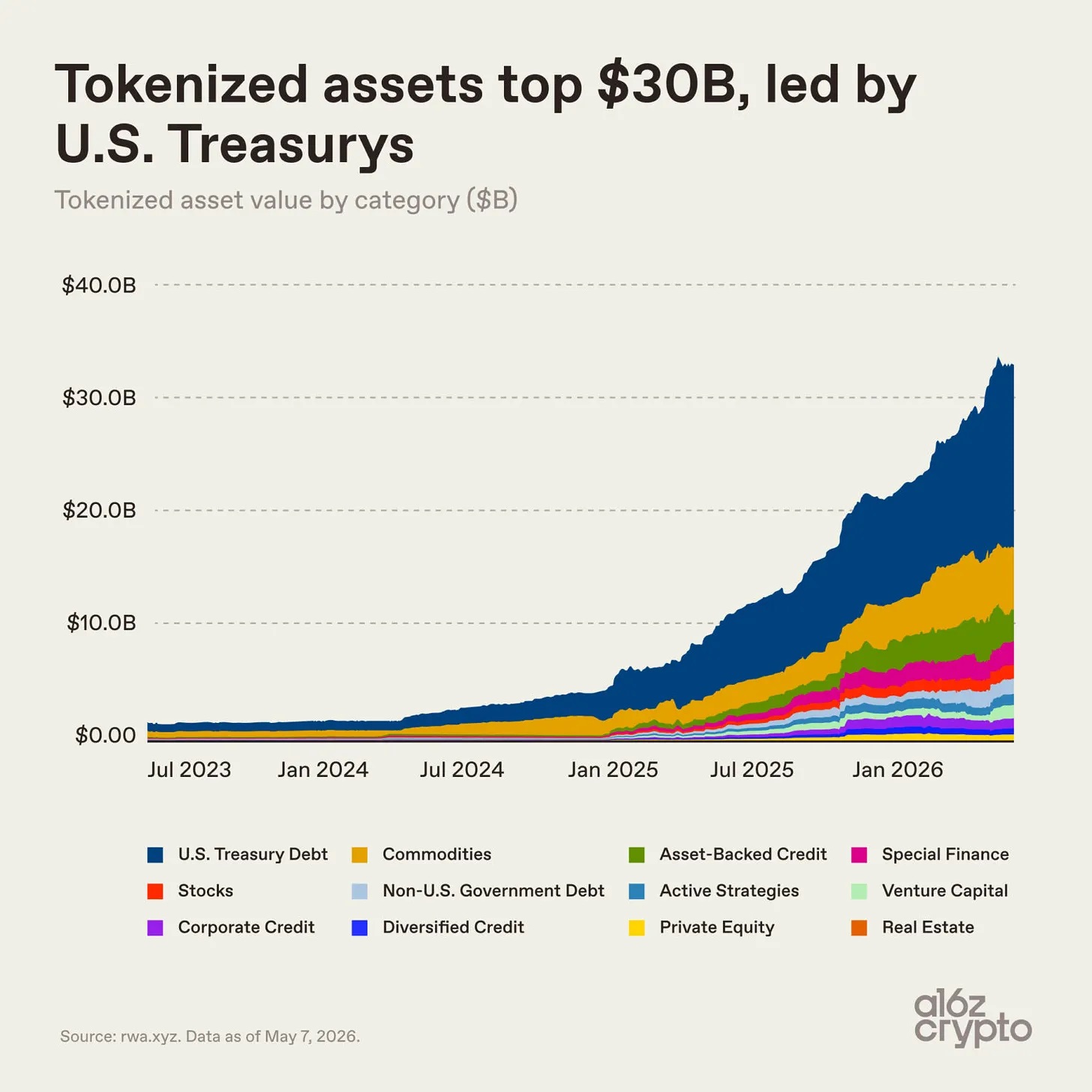
From July 2023 to May 2026, the tokenized assets market surpassed $30 billion, with tokenized U.S. Treasuries serving as the dominant growth engine
For crypto investors, tokenized Treasuries unlock idle stablecoin capital while enabling holders to earn traditional money-market yields. Asset managers including BlackRock and Franklin Templeton swiftly responded to market demand, building multi-billion-dollar trading markets around this asset class.
Growth rates across tokenized asset categories vary significantly—reflecting both differences in technical complexity for onboarding each asset type and early market adoption speed.
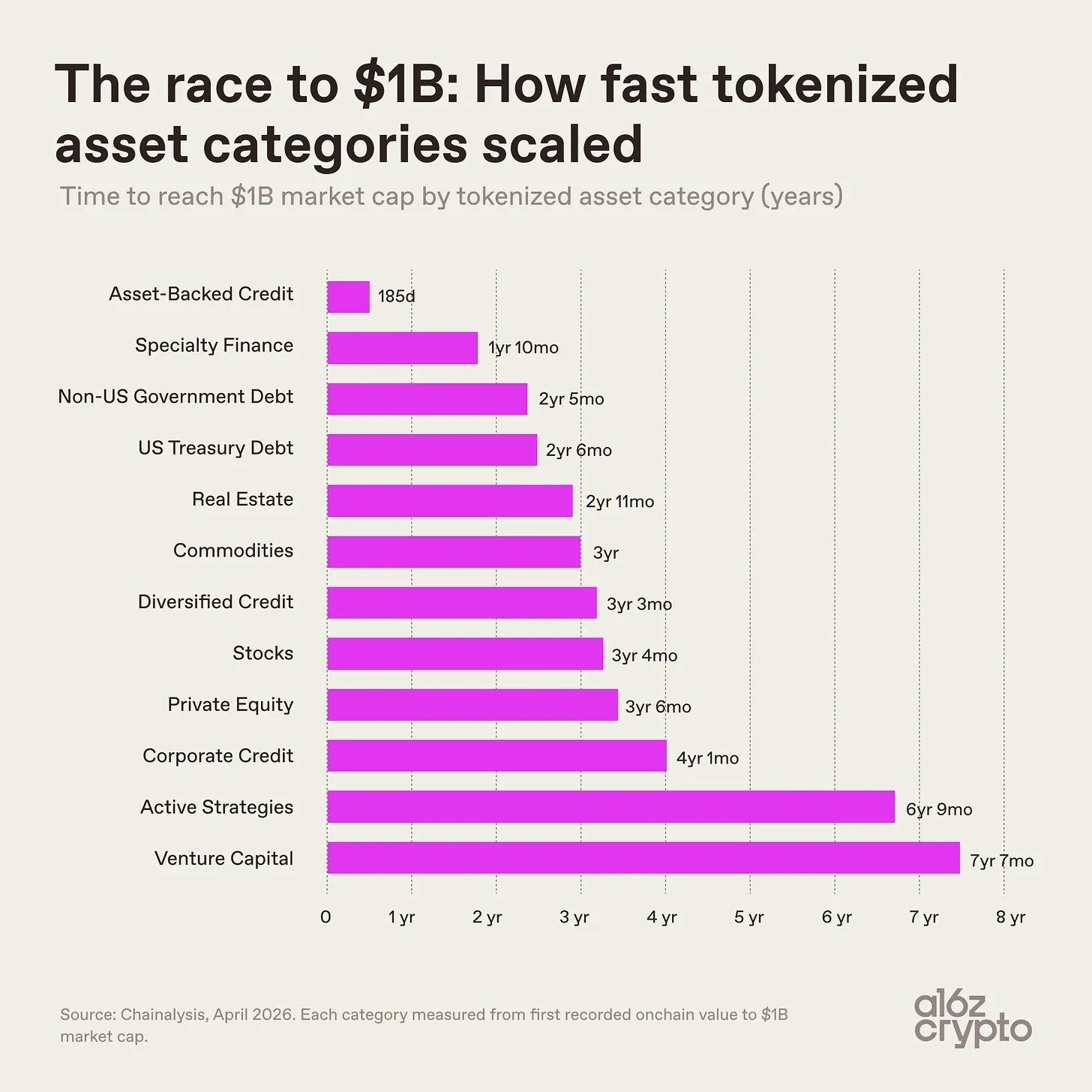
Time required for different tokenized asset categories to reach $1 billion in market value after first onchain record
Asset-backed credit leads all categories, encompassing tokenized home equity lines of credit (HELOCs), lending pool tokens, and similar instruments. This category reached $1 billion in market value just 185 days after its first onchain transaction.
Tokenized reinsurance contracts and Bitcoin mining notes—specialized financial assets—rank second, achieving $1 billion in under two years.
In contrast, venture capital–backed assets took over seven years to reach $1 billion, with actively managed strategies following a similarly protracted path. These assets feature complex structures, long investment horizons, and heightened operational and compliance challenges.
Government bonds and commodities fall into the mid-tier, taking two to three years to cross the $1 billion threshold—and have now become mainstream categories. At the start of 2024, these two categories nearly monopolized the entire tokenized market.
Since 2024, market shares for asset-backed credit, specialized finance, equities, and actively managed strategies have grown steadily—but the sector remains highly concentrated. Currently, tokenized U.S. Treasuries and commodities collectively account for approximately two-thirds of total market share.
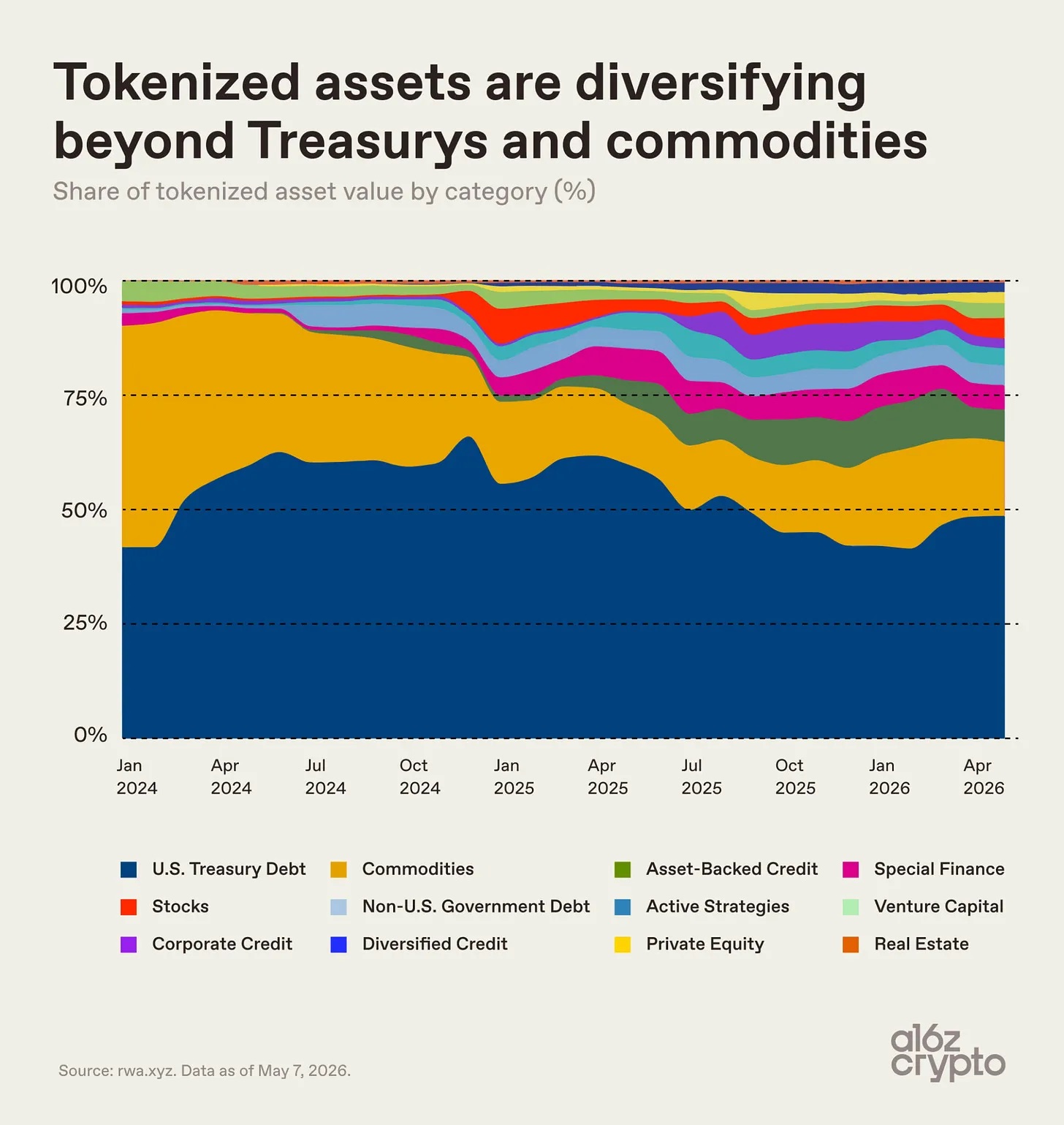
The composition of the tokenized assets market is shifting—from dominance by U.S. Treasuries and commodities toward greater diversification across asset-backed credit, specialized finance, and other categories
Deep Dive Into the Tokenized Assets Market
Within commodities, market concentration is extremely high: gold accounts for nearly the entire share. Total commodity market value stands at ~$5.1 billion, of which gold-backed tokens represent $5 billion. Silver and other commodities total only $57.6 million—just 0.01% of the total.
Gold possesses inherent advantages for tokenization: globally standardized, easy to store, resistant to degradation, and historically traded via paper certificates. Crypto investors have long favored gold; even before gold tokens existed, Bitcoin earned the moniker “digital gold.” Products like Tether’s XAUT and Paxos’ PAXG migrate traditional gold ownership onto blockchain—converting physical gold rights into onchain tokens storable in digital wallets.
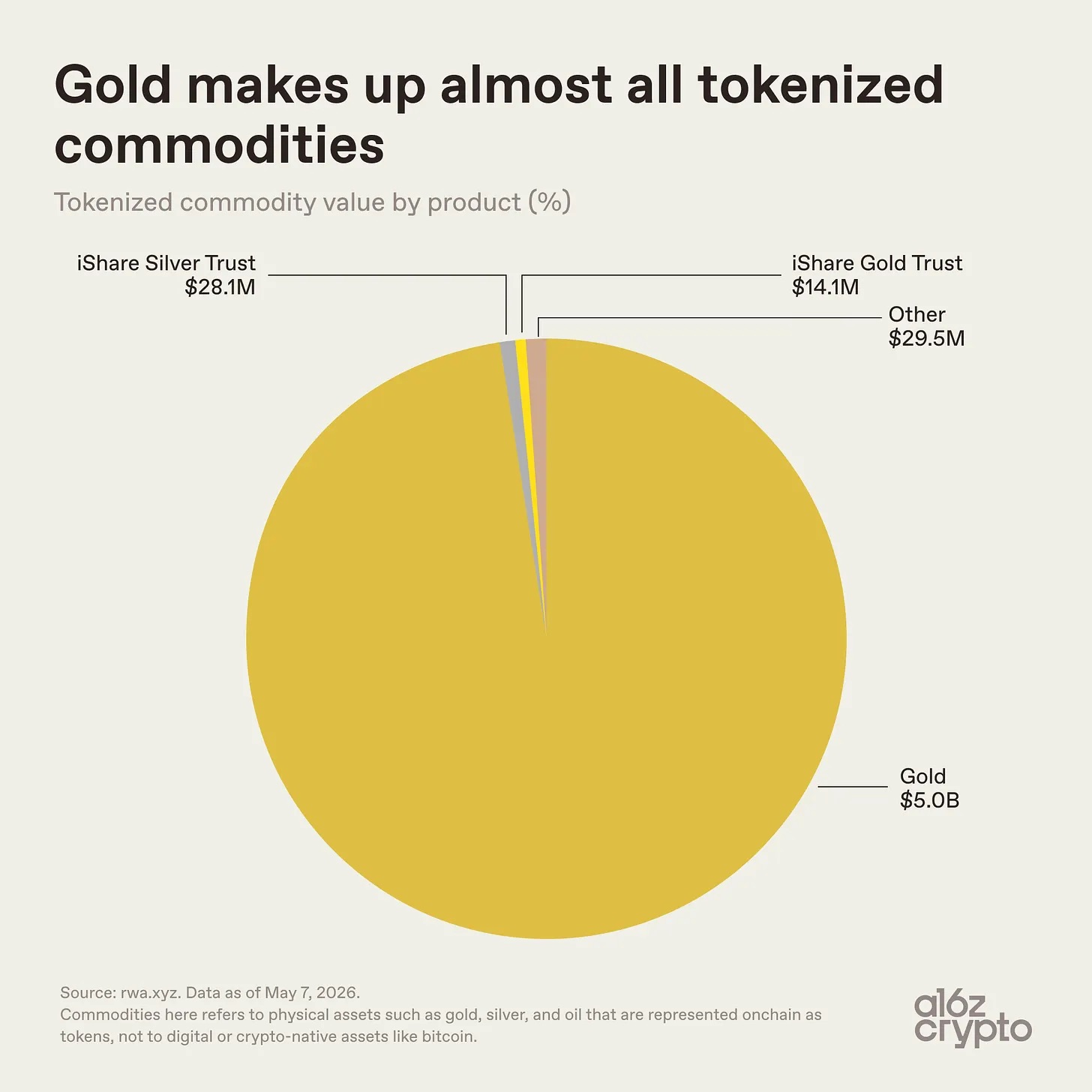
Among tokenized commodities, gold commands nearly the full market share ($5 billion), while silver and others occupy negligible portions
Oil, agricultural products, and emerging tokenized categories—including energy and compute—represent tiny fractions of the market. Their ecosystems remain immature. For now, the tokenized commodities market is effectively synonymous with gold.
Across underlying blockchains, the landscape is far more diversified. Ethereum maintains its leadership position—leveraging its first-mover advantage in decentralized finance (DeFi) and mature institutional ecosystem—to host $15.7 billion in tokenized assets, representing over half the total market value.
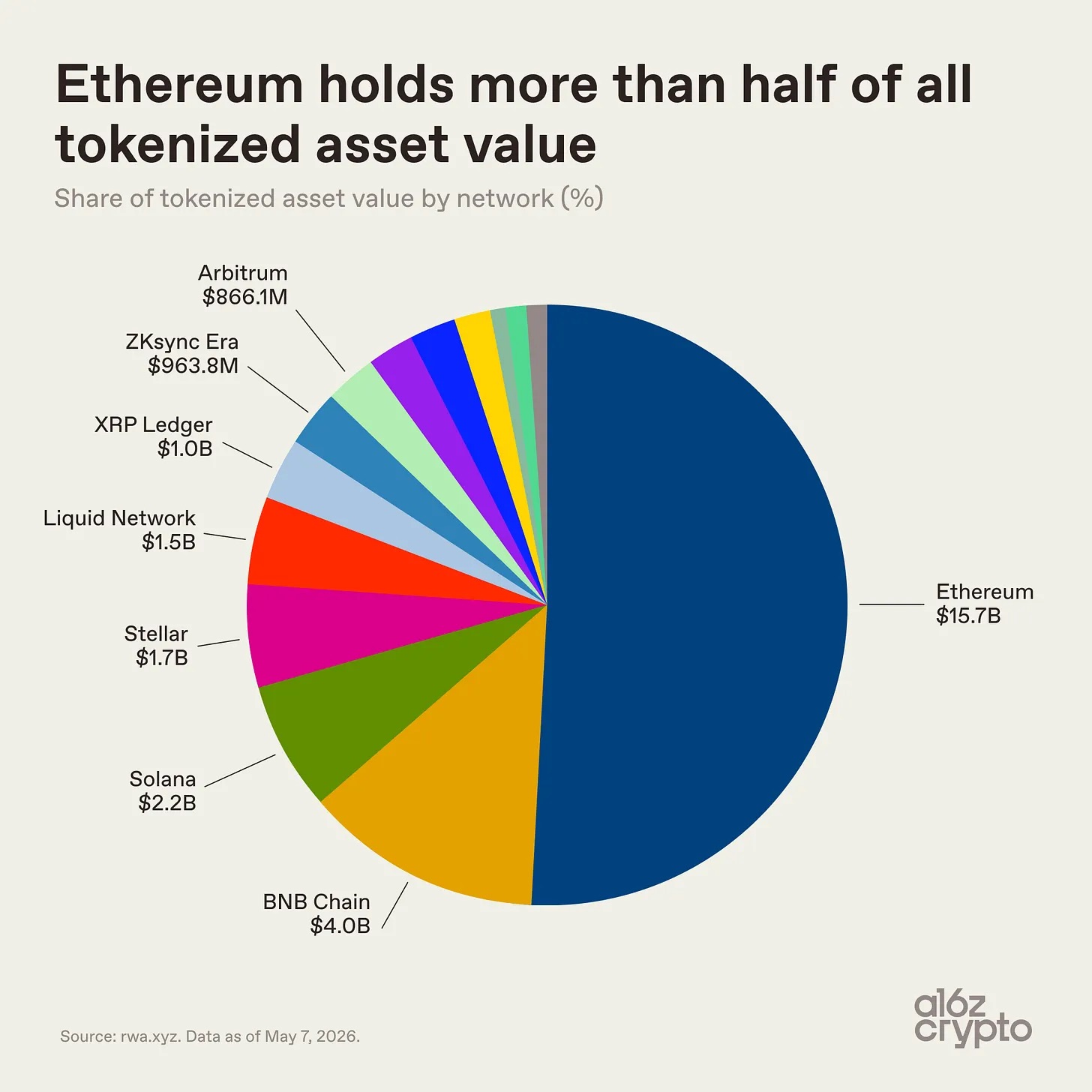
Ethereum hosts over half the tokenized assets value ($15.7 billion); other public chains—including BNB Chain and Solana—trail far behind
The remainder is distributed across multiple chains: BNB Chain hosts $4 billion; Solana, $2.2 billion; Stellar, $1.7 billion; and the Bitcoin sidechain Liquid Network, $1.5 billion. The XRP Ledger, zkSync Era, and Arbitrum each host approximately $1 billion.
Driven by factors including operational costs, market liquidity, regulatory compliance, and commercial partnerships, tokenized assets are not siloed on any single chain—but instead widely distributed across major blockchain ecosystems.
A core indicator of industry maturity lies not in market size—but in actual use cases.
Most Tokenized Assets Remain Non-Composable
Bonds constitute the largest tokenized asset category by market value ($15.2 billion)—yet only ~5%, or ~$800 million, flows into DeFi protocols for composability and reuse.
Precious metals tokens show similarly low utilization: most are held passively onchain and rarely serve as modular, composable components—enabling functional extension, restructuring, or cross-asset interaction.
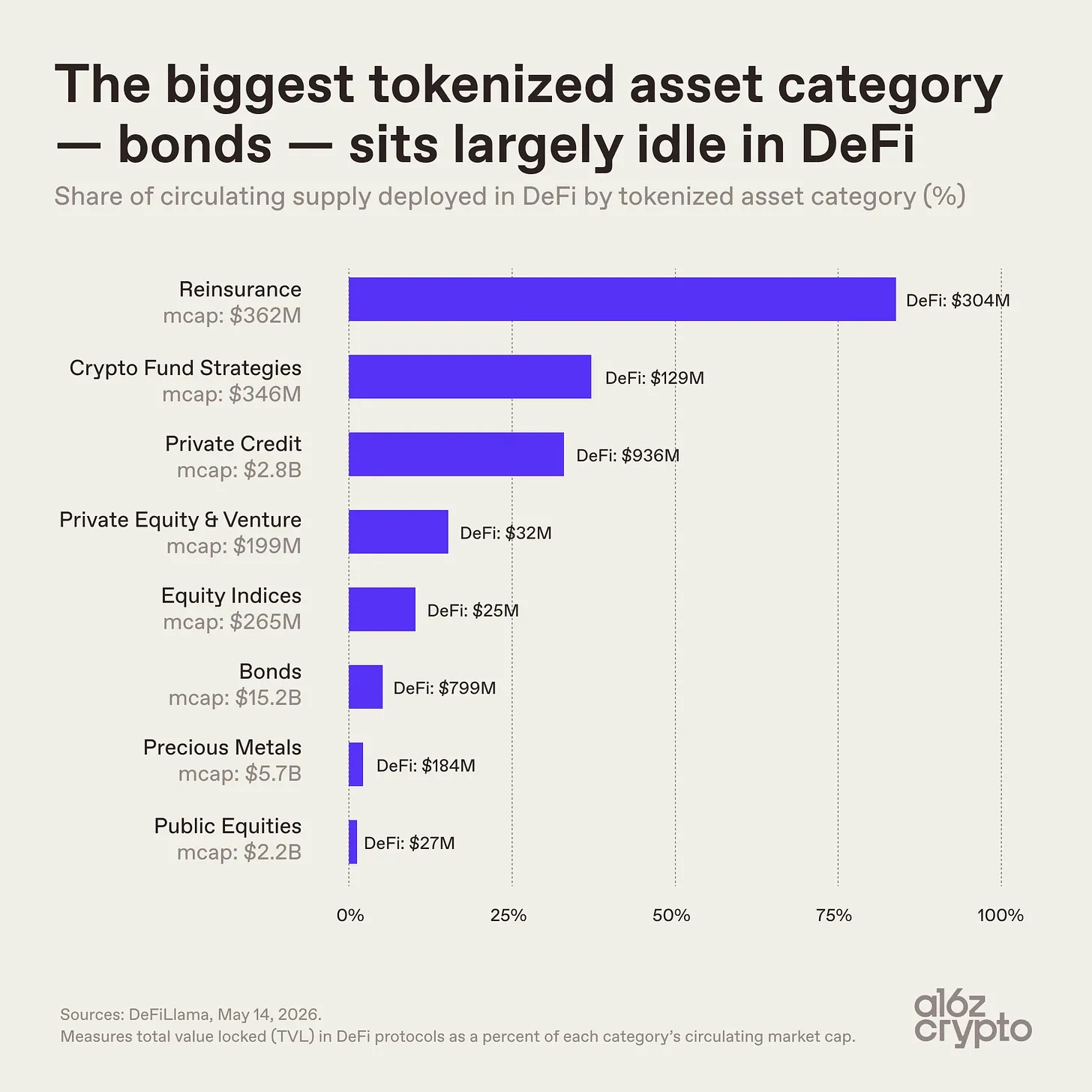
The largest tokenized asset category—bonds—shows extremely low DeFi utilization (~5%), whereas smaller categories such as reinsurance tokens achieve 84% DeFi usage—highlighting that mainstream tokenized assets largely function as onchain records rather than truly composable DeFi primitives
Niche categories behave differently. Reinsurance tokens ($362 million market cap) see 84% deployed in DeFi; private credit tokens reach 33% DeFi utilization.
The reason is straightforward: high-utilization assets were designed from inception to conform to onchain composability standards. In contrast, mainstream tokenized assets—such as Treasuries and gold—were built solely to simplify onchain holding and transfers, without altering their underlying operational logic.
This divergence reveals an industry split: tokenized assets lack uniform native onchain properties.
Some tokens support unrestricted transfers and plug seamlessly into diverse onchain applications; others treat blockchain purely as a ledger—with transfers and composability heavily restricted.
Much current tokenization amounts to mere digitization: recording asset metadata onchain—without unlocking composability. Composability is the defining value proposition of onchain finance—and its realization will determine the industry’s ultimate ceiling.
Multiple institutions have developed onchain-native assessment frameworks—and all reach the same conclusion. Pantera Capital’s Token-Native Index shows over three-quarters of tokenized assets score at the lowest tier for native onchain properties. These tokens are essentially digital certificates—their underlying physical assets continue to be managed via offchain ledgers and intermediaries.
“Synthetic” tokens that merely replicate offchain assets onchain—and truly native onchain assets engineered to leverage blockchain’s unique features—remain worlds apart. This gap underscores the industry’s early-stage status.
Both the technical architecture and asset classes needed for composability are already available—yet deep integration work has only just begun.
Future Trends in Tokenized Assets
While institutions differ in projected market sizes, they converge on one outlook: sustained, rapid expansion.
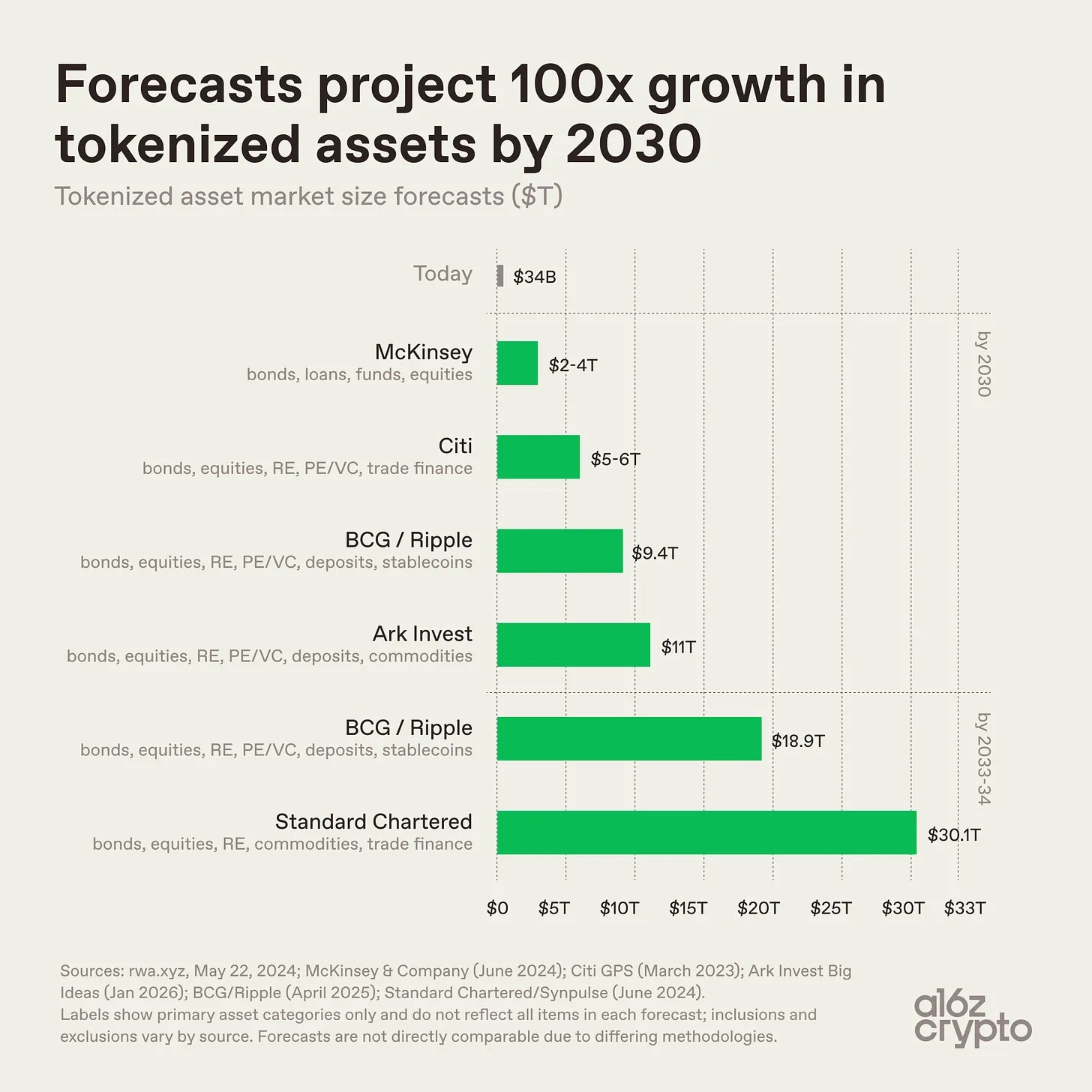
Multiple institutions forecast the tokenized assets market will grow over 100x from its current $34 billion—reaching $30 trillion or more by ~2030
McKinsey’s base-case projection estimates $2–4 trillion by 2030; ARK Invest forecasts $11 trillion; Boston Consulting Group (BCG) and Ripple jointly project $9.4 trillion by 2030 and $18.9 trillion by 2033; Standard Chartered anticipates surpassing $30 trillion by 2034.
All projections imply growth of over 100x from today’s $30 billion baseline. Differences stem not from divergent views on adoption speed—but from varying definitions and scope. Institutions differ in which assets they include (e.g., bonds, credit, funds, equities), whether stablecoins and deposits are counted, and how “tokenization” itself is defined. McKinsey focuses primarily on bonds, credit, funds, and equities; Standard Chartered adds commodities and trade finance; BCG and Ripple include deposits and stablecoins.
Despite methodological variance, every institution agrees: the tokenized assets market is poised for exponential growth.
Globally, today’s tokenized assets remain negligible. The global bond market exceeds $140 trillion—tokenized bonds represent just 0.01%. Global physical gold is worth several trillion dollars—tokenized gold accounts for under 0.02%. The global equity market exceeds $100 trillion—tokenized equities make up only 0.001%.
Yet despite these tiny shares, a nascent tokenized market is clearly established. Assets with transparent pricing, stable demand, and simple ownership structures—like Treasuries, gold, and private credit—have led the way ontochain.
Today’s tokenization does not reshape asset fundamentals—it only changes how assets settle and transfer. Deep integration between tokenized assets and the digital financial system remains in its infancy. Most tokenization achieves digitization alone—not true onchain composability. While assets reside onchain, they fail to function as programmable financial modules.
The next phase brings greater challenges: bringing increasingly complex financial assets onchain—and embedding tokenized assets deeply within an internet-native financial system built for composability.
Join TechFlow official community to stay tuned
Telegram:https://t.me/TechFlowDaily
X (Twitter):https://x.com/TechFlowPost
X (Twitter) EN:https://x.com/BlockFlow_News
 a16z
a16z