MicroStrategy: The life-or-death game of the world's largest Bitcoin whale
TechFlow Selected TechFlow Selected
MicroStrategy: The life-or-death game of the world's largest Bitcoin whale
MicroStrategy's position at the end of 2025 vividly illustrates the opportunities and challenges a company faces when attempting to redefine corporate financial boundaries.
 Navigating Web3 tides with focused insights
By Clow
670,000 bitcoins, approximately 3.2% of the global total supply.
This is the amount of bitcoin held by Strategy Inc. (formerly MicroStrategy) as of mid-December 2025. As the world's first publicly traded company to adopt bitcoin as its primary treasury asset, this former business intelligence software provider has transformed entirely into an "operating entity engaged in structured financial design around bitcoin."
The name change is not merely a rebranding, but the ultimate declaration of its corporate strategy fully pivoting toward a "bitcoin standard."
However, entering the fourth quarter of 2025, amid increasing market volatility and potential changes in index provider rules, this model—called a "revolutionary financial innovation" by founder Michael Saylor—is facing its toughest test since its inception in 2020.
So where does Strategy Inc.'s money actually come from? Can its business model be sustained? And what are its biggest risks?
From Software Company to "Bitcoin Bank"
In 2025, MicroStrategy officially changed its name to Strategy Inc., marking a complete transformation in identity.
The company’s core logic is straightforward: leverage the premium of its stock price over the net asset value of its bitcoin holdings to continuously raise capital and buy more bitcoin, thereby driving per-share bitcoin ownership higher.
In plain terms: as long as the market values MSTR stock above the bitcoin it holds, the company can issue new shares to purchase additional bitcoin, increasing each existing shareholder’s proportional bitcoin exposure.
Once initiated, this "flywheel effect" creates positive feedback: rising stock price → issuing shares to buy bitcoin → increased BTC holdings → further stock price appreciation.
But this flywheel rests on one fatal assumption: the stock price must remain persistently above the bitcoin net asset value. If this premium disappears, the entire mechanism halts abruptly.
Where Does the Money Come From? The Three-Pronged Financing Strategy
There is widespread curiosity about the source of funds enabling Strategy Inc.’s continuous bitcoin purchases. Analysis of filings submitted to the U.S. Securities and Exchange Commission (SEC), particularly Form 8-K, reveals that its financing model has evolved from early reliance on convertible bonds into a diversified capital matrix.
First Prong: ATM Program—the Premium-Capturing Money Printer
The primary source of funding for Strategy Inc. is its at-the-market (ATM) program for issuing Class A common stock (MSTR).
The mechanism is simple: when the trading price of MSTR stock exceeds the net value of the bitcoin it holds, the company sells new shares into the market and uses the proceeds to purchase bitcoin.
During the week of December 8–14, 2025, the company generated approximately $888.2 million in net proceeds from selling over 4.7 million MSTR shares.
The appeal of this method lies in the fact that, so long as the stock trades above bitcoin net asset value, each share issuance "thickens" rather than dilutes existing shareholders’ holdings.
Second Prong: Perpetual Preferred Stock Matrix
In 2025, Strategy Inc. took a significant step forward in capital instrument innovation by launching a series of perpetual preferred stocks designed to attract investors with varying risk appetites.
In a single week in December, these preferred shares raised $82.2 million from STRD.
These instruments are typically structured as "return-of-capital" dividends, offering tax advantages to investors by allowing deferral of tax obligations for up to ten years or more.
Third Prong: The "42/42 Plan"—An $84 Billion Ambition
Strategy Inc. is currently executing its ambitious "42/42 Plan."
The plan aims to raise $42 billion through equity issuance and another $42 billion via fixed-income securities between 2025 and 2027—totaling $84 billion—all dedicated to purchasing bitcoin.
This initiative is an upgrade from the earlier "21/21 Plan," reflecting management’s extreme confidence in the capital markets’ ability to absorb its securities. This scale of capital operation effectively turns Strategy Inc. into a closed-end fund with leveraged exposure to bitcoin, while its operating company structure grants it financing flexibility unavailable to traditional funds.
The Truth Behind "Selling Bitcoin" Rumors
Recent rumors circulating in the market suggest that Strategy Inc. might be selling bitcoin, but such claims collapse under scrutiny of financial data and on-chain evidence.
In mid-November and early December 2025, on-chain monitoring tools (such as ArkhamIntelligence) detected large-scale asset movements from wallets controlled by Strategy Inc. Data showed approximately 43,415 bitcoins (worth about $4.26 billion) transferred from known addresses to over 100 new ones. This triggered panic on social media, causing bitcoin prices to briefly fall below $95,000.
However, subsequent professional audits and clarifications from management revealed this was not a disposal, but routine "custodian and wallet rotation." To reduce counterparty risk and enhance security, Strategy Inc. redistributed assets from traditional custodians like Coinbase Custody to a broader set of defensive addresses. Arkham analysis indicates such operations typically stem from security-driven address refreshing, not asset liquidation.
Michael Saylor, Executive Chairman of Strategy Inc., repeatedly denied the rumors publicly, stating clearly in tweets and a December interview with CNBC: "We are buying—and buying at a very large scale."
In fact, during the second week of December, the company added 10,645 bitcoins at an average price of $92,098 each, directly disproving any sell-off speculation.
Furthermore, the company’s recent establishment of a $1.44 billion USD Reserve demonstrates it does not need to sell bitcoin to pay dividends or debt interest—this reserve can cover at least 21 months of financial obligations.
The Overlooked Software Business
Despite bitcoin dominating headlines, Strategy Inc.’s software business remains crucial for maintaining its status as a public company and covering ongoing financial expenses.
In Q3 2025, software operations generated $128.7 million in revenue, up 10.9% year-over-year, exceeding market expectations.
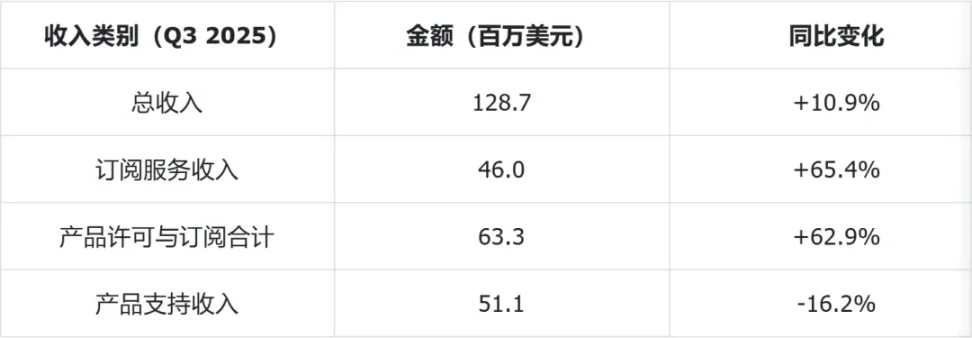
Although subscription revenue grew significantly, due to continued investments in AI research and cloud infrastructure, the business did not generate positive operating cash flow during the first half of 2025. Free cash flow in Q3 stood at -$45.61 million, meaning the company remains operationally unprofitable. Its continuous accumulation of bitcoin is entirely dependent on external financing.
Starting January 1, 2025, Strategy Inc. adopted ASU 2023-08, which requires bitcoin holdings to be revalued at fair value with changes recorded in current net income. This accounting change makes reported profits highly volatile. In Q3 2025, due to rising bitcoin prices, the company recorded $3.89 billion in unrealized gains, resulting in a quarterly net profit of $2.8 billion.
Three Swords of Damocles Hanging Overhead
While Strategy Inc. has used sophisticated financial engineering to reduce short-term forced liquidation risks, several systemic threats could still undermine its foundation.
Risk One: Exclusion from MSCI Index
The most immediate threat currently facing Strategy Inc. stems from MSCI’s review process.
MSCI has launched a formal consultation proposing to reclassify companies with more than 50% of assets in digital assets as "investment vehicles" rather than "operating companies." Given that bitcoin constitutes the vast majority of Strategy Inc.’s assets, if this rule passes, the company would be removed from the MSCI Global Investable Market Index (GIMI).
Such exclusion could force passive funds to sell $2.8–$8.8 billion worth of shares. This massive forced selling would directly pressure its stock price, compressing the NAV premium of MSTR. If the premium vanishes or turns into a discount, the "flywheel" of issuing shares to buy bitcoin would grind to a halt.
Risk Two: NAV Premium Compression and Financing Freeze
The entire logic of Strategy Inc.’s accumulation strategy depends on the market assigning a valuation premium above its net asset value.
Toward the end of 2025, this premium proved highly unstable. In early December, amid concerns over index exclusion, MSTR traded at an 11% discount to the value of its held bitcoin.
When shares trade at a discount, any new equity issuance dilutes existing shareholders’ per-share bitcoin ownership, forcing the company to halt asset accumulation—or even face creditor challenges regarding asset integrity. Strategy Inc. paused its ATM program for the first time in September 2025, highlighting management’s acute sensitivity to valuation multiples.
Risk Three: Debt Burden and Theoretical Liquidation Threshold
As of the end of Q3 2025, Strategy Inc.’s total debt stood at approximately $8.24 billion, requiring around $36.8 million in annual interest payments, plus $638.7 million annually in preferred stock dividends.
While its convertible bonds do not include bitcoin collateral clauses—reducing direct "liquidation" risk during market downturns—extreme declines in bitcoin prices would still strain the company’s ability to service debt.
Summary
Strategy Inc.’s situation at the end of 2025 vividly illustrates both the opportunities and challenges faced by a company attempting to redefine the boundaries of corporate finance.
Its intent to keep accumulating remains unchanged, and by establishing a $1.44 billion USD reserve, the company has built a defensive wall against potential liquidity winters.
Yet Strategy Inc.’s greatest risk does not stem from bitcoin price volatility itself, but from its connection points to the traditional financial system—specifically, index inclusion and NAV premium.
If institutions like MSCI ultimately exclude it from mainstream equity classifications, Strategy Inc. must find a way to prove that, as a "structured financing platform backed by bitcoin," it can maintain growth momentum independent of passive index inflows.
The success of the future "42/42 Plan" will depend on whether it can continue creating yield products attractive to institutional investors within the bitcoin financialization landscape, while maintaining minimal financial credibility through the painful cloud transition of its software business.
This is not just an experiment for one company—it is a microcosm of the entire crypto industry’s integration journey with traditional finance.
In this unprecedented gamble, one thing is certain: no one knows how this story will end.
Join TechFlow official community to stay tuned
Telegram:https://t.me/TechFlowDaily
X (Twitter):https://x.com/TechFlowPost
X (Twitter) EN:https://x.com/BlockFlow_News
 白话区块链
白话区块链