How does Twitter generate "fake traffic"?
TechFlow Selected TechFlow Selected
How does Twitter generate "fake traffic"?
Priority on visibility rather than deep engagement, high exposure over profound reach, is what X and Musk need most.
 Navigating Web3 tides with focused insights
By: Cookie
Earlier this month, CZ and Peter Schiff had an interesting debate on "Bitcoin vs Gold" during Binance Blockchain Week. After watching the debate video, I browsed related discussions about it on X and suddenly noticed something...
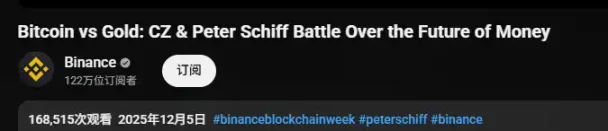
On YouTube, Binance's official channel has 1.22 million subscribers, yet the debate video only received 160,000 views and 5,358 likes:
Meanwhile, a random tweet discussing the topic—like the one shown below—from an account with only about 250,000 followers achieved 517,000 views and over 4,100 likes:

This disparity in metrics is significant. So, is X generating "fake traffic"?
Are View Counts "Inflated"?
X’s method of calculating views differs from what we might expect—it's much more lenient. A view is counted whenever a tweet appears on the screen of a logged-in user's device. This means even if a user doesn’t notice the tweet at all, as long as X’s algorithm pushes it onto their timeline and it appears on-screen—even if immediately scrolled past—it still counts as one view.
This applies not only to recommended content timelines but also to search results and when browsing through all historical posts of an X account—the "scroll-by +1" rule holds true across these scenarios.
Moreover, this count isn't unique per user. If the same tweet appears multiple times on the same user’s screen, each appearance adds another view.
Therefore, if you check the Creator Dashboard on X, you'll see the term used isn’t “views” but “impressions.” X’s view metric primarily measures post exposure rather than actual engagement (such as likes, reposts, or comments), although the latter better reflects genuine interaction.
Is this approach inflated? Well, somewhat—but it's hard to say definitively.
Let’s compare with other social platforms. Threads uses almost the exact same view calculation method, focusing mainly on measuring post reach rather than direct interaction.
In contrast, video-centric platforms like YouTube and TikTok set higher thresholds. For traditional long-form videos, YouTube requires a watch time exceeding 30 seconds for a view to count. Given that long videos are inherently more demanding than short tweets, requiring 30 seconds of viewing seems reasonable. However, TikTok’s short-form videos aren’t too different from X—especially on the auto-playing recommendation feed, where simply appearing on a user’s screen counts as a view, regardless of whether they actually watched it before scrolling away.
The purpose of this seemingly "inflated" counting is to better reflect content visibility. But why emphasize this so much?
Actually, making tweet impressions publicly visible was an update introduced after Elon Musk acquired Twitter. Previously, only the poster could see impression data. Musk himself explained the reasoning behind this change via tweet:
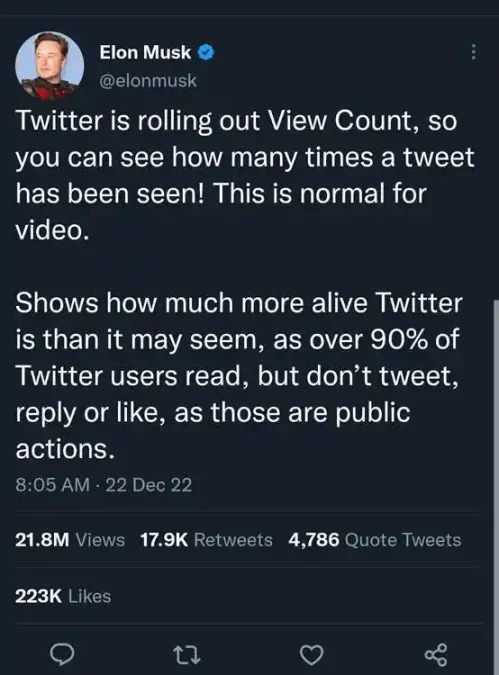
"Twitter is far more active than it appears because 90% of Twitter users only read without posting, liking, or commenting."
Musk also noted in that tweet, “For videos, this is just standard practice.” At the time, Twitter had just been acquired by Musk, followed quickly by mass layoffs and controversy around the “Blue Verified subscription,” leading to widespread mockery declaring “Twitter is dead.”
It’s difficult not to interpret Musk’s decision to open up impression data as partly defensive. After all, even his own AI Grok agreed:

And this sense of inflation may not be purely subjective. According to a Yahoo News report, former Twitter employees said the reason view counts weren't previously public was because “it was hard to tell whether a tweet was genuinely read or merely scrolled past.”
Clearly, defining whether a tweet has been “effectively read” is inherently challenging. While Musk certainly had motivations to push back against criticism, he wasn’t wrong. For tweets, simplifying the metric is necessary—many types of tweets (e.g., memes) don’t require deep user engagement but instead aim for maximum top-of-funnel visibility: attract as many eyes as possible.
Prioritizing exposure over deep interaction, high visibility over deep penetration—this is exactly what X and Musk value most.
Finding "Truth" Within the "Hype"
Of course, if creators focus solely on visibility, they risk falling into another extreme—chasing quantity over quality. Over time, this could lead Twitter into decline due to deteriorating content standards.
Hence, view count alone shouldn’t be the sole key performance indicator for creators. Most creators work hard to produce content with monetization in mind. Income serves as measurable reward, incentivizing high-quality creation. In this context, view count is like a rest station during a marathon—congratulations, you've come a long way ahead of others; keep going.
Driving up views is the first step toward monetization. Yet even with high views, if content fails to attract advertisers—such as relying on sensitive topics targeting niche audiences or short-term trend-jacking—revenue will still remain zero.
On X, the creator revenue-sharing program clearly acts as the compass for finding "truth" amid the "hype." When assessing an account’s real influence, revenue share matters far more than view count. To qualify for revenue sharing, view count is merely a threshold and one of several indicators helping creators craft viral content.
X launched its Ads Revenue Sharing program in July 2023. Former CEO Linda Yaccarino revealed in May 2024 that over $50 million in creator revenue share payments had already been distributed.
To qualify, creators must first meet requirements: verified identity, active X Premium membership, at least 500 X Premium member followers, and a cumulative 5 million views within three months.
But as mentioned earlier, achieving high view counts is just the beginning. Revenue sharing is calculated based on verified (Premium member) interactions such as likes and replies, while also factoring in the impact of different content formats including articles, videos, Spaces, and live streams.
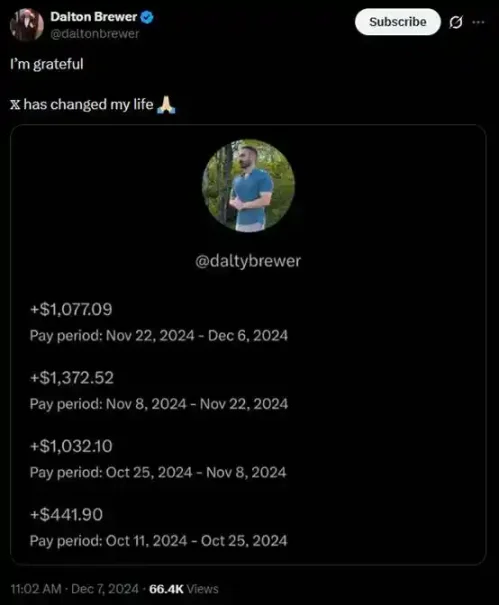
Thus, on X, we can observe a creator with 330,000 followers earning over $2,000 in a month:
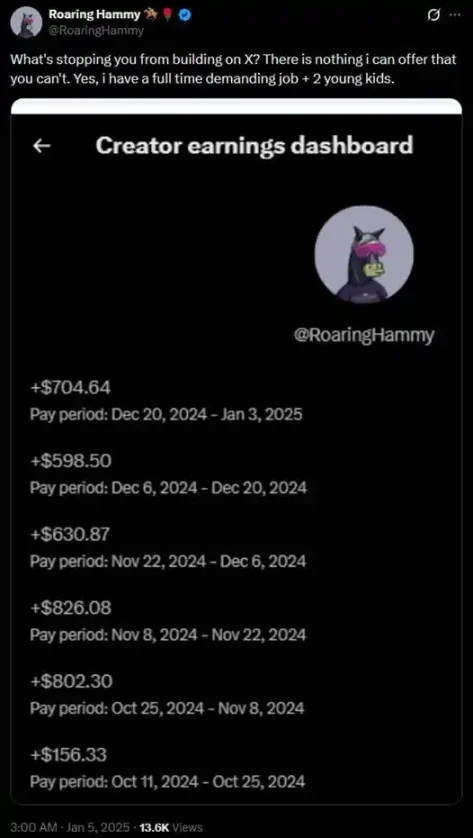
And another creator with only 13,000 followers earning over $1,000 monthly:
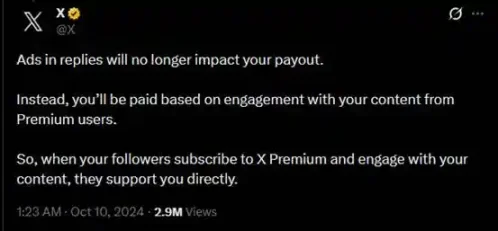
In October last year, X announced that revenue sharing would no longer derive from ad revenue generated in comment sections, but instead from subscription revenue from X Premium members. This move aims to encourage more high-quality creators—let’s grow the pie together: the more people paying for X, the more we can pay creators.
In November this year, X introduced a new feature called "Bangers," which periodically selects outstanding tweets based on authentic engagement metrics and awards selected creators with a "Bangers" badge. Functioning like a "Hall of Fame for tweets," this feature offers another benchmark for identifying authenticity amidst the noise.

Conclusion
Perhaps now more than ever, we see proof that "courage is the most important quality for success." The first step for any creator is "the courage to express oneself"—and this remains the core trait of a capable creator.
Now that livestream commerce and self-media have quietly reshaped work culture for years, we often say, "traffic equals money." But the very first step toward income lies in those incremental +1, +1, +1 view counts behind the screen. By bravely expressing yourself, you’ve already taken your position at the starting line.
Now that you understand how X generates what some call "fake traffic," will you start today to create your own real traffic?
Join TechFlow official community to stay tuned
Telegram:https://t.me/TechFlowDaily
X (Twitter):https://x.com/TechFlowPost
X (Twitter) EN:https://x.com/BlockFlow_News
 BlockBeats