"Legal" Harvesting? The Profit Chain and Scandal Behind the Trumps' Meme Coin Frenzy
TechFlow Selected TechFlow Selected
"Legal" Harvesting? The Profit Chain and Scandal Behind the Trumps' Meme Coin Frenzy
No one wants to take credit for helping the first couple launch a cryptocurrency that plummeted over 90% from its peak.
 Navigating Web3 tides with focused insights
By Zeke Faux, Max Abelson, Bloomberg
Translated by Saoirse, Foresight News
Days before Donald Trump’s return to the White House, George Santos was walking up the steps of the nearby Andrew W. Mellon Auditorium. It was January 17—the opening of presidential inauguration weekend—and the disgraced former U.S. congressman was about to enter a $2,500 “crypto ball.”
Santos strode past a row of tuxedo-clad men into the neoclassical building. Inside, House Speaker Mike Johnson posed for photos with crypto influencers and lobbyists; Donald Trump Jr. filmed TikTok videos. Brock Pierce, child star of "The Mighty Ducks," was there—now co-founder of an $180 billion cryptocurrency firm—while Trump’s political advisor Alina Habba played claw machines. Incoming Treasury Secretary Scott Bessent attended, as did former dating coach Zak Folkman, now one of the Trump family’s crypto business partners.
Before Snoop Dogg took the stage as DJ, attendees pulled out their phones to check announcements from the president-elect on his social media platform Truth Social: he had launched a cryptocurrency named after himself, “TRUMP.” “Have fun!” he wrote. The coin’s price immediately surged. Some at the party fumed they hadn’t bought in early; others suspected the account had been hacked. “This has to be fake,” one crypto founder told a colleague.
But it was real—not in terms of actual investment value, but in authenticity. It wasn't a hack. In fact, it belonged to the category of “Meme coins,” digital tokens built entirely on hype. That same weekend, his wife Melania also launched her own Meme coin, “MELANIA.” The scene resembled the Trumps lining the National Mall with slot machines emblazoned with the “Trump” logo.
Their tokens briefly soared, and within hours, the combined holdings of the Trump family and their business associates surpassed $50 billion in market value. Then prices collapsed, wiping out hundreds of thousands of ordinary investors. According to estimates by blockchain analytics firms Chainalysis Inc. and Bubblemaps SAS, the Trump team may have cashed out over $350 million.
Almost no one walked away satisfied except those few who made massive profits. Critics accused corruption—they believed TRUMP was essentially a scheme allowing foreign investors to anonymously funnel unlimited funds to the incoming president. Crypto traders accused the Trumps of running a scam. Yet the new administration assured the public everything was compliant. “The president and his family have never had, and will never have, conflicts of interest,” White House spokesperson Karoline Leavitt later told Bloomberg Businessweek.
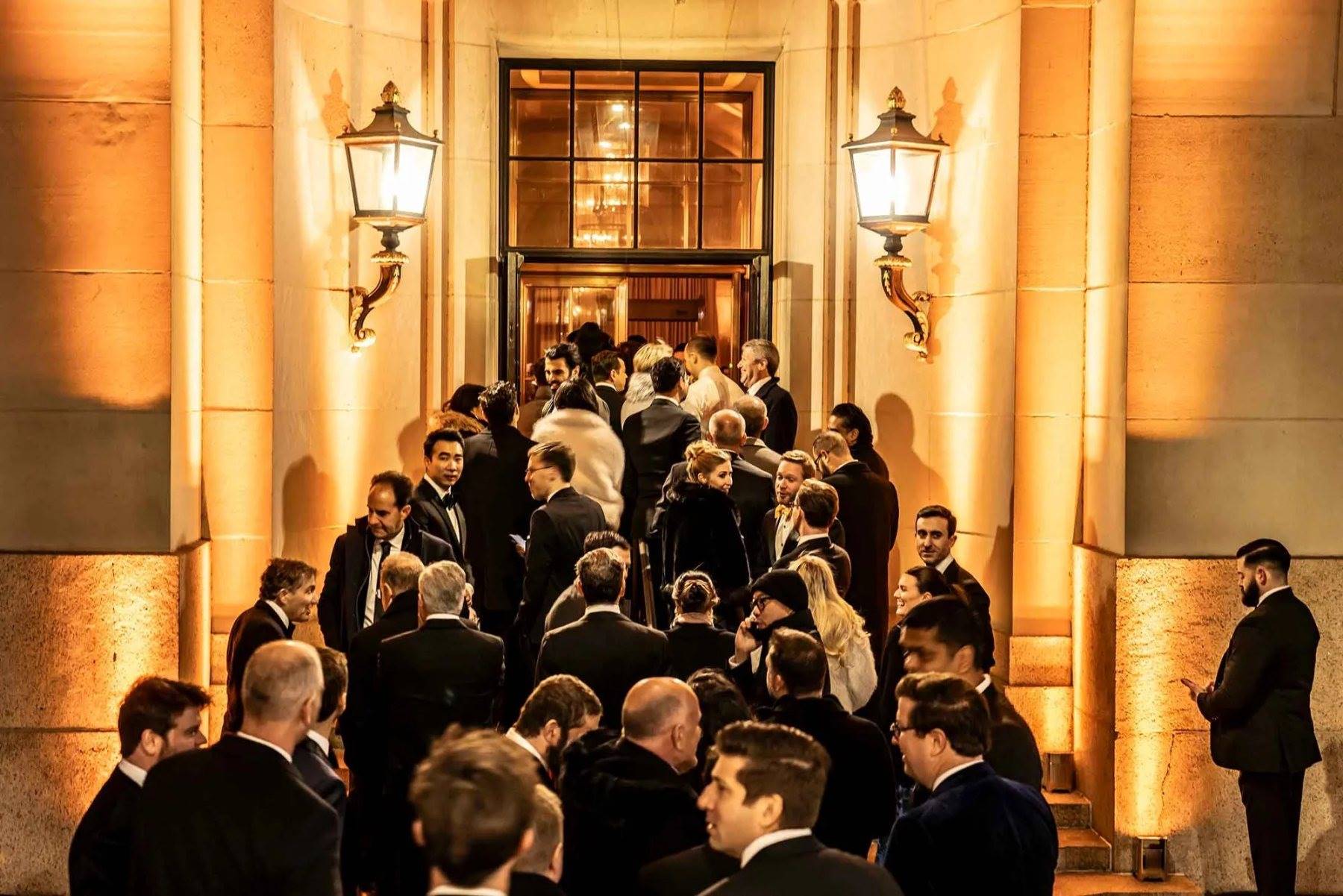
Crypto ball outside Washington's Mellon Auditorium, January 2025. Photographer: Mark Peterson / Redux
Meme Coins: An Unregulated, Nihilistic Gamble
The entire operation unfolded almost in plain sight, yet no one knows exactly how the Trumps launched these tokens. Someone must have explained what Meme coins are and the vast profits they could generate—a senior politician and a middle-aged former model couldn’t possibly create digital tokens on the blockchain alone. But who were their “mysterious partners”? Only they know how the couple extracted massive sums from supporters.
“Other than knowing I launched it, I don’t know anything about it. I just heard it was successful.” —Trump responding to questions about the token during his first press conference as president.
To unravel the mystery, we must start with the origins of Meme coins. This unregulated, nihilistic form of gambling once swept through the crypto world, involving several key figures: a college student founder whose company earned $1 billion from Meme coins; a 29-year-old dubbed “the phantom” who sparked a national scandal in Argentina; and a Singapore-based crypto executive known by the alias “Meow,” whose online avatar is a cartoon cat wearing an astronaut helmet.
Together, they set a new standard for turning hype into cash—and laid the groundwork for this year’s “presidential windfall.” Now that the Meme coin frenzy has faded, it reveals a truth: under a Trump administration relaxing financial regulations, when rules are written by hype-men themselves, markets descend into chaos.
Meme coins began as a joke. In 2013, two software engineers adopted a “shiba dog side-eye” meme—already an inside joke on Reddit and 4chan—as the logo for a new cryptocurrency called Dogecoin. They intended the silly design to mock the flood of Bitcoin-inspired cryptocurrencies, but investors rushed in anyway, pushing Dogecoin’s market cap past $12 million within weeks. Fans even sponsored a NASCAR team, covering the car in Dogecoin ads.
“I really hope people don’t see Dogecoin and think every popular internet meme should become a token,” one Dogecoin founder once worried in an interview.
But that’s exactly what happened. Over the years, while the broader crypto market fluctuated, Meme coins kept multiplying. After Elon Musk began promoting Dogecoin in 2021, the pace accelerated dramatically, spawning countless variants like Dogwifhat, Bonk, and Fartcoin.
Their “success” defied all basic financial principles: even the biggest stock bubbles rest on some optimistic expectation—however flimsy—of a company or industry’s potential. Meme coins had neither products nor cash flows—by traditional valuation metrics, they should be worthless. The only way buyers profit is by selling these “useless tokens” to others at higher prices. Essentially, they’re speculating on speculation itself.
“According to the efficient market hypothesis, this shouldn’t work—but the reality is, it does make money,” said Alon Cohen, co-founder of Pump.fun, in a Bloomberg Businessweek guide titled “How to Meme Coin.” Pump.fun is currently the hottest Meme coin creation and trading platform, and few have profited more than Cohen during this craze. He revealed the platform helped launch around 1,400 Meme coins (excluding the Trumps’), and estimated it collected roughly $1 billion in transaction fees since January 2024.
The 22-year-old Cohen has short black hair and a scruffy beard. Restless in a downtown Manhattan café, he spoke anxiously about fears of having his newfound wealth targeted—crypto-related violent robberies have recently surged. Even though his company’s legal name appears in public records, he refused to disclose where he lives or his firm’s real name.
Cohen opened Pump.fun on one of his three phones to demonstrate how the Meme coin market works: the interface looks crude and retro, filled with flashing pixelated icons, each representing a different token. Creating a token takes just a few clicks—no coding, no paperwork, not even understanding that it trades on the Solana blockchain.
Any trending topic or news event online can become a Meme coin—even tragedies like the “Charlie Kirk assassination attempt” spawned thousands of related tokens. To grab attention, creators livestream absurd stunts: explicit performances, fentanyl use, decapitating live chickens (it’s hard to tell which footage is real). Among the tokens Cohen browsed were names laden with racial slurs. He explained the platform has a toggle to hide offensive content, and a moderation team filters out illegal material.
Buying Meme coins is equally simple: initial prices start at fractions of a cent, rising according to a specific formula as demand grows. Pump.fun’s users are mostly young males and active internet participants who discuss trades on X and Discord. Once a token gains enough traction, it gets listed on major exchanges like Binance or Coinbase, attracting more traders and driving prices higher. Pick the right token, and returns can multiply tenfold—or more—within hours.
Cohen says the platform was designed so “everyone has a fair chance at the next big thing.” “In a way, it’s like a game, right? And you definitely want to play a fair game.”
But many Meme coin traders, creators, and influencers disagree. Interviews reveal a complex world rife with schemes and betrayal, incomprehensible to outsiders. The core conflict is obvious: creators promise to sell fixed amounts of tokens at low prices to attract buyers, but once prices rise, they’re incentivized to dump as much as possible. Common (though non-compliant) tactics include fabricating trading volume to create false activity, secretly paying influencers to simulate organic buzz. If creators remain anonymous, dumps can happen covertly. Regardless of method, the only guaranteed winners are insiders who got in early.
Nobody cares much whether Meme coins are legal. A month after Trump’s inauguration, the U.S. SEC announced it would not regulate them, merely stating “other fraud laws may still apply”—because fraud is fraud, regardless of format. But so far, no other regulators or prosecutors have stepped in.
The dark side of Meme coins isn’t a secret. Except for the most gullible traders, nearly everyone understands the game—but they believe they can exit before the crash and still profit. It’s like “consensual fraud”: unlike the sleazy salesman in *The Wolf of Wall Street* who cold-called retirees to push penny stocks, today investors actively seek out “pump-and-dump” scams.
Celebrity endorsement is powerful for Meme coins, but top-tier stars largely avoid them—perhaps fearing backlash from fans. Before the Trumps, the most famous celebrity Meme coin creators included Caitlyn Jenner, rapper Iggy Azalea, and viral sensation Haliey Welch (“Hawk Tuah” girl).
When their coins crash, celebrities often claim ignorance or blame third-party promoters. “Mine is the only one that isn’t a scam,” Azalea told Bloomberg Businessweek—even though her coin has dropped 99% from its peak last year.
Trump was perhaps the ultimate endorser the Meme coin market could dream of. During his campaign, countless tokens bearing “Trump-style” names emerged—some falsely claiming family approval, others hoping to earn recognition. Clearly, whoever secured his backing would instantly dominate the Meme coin space. Yet when it actually happened, no one claimed credit. The only clue was a company name listed at the bottom of the token website: “Fight Fight Fight LLC,” clearly referencing Trump’s words after being attacked in July 2024.
Mar-a-Lago’s Crypto Business Playbook
Before TRUMP started trading, the president-elect’s Mar-a-Lago estate in Florida was already buzzing with talk of crypto riches. The Trump family had been promoting World Liberty Financial Inc., raising $550 million by selling proprietary tokens. Trump also promised to ease regulations on the crypto industry, which had faced crackdowns under Biden. Several companies donated millions to his inauguration and lobbied to secure favorable treatment under the new administration.
A crypto executive who visited Mar-a-Lago during that time told Bloomberg Businessweek the TRUMP plan was “rushed together just weeks before launch.” The unnamed executive, requesting anonymity due to private discussions, said the Trump team was eager to release the token before inauguration day—they anticipated stricter scrutiny afterward.
The weekend TRUMP launched became the busiest in Meme coin trading history: its price rocketed from near zero to $74. Two days later, MELANIA debuted, peaking at $13. By the next day, both coins had crashed—and never recovered.
Rise and Fall: The Fate of the Trumps’ Meme Coins
Price trajectory of the Trumps’ Meme coins since launch:
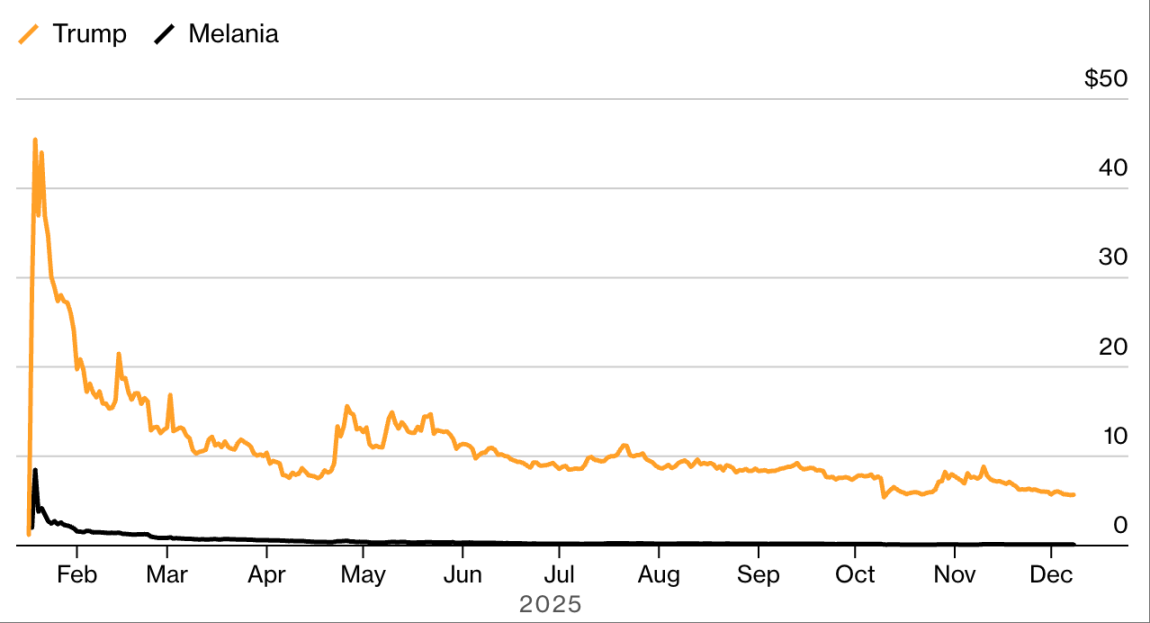
Source: CoinMarketCap; Note: Prices as of 7 p.m. New York time, not reflecting intraday highs
During his first press conference as president, when asked about the tokens, Trump claimed complete ignorance: “Other than knowing I launched it, I don’t know anything about it. I just heard it was successful.” He then asked reporters, “How much money did I make?”
The TRUMP website lists no executives for “Fight Fight Fight LLC,” only a UPS store address across from a tire shop in West Palm Beach, Florida. But in sparse Delaware corporate filings, one “authorized person” emerges: Bill Zanker.
The name is familiar. The 71-year-old Zanker is an entrepreneur who co-authored Trump’s 2007 book *Think Big and Kick Ass in Business and Life*. Over decades, he promoted psychic hotlines, boxing gyms, and chain massage parlors. He rose to fame with Learning Annex, a seminar company offering courses like “How to Open a Greeting Card Store” and “How to Cheat on Your Spouse.” In the 2000s, his “Real Estate Wealth Expos” sold out nationwide, with Trump as the star guest. In 2013, the pair held a press conference at Trump Tower to launch a crowdfunding site—models in white tank tops handed stacks of cash pulled from fish tanks to the audience. Zanker introduced Trump as “the man with the Midas touch, the man with the heart of gold, the man who will change all our lives.” The site ultimately fizzled out.
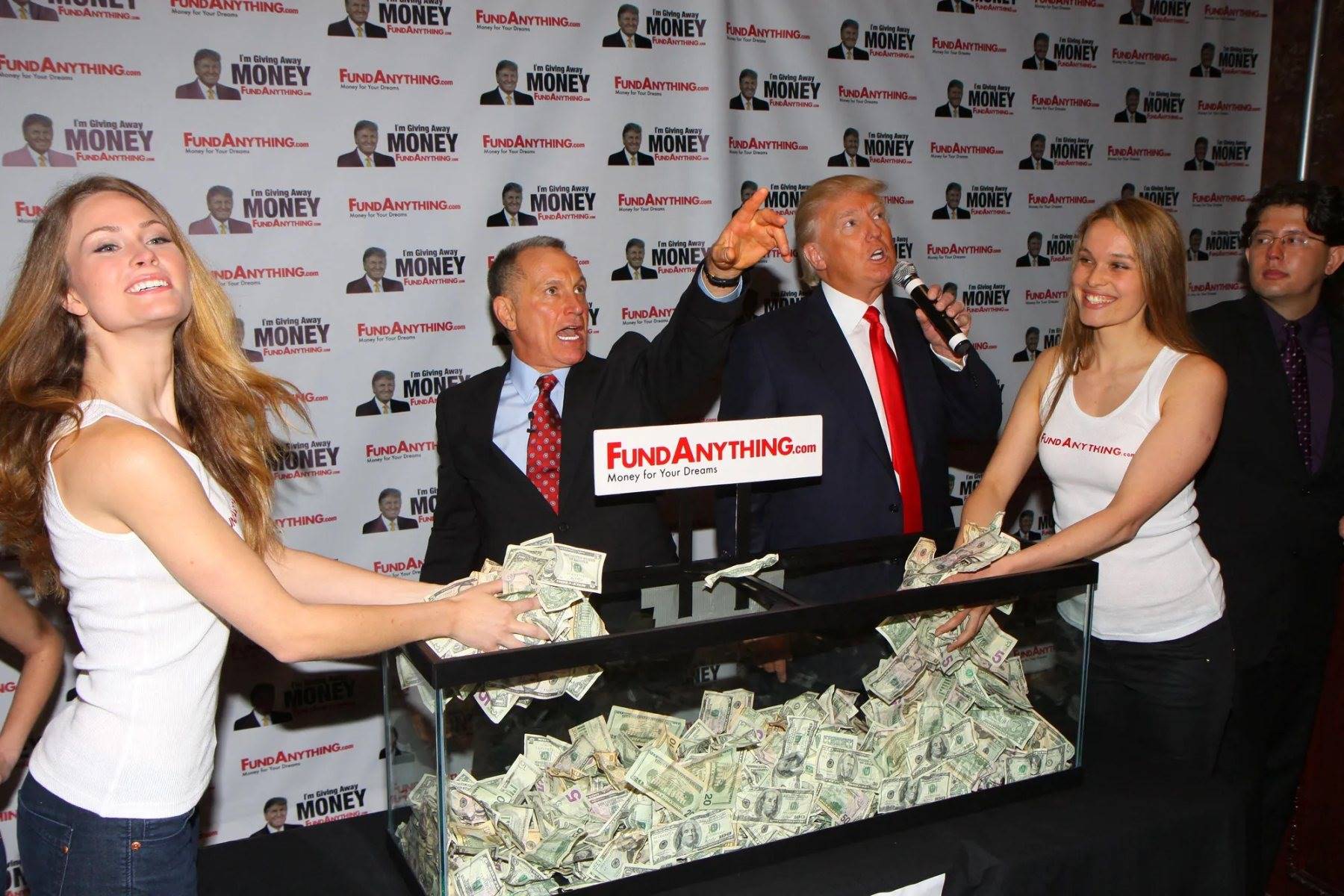
2013: Zanker and Trump promote their crowdfunding site. Photo: WENN/Alamy
In 2022, after Trump faced lawsuits over “financial fraud” and “sexual assault” (which he denies), Zanker brought him a new moneymaking idea: NFTs. They eventually launched “$99 digital trading cards” featuring muscular cartoon versions of Trump posing as a hunter or shooting lasers from his eyes. From that licensing deal alone, Trump earned at least $7 million. During Trump’s 2024 re-election campaign, they partnered again on watches, perfume, and “Never Surrender” sneakers. (After returning to office, Trump reportedly sprayed Syrian President Bashar al-Assad with a $249 bottle of “Victory No. 47” cologne, calling it “the best fragrance.”)
Given this history, Zanker’s involvement in Meme coins isn’t surprising. But the self-made marketer stayed unusually quiet—calls, texts, and emails went unanswered. One crypto investor mentioned Zanker’s son Dylan was involved in the business. Bloomberg Businessweek later spotted Dylan at a Manhattan crypto conference, wearing a Moncler jacket and photographing prominent attendees. When asked about the Meme coins, he replied: “I respect your work, but I don’t do interviews.”
The trail didn’t end there—Zanker himself would soon appear in Washington.
In April 2025, a message appeared on the TRUMP website: “The top holders of TRUMP will have the honor of dining with the president. Will you be among them?” The top 220 buyers were invited to a dinner the following month at the “Trump National Golf Club” in northern Virginia.
Senator Elizabeth Warren (D-Mass.) called the dinner a “corruption carnival.” Many invitees were crypto entrepreneurs hoping to influence policy. The largest holder was Chinese-born crypto billionaire Justin Sun, who purchased $15 million worth of TRUMP. Months earlier, U.S. regulators had paused litigation against Sun for alleged fraud, sparking suspicions of quid pro quo. (Sun denies wrongdoing and is currently suing Bloomberg L.P. over a prior article; the case remains unresolved.)
Hours before the dinner, White House spokesperson Leavitt defended Trump, saying he was attending “in his personal time,” as if clocking out could eliminate conflict of interest. “Suggesting the president profits from his office is absurd,” she said.

May 2025: Sun arrives at the White House. Photographer: Jason Andrew / The New York Times / Redux
That evening, dozens of protesters gathered in the rain outside the golf club. Sun arrived with an umbrella-carrying assistant and three photographers; guests showed ID at security—including foreign passports, giving protesters ample material. As two tuxedoed guests passed, someone shouted: “What’s for dinner, assholes?”
The main course was filet mignon. Zanker attended as host, wearing a blue suit and red tie. At one point, he stepped onto the stage (behind an American flag) holding a magazine with Sun’s face on the cover.
But the hoped-for access to power failed to materialize—one attendee said he saw no one speaking privately with the president. Trump arrived by helicopter, delivered a routine “crypto cheer” speech, and left.
The dinner proved at least one thing: Zanker’s role went beyond “a name on Delaware documents.” Yet the mystery of how the president created and traded digital tokens remained unsolved.
Breakthrough: Argentina’s President and Blockchain Forensics
The breakthrough came a month after the Trumps launched their tokens: another world leader got entangled in a Meme coin scandal—Argentine President Javier Milei. The “chainsaw-wielding, Trump-admiring” president endorsed a token called “Libra” on February 14. Hours later, the price crashed, and Milei quickly deleted his social media post.
Crypto transactions are recorded on a public ledger called the blockchain, leaving traceable footprints. Nicolas Vaiman, co-founder of data firm Bubblemaps and known as a “crypto detective,” told Bloomberg Businessweek he found anomalies in the transaction records of MILEI and TRUMP.
Though blockchain data is pseudonymous, by analyzing “which addresses bought what, when, and where funds flowed,” Vaiman uncovered links: one address bought $1.1 million in TRUMP seconds after launch (clearly with insider knowledge), then dumped it over three days for a $100 million profit. Another address bought MELANIA before its public announcement, making $2.4 million—Vaiman traced this address back to the same person or team behind MELANIA’s creation.
“On Wall Street, this is called insider trading. But no enforcement agency wants to apply such rules to Meme coins. In essence,” Vaiman said, “crime is legal in crypto.”
More intriguingly, Vaiman found network connections between the wallets that created MILEI and MELANIA—and the mastermind behind MILEI had already revealed himself.
Milei’s crypto advisor is Hayden Davis, a dropout from Liberty University in Virginia (a evangelical school), who describes himself on LinkedIn as a “startup expert.” Davis works with his father Tom, who once told the Christian Broadcasting Network he served prison time for check forgery. The pair previously promoted energy drinks for Limu, a multi-level marketing company.
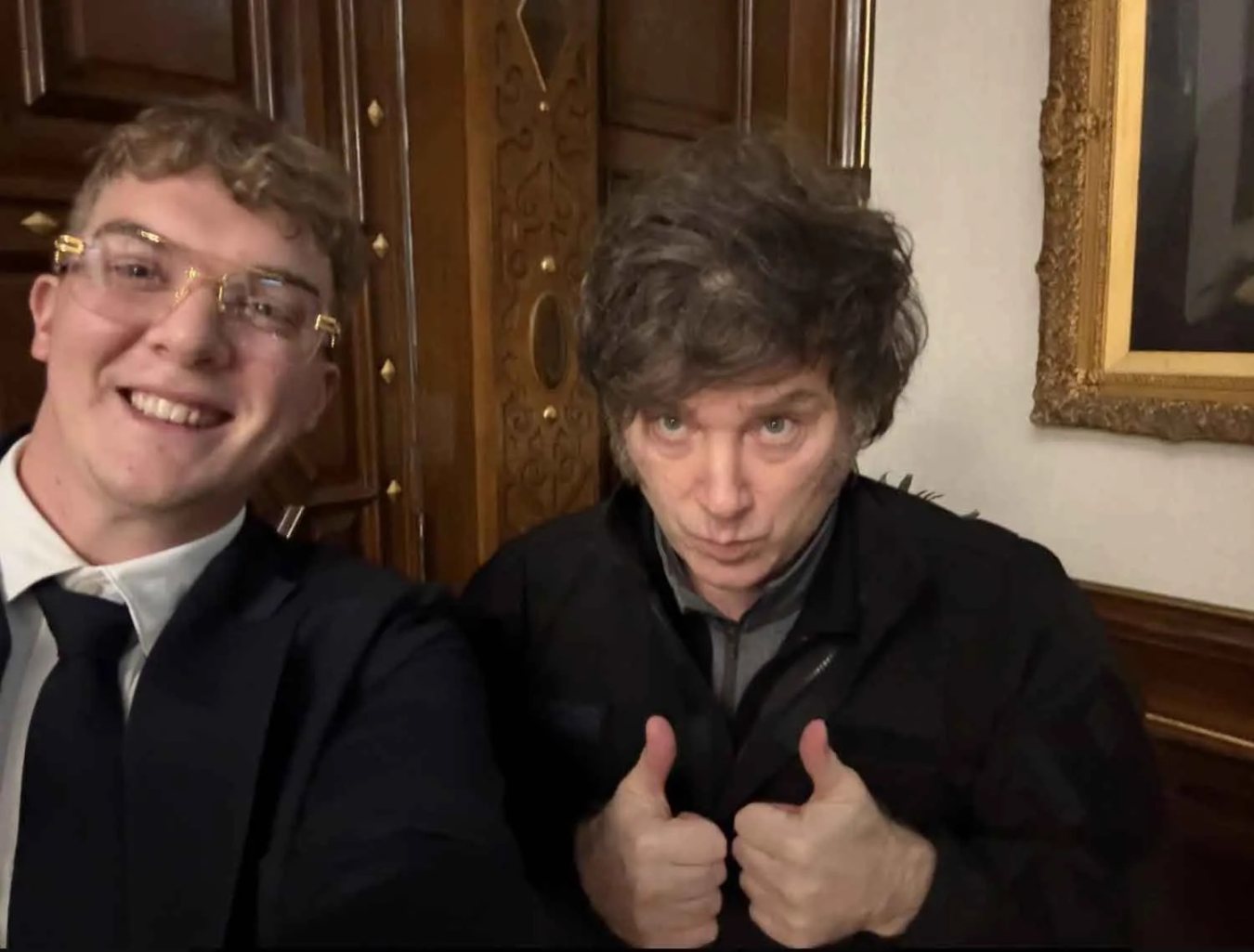
Caption: Hayden Davis with Milei, posted on Milei’s X account. Source: JMilei/X
The Meme coin venture turned the Davises into behind-the-scenes players. They founded Kelsier Ventures, functioning like an investment bank for token launches: advising clients, connecting them with influencer promoters, managing trades. But according to Vaiman’s analysis, their tokens followed a suspicious pattern: insiders dump → price surges → rapid collapse. By his calculations, Davis and his partners netted over $150 million.
More than half came from Libra. When a domestic scandal erupted over the president’s involvement in a pump-and-dump scheme, Davis posted a video admitting he helped launch the Meme coin. “I am indeed Javier Milei’s advisor,” he said. In the video, trying to appear serious, his striped balaclava hoodie, messy golden curls, and oversized aviators made him look nothing like a high-finance professional. Davis admitted earning $100 million from selling Libra but claimed he was merely “holding funds”—which he has yet to return.
The video amplified the scandal. Crypto media CoinDesk published texts allegedly sent by Davis to accomplices: using racial slurs to refer to Milei, saying “He signs whatever I say, does whatever I tell him.” Amid calls for impeachment, Milei denied responsibility on TV, arguing: “It’s like Russian roulette—you lose, you blame yourself.” (Davis’s spokesperson told CoinDesk he “doesn’t recall sending the message, and has no record on his phone.”)
Meanwhile, Davis gave an interview to YouTube anti-scam influencer Stephen Findeisen (aka Coffeezilla), admitting the Meme coin industry he helped promote “isn’t honest.” “Meme coins are unregulated casinos. Other cryptos aren’t much better,” he said. “It’s all bullshit.” Davis described a tactic called “sniping”: experienced traders use insider info to buy massive amounts of a new token at launch, then sell when retail investors follow. He admitted his team did this too, but claimed it was “defensive—to prevent others from sniping retail investors faster.”
In the interview, Davis first acknowledged involvement in MELANIA’s launch, though he didn’t specify his role and insisted he “didn’t profit.” “I did get involved,” he said awkwardly, urging retail investors to “stay away from Meme coins to avoid getting scammed.” “TRUMP, MELANIA, LIBRA… you can keep listing them. They’re all games.”
Bloomberg Businessweek also reviewed another key piece of evidence: text screenshots showing Davis messaging allies after TRUMP launched but before MELANIA was public. In the messages, Davis revealed “MELANIA is coming soon,” promised to “tip off friends,” and mentioned the then-secret “MILEI plan.” He boasted of earning “astronomical money” from launching Meme coins and hinted at TRUMP: “TRUMP gave me unprecedented power—and huge risk.”
When Bloomberg Businessweek tried to follow up, Davis refused to respond. “Most reported details are ridiculous and false,” he texted. “I’ll clarify once I’ve sorted all facts.” (Lawyers for the Davises said the magazine’s questions contained “numerous inaccuracies,” without specifying which.)
Whistleblower Emerges: Connecting the Exchange Executive
Luckily, one of Davis’s former associates stepped forward as a whistleblower—and revealed Davis wasn’t the true mastermind.
Shortly after Milei’s Libra coin collapsed, Moty Povolotski, co-founder of crypto startup DefiTuna, publicly stated his company had worked with Davis on Meme coin launches and possessed evidence of a “larger conspiracy” involving a crypto exchange executive. Though Povolotski’s account was somewhat chaotic, he was the only one willing to expose the truth. In April 2025, he agreed to meet at the “Solana Crossroads” crypto conference in Istanbul (his home city).
Povolotski wore black jeans and a DefiTuna hoodie, with a square head, crew cut, and bright smile. He was blunt: “Most Meme coins are scams. It’s a rigged game—pure pump-and-dump.” As he spoke, he nervously snapped his AirPods case open and shut.
Yet he participated anyway. Povolotski revealed Davis hired his company to “assist with Meme coin trades”—not inherently suspicious, as most token issuers hire experts to ensure smooth early trading. But from the start, Davis’s sole goal was clear: “to make money for himself.” Povolotski recalled his former partner asking Davis in a group chat how to handle trading for an upcoming token. Davis replied: “Sell as much as possible, even if the price drops to zero.” “Guys, let’s be honest—we’re here to extract maximum profit from this token,” Davis texted.
MELANIA was handled similarly: Davis transferred about 10 million tokens to Povolotski’s partner, instructing them to “sell once market cap hits $100 million,” and emphasized “it must be done anonymously.” “They said, ‘Must sell anonymously,’” Povolotski recalled with a laugh.
Two weeks later, Povolotski visited Davis in Barcelona—where Davis was launching another Meme coin, ENRON, named after the energy giant that collapsed in an accounting scandal two decades prior. At a hookah bar, Povolotski saw Davis’s father show off “an automated program” to “secretly snipe ENRON.”
Povolotski said his former partner was “the main person handling trades for Davis,” and after witnessing this in Barcelona, he severed ties. (His partner Vlad Pozniakoff did not respond to messages; his old number is disconnected.)
When asked about Davis’s other partners, Povolotski named a key figure: an executive at crypto exchange Meteora. He explained Meteora holds the key to why the Trumps made money so fast—the platform is larger and more customized than Pump.fun, not exclusively focused on Meme coins, yet TRUMP, MELANIA, and LIBRA all launched there.
Meteora’s co-founder is Meow, the man with the astronaut-cat avatar. Colleagues say Meow, though lacking a formal title, runs the exchange. Povolotski added that when he first met Davis at a Singapore party in September 2024, it was Ben Chow, then CEO of Meteora, who introduced them. Ben Chow seemed deeply involved in the exchange’s “major Meme coin launches,” and Davis frequently referenced “Ben’s instructions” in texts and calls.

2023: Meow at Solana Crossroads. Source: YouTube
Confrontation and Silence: Ben Chow Resigns, Meow’s Identity Unraveled
After MILEI collapsed, Povolotski confronted Ben Chow. He shared a recorded video call with Bloomberg Businessweek—in it, Povolotski directly accused Davis of running a pump-and-dump scam and suggested Chow and Davis were collaborators: “Davis always says, ‘Oh, Ben said this,’ ‘Ben told me to do that,’ ‘Ben said the token is launching,’ ‘Ben said she’ll tweet about it.’”
In the video, Chow looked shocked hearing accusations of fraud. “I’m devastated,” he groaned. But he didn’t deny close ties to Davis and admitted introducing him to clients. “I was just making introductions, right?” Chow said. “You know, the Melania team needed help, so I connected them with Hayden Davis.”
If Chow and Meteora facilitated the Melania launch, did they play the same role for Trump’s token? Povolotski wasn’t sure, but he told Bloomberg Businessweek he didn’t believe Chow’s claim of ignorance. “It’s all bullsh*t,” he scoffed, waving dismissively.
Povolotski said after the call, he reached out to Meow for answers. When Meow ignored him, Povolotski shared the video with crypto media SolanaFloor. Amid the backlash, Chow resigned. (Chow and his lawyers declined to comment.)
Bloomberg Businessweek asked Povolotski whether Meow knew who orchestrated the Trump tokens and how they generated massive profits. Povolotski fell silent. For a full 15 seconds, his expression and body language shifted constantly—grinning, raising eyebrows, spreading hands, shrugging, staring, then shrugging harder—clearly restraining himself from revealing something. Finally, he just raised both hands and smiled.
It was time to find Meow himself.
Meow Revealed: Singapore Entrepreneur Ming Yeow Ng and His Financial Utopia
Finding Meow wasn’t hard. In Meme coin circles, he’s a minor celebrity: co-founder of Meteora exchange and developer of Jupiter, a popular crypto trading app. Earlier this year, Bloomberg Businessweek reporters stumbled upon him in an online chat room—where TV personality Nick Cannon was promoting a Meme coin for his improv comedy show *Wild’N Out*.
“If you get enough attention, you can make big money—but it’s a double-edged sword,” Meow said in the chat. “Theoretically, we’re building a whole new financial system. But at the same time, you attract the worst people in the world.”
“We’re talking to the big boss!” Cannon later exclaimed excitedly. Days later, the token crashed.
Right after Trump’s inauguration, Meow hosted a conference in Istanbul drawing over 1,000 attendees. He named it “Catstanbul”—essentially a celebration, perhaps Davis’s victory lap after profiting from Trump’s token. Texts reviewed by Bloomberg Businessweek show Davis claimed he was “with Ben Chow and Meow 24/7.”
The climax of “Catstanbul” was the burning of a 15-foot (4.6-meter) cat sculpture—inspired by Burning Man. The cat’s eyes glowed red in the firelight as Meow posed for photos with fans.
On his personal website and podcast, Meow often philosophizes about the “free crypto market” he helped build. He envisions a “Giant Unified Market” (GUM), where anyone can trade any asset. He believes creating new currencies is key to a “more equal future.” In one article, he argues Meme coins aren’t scams but “pioneers of a new era of digital connection and cultural expression.” In another, he compares launching a cryptocurrency to “founding a religion”: “Creating a new religion or god requires only a new symbol, supported by a community and story,” he wrote. “And I find that fascinating! Why should warlords monopolize nation-building, or central banks control money issuance?”
Though Meow cultivates an “anonymous” image, his real name is searchable online. His personal website lists startups he advises, one of which disclosed his identity in a press release, leading to traces of his abandoned social media accounts. Ultimately, Meow was identified as Ming Yeow Ng, a Singaporean in his 40s.
Face to Face with Ming Yeow Ng: “The Dollar Is a Meme Coin” and the “Baby in the Bathtub” Analogy
After exchanging texts about Meme coins and presidential tokens (including a photo of his pet cat), Ng agreed to meet. Bloomberg Businessweek proposed meeting at a cat café near his Chinatown office in Singapore.
Ng arrived in a T-shirt, linen pants, and flip-flops, limping—he’d just returned from Nepal, where he twisted his knee hiking with a YouTuber who also gave him hallucinogenic “mad honey.” At the café, young patrons played with lazy cats. Ng eagerly discussed a new article he was writing, arguing “all financial assets are essentially Meme coins” because their value rests on “shared belief in something.” To him, even the dollar fits. “The dollar is a Meme coin,” Ng slammed the table, eyes wide. “Everything is a Meme coin!”
Ng grew up in Singapore, where his parents ran a food stall. He studied computer engineering there. In the late 2000s, he developed a service called “Mr. Tweet” in San Francisco—filling a gap before Twitter (now X) had a “suggested users” feature. Back then, he went by “Steve.”
Ng said he first learned about crypto at a “Dogecoin-themed party” and became obsessed. In 2021, he launched a crypto app called “Mercurial Finance,” funded by Sam Bankman-Fried’s hedge fund. After Bankman-Fried was exposed for running a massive fraud, Ng renamed the app “Meteora.” In one article, he expressed regret for “staying silent about the garbage I saw” and for “blindly participating” in what he called “dirty business.”
Meteora allows issuing and trading various cryptocurrencies, not just Meme coins. But the Meme coin boom greatly enriched Ng. According to Blockworks, about 90% of the exchange’s $134 million in revenue over the past year came from Meme coin trading—which typically charges higher fees. Ng says Meme coins are more “pure” because they reflect only “value assigned by users based on belief,” nothing else. “I have zero interest in moralizing,” he said. “I focus on observable phenomena. For example, if you bought Fartcoin months ago, you can now buy more with it than before.”
Evasion and Justification: “Technical Support” and “Don’t Throw the Baby Out With the Bathwater”
When the conversation finally turned to the Trumps, Davis, and his company’s role, Ng grew quiet. “Would you believe me if I said it’s actually way more boring than you think?” he said, frowning with discomfort.
He admitted someone from the Trump team (who wished to remain unnamed) contacted Meteora before the token launch seeking technical support to build the token. But he stressed Meteora provided only “technical assistance,” with no involvement in trading or wrongdoing. “Absolutely no backroom deals.”
Ng said his decentralized platform aims to “let anyone issue any token,” not regulate issuers’ intentions. Innovations like Bitcoin could never emerge under strict regulation. “There are things we truly can’t and shouldn’t control,” he said, as a gray-and-white cat climbed onto a railing and pawed at his phone.
He argued it’s unfair to label the entire crypto industry a “scam”—like the old saying, “don’t throw the baby out with the bathwater.” He expanded the metaphor: “The bathtub might contain dog shit, baby poop, even E. coli—but maybe there’s actually a baby in there. My point is, the ‘baby’ exists.”
By this vivid analogy, promoters like Davis—who flood the market with rapidly collapsing tokens—are clearly the ones “defecating.” So, did Ng ever tell Davis to “leave his bathtub” (stop collaborating)?
Ng said he met Davis only once, for about 20 minutes, and had no idea what Davis was doing. “It’s hard to judge,” he added, claiming his team had no involvement in Milei’s token launch.
Behind Closed Doors: “Empire of Little Ass-Kissers” and the Fantasy of “Infinite Money”
The conversation later moved upstairs to Jupiter’s office above a noodle shop. Worn wooden stairs lined with shoes led to a room where about 30 men and a few women worked at laptops. One employee demoed a new QR code feature—sending some Fartcoin made Ng shriek with excitement. Another developer showcased a prototype to “make token creation easier” (she just created a token called “Empire of Little Ass-Kissers”), while Ng watched intently, chewing on pork jerky.
In the following days, reporters met Ng multiple times, repeatedly circling back to Davis and the Trump tokens—clearly testing his patience. He claimed major Meme coin launches weren’t “that important” to his business (though Blockworks data shows the Trump token launch weekend was Meteora’s second-highest trading volume weekend ever). He insisted his vision was “much bigger.” “Money can be infinite,” he said. “What if we created a dedicated currency for every problem?”
While eating noodles at a hawker stall, Ng said he focused only on “building the best token creation and trading technology,” not controlling how people used it. As for Meme coin trading resembling a casino more than his utopian vision, he said that’s just how the real world works.
“Crypto is actually a microcosm, right? It reflects what the world truly wants,” Ng said, scooping fish balls into his bowl. “The world wants to get rich quick, to get something for nothing.”
Epilogue: The Frenzy Ends and the “Ultimate Value Extraction Machine”
Perhaps Ng is right. Clearly, when the Trumps launched their tokens, some sought quick profits. But as prices declined month after month and few celebrities stepped forward to attract investors, Meme coins lost appeal. According to Blockworks, total Meme coin trading volume had dropped 92% from its January peak by November. Investors were repeatedly “harvested” until their money ran out.
In June 2025, “Fight Fight Fight Co.” announced plans to develop a new Trump crypto trading app. But Trump’s sons publicly denounced the project as “unauthorized”—the family was developing its own app. Zanker unveiled a new plan in early December: a mobile game called “Trump Billionaire Club” incorporating Trump Meme coin elements. The news failed to boost token prices. By December 10, TRUMP had fallen 92% from its peak to $5.90; MELANIA had dropped 99% to just $0.11—nearly worthless.
Davis is now crypto’s pariah—a rare fate in an industry that scorns rules. No one knows where he is; his social media is inactive. But blockchain data shows his wallet still conducts Meme coin trades.
As for Ng, Meteora exchange launched its own cryptocurrency in October, now valued at over $300 million.
As long as those who helped launch and promote Meme coins stay silent (let alone the Trumps themselves), it will remain unclear how they extracted massive profits so quickly. In stock markets, regulators can scrutinize trades, demand private records, and hunt for manipulation evidence. In the Meme coin world, such oversight seems unlikely anytime soon.
Regulatory Vacuum and Conflict of Interest: The Trump Family’s Crypto Empire
“It’s an ‘ultimate value extraction machine’ designed by highly capable people,” said Max Burwick, a New York lawyer pushing for accountability in the Meme coin market. In 2025, he sued Pump.fun on behalf of losing investors, calling it a “casino run by insiders.” In another lawsuit, he sued Davis, Ben Chow, and Meteora, accusing them of repeated participation in “pump-and-dump” scams. Both cases are ongoing; neither alleges wrongdoing by Trump or Milei. All defendants deny the claims: Davis’s lawyers argue MILEI “was not a scam” and they never promised price increases; Chow’s lawyers say he “only participated in Meteora software development,” and even if illegal acts occurred, he wasn’t involved.
Burwick told Bloomberg Businessweek that the forces behind the Meme coin frenzy extracted hundreds of millions by exploiting uninformed traders.
Meanwhile, Trump and his family have shifted focus to a diversified portfolio of conflict-of-interest ventures, despite denying personal finances influence policy: the president pushed a plan for the U.S. government to acquire a strategic Bitcoin reserve; his son Eric runs a Bitcoin mining company; the government advanced a fighter jet sale to Saudi Arabia, while the Trumps licensed their brand to a seaside skyscraper in Jeddah; Trump pardoned billionaire Changpeng Zhao (co-founder of Binance), which had provided key support for another Trump crypto project. (All involved in Zhao’s pardon denied any conflict of interest.)
Many influencers who promoted Meme coins have moved on—some now promote “prediction markets.” Under Biden, regulators largely deemed such platforms illegal gambling and banned them. But the Trump administration adopted a looser stance, and the Trump family entered the space. On prediction platforms Polymarket and Kalshi—both advised by Donald Trump Jr.—users can bet on sports, elections, and nearly any event.
Polymarket even launched a betting market on “Will Hayden Davis go to jail this year?”—currently, the odds are very low.
Join TechFlow official community to stay tuned
Telegram:https://t.me/TechFlowDaily
X (Twitter):https://x.com/TechFlowPost
X (Twitter) EN:https://x.com/BlockFlow_News
 @Bloomberg