








Can the 40 billion yuan worth of Bitcoin taken by Qian Zhimin be returned to China?
TechFlow Selected TechFlow Selected
Can the 40 billion yuan worth of Bitcoin taken by Qian Zhimin be returned to China?
"Our core demand is very clear—to return the property to its rightful owner, which means returning it to the Chinese victims."
 Navigating Web3 tides with focused insights
Source: China Newsweek
"Qian Zhimin"—this name hadn't appeared to Ge Qiu for several years. Discussions surrounding this name and the underlying Tianjin Blue Sky Grace investment case had gradually faded—until recently, when her nearly 400-member rights-protection group became active again, with members sharing legal interpretations and various short videos about developments in the case.
On November 11 local time, Qian Zhimin, the mastermind behind China's massive Tianjin Blue Sky Grace illegal fundraising scheme and Britain’s largest-ever Bitcoin money laundering case, was sentenced to 11 years and eight months in prison in the UK. With the criminal portion of the case now settled, public attention has shifted toward cross-border asset recovery.
In this case, British police have identified 61,000 Bitcoins. According to UK judicial documents, these Bitcoins were primarily purchased using proceeds from Qian Zhimin’s criminal activities in China. The UK Supreme Court was originally scheduled to hold another hearing on November 17 to discuss the disposition of these 61,000 Bitcoins, but later announced a postponement until January 2026.
A lawyer who attended multiple court hearings in the Qian Zhimin case told China Newsweek that the UK courts are currently conducting both criminal prosecution and civil asset recovery procedures simultaneously. These two processes involve different participants and courts. Some evidence from the criminal proceedings may be used in the civil recovery process, and it takes time for participants and judges in the civil process to become familiar with such evidence—making the hearing delay understandable.
Due to the surge in Bitcoin prices, the market value of the seized Bitcoins once approached 50 billion yuan. Whether victims can expect full compensation—or even profit from the appreciation—and who should benefit from the increased value have become focal points of discussion.
Yan Lixin, professor at Fudan University’s School of International Finance and executive director of Fudan University’s China Anti-Money Laundering Research Center, told China Newsweek that this Bitcoin money laundering case is not only an "epic" case in the field of anti-money laundering for digital currencies, but also a complex legal, diplomatic, and geopolitical struggle—a battle over "ownership" and "jurisdiction." “Our core demand is very clear: return what belongs to its rightful owners—that is, returning assets to Chinese victims.”
More Than Just 61,000 Bitcoins
Zheng Zhengge described the past seven or eight years as “losing everything and family breakdown.” In 2016, introduced by a friend, this modestly paid teacher encountered an investment project called “Blue Sky Grace.”
At the time, Blue Sky Grace claimed to partner with local governments on elderly care projects, portraying smart eldercare as the future trend. Zheng didn’t trust private enterprises, but the mention of “government cooperation” lowered his guard. To get on this wealth train, he maxed out credit cards and took salary loans, investing over one million yuan in total.
The myth collapsed abruptly. Since then, he has struggled in a debt trap, still owing more than 100,000 yuan today. At his most desperate moment, due to loan defaults, he was placed on a credit blacklist and his salary card was frozen for three to four years. As a teacher, he showed up for class on time but received no pay—while his child waited for tuition money to attend university.
Meanwhile, Qian Zhimin, who reaped profits from these “investors,” began systematically converting investor funds into crypto assets starting June 2014 by instructing “frontmen” to open accounts on Huobi, a cryptocurrency exchange. The UK Supreme Court judgment detailed this process.

The person on the far right wearing a mask is Qian Zhimin (archival image)
When Qian arrived in the UK in September 2017, she held approximately 70,000 Bitcoins worth £305 million. In October 2018, London police first searched her residence in Hampstead, discovering £163,000 in cash and identifying transfers and conversions involving over 18,800 Bitcoins, gradually tracing leads to about 61,000 Bitcoins.
According to previous reports by China Newsweek, special audits revealed that between August 2014 and July 2017, Blue Sky Grace raised a total of over 40.2 billion yuan, all controlled and directed by Qian Zhimin. Between April 2014 and August 2017, Blue Sky Grace made repayments totaling over 34.1 billion yuan to 128,409 people, while more than 1.14 billion yuan was used to purchase Bitcoins.
Documents obtained by media from UK courts also show that Qian Zhimin bought a total of 194,951 Bitcoins—far exceeding the 61,000 Bitcoins seized by police. However, the court did not disclose the status of the remaining 120,000+ Bitcoins. This suggests that there may still be undiscovered or unrecovered Bitcoins among Qian’s assets. In an interview with UK media, Detective Joe Lane from Scotland Yard revealed that Qian claimed to have “lost the password” to a wallet containing 20,000 Bitcoins. Based on current market value, just these “lost” Bitcoins are worth around 12.5 billion yuan.
The UK Supreme Court expressed particular sympathy for the plight of these “investors.” On November 11, 2025, during sentencing remarks for Qian Zhimin, Judge Sally-Ann Hale specifically noted that although recovered funds are sufficient to repay investors, this does not erase the real harm suffered beyond financial loss: “People lost homes, suffered damage to mental and physical health, experienced marital and family breakdowns, and feelings of ‘shame’ repeatedly emerged.”
The court ruled that given Qian Zhimin’s role in the crime, the sentence needed to be increased upward from the standard 10-year baseline. After comprehensive consideration, her final sentence was set at 11 years and eight months.
Since her arrest in the UK in April 2024, Qian Zhimin has consistently claimed innocence. But her guilty plea on the first day of this trial led some observers to speculate that UK authorities likely received evidentiary support from Chinese law enforcement agencies.
On October 30, 2025, the Hedong District Branch of Tianjin Public Security Bureau issued a statement saying that Tianjin’s public security organs have conducted extensive international fugitive repatriation and asset recovery collaboration with UK law enforcement through channels like international law enforcement and judicial cooperation, striving to minimize losses for fund participants.
In addition, the Hedong District Finance Bureau’s “Blue Sky Grace Case Asset Return Task Force” also released a notice reminding unregistered fund participants in the Blue Sky Grace case to verify their status between October 31, 2025, and December 29, 2025. The announcement stated: “This verification will serve as the basis for returning funds. Relevant participants must complete verification within the specified period.”
“The biggest highlight of this case is the breakthrough in ‘intelligence sharing’ and ‘evidence mutual recognition.’ Although there was no extradition, UK police accepted basic facts provided by Chinese police regarding upstream fraud crimes—this is extremely difficult to achieve,” Yan Lixin told China Newsweek.
The head of the Economic and Cyber Crime Command at Scotland Yard also said that Qian Zhimin’s conviction marks “the result of years of joint efforts between UK police and Chinese law enforcement agencies.”
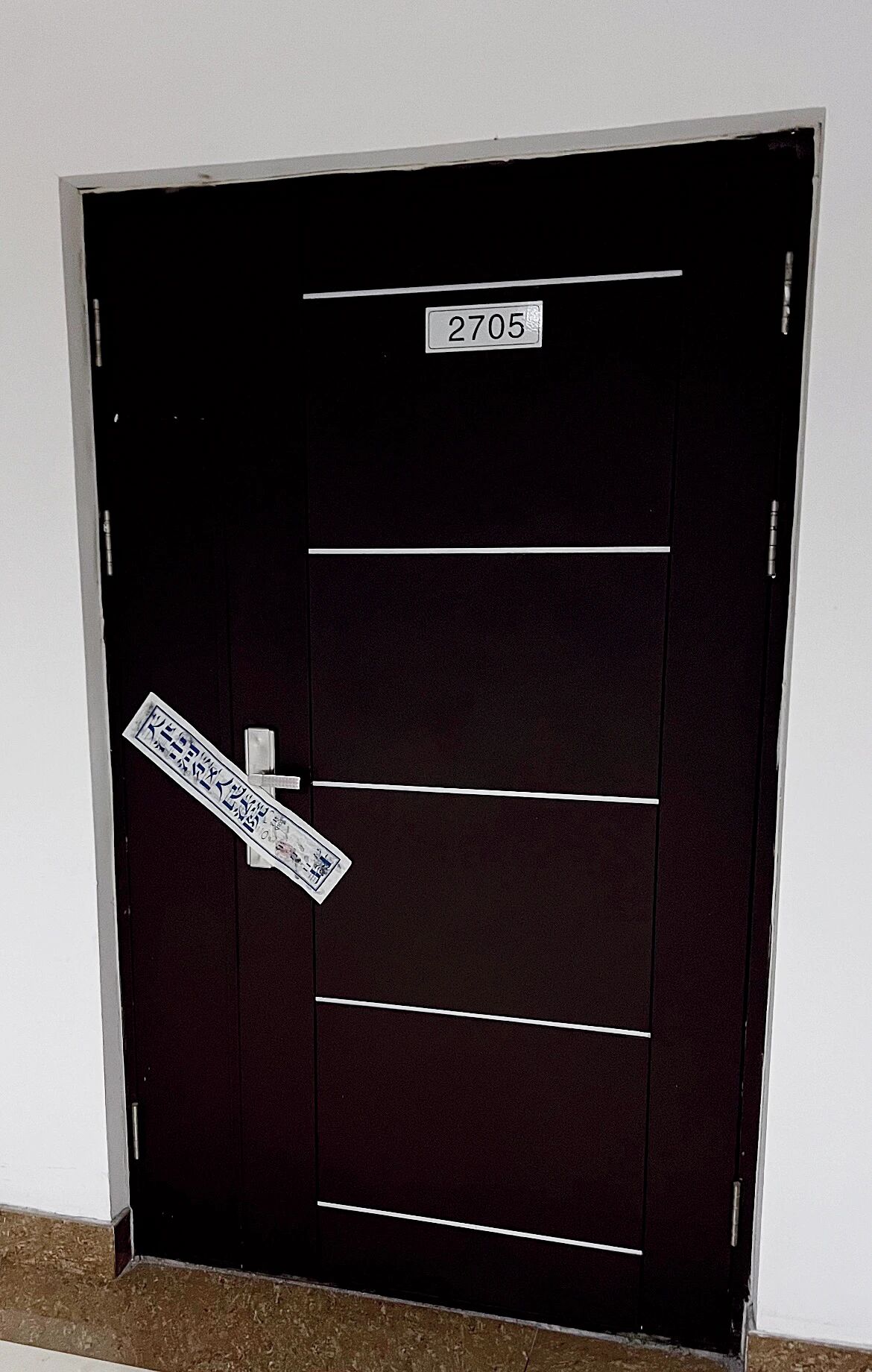
The office of Blue Sky Grace located inside Fujian Building, Hedong District, Tianjin, has been sealed off. Photo by reporter Liu Xiangnan
Proving It’s Blood-Stained Illicit Money
Several interviewees recalled to China Newsweek that between 2021 and 2022, the Tianjin Public Security Bureau conducted two rounds of partial reimbursements to registered victims, at rates of 5% and 8%. Zheng Zhengge said: “For those who invested tens or hundreds of millions, this is barely a drop in the bucket.”
In November 2021, Wu Xiaolong, general manager of Blue Sky Grace, stood trial, with personal involvement amounting to 8.7 billion yuan. His available assets totaled only 9.56 million yuan—just one-thousandth of the amount subject to confiscation.
Across the ocean, the UK has already issued a property freezing order under the Proceeds of Crime Act. The 61,000 frozen Bitcoins, boosted by market surges, are now valued at over £5 billion. In September 2024, the Crown Prosecution Service (CPS) officially launched civil recovery proceedings under the Proceeds of Crime Act 2002 (POCA), releasing a “Victim Notice Regarding the Blue Sky Grace Fraud Case” explaining the recovery process.
Theoretically, under POCA Section 281, a narrow path exists for claimants seeking redress—“investors” can file claims with the UK Supreme Court asserting legitimate ownership over their property.
On October 15, 2025, during a preliminary hearing, the CPS proposed considering a “compensation scheme” for Chinese victims not participating in civil litigation. This proposal awaits court review and approval. China Newsweek emailed the CPS for details but had not received a substantive response by publication time.
According to UK government statistics on asset recovery, the Home Office typically shares confiscated assets equally (50%) with the requesting country. In cases involving victims, however, different sharing ratios may be negotiated.
Professor Zhu Jiangnan from the Department of Politics and Public Administration at the University of Hong Kong told China Newsweek that under the Sino-British Treaty on Mutual Legal Assistance in Criminal Matters, when seized assets originate from public funds embezzled or misappropriated in the requesting state, the requested party shall return the confiscated assets or proceeds from their sale to the requesting party—even if the funds have been laundered—after deducting reasonable disposal costs. For non-public economic fraud cases like Qian Zhimin’s, specific return conditions depend on judicial procedures, evidence chains, trials, diplomatic negotiations, and consultations, without a fixed ratio.
Moreover, once ownership is determined, internal distribution among UK government departments varies. Zhu Jiangnan explained that the UK’s Asset Recovery Incentivisation Scheme (ARIS) clearly divides recovered assets 50:50 between central government and law enforcement agencies to incentivize crime-fighting efforts. “In the Qian Zhimin case, the high level of enthusiasm shown by UK police and prosecutors cannot be entirely separated from this incentive mechanism,” Zhu analyzed.
In response to inquiries from China Newsweek regarding asset disposition, Scotland Yard explicitly stated that they hope part of the recovered assets will “benefit London and its citizens.” For UK police who spent seven years investigating this case, it undoubtedly serves as a way to recoup investigative costs.
“Facing huge interests, any institution could act as a ‘rational economic agent.’ The ARIS mechanism turns law enforcement into a business. What we must do is prove this money is blood-stained illicit gain, not ownerless profit,” Yan Lixin told China Newsweek.
The mismatch of “the case being abroad while victims suffer at home” is the biggest challenge in cross-border asset recovery. Multiple experts emphasized the need to uphold the principle of “victims first” during negotiations. Yan Lixin pointed out that under the United Nations Convention against Corruption (UNCAC) and the United Nations Convention against Transnational Organized Crime (UNTOC), returning assets to legitimate owners is the top priority. “Only after all victims are compensated should any surplus be discussed between China and the UK.”
Zhao Binghao, Dean of the Institute of Fintech and Rule of Law at China University of Political Science and Law, told China Newsweek that China may accept the UK deducting “reasonable enforcement costs,” but must avoid automatically defaulting to a 50% or lower return ratio.
Previously, the UK Supreme Court emphasized that unless individuals or entities assert rights during the stage defined under POCA Section 281, no intergovernmental contact will occur. In other words, the UK will first determine asset ownership through domestic legal procedures before considering consultations with China on asset return.
This approach has sparked controversy. Qian Zhimin’s lawyer Roger Sahota stated publicly: “The UK court’s move means any surplus from recovered assets might be retained by the state, effectively turning law enforcement into a potential new source of government revenue.”
How Much Can Be Returned?
For victims of this case, the most desired outcome is “full repayment.” Such precedents do exist.
Zhu Jiangnan cited a landmark case in China’s fugitive repatriation and asset recovery—the Li Huabo case. In 2015, despite the absence of a bilateral judicial assistance treaty between China and Singapore, the two sides cooperated so that Singapore’s High Court enforced China’s confiscation order, returning all ill-gotten gains totaling 20.4464 million RMB to China. This marked the first instance where Chinese prosecutors used the unlawful gains forfeiture procedure to recover assets from a fugitive corrupt official abroad.
Yan Lixin suggested a feasible path would be for the Chinese government or a designated asset manager to represent all victims in filing civil lawsuits or joining criminal proceedings as civil claimants in UK courts. “This isn’t merely a legal technicality—it’s a matter of social governance. Government involvement would best soothe domestic victims and demonstrate national resolve in international courts.”
Shanghai Duan & Duan Law Firm is one of the firms representing Blue Sky Grace investors in overseas cross-border claims. Gu Zhaoqin, a lawyer at its Hongqiao branch, told China Newsweek that the CPS’s civil recovery process remains in early stages, with substantial evidence exchange yet to begin, indicating a lengthy overall timeline.
Earlier, Yang Yuhua, partner at UK-based law firm Jun Ze, wrote that over a thousand Chinese investors have attempted to assert rights through this process, some making “radical” claims—not only demanding principal repayment but also seeking capital gains from Bitcoin’s seven-year appreciation.
Yan Lixin believes that if Chinese victims seek compensation based on appreciated values, they may face skepticism in UK courts over “unjust enrichment.” “However, the ‘tracing principle’ in anti-money laundering tells us: if a victim’s money was used to buy a lottery ticket that won big, the victim has the right to claim the prize—not just the ticket’s original cost.”
Zhao Binghao agrees with this logic. He said civil recovery focuses on whether property represents proceeds of crime. In principle, as long as victims can prove their defrauded funds led directly to acquiring cryptocurrencies—this “fruit”—they have the right to claim compensation at current market value. But actual recovery depends on whether blockchain funds can be fully traced, how claims are distributed among victims, and how courts assess evidentiary links.
Nonetheless, Yu Jianing, co-chair of the Blockchain Committee of the China Communications Industry Association, offered a contrasting view to China Newsweek. He argued that the massive appreciation of 61,000 Bitcoins over seven years constitutes typical capital gains derived from Bitcoin’s market rise. Allowing victims to claim rights based on current Bitcoin valuations would imply recognizing their entitlement to speculative returns within an inherently illegal pyramid scheme—“which contradicts criminal law’s negative evaluation of illegal fundraising and creates an ethically problematic reverse incentive where success equals high returns, while failure makes one a victim.”
He noted that referencing domestic precedents like the “first crypto case in China,” the PlusToken case, Chinese courts have uniformly treated the entire value of virtual currencies—including price appreciation—as illegal proceeds, not calculating them based on cost or purchase price. This significant excess over principal “is better understood as public residual value.” China should use diplomatic and judicial channels to assert that this massive premium forms an inseparable whole of the criminal asset package, reclaim it, and deposit it into the national treasury. After compensating victims’ principal, the remaining vast sum could become public fiscal resources.
Technical Challenges in Evidence Verification
Beyond legal issues, technical evidence verification presents even greater difficulties.
Yu Jianing said that for ordinary investors, accurately tracing their original RMB investments from years ago to the 61,000 Bitcoins currently seized by UK police is technically nearly impossible. This is because the path crosses three fundamentally disconnected systems: first, the RMB-based banking and cash collection system; second, the OTC currency exchange market heavily reliant on personal networks and WeChat groups; third, the on-chain fund flows deliberately obfuscated by cold wallets, multi-hop transactions, and mixing services.
From 2014 to 2017, when Qian Zhimin systematically converted investor funds into crypto assets, according to Yu Jianing, it was a classic era of OTC exchanges, centralized buying, highly mixed funds, and mixer usage. At the moment funds entered the pool, individual traceability was lost. On-chain analysis can confirm “this water is dirty,” but not “this drop belongs to whom.” “Once funds reach field agents or pooled accounts, they vanish into a giant black box—individuals completely lose sight of which money bought which coins.”
Adding complexity, many investors in the Blue Sky Grace case engaged in rolling investments across multiple projects. A lawyer deeply involved in the case told China Newsweek that principal, profits, and reinvestments were intricately mixed, with varying payout methods—some rolled over in cash, others reinvested via physical items like “Dot Coins”—leading to discrepancies between book balances and actual losses. “Currently, neither China nor the UK possesses professional capabilities capable of fully reconstructing and credibly verifying the entire fund flow, Bitcoin conversion process, and corresponding holder relationships.”
Facing high legal barriers and recovery costs, Zheng Zhengge ultimately turned to a third-party agency facilitated by a multinational company for assistance. Though the agency may take up to 20% of any recovered amount, he simply hopes to recover his principal quickly. “As for gains from appreciation, I don’t dare dream of that.”
Additionally, Zhao Binghao noted that some international judicial bodies may exploit contradictions in China’s current regulatory and judicial practices to challenge Chinese claims. “Domestically, issuing or financing via Bitcoin is illegal. Yet in handling cases, we treat virtual currencies as property—placing us in an awkward position.”
To this, Yu Jianing responded that although China denies Bitcoin’s monetary attributes, the Civil Code explicitly protects its status as “virtual network property,” providing solid property rights grounds for cross-border asset recovery.
Yan Lixin offered a sharper “pragmatic, piercing” analogy: “We ban internally to prevent financial risks, but pursue externally to uphold judicial justice. These aren’t contradictory—just like cleaning your house doesn’t mean others can freely take things left outside your door.”
“This case isn’t just about asset recovery—it’s an opportunity. It forces China to evolve cryptocurrency regulation from mere ‘risk emphasis and prohibition’ toward refined governance featuring risk prevention, clear rules, and international alignment. Only then can China gain sufficient voice and institutional confidence in future cross-border asset recovery and sharing negotiations,” said Zhao Binghao.
(Pseudonyms used: Zheng Zhengge, Ge Qiu)
Join TechFlow official community to stay tuned
Telegram:https://t.me/TechFlowDaily
X (Twitter):https://x.com/TechFlowPost
X (Twitter) EN:https://x.com/BlockFlow_News


