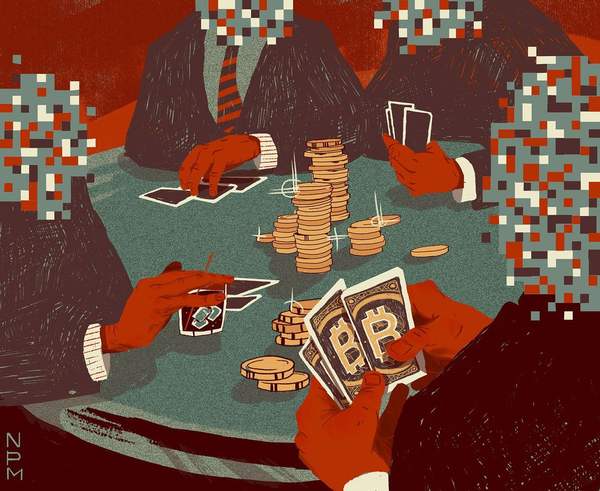
When the market falls into despair, why is Bitcoin's dawn already visible by 2026?
TechFlow Selected TechFlow Selected
When the market falls into despair, why is Bitcoin's dawn already visible by 2026?
Risk assets are expected to perform strongly in 2026, and Bitcoin will follow suit.
 Navigating Web3 tides with focused insights
Author: Jordi Visser
Translation: Luffy, Foresight News
On April 8 this year, amid escalating tariff disputes and panic surrounding "Liberation Day," I published an article titled *After the Storm Comes the Calm* on Substack. At that time, the S&P 500 had plunged 20%, economists were warning of a recession, and markets were gripped by fear. In the article, I argued that this market-driven sell-off would become an exceptional buying opportunity thanks to the advancement of artificial intelligence; half a year later, people would realize that the earlier panic was entirely unwarranted in light of AI's rapid progress.
In the end, events unfolded exactly as predicted. Markets gradually recovered, risk assets rebounded strongly, and enthusiasm for artificial intelligence continued to rise, with investors adapting to these shifts.
By November, Bitcoin entered a consolidation phase, significantly underperforming equities, leaving crypto investors filled with disappointment. In my article *Bitcoin’s Silent IPO*, I proposed that Bitcoin’s seemingly disappointing consolidation—while other assets surged—was not a sign of weakness but a necessary distribution phase. Early Bitcoin whales finally had the chance to liquidate their holdings, methodically offloading Bitcoin into strong institutional demand fueled by exchange-traded funds and corporate treasury purchases. This process resembles the expiration of lock-up periods in traditional IPOs—unsettling and slow, yet vital for long-term market health.
However, this consolidation phase was eventually disrupted. As equity markets began to correct, especially with retail-favorite AI growth stocks leading the decline, Bitcoin’s “silent IPO”-style distribution triggered a deeper downturn. This volatility turned Bitcoin’s year-to-date gains into slight losses. The cognitive dissonance that once puzzled the crypto industry has now evolved into outright bearish sentiment and skepticism. The optimism of Liberation Day feels like a distant memory, and talk about the end of Bitcoin’s four-year cycle grows louder. Social media is flooded with claims that “Bitcoin has no room to rise,” and even those who insisted “this time is different” have begun to capitulate and exit.
This decline pushed the Crypto Fear & Greed Index down to 15, matching the lows seen around Liberation Day, making the market feel utterly hopeless. Precisely for this reason, I am writing this article. Consistent with my previous views on Liberation Day, I maintain that movements across all asset classes today are driven by advances in artificial intelligence. And I firmly believe that years from now, all investors will realize they missed a critical opportunity—and that Bitcoin is the asset most reflective of AI’s true value.
Notably, the Bitcoin whitepaper emerged in 2008, while the Raina-Madhavan-Ng paper in 2009 became a landmark study proving GPUs could accelerate deep learning efficiency by over 70 times, ushering in the era of GPU-powered machine learning. These breakthroughs arose almost simultaneously—both revolutionary innovations that complement each other and are mutually indispensable.
Such transformative innovations not only reduce the need for office work but also diminish overall employment to some extent. They exacerbate wealth inequality, forcing governments worldwide to sustain fiscal deficits indefinitely. Rising financial asset prices have become a form of universal basic income via broad-based returns—what we might call "universal beat income." Today’s UBI isn’t cash handouts from governments but collective gains from asset appreciation—a system structured so that people’s wealth inevitably grows. For those without assets, government transfers serve as another form of UBI. This dynamic gives rise to what’s commonly known as the K-shaped economy. Most people face job insecurity, wage pressure from shrinking hiring, and inflation caused by government UBI policies, leading to rising living costs and growing discontent. Under these conditions, Bitcoin benefits. Prior to AI fully penetrating capitalism and public markets, Bitcoin remains correlated with risk assets. Stablecoins combined with AI agents accelerate capital velocity and reduce reliance on leverage; asset tokenization enables round-the-clock trading of illiquid assets such as real estate, private debt, private equity, and venture capital, thereby reducing the leverage required to support their valuations. As AI continues to advance, its deflationary effects will become increasingly evident. By 2026, developments in AI-driven drug discovery, autonomous ride-hailing, and AI agents will boost corporate profits, while widespread adoption of intelligent technologies intensifies competition, further influencing asset prices.
There’s another interesting phenomenon in today’s market: previously, people worried Bitcoin couldn’t keep pace with equities’ rally, but now its trajectory has realigned. As stock markets pull back—especially speculative retail-favorite AI stocks—Bitcoin has declined in tandem. The puzzling divergence between Bitcoin and equities during the “silent IPO” phase has disappeared. Bitcoin has reasserted its identity as a risk asset, with price movements closely tied to growth expectations and liquidity conditions. In my view, this alignment is accumulating sufficient buying power and momentum to lay the foundation for the next upward leg.
This means that looking ahead to 2026, I again see signs of hope. Just as the April tariff scare created a prime buying opportunity, Bitcoin’s current correction alongside broader risk assets is setting the stage for a major rebound.
Bitcoin’s correlation with equities actually signals a bull market
A common misconception persists in the market: Bitcoin should decouple from traditional risk assets and chart its own independent course. A prevailing belief holds that Bitcoin is digital gold—hedging against risks in the existing financial system and uncorrelated with stocks. Therefore, if Bitcoin falls when equities drop, something must be wrong with Bitcoin itself.
But this view is incorrect. Bitcoin is fundamentally a risk asset.
To be sure, Bitcoin has store-of-value properties and operates in a decentralized manner. Yet from a market psychology and capital flow perspective, it behaves as a high-beta risk asset. ETF investors include Bitcoin alongside stocks in portfolios and sell both simultaneously when de-risking. Retail investors often use the same pool of funds for both crypto and equities. Even those investing in Bitcoin due to concerns about currency devaluation tend to increase purchases when the economy improves and cash flow strengthens.
Thus, when the Nasdaq falls, Bitcoin follows. When AI-related stocks falter, Bitcoin suffers too. This isn’t a market flaw—it’s normal. Given Bitcoin’s current ownership structure, this behavior makes perfect sense.
Beneath this lies a hidden bullish signal: since Bitcoin correlates with risk assets, its future is intrinsically linked to theirs. To forecast Bitcoin’s path, one must first understand where equities are headed.
Now let me explain why I’m confident in the outlook for risk assets in 2026.
2026 Market Outlook: Fiscal, Monetary, and AI Alignment
Markets often rise despite widespread skepticism. Today’s concerns center on an AI bubble, recession risks, and crypto market stagnation—but the setup for 2026 is highly favorable.
Fiscal support will remain robust. Infrastructure bills, the CHIPS and Science Act, and the Inflation Reduction Act are not empty promises. These multi-trillion-dollar spending programs will stimulate real economic activity—and widen fiscal deficits. To win midterm elections, favorable policy packages have already been accelerated. Data centers are being built at unprecedented speed, semiconductor fabs are coming online, and power infrastructure is undergoing continuous upgrades.
The Federal Reserve has ample room to ease monetary policy. Current inflation is under control, with wages, housing prices, and oil prices all under downward pressure. Even if tariff adjustments cause some impact, weak labor data suggests inflation will likely remain stable. Moreover, AI will not only exert deflationary pressure but also disrupt labor markets.
Breakthroughs in AI are imminent. Over the past year, AI development has accelerated dramatically, and tangible applications are about to capture mainstream attention:
-
AI-driven drug discovery: The first drugs developed using AI are nearing clinical trials. Positive results would revolutionize healthcare and productivity. Already, pharmaceutical stocks posted their best November performance in 30 years. Major drugmakers will rush to adopt AI in R&D, and massive capital will flood into AI healthcare.
-
Autonomous driving: After years of “autonomous driving in five years” being just a slogan, the sector is finally turning a corner. Waymo is expanding operations, Tesla’s full self-driving improves continuously, and Chinese firms are deploying autonomous taxis at scale. If robotaxis go mainstream in major cities by 2026, humanoid robots will ignite speculative fervor.
-
AI agents and productivity: Autonomous AI agents capable of handling complex tasks will see broad adoption in enterprise software, customer service, and creative industries. Their impact on productivity is immeasurable, boosting profit margins across sectors. AI will help companies enhance efficiency, expand capacity, and increase profitability.
Manufacturing is expanding. AI infrastructure investment is driving a revival of U.S. manufacturing, showing clear signs of recovery after years of contraction. I believe that under these favorable conditions, the Purchasing Managers’ Index (PMI) will rebound in 2026. Historically, periods of PMI growth have coincided with strong performance in cryptocurrencies—especially altcoins.
Bearish voices will cry, “The AI bubble is about to burst.” There may indeed be a bubble, but bubbles often last longer and grow larger than expected. The internet bubble didn’t collapse when valuations first appeared unreasonable in 1997, but peaked three years later in March 2000. From late 1994 to late 1999, the Nasdaq 100 rose 800%, whereas over the past five years it’s gained less than 100%. Compared to the dot-com bubble, any AI bubble today is still in its early-to-mid stages. The mainstream hasn’t fully embraced AI investments—your relatives won’t be asking about AI stocks at Thanksgiving dinner yet, a hallmark of late-stage bubbles, which typically coincide with crypto mania.
Moreover, bubbles usually burst due to specific triggers—often the Fed tightening policy amid economic weakness. But the Fed has already completed its tightening cycle and may ease policy in 2026 rather than restart tightening. Thus, the classic catalyst for a crash is absent.
Bitcoin Catalysts in 2026
If risk assets surge in 2026, Bitcoin—as a high-beta risk asset—is likely to outperform dramatically. Beyond that, several Bitcoin-specific catalysts will amplify its upside:
-
The Clear Act. Regulatory uncertainty has long constrained crypto markets. Expected to pass by late 2025 or early 2026, this legislation will establish a clear regulatory framework, define jurisdictional responsibilities, and eliminate legal gray areas. Large asset managers and pension funds previously on the sidelines will gain permission to invest in crypto. Relative to the inflows expected then, current ETF flows will seem negligible.
-
Expanding asset tokenization. Major institutions like JPMorgan, BlackRock, and Franklin Templeton are advancing tokenization of Treasuries, real estate, commodities, and equities, building dedicated platforms. This validates crypto infrastructure and proves blockchain technology applies beyond digital assets like Bitcoin. As more illiquid assets become tradable 24/7 with reduced leverage needs, Bitcoin’s role as a neutral settlement layer will grow—akin to a network protocol for digital finance.
-
Accelerating stablecoin adoption. This is an underappreciated catalyst. Stablecoin usage is rapidly expanding globally, especially in emerging markets. USDT and USDC are becoming dollar payment rails in many regions. Whether Nigerians receive USDC instead of naira, Argentine businesses hold dollar stablecoins over pesos, or cross-border payments shift from correspondent banking to stablecoins, crypto infrastructure is becoming integral to global trade.
Stablecoins and Bitcoin aren’t competitors—they’re complementary. Stablecoins act as transaction mediums in the digital economy, while Bitcoin serves as a store of value. As more commerce and capital flow into the digital economy, increasing amounts will naturally migrate to Bitcoin. Think of stablecoins as broad money in the digital economy, and asset tokenization as bridges connecting traditional fiat-denominated assets to digital systems. This creates powerful network effects: stablecoin adoption brings millions of new users into crypto, and these users—once holding stablecoins—will seek long-term value storage, making Bitcoin the natural choice. The network effect from stablecoin growth will massively boost Bitcoin adoption—an impact hard to quantify but impossible to ignore.
History May Repeat Itself
Decades of market experience show that initial market bottoms often undergo retests. We saw this in April: after a bottom and rebound, markets retested the prior low before launching a major rally. This pattern is normal and healthy—it reinforces support levels and forces weak hands to exit.
I expect Bitcoin may follow a similar path. An initial bottom is likely already in place, but over the coming weeks, a retest could occur. The weakest holders may dump en masse, triggering another leg down—even brief panic selling pushing prices lower.
If this retest happens, it will be the year’s best buying opportunity. During such a retest, sophisticated investors who missed the first entry point get a second chance to position. A retest on low volume and fading fear confirms the strength of the prior bottom. Still, I don’t advise waiting deliberately. Both Bitcoin and equities are currently in phases of widespread fear and minimal greed—an ideal environment for strategic positioning.
Bitcoin has struggled this year, and while the “silent IPO” distribution phase isn’t fully complete, significant progress has been made. Ownership is more dispersed than ever. Retail sentiment is bearish and观望, ETF investors are accumulating patiently, those fearing currency devaluation continue steady buying, and developing nations are gradually integrating Bitcoin into their financial infrastructure.
Meanwhile, the 2026 macro backdrop is highly favorable: sustained fiscal stimulus, supportive monetary policy, AI-driven speculation and earnings growth, manufacturing expansion, regulatory clarity via the Clear Act, accelerating asset tokenization, and powerful network effects from stablecoin adoption.
Bitcoin is tightly linked to risk assets, and with risk assets poised for strength in 2026, Bitcoin will naturally follow.
The Light of Hope Never Dies
I often recall the market conditions during Liberation Day. The S&P 500 had dropped 20%, economists warned of recession, and investors sold in panic. I argued then that within six months, people would see the fear was baseless—and history proved me right.
Today, I hold the same view on Bitcoin. This correction is painful, sentiment has hit rock bottom, and the Crypto Fear & Greed Index stands at 15—matching Liberation Day’s lows. But bear markets always make investors feel trapped, always create the illusion that “this time is different,” and always lead people to believe the bull run is truly over.
Yet for investors who can overcome fear, these moments are always golden opportunities to buy.
In my trading career, I’ve lived through many crises—from Mexico’s 1994 financial crisis and Brazil’s turmoil in 1998, to the global financial crisis, pandemic-induced market shocks, and the recent Liberation Day volatility. These experiences taught me that no matter how dire things appear, reality is rarely that bad. One constant truth remains: if you can conquer fear, these extraordinary times offer exceptional investment opportunities.
Bitcoin is not broken, nor is crypto doomed. Today’s volatility reflects the normal behavior of a maturing risk asset—still recovering from the 2022 winter, adjusting positions amid uncertainty, and correcting alongside other risk assets. Compared to April’s broad selloff, this pullback is more focused, mainly affecting growth stocks and crypto rather than triggering systemic panic. This is healthier—it shows markets are differentiating, and the next rebound could be sharper and more targeted.
For discerning investors, now is the ideal time to position. Of course, discipline is key—avoid reckless leverage and never invest beyond your risk tolerance. Instead, analyze fundamentals calmly and deploy with conviction.
In an era where AI drives outsized investment returns, volatility is inevitable. Governments face immense challenges managing this disruptive technology, and markets will experience moments of fear and doubt. Media headlines may scream about crashes and bear markets. But investors should ignore the noise and focus on fundamentals. AI, one of humanity’s most impactful innovations, will ultimately create a better future.
When everyone sees the light of hope, it will be too late to act. With the Crypto Fear & Greed Index at 15, investors capitulating en masse, and sentiment deeply depressed, this is precisely the moment of maximum opportunity in crypto markets.
Six months from now, just as after the Liberation Day turmoil, Bitcoin’s narrative will transform completely. Looking back at today’s prices and sentiment, people will wonder why they ever doubted.
The light of hope is there—you just need to be willing to see it.
Join TechFlow official community to stay tuned
Telegram:https://t.me/TechFlowDaily
X (Twitter):https://x.com/TechFlowPost
X (Twitter) EN:https://x.com/BlockFlow_News
 @jvisserlabs