What conditions does Bitcoin need to rise?
TechFlow Selected TechFlow Selected
What conditions does Bitcoin need to rise?
Will December be a turning point?
 Navigating Web3 tides with focused insights
By: Lüdong Xiao Gong
NVIDIA delivered a spectacular earnings report last night.
Third-quarter revenue reached $57 billion, a 62% year-on-year surge, while net profit soared 65% to $31.9 billion. This marks the twelfth consecutive quarter of outperforming expectations. After the earnings release, the stock jumped 4-6% in after-hours trading and rose another 5.1% pre-market the next day, adding approximately $22 billion to the company's market capitalization and pulling up Nasdaq futures by 1.5-2%.
Given such strong market sentiment, shouldn't Bitcoin—the so-called "digital gold"—also benefit? Reality, however, delivered a slap: Bitcoin dropped instead, sliding to $91,363 with a decline of about 3%.
NVIDIA surges, but Bitcoin falls?
Investors who once saw Bitcoin as a safe haven are now likely feeling uneasy.
Promoted as a "tool against inflation" and a "refuge during economic anxiety," Bitcoin is now behaving more like a high-risk tech stock than a safe-haven asset like physical gold.
The data speaks louder: After plummeting 26% from its early October all-time high, Bitcoin has essentially returned to its price level at the beginning of the year—meaning it's been a wasted year.
Meanwhile, real gold? It surged 55% in 2025. The psychological gap for Bitcoin holders is enormous.
The drivers behind gold’s rise are clear: potential interest rate cuts, a weakening dollar, heightened market volatility, and uncertain economic outlook. According to traditional Bitcoin logic, these conditions should have boosted Bitcoin prices too. Yet the opposite happened.
Mark Schorr, economist at CME, pointed out in May that since 2020, Bitcoin has developed a positive correlation with U.S. equities—and this remains true today. More importantly, over the past year, the amount of Bitcoin flowing into institutional hands via ETFs and publicly listed crypto companies hit a record high.
In other words, Bitcoin is becoming increasingly "mainstream," but at the cost of resembling a conventional risk asset more closely.
Another reason for "NVIDIA up, Bitcoin down" lies in capital flows.
NVIDIA benefits from the undeniable, concrete demand in AI. CEO Jensen Huang emphasized that "computational demand continues to accelerate," with new Blackwell chips seeing "explosive" sales. Visibility on $500 billion in orders has effectively dispelled market concerns about an AI bubble. Hyperscale cloud providers—giants like Amazon and Microsoft—are spending over $380 billion this year, much of which is flowing directly to NVIDIA.
Bitcoin, on the other hand, is bearing the full brunt of rising risk aversion. As a "high Beta risk asset," it's the first to suffer under tightening liquidity. In just one week, it fell 12.5%. Crypto ETFs saw a single-day net outflow of $867 million on November 13, long-term holders began selling, and the supply of dormant Bitcoin dropped from 8 million at the start of the year to 7.32 million.
So what does Bitcoin need to rise again?
While the current situation isn’t optimistic, there’s still hope. For Bitcoin to take off again, several key conditions may need to align simultaneously.
Liquidity injection following U.S. government reopening
The 43-day government shutdown officially ended on November 18. It affected 1.25 million federal employees, caused around $16 billion in lost wages, and dragged consumer confidence down to a three-year low of 50.4.
Now that the government has reopened, liquidity injection becomes critical.
Here’s a quick primer: TGA (Treasury General Account), the U.S. Treasury’s primary operating account at the Federal Reserve. All government revenues and expenditures flow through this account. When TGA rises, funds move from markets to the government, reducing market liquidity; when TGA falls, government spending injects money back into the economy, increasing liquidity.
Data shows that between October 1 and November 12, 2025—a 43-day period—TGA balances steadily accumulated, peaking at $959 billion on November 14. This level far exceeds the Treasury’s usual cash holdings, mainly due to constrained spending during the shutdown and ongoing debt issuance, resulting in massive cash buildup in the treasury account.
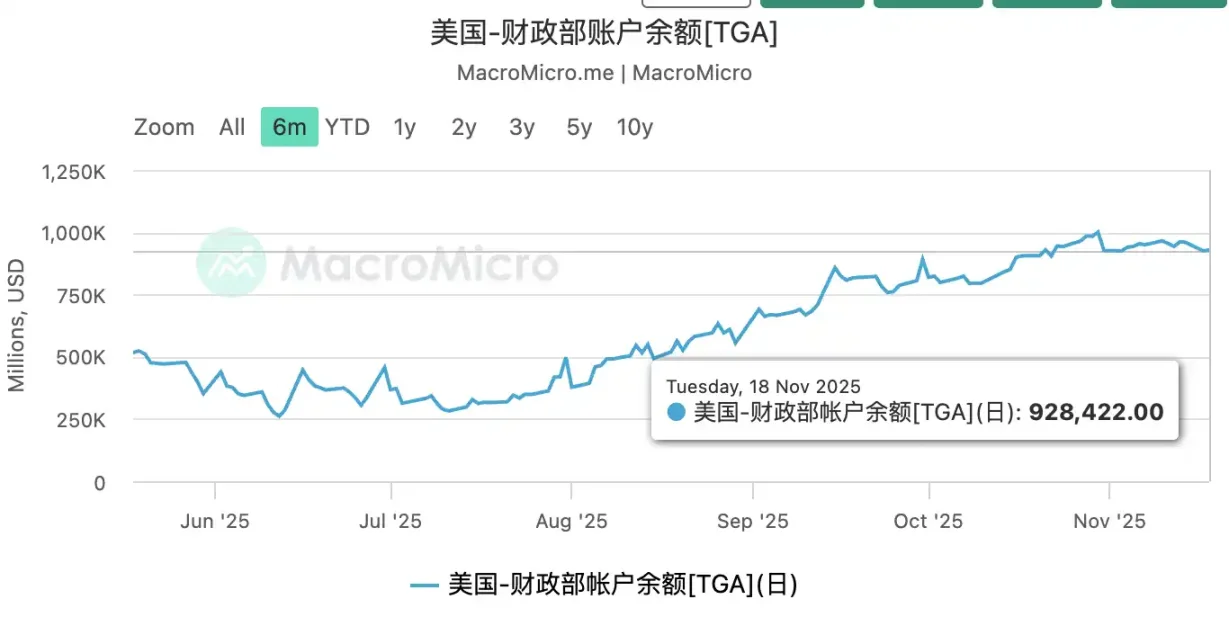
Currently, TGA data shows no significant downward trend.
Based on the government reopening on November 13, historical patterns suggest that in the first week, priority will be given to back-payments for federal workers—around $16 billion entering the economy, a relatively small impact. Meaningfully large liquidity injections are unlikely before November 20.
About 1–2 weeks later, by early December, normal TGA operations resume, regular government spending restarts, seasonal tax inflows return, and the TGA balance begins substantial fluctuation and release—only then will markets feel a noticeable improvement in liquidity.
Increased interbank liquidity and ample institutional funds mean Bitcoin, as a risk asset, could see renewed capital inflows and begin rising.
A key precedent comes from early 2019. The U.S. government experienced a prolonged shutdown from December 22, 2018, to January 25, 2019—35 days. During the closure, TGA balances also surged, peaking at $413 billion on January 29, 2019. Once operations resumed, the Treasury rapidly increased spending. Between January 29 and March 1, TGA dropped by $211 billion in just one month, injecting massive liquidity into the financial system. This drove equities and Bitcoin to rise 8.5% and 35%, respectively, within 30 days post-reopening.
Comparing current conditions, the TGA balance in November 2025 reached $959 billion—far exceeding the 2019 peak of $413 billion—indicating even greater potential for liquidity release.
Fed policy pivot
The Federal Reserve is another major force shaping Bitcoin’s trajectory.
The latest FOMC minutes reveal deep divisions among officials on whether to deliver a third consecutive rate cut. Most believe further easing could exacerbate inflation risks. White House economic advisor Hassett even admitted, “We’ve lost control of inflation.”
Trump, predictably furious, lashed out at Fed Chair Powell again, saying he “really wants to fire him” and calling him “extremely incompetent.”
According to CME’s “Fed Watch,” the probability of a 25-basis-point rate cut in December is only 36.2%, while the chance of holding rates steady stands at 63.8%.
Worse, the Bureau of Labor Statistics confirmed that October household data—used to calculate key statistics like unemployment—cannot be retroactively collected. Therefore, the October jobs report will not be released; nonfarm payroll data will be combined into the November report, scheduled for December 16. This means the Fed will enter its final meeting of the year without crucial employment data.
With U.S. Treasury yields rising across maturities—10-year yield up 2.5 basis points—market hopes for a December rate cut have largely evaporated, with cut odds falling to around 31%.
But looking further ahead, the picture may not be so bleak. The delayed November jobs data will be released on December 16. If weak, it could revive expectations for a rate cut in January 2026. Current odds stand at 48%, the highest among 2026 meetings.
Broadening the view, although the Fed remains ambiguous, other major central banks globally are already moving toward dovish policies. This undercurrent could become a powerful driver for Bitcoin.
For example, the ECB has kept its deposit facility rate at 2.00%, but a 25-basis-point cut in December is highly likely as inflation has fallen to 2.1%, close to target. An interesting fact: Historically, ECB rate cuts correlate with Bitcoin rallies at 0.85. Why? Because monetary easing in the eurozone spills over into global markets, boosting overall risk appetite.
Clear economic improvement
The current U.S. economy presents a delicate mix—bright spots amid underlying concerns.
The August trade deficit narrowed sharply by 23.8% to $59.6 billion, beating the expected $61 billion, primarily due to a 6.6% drop in goods imports driven by tariff effects. This improvement is projected to add 1.5–2.0 percentage points to Q3 GDP growth, pushing estimates up to 3.8%. Sounds good, right? But this gain comes at the cost of reduced imports, which could harm supply chains and consumption over time.
Although the 43-day government shutdown has ended, its damage lingers. $16 billion in lost wages, consumer confidence at a three-year low of 50.4, and CBO projecting a 1.5 percentage point loss in Q4 GDP—all reflect real economic pain.
Food inflation remains critical. Items that cost $100 before now cost $250, often with lower quality. Just as egg price surges ease, beef—America’s favorite—is facing new inflation.
The latest CPI released on October 24 showed roast beef and steak prices up 18.4% and 16.6% year-on-year, respectively. USDA data shows ground beef retail prices have soared to $6.10 per pound, a record high. Compared to three years ago, beef prices have risen over 50% cumulatively.
Coffee prices up 18.9%, natural gas up 11.7%, electricity up 5.1%, car repairs up 11.5%. Many young Americans burdened with student debt are under growing pressure as living costs climb further.
"K-shaped economy warning signs" may be the most troubling trend in today’s U.S. economy. Nearly 25% of American households live paycheck to paycheck, with wages stagnant for low-income groups, while high-income earners—driven by AI investments and responsible for 50% of consumption—continue to benefit. Economic polarization is rising sharply.
Additionally, ongoing tariff policies continue to weigh on global export economies, with Japan, Switzerland, and Mexico contracting in Q3. These global ripple effects will eventually feed back into U.S. markets, affecting investor risk appetite.
But if the U.S. government can stabilize the economy, assets including Bitcoin could see renewed upside potential.
Institutional capital returning
If the above factors represent "timing," institutional capital represents "human alignment"—perhaps the most direct and immediate catalyst.
Current data isn’t encouraging. From November 13–19, ETFs saw $2 billion in net outflows (~20,000 BTC), the largest weekly outflow since February this year. Current AUM stands at $122.3 billion, or 6.6% of Bitcoin’s total market cap.
What does this mean? Institutional investors are retreating—and quickly.
Under current macro conditions, institutional funds face multiple pressures. First, severe liquidity stratification: Tech/AI sectors receive abundant capital, traditional safe havens like gold perform strongly, while pure risk assets like crypto see drying liquidity. Money hasn’t disappeared—it’s just moved elsewhere.
Moreover, institutional investors and fund managers are often shaped by an incentive structure focused on "avoiding mistakes." Industry evaluation systems prioritize "not lagging peers" over "achieving alpha." Under this framework, deviating from consensus carries far higher costs than potential rewards.
Thus, most managers prefer portfolio allocations aligned with market norms. For example, if Bitcoin corrects broadly and a fund manager maintains a significant long position, the resulting drawdown is interpreted as "misjudgment," drawing far more criticism than equivalent gains would earn praise. Ultimately, under such institutional constraints, "conservatism" becomes rational.
Yet history shows institutional flows often reverse suddenly at a tipping point. Where might that be? Three clear signals:
Signal One: Three consecutive days of net inflows
This is the most important signal. Historical data shows that after ETF flows turn positive and sustain net inflows for three consecutive days, Bitcoin typically rises 60–70% within 60–100 days.
Why so powerful? Because institutional investing exhibits the strongest "herding behavior." Once the trend shifts, follow-up capital pours in like dominoes. That’s how the early 2024 rally ignited.
Signal Two: Single-day inflow exceeding $500 million
This signals major institutional entry. In October 2024, a weekly inflow of $3.24 billion pushed Bitcoin past its all-time high. Such scale is beyond retail capability.
What does $500 million in a single day mean? It implies giants like BlackRock and Fidelity simultaneously deciding to increase exposure. This level of capital influx usually reflects clear macro convictions—they’re seeing signals invisible to ordinary investors.
Signal Three: AUM ratio rebounds above 8%
Currently, $122.3 billion AUM represents 6.6% of Bitcoin’s market cap—a historically low level. At its 2024 peak, this ratio reached 8–9%. A rebound indicates institutions aren’t just buying Bitcoin, but buying faster than its price is rising.
Under what conditions might institutional capital return?
Largely as discussed earlier: Clear Fed rate-cut signals; clarified U.S. economic data; coordinated global central bank easing; technical breakout above key resistance levels, etc.
Potential timing for a rally
After discussing all these conditions, the biggest question remains: When could Bitcoin actually rise?
No one can precisely forecast markets, but based on the macro calendar, we can identify several key junctures.
December 10: FOMC Meeting
This is the Fed’s final meeting of the year—and the most watched event.
If they cut rates, Bitcoin could surge. If not, another dip may follow.
A key nuance: Even without a cut, if the Fed sends dovish signals (e.g., emphasizing "flexibility" or "close monitoring of labor data"), market sentiment could still be supported. Conversely, no cut plus a hawkish tone means brace for short-term pressure.
December 16: Delayed November Employment Data
This report will include full data for both October and November, confirming true labor market trends.
If two months of weak data emerge, chances of an early 2026 rate cut rise significantly—providing medium-term support for Bitcoin. If data is mixed or contradictory, markets may remain stuck in indecision, prolonging range-bound trading.
The release is certain, but data quality may be questionable (due to statistical disruptions from the shutdown), so market reactions may hinge more on interpretation than the numbers themselves.
Late December to Year-End: Traditional "Liquidity Season"
An interesting seasonal pattern. Historically, late December through New Year sees institutional year-end rebalancing, and holiday-low trading volumes amplify price swings.
If prior events create a favorable confluence, a "Santa Claus rally" could materialize. But beware the "sell the news" effect—profit-taking after利好 realization.
Q1 2026: Global synchronized liquidity easing—the "Grand Game"
This offers the greatest upside potential.
If the Fed cuts in December or January, and the ECB and PBOC maintain easing, a globally synchronized improvement in liquidity could emerge. In such a scenario, Bitcoin might repeat its 2020 surge—from $3,800 in March to $28,000 by year-end, a gain over 600%.
Of course, 2026 won’t perfectly replicate 2020 (when pandemic stimulus was unprecedented), but a combination of global central bank coordination, TGA fund release, and institutional capital return could fuel a meaningful rally.
The likelihood of synchronized global easing is moderately high (60–65%). With slowing economies worldwide, monetary easing is the probable path.
Join TechFlow official community to stay tuned
Telegram:https://t.me/TechFlowDaily
X (Twitter):https://x.com/TechFlowPost
X (Twitter) EN:https://x.com/BlockFlow_News
 BlockBeats