








"To VB" project secures new funding as Ethereum veterans team up to launch "compliant privacy pool"
TechFlow Selected TechFlow Selected
"To VB" project secures new funding as Ethereum veterans team up to launch "compliant privacy pool"
0xbow is essentially the compliant version of Tornado Cash.
 Navigating Web3 tides with focused insights
By Eric, Foresight News
On November 18, 0xbow, the development team behind Privacy Pools, announced it had raised $3.5 million in funding. The round was led by Starbloom Capital, with participation from venture firms including Coinbase Ventures and BOOST VC, as well as angel investors such as former Coinbase CTO Balaji Srinivasan.
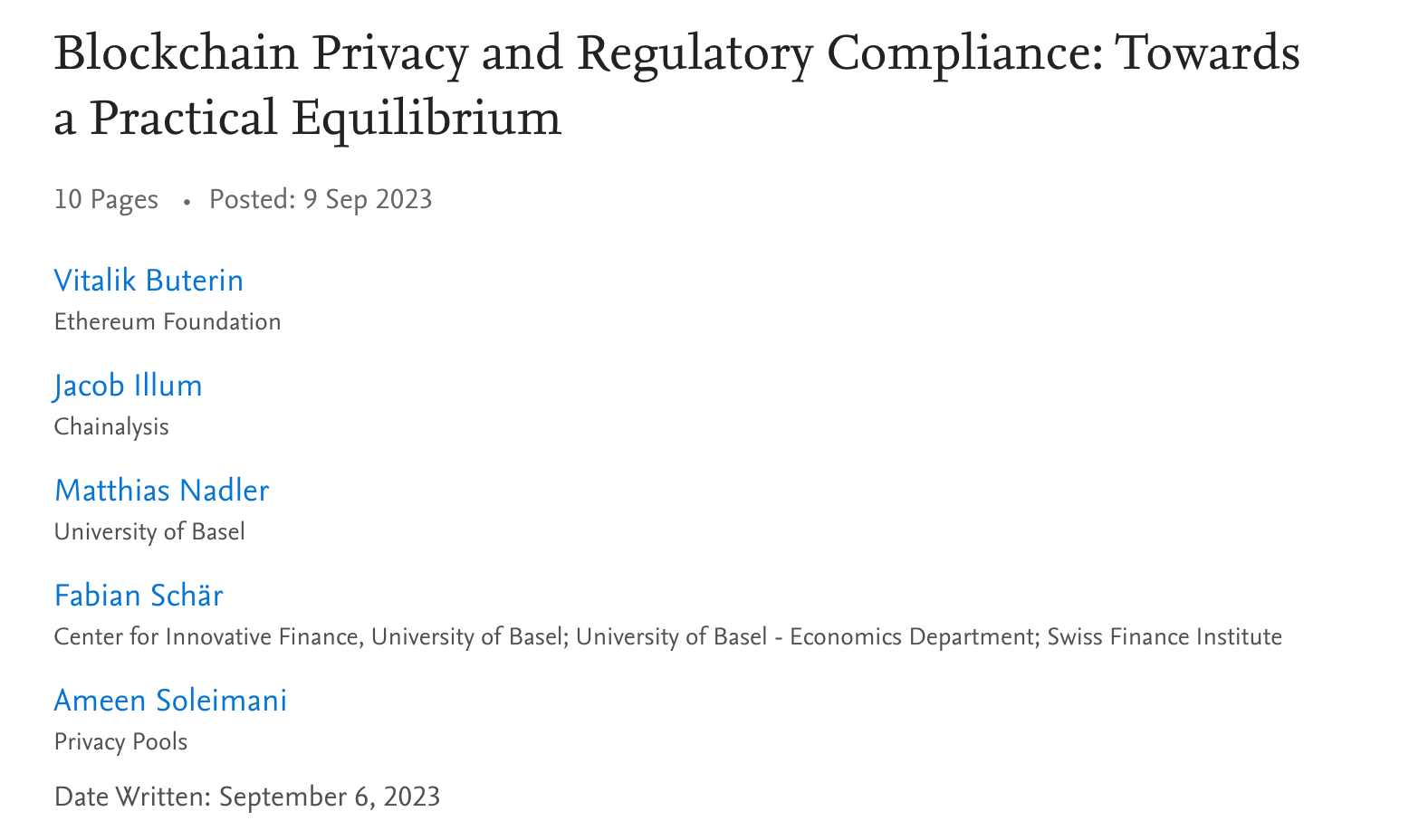
Privacy Pools is a core component of the Ethereum Foundation's Kohaku initiative, designed to enable private fund transfers under regulatory compliance. It builds on research into association sets co-authored by Vitalik Buterin. An association set acts essentially as an anti-cheating mechanism for privacy protocols—preventing malicious actors from exploiting privacy tools for coin mixing while allowing monitoring of suspicious activity.
Privacy Pools is another classic example of a To VB (Vitalik Buterin) startup. Privacy has been an unavoidable topic in Web3 since Zcash emerged, but only now, with advances in zero-knowledge proof (ZKP) technology and support for compliance, has privacy moved from theory to productization.
What is Privacy Pools?
According to its documentation, Privacy Pools enables private transactions by combining ZKPs with a commitment mechanism. Users can deposit assets into a privacy pool and later withdraw part or all of them without creating an on-chain link between the deposit and withdrawal addresses. The protocol uses Association Set Providers (ASPs) to maintain a list of approved deposits, preventing illicit funds from entering the system and ensuring regulatory compliance.
This sounds similar to Tornado Cash—and indeed, it largely is—with the key difference being that Privacy Pools natively integrates compliance mechanisms.
After facing heavy criticism for enabling money laundering by hackers, Tornado Cash introduced a "compliance tool," which allows users to provide a ZKP when transferring funds to exchanges, proving their funds originated from legitimate sources rather than hacker-linked addresses. However, this significantly compromises privacy.
Privacy Pools offers a more privacy-preserving alternative through the aforementioned "association set." This is a manually maintained list. When a user deposits funds into Privacy Pools, the deposit information is added to an "allowlist." During future withdrawals, users can prove via ZKP their connection to an approved deposit address and proceed to withdraw.
When depositing into Privacy Pools, users must submit a ZKP-based "commitment" asserting that their funds are compliant. The association set then adds the deposit to the list. Later, during withdrawal, users again use ZKP to prove a link between the withdrawal address and a valid deposit address to complete the transaction.
A potential issue is that the association set may inadvertently accept illicit funds due to delayed censorship updates. This is where "manual maintenance" comes into play: even after illegal funds enter the pool, non-compliant addresses can still be manually removed from the allowlist.
To handle such cases, Privacy Pools includes a "Ragequit" feature, allowing funds to be returned to the original deposit address if withdrawals to other addresses are blocked.
Two Ethereum Veterans at the Helm
0xbow was co-founded by Ameen Soleimani, Nathaniel Fried, and Zak Cole. Although Privacy Pools only launched on mainnet in March this year, the association set paper was actually published in September 2023, marking a one-and-a-half-year journey from concept to implementation.
Two of the three co-founders are seasoned veterans of the Ethereum ecosystem. CTO Ameen Soleimani led state channel research at ConsenSys as early as 2016. After leaving, he played key roles in several notable projects, including MolochDAO—a nonprofit supporting Ethereum public goods—Reflexer Finance, issuer of the RAI stablecoin, and IranUnchained, a DAO providing humanitarian aid to Iran.
Zak Cole’s background is even broader. He served as chairman of the Enterprise Ethereum Alliance (EEA) in 2018, promoting Ethereum technology in enterprise applications. Since then, he has contributed to numerous projects including Whiteblock, Syscoin, DeFi Pulse, Slingshot, and Code4rena.
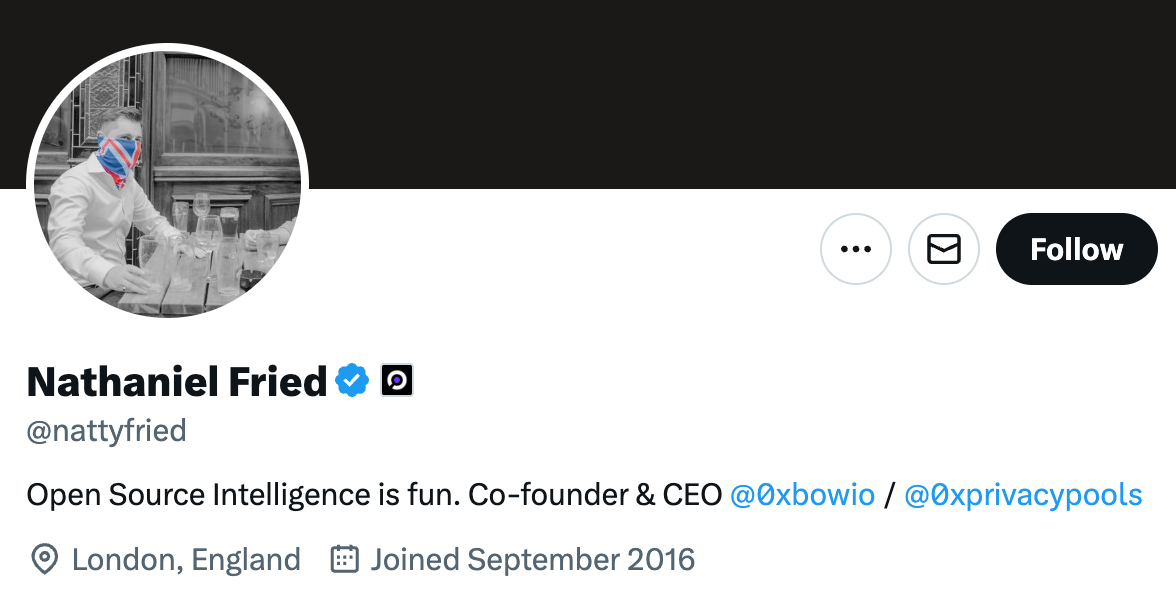
Nathaniel Fried is relatively less experienced compared to the other two. Prior to joining 0xbow, he worked at Blacklake, a firm focused on national security, and at a UK-based open-source intelligence company and nonprofit. His X profile also reflects a strong interest in open-source intelligence.
According to The Block, before this latest round, 0xbow had already received investments from Bankless, Number Group (where Zak Cole is co-founder and CEO), Public Works, Sam Kazemian (founder of Frax), and Dan Finlay, lead developer of MetaMask.
Ethereum's Kohaku Privacy Vision
Vitalik recently unveiled Kohaku, a privacy toolkit framework for Ethereum, at an Ethereum developer conference in Argentina. We briefly summarized Vitalik’s plan in our article “Vitalik’s ‘Don’t Be Evil’ Roadmap: Privacy’s New Role in Ethereum’s Narrative.”
In short, Kohaku aims to package protocols like Privacy Pools and Railgun into composable modules, with future expansion planned into network-layer anonymity and zero-knowledge-proof-based browsers. Supporting this effort, the Ethereum Foundation has formed a Privacy Cluster comprising dozens of researchers and engineers, rebranding its former Privacy & Scaling Explorations team as the “Privacy Stewards of Ethereum,” shifting focus from pure research to engineering implementation around concrete use cases such as private voting and anonymous DeFi. The future of Ethereum will resemble a “transparent settlement layer + programmable privacy layer” hybrid, rather than a simple binary choice between full transparency and complete opacity.
Kohaku is not a standalone product but a suite meant to be integrated into wallets and other applications. For example, once MetaMask integrates Kohaku, users could perform anonymous transfers using Privacy Pools as the backend.
For users, 0xbow serves more as a privacy tool than a means to farm airdrops. Especially for those managing large amounts of capital, the protocol offers a secure way to transfer funds to new addresses when wallet keys have been frequently copied or otherwise compromised. However, there are some underlying logical flaws: for large depositors, withdrawing significant amounts automatically excludes smaller depositors from the association set.
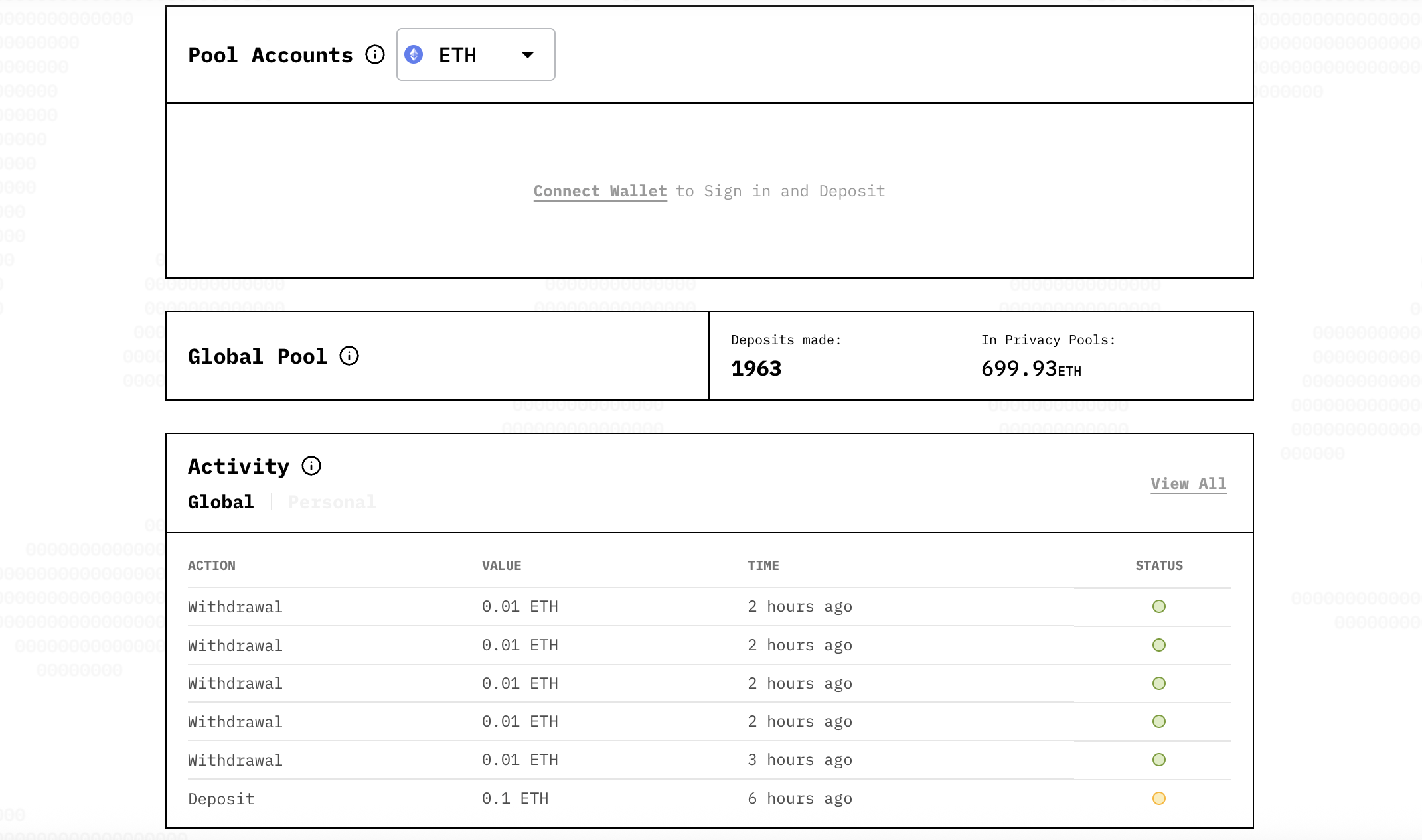
For instance, suppose 10 people deposit into a pool—nine deposit less than 1 ETH each, and one deposits 100 ETH. If the large depositor withdraws more than 1 ETH at a time or makes frequent withdrawals, their activity becomes easily traceable. Users are advised to pay attention to the total pool size and others' deposit amounts to avoid actions intended to enhance privacy from instead revealing more information about themselves.
Join TechFlow official community to stay tuned
Telegram:https://t.me/TechFlowDaily
X (Twitter):https://x.com/TechFlowPost
X (Twitter) EN:https://x.com/BlockFlow_News
 Foresight News







