Ethereum Interop Roadmap: How to Unlock the Last Mile for Mass Adoption?
TechFlow Selected TechFlow Selected
Ethereum Interop Roadmap: How to Unlock the Last Mile for Mass Adoption?
We are witnessing another structural upgrade in the Ethereum ecosystem.
 Navigating Web3 tides with focused insights
Author: imToken
In the Web3 world, from "cross-chain" to interoperability (Interop), it has always been a long-standing narrative.
Of course, many people may not strictly distinguish between the two concepts. To summarize in one sentence, cross-chain focuses more on assets and mainly solves the problem of "moving" them; while interoperability (Interop) covers multiple dimensions including assets, states, and services, aiming to solve the issue of "collaboration."
As modularization increases the number and heterogeneity of L1s/L2s, users and liquidity are further fragmented. Interoperability is now widely recognized as the ideal endgame—users no longer perceive which chain they're on, simply submitting an intent once, after which the system automatically completes operations in the most suitable execution environment.
With the recent release of a new UX roadmap by the Ethereum Foundation (EF), along with engineering advances around withdrawal delays, message passing, and real-time proofs, the pieces of interoperability are being methodically assembled.
1. What Exactly Is "Interop"?
Briefly, "interoperability" is far more than just an "asset bridge"—it's a full suite of system-level capabilities.
It means different chains can share state and proofs, smart contracts can invoke each other’s logic, users enjoy a unified experience, and all execution environments maintain equivalent trustworthiness within security boundaries.
When these capabilities are simultaneously met, users can finally focus purely on value creation, freed from network switching, repeated authorizations, or fragmented liquidity. This aligns precisely with the ultimate goal of cross-chain engineering: enabling users to concentrate on value flow itself, rather than barriers between chains (see further reading: The Evolution of Cross-Chain Engineering: From "Aggregated Bridges" to "Atomic Interoperability," What Future Are We Heading Toward?).
Especially since 2024, as modular narratives have entered a period of explosive growth, an increasing number of fragmented L1s and L2s have emerged, making interoperability no longer just theoretical protocol-layer talk but something increasingly embedded into mainstream user experiences and foundational application logic.
Whether it's intent-centric execution architectures, cross-chain aggregators, or omnichain DEXs—these new application forms all pursue the same goal: allowing users and liquidity to operate beyond Ethereum's mainnet without frequent network switching, enabling asset swaps, liquidity provision, and strategy execution through a single interface in one place.
In other words, the ultimate vision of interoperability lies in completely abstracting blockchains away from users' view—allowing dApps and projects to return to a user-centered product paradigm, creating simple-to-use, Web2-like low-barrier environments that remove the final obstacles for outsiders entering the Web3 world seamlessly.
After all, from a product perspective, mass adoption doesn't hinge on everyone understanding blockchain—but on letting them use it without needing to understand it. In this sense, if Web3 aims to reach billions, interoperability is precisely the infrastructure for that "last mile."
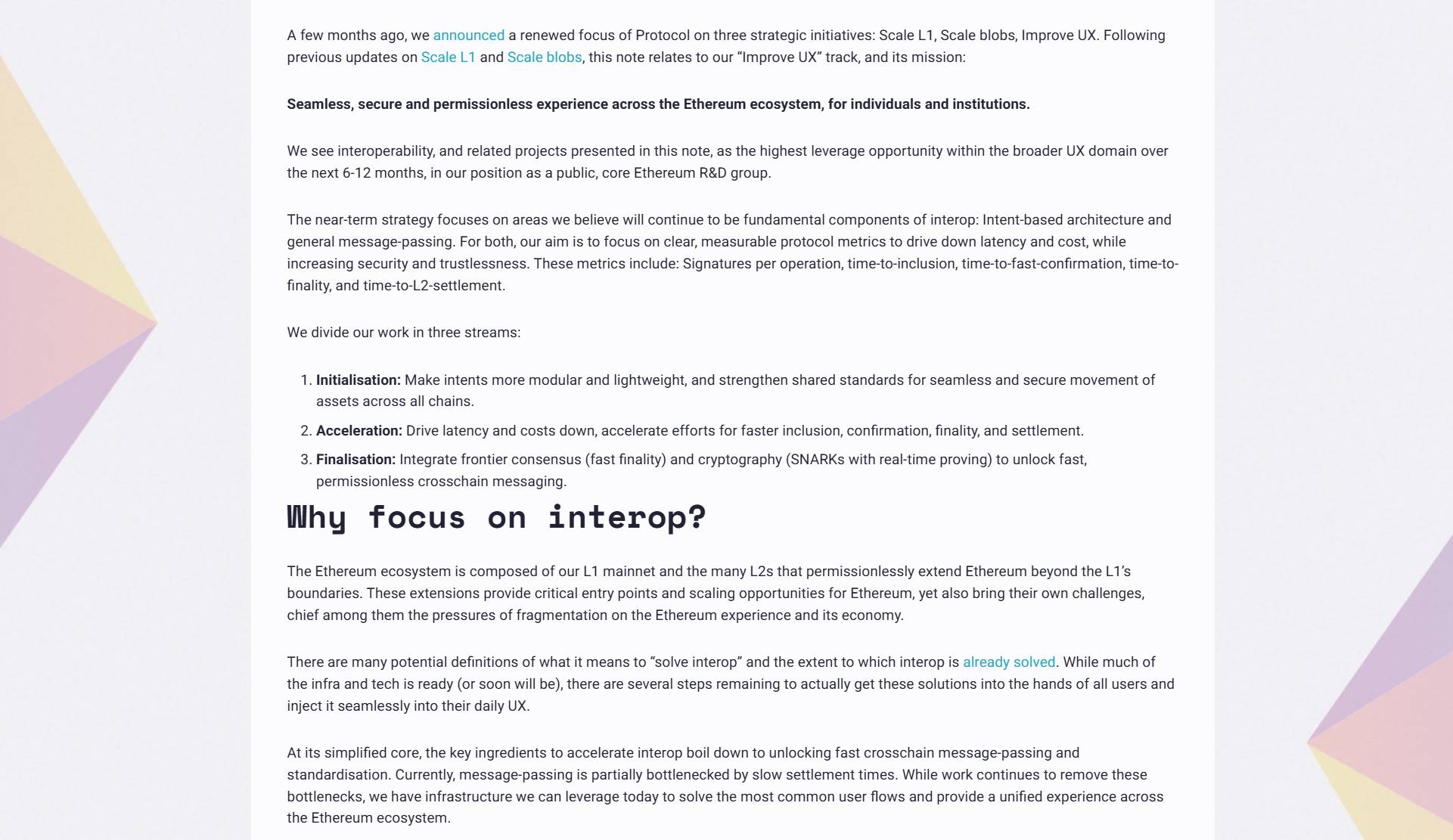
Back on August 29, the Ethereum Foundation released "Protocol Update 003 — Improve UX," continuing EF's three strategic directions following its R&D team reorganization this year—Scale L1 (mainnet scaling), Scale Blobs (data expansion), and Improve UX (enhancing user experience).
Among these, the core theme of "Improve UX" is interoperability.
Source: Ethereum Foundation
2. From "Cross-Chain" to "Interoperability": Signals from EF
This EF article emphasizes interoperability (interop) as the core, targeting a seamless, secure, permissionless Ethereum ecosystem experience. Its essence can be summarized in one sentence: Asset bridging is only the first step; true "interoperability" lies in cross-chain collaboration of data, state, and services. The future Ethereum plans to make all Rollups and L2s "appear as one chain."
EF also acknowledges that although most infrastructure and technologies are already mature (or nearly so), delivering these solutions to users and naturally integrating them into wallet and dApp daily usage requires several key engineering implementation steps.
Hence, EF has divided the "Improve UX / Interop" R&D work into three parallel tracks: Initialization, Acceleration, and Finalisation.
First comes "Initialization," aiming to serve as the starting point of interoperability, making Ethereum's cross-chain actions lighter and more standardized.
Core tasks include making intents lighter and more modular, establishing universal standards to unify paths for cross-chain assets and operations, and providing interchangeable, composable interfaces across different execution layers.
Key projects being implemented include:
-
Open Intents Framework (OIF): A modular intent stack co-developed by EF with Across, Arbitrum, Hyperlane, LI.FI, OpenZeppelin, etc., supporting free combinations of different trust models and security assumptions;
-
Ethereum Interoperability Layer (EIL): Led by the ERC-4337 team, building a permissionless, censorship-resistant cross-L2 transaction transport layer so multi-chain transactions feel as natural as single-chain ones;
-
A set of new standards (ERC series): Covering interoperable addresses (ERC-7828/7930), asset aggregation (ERC-7811), multicall (ERC-5792), and intent & generic message interfaces (ERC-7683/7786);
The goal is straightforward: decouple "what the user wants to do" (declarative) from "how the system executes it" (procedural)," enabling wallets, bridges, and verification backends to collaborate under a unified semantic framework.
Next is the "Acceleration" phase—reducing latency and cost to make multi-chain interactions more real-time.
This focuses on measurable metrics such as signature count, inclusion time, fast confirmation, finality, and L2 settlement, with initiatives including L1 fast confirmation rules (advancing strong confirmation to 15–30 seconds), shortening L1 slot times (from 12s down to 6s through research and engineering prep), and reducing L2 settlement/withdrawal windows (cutting optimistic rollup’s 7-day delay to 1–2 days, or introducing ZK proofs and 2-of-3 fast settlement mechanisms). These efforts essentially lay the groundwork for cross-domain messaging and unified user experience.
Finally, "Finalisation" involves combining real-time SNARK proofs with faster L1 finality to explore second-level finality in interoperation. Long-term, this will reshape the landscape of cross-domain issuance, bridging primitives, and cross-chain programmability.
Objectively speaking, within the Ethereum context, Interop is no longer limited to the concept of an "asset bridge," but rather a collective term for a comprehensive system-level capability:
-
Cross-chain data communication—different L2s sharing state or verification results;
-
Cross-chain logic execution—a contract invoking logic on another L2;
-
Cross-chain user experience—users see only one wallet, one transaction, not multiple chains;
-
Cross-chain security and consensus—maintaining equivalent security boundaries across different L2s via proof systems;
From this perspective, Interop can be seen as the future common language among Ethereum ecosystem protocols—not just transferring value, but sharing logic.
3. How Is Ethereum Paving the Way for "Interoperability"?
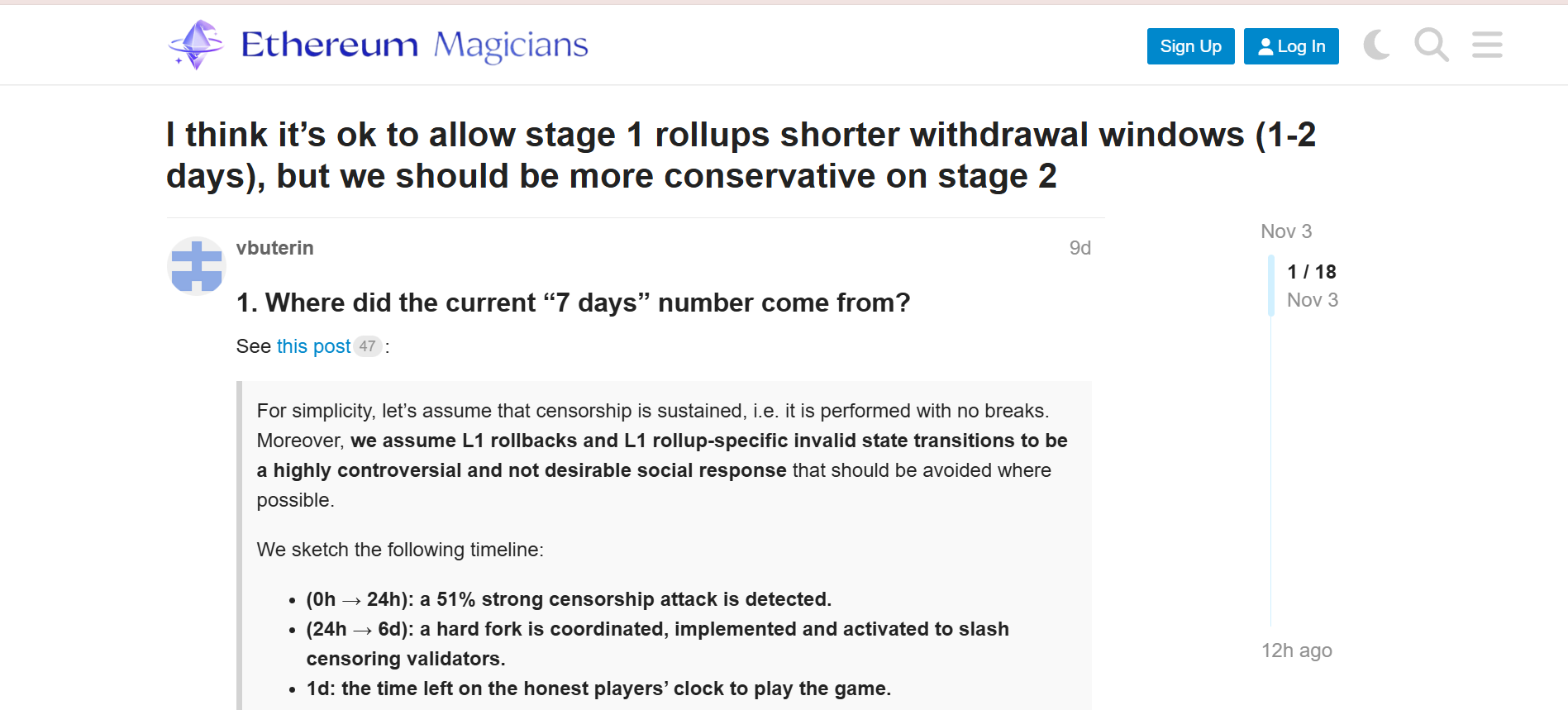
Notably, Vitalik recently initiated a discussion on the Ethereum Magicians forum about shortening Stage-1 optimistic rollup withdrawal times, proposing to reduce the traditional 7-day withdrawal period to 1–2 days, and advocating for progressively faster settlement and confirmation mechanisms under controllable security conditions.
While this discussion appears related to Rollup withdrawal experience, it directly echoes one of the three Interop directions—Acceleration.
Source: Ethereum Magicians
After all, withdrawal delay isn't merely a user experience issue of waiting too long—it's a liquidity bottleneck for the entire multi-chain collaboration system:
-
For users, it determines how quickly funds move between different Rollups;
-
For intent protocols and bridge networks, it affects capital efficiency;
-
For the Ethereum mainnet, it determines whether the ecosystem can maintain consistency and security amid higher-frequency interactions;
Vitalik’s stance is essentially opening the floodgates. In short, shortening withdrawal times is not just about improving Rollup UX—it's an infrastructural upgrade unlocking rapid cross-domain message, liquidity, and state transfer. This direction fully aligns with EF’s goals under the "Acceleration" track: reducing confirmation time, accelerating settlement, lowering in-transit capital costs, ultimately making cross-chain communication real-time, trustworthy, and composable.
This series of efforts will converge at the Devconnect event held in Argentina on November 17. According to the official agenda, Interop will be one of the key themes this year, with the EF team unveiling further details about EIL (Ethereum Interoperability Layer).
Overall, everything points in the same direction—Ethereum is completing a shift from "scaling" to "integration."
Of course, this article—the first in the Interop series—only raises the foundational question that interoperability, not cross-chain, is the endgame, offering an initial glimpse into the structural upgrade underway in the Ethereum ecosystem—from EF’s technical roadmap to Vitalik’s live discussions, from standardized engineering deployment to gradually shortened settlement cycles.
We’ll continue exploring from various angles why interoperability is not just a bridge, but the foundational protocol connecting Ethereum’s future.
Stay tuned.
Join TechFlow official community to stay tuned
Telegram:https://t.me/TechFlowDaily
X (Twitter):https://x.com/TechFlowPost
X (Twitter) EN:https://x.com/BlockFlow_News
 @imTokenOfficial