Perp DEX Industry In-Depth Research Report: Comprehensive Upgrades from Technological Breakthroughs to Ecosystem Competition
TechFlow Selected TechFlow Selected
Perp DEX Industry In-Depth Research Report: Comprehensive Upgrades from Technological Breakthroughs to Ecosystem Competition
The Perp DEX sector has successfully crossed the technical validation phase and entered a new stage of ecosystem and model competition.
 Navigating Web3 tides with focused insights
Author: Yiran (Bitfox Research)
Executive Summary
The perpetual contract DEX sector experienced explosive growth in 2025, with market share surging from 5% at the beginning of the year to 20-26%, and quarterly trading volume surpassing $1.8 trillion. Hyperliquid continues to lead with $4.78B TVL and robust on-chain order book technology, but faces intense challenges from emerging platforms like Aster and Lighter. Zero-fee models and aggressive airdrop strategies have reshaped the competitive landscape, though their sustainability remains questionable. Technological innovation (ZK-Rollup, app-chains) and business model breakthroughs (permissionless listings, yield-bearing collateral) are advancing in parallel, ultimately building a more open and transparent derivatives trading ecosystem in the long term.
I. Industry Background and Development Status
1.1 Structural Shift from CEX to DEX
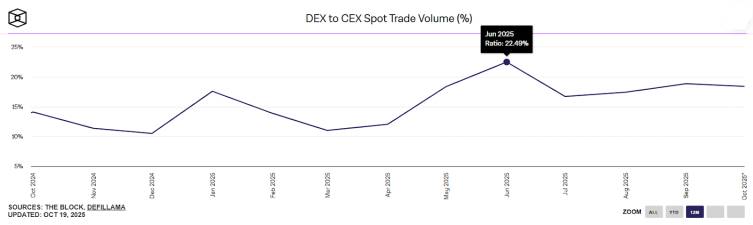
2025 marks a watershed moment for Perp DEX development. Latest data shows that DEXs' share of the perpetual contract market has surged from around 5% in early 2024 to 20-26%, with Q3 trading volume reaching a record $1.8 trillion—up 87% from Q2’s $964.5 billion. Q3 DEX spot trading volume hit $1.43 trillion, marking the strongest quarterly performance on record and signaling a structural shift in crypto market pricing. This growth is driven by fundamental technological breakthroughs and the rebuilding of user trust.
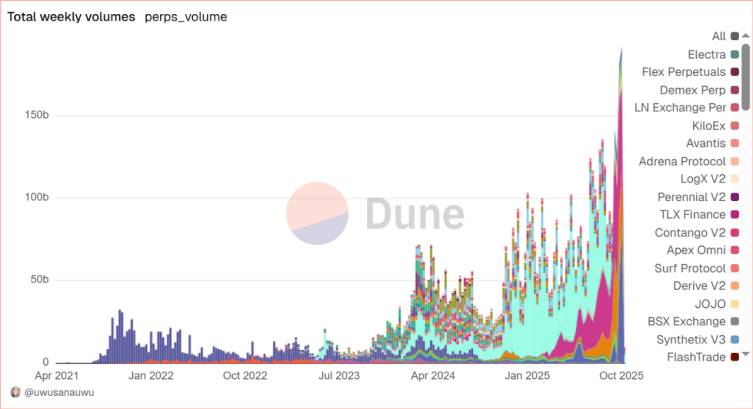
Events such as the FTX collapse and Binance's token depeg on October 11 fundamentally changed users’ perception of centralized custody. "Not Your Keys, Not Your Coins" is no longer just a slogan but a harsh lesson. The DEX-to-CEX futures trading volume ratio reached an all-time high of 0.23 in Q2 (equivalent to 23% of CEX volume), compared to less than 2% two years ago.
1.2 Intense Competition in the Perp DEX Market
Based on data from October 21, 2025, the current Perp DEX market exhibits clear head dominance.
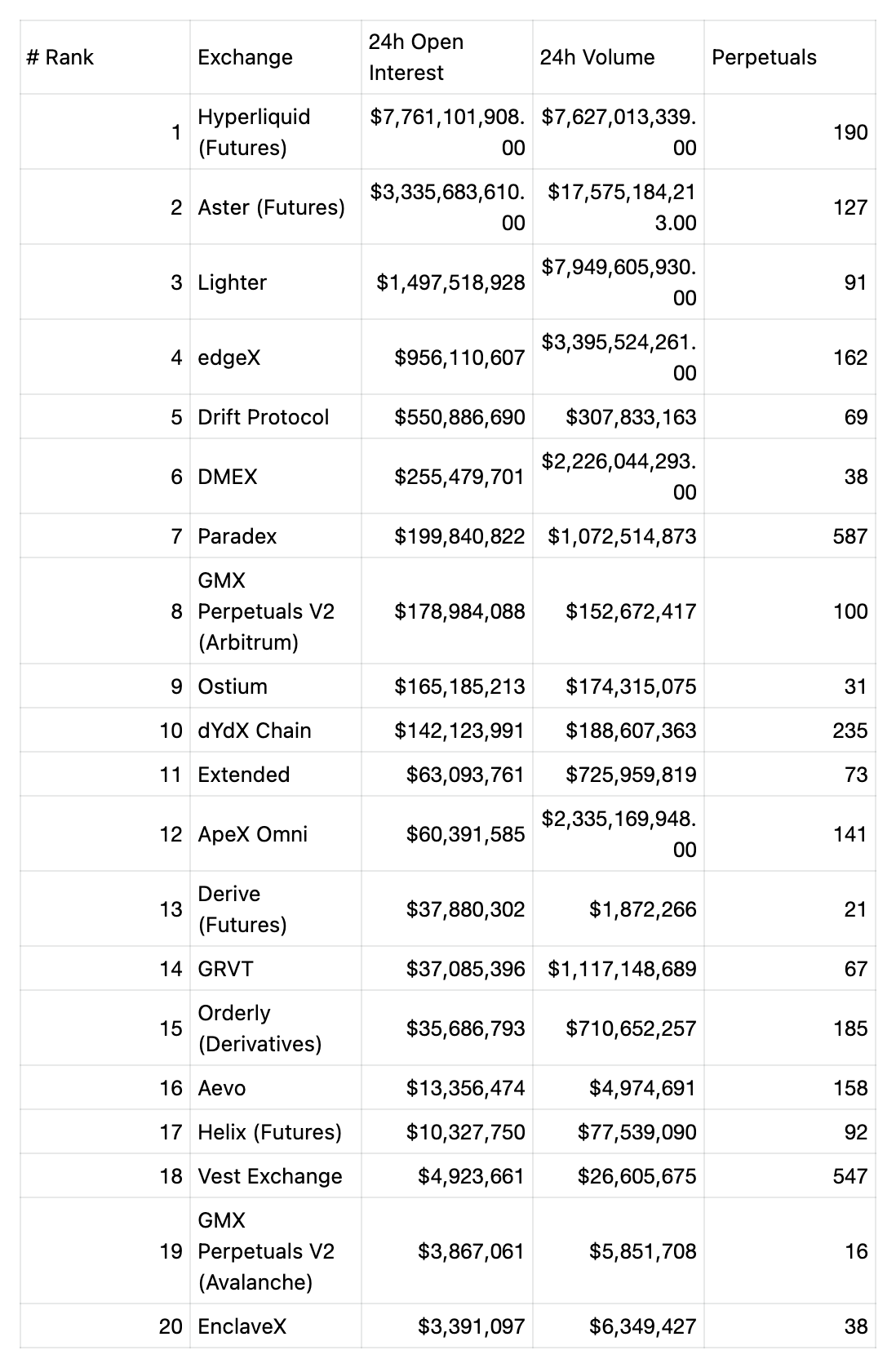
In 2024, Hyperliquid rapidly emerged as the leader in the decentralized derivatives space, capturing over 65% of trading volume and significantly outpacing rivals like Jupiter and dYdX. However, rising interest in decentralized derivatives and strong performance of the HYPE token soon attracted a wave of new competitors.
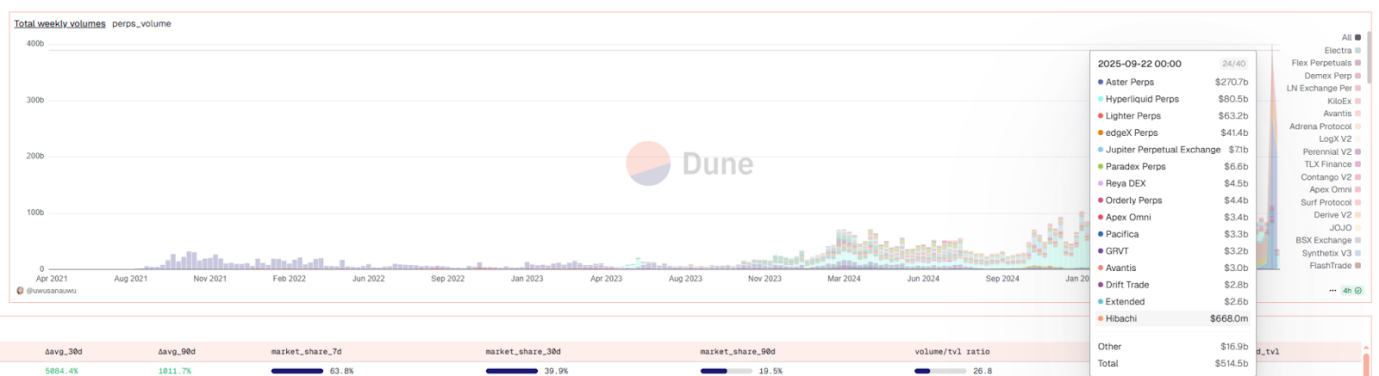
Aster stands out most prominently, quickly overtaking Hyperliquid to become the top decentralized derivatives trading platform by volume, with current daily trading volume approximately three times that of the latter. In July this year, Hyperliquid still held about 65% of the sector’s trading share and had maintained its lead since its mainnet launch at the end of 2024. But according to data from October 20, 2025, in the past week’s breakdown of perpetual contract trading volume among the top ten protocols, Aster accounted for 40%, Lighter around 17%, while Hyperliquid dropped to 7.67%.
Perps Volume Market Share—top 10 protocol
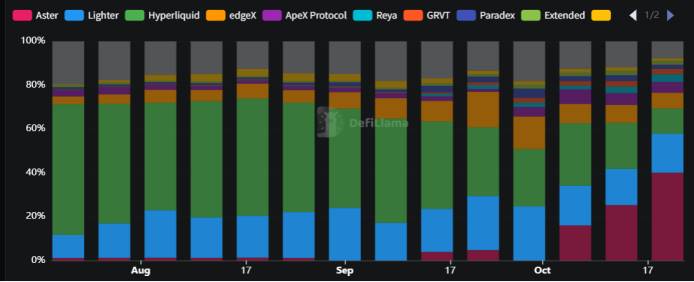
In terms of user scale, Aster also demonstrates significant advantages, leveraging BNB’s powerful ecosystem to surpass 4.6 million total users. By contrast, Hyperliquid reached 750,000 users after one year of operation, showing notably slower growth. Besides Aster, competitors such as Lighter and edgeX have also performed strongly recently, intensifying competition for Hyperliquid.
However, this shift in market share did not occur within a stagnant market. Hyperliquid’s trading volume has remained largely unchanged—or even slightly increased. The entry of Aster into the market, along with trading incentives, brought massive incremental volume. For example, during the week of September 22–29, Hyperliquid’s transaction volume was $80 billion, still at a historically high level. It simply paled in comparison to Aster’s staggering $270 billion in trading volume during the same period.
II. Core Project Analysis in the Perp DEX Sector
2.1 Hyperliquid: The Moat and Hidden Risks of a Performance King
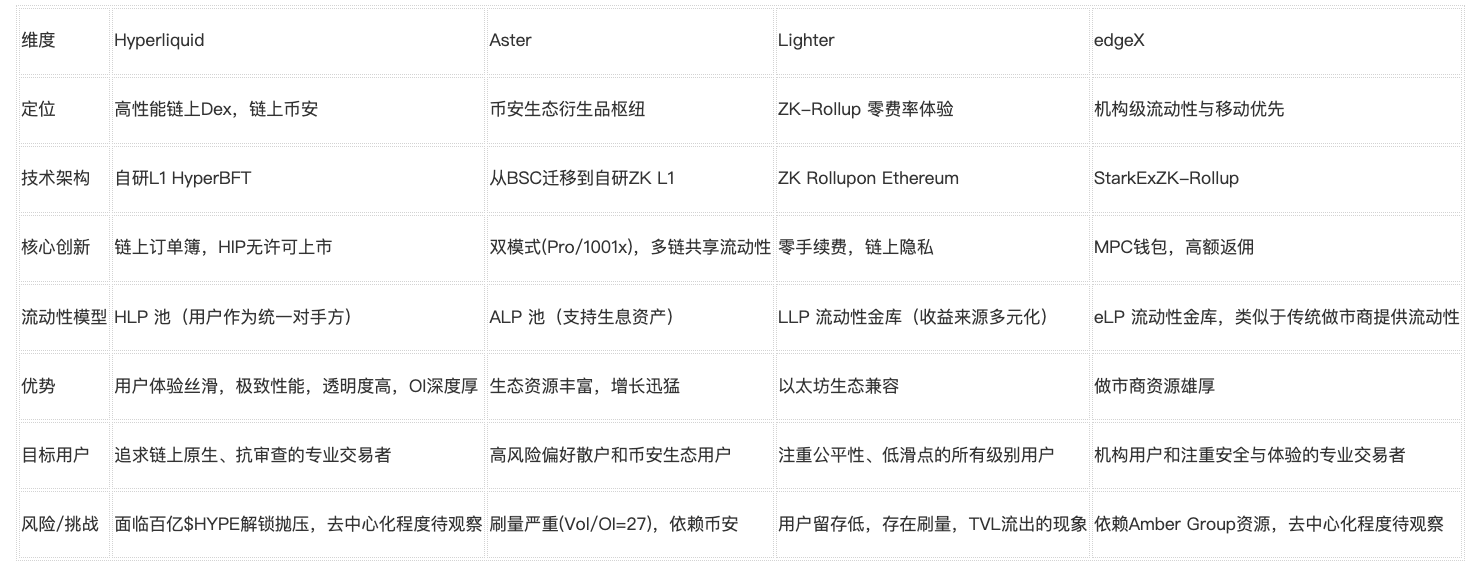
Hyperliquid is a high-performance Layer 1 blockchain focused on derivatives trading, aiming to build a fully on-chain open financial system. Its TVL grew steadily from $4.02B in July to a peak of $6.35B in September, and although it has recently pulled back to $4.78B, it still maintains industry leadership. Its HIP-3 proposal has ushered in a new era of permissionless asset listing, making perpetual contracts for traditional assets such as stocks and commodities possible.
Technical Advantages: Hyperliquid achieves a true on-chain central limit order book (CLOB) through its HyperBFT consensus mechanism. Centered on its on-chain order book technology, it offers users a fast trading experience comparable to centralized exchanges (confirmation time under 1 second) and processing capacity of up to 200,000 orders per second. Most of the platform’s trading volume comes from derivatives such as perpetual contracts, and it has achieved rapid growth through unique economic models—airdropping its HYPE token to the community and using platform revenue for buybacks—without seeking traditional venture capital funding.
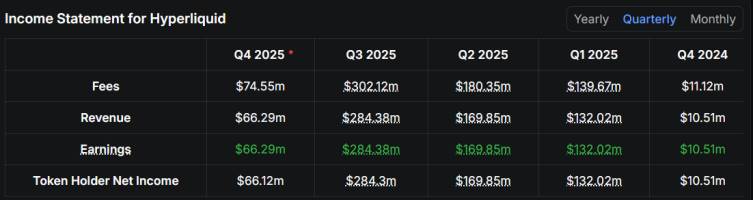
Revenue Model: Hyperliquid employs a highly sustainable tokenomics model. Its financial data strongly proves the effectiveness of this model—the vast majority of fees generated by the platform (such as the $302 million in Q3 2025 shown in the chart) are almost entirely converted into “net income for token holders” ($284 million in the same period) and explicitly used for $HYPE token buyback and burn. This deflationary mechanism, which directly ties platform success to token value, not only enables explosive wealth growth during bull markets (e.g., over 27x revenue increase within a year), but also provides solid price support during bear markets through continuous buybacks, making it highly attractive.
Potential Risks: Faces pressure from large-scale SHYPE token unlocks. According to its token unlock schedule, approximately 19.83 million SHYPE tokens will unlock in Q4 2025 (5.3% of circulating supply), marking only the beginning of long-term selling pressure. A more severe challenge begins at the end of November 2025, when a total of 238 million core contributor tokens will start linear unlocking, expected to create a daily sell-off pressure of about $17 million between 2027 and 2028. This far exceeds the current ~$2 million daily buyback capacity of the “aid fund,” resulting in a sell pressure 8.6 times greater than buyback capacity—a significant structural resistance. Additionally, the protocol’s relatively centralized governance structure (secured by only 24 validator nodes) contrasts with more decentralized networks like Ethereum, potentially introducing single points of failure.
2.2 Aster: The Double-Edged Sword of Aggressive Growth
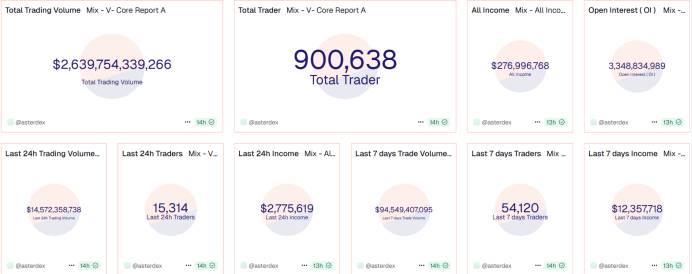
Aster is arguably the most controversial project of 2025. Its TVL saw a jaw-dropping sixfold surge in late September (from $367M to $2.27B), with daily trading volume briefly exceeding $27 billion—but this “rocket-like” growth has sparked skepticism.
Technological Innovation: Aster demonstrates deep insight into user needs. Its product design is not merely a feature stack but a dual-mode platform serving both professional traders and retail users. Currently deployed primarily on BNB Chain, it uses a hybrid “order book + vAMM” model. The order book ensures precise pricing for major coins, while vAMM supports ultra-high leverage (e.g., 1001x) trading for long-tail assets. It innovatively introduces yield-generating assets as margin—for example, allowing users to trade with liquid staking tokens like asBNB or native yield-bearing stablecoin USDF—significantly improving capital efficiency and enabling “trading while earning interest.” For institutional users, Aster emphasizes privacy-first features like “hidden orders,” effectively protecting large order strategies from MEV attacks. Early deep integration with Binance’s ecosystem provided a massive initial user base and liquidity, and public endorsements enhanced market trust, laying a solid foundation for future growth.
Controversy: DefiLlama delisted Aster on October 5 due to data anomalies, primarily because of an abnormally high trading volume to open interest ratio (as high as 27x), far beyond normal levels. While the official explanation attributes this to market maker activity and points incentives, accusations of “volume inflation” persist.
2.3 Lighter: Pioneering the Zero-Fee Revolution
Lighter represents a completely different business model approach—using zero fees to attract users and monetizing via paid APIs and spreads, similar to the traditional finance “payment for order flow” model. Its TVL achieved a sixfold steady growth (from $186M to $1.10B), demonstrating a linear and sustained development trajectory.
Technological Innovation: Its high-performance trading engine, built on ZK-Rollup, achieves sub-5 millisecond trading latency through verifiable off-chain matching, while ensuring final transparency and security via on-chain settlement. This technology lays a solid foundation for its “zero-fee” model. By offering up to 63% APY in its LLP liquidity vault, it successfully attracted capital and built a vibrant trading ecosystem.
Challenges: Lighter suffers from low user retention, indicating weaker user stickiness. Like Aster, Lighter’s trading volume to OI ratio is much higher than competitors like Hyperliquid. High turnover may suggest significant short-term, speculative behavior rather than long-term, committed users. Thus, Lighter’s long-term profitability is questionable—it must convert the massive traffic drawn by zero fees and airdrop expectations into genuinely sticky users.
2.3 EdgeX: A Differentiated Competitor with Steady Operations
Incubated by renowned market maker Amber Group, EdgeX is a relatively small yet distinctive player in today’s Perp DEX market, holding about 5.5% market share. Rather than adopting extreme strategies in performance or incentives, EdgeX has secured a stable niche through risk management expertise from its market-making DNA and regional focus. It represents another path in the Perp DEX market emphasizing stability and sustainable growth.
Market Strategy: EdgeX’s user base is concentrated in Asian markets (China, Japan, Korea, and Taiwan). It adopts a conservative operating strategy, incentivizing users through multi-dimensional points programs, though its fee structure lacks competitiveness. Its OI/Volume ratio (~0.27), while far below Hyperliquid’s, is significantly higher than Aster and Lighter’s, suggesting less “inflated volume” and more authentic, sustainable user behavior. Its liquidity vault (eLP) size ($147M) is the smallest among the four, but like HLP, it turned a profit during the “October 11” market crash, demonstrating strong risk resilience.
2.5 Emerging Forces and Niche Competitors
● dYdX: A pioneer of the order book model, now migrated to an independent app-chain aiming to build a fully decentralized, high-performance derivatives exchange.
● GMX: Pioneered the multi-asset shared liquidity pool (GLP) model, known for slippage-free trading and “real yield,” popular among retail investors.
● Paradex (incubated by Paradigm): Focuses on unified margin accounts and institutional-grade services.
● Orderly Network: Provides derivative trading capabilities as infrastructure for other applications.
● Drift Protocol: Holds a key position in the Solana ecosystem, offering a one-stop cross-margin trading experience.
The current Perp DEX landscape is fiercely competitive, featuring diverse development models including high-performance on-chain order books, high-leverage incentives, zero-fee structures, and institutional services. In terms of long-term potential and resilience across market cycles, Hyperliquid stands out with its solid technical architecture (self-developed L1 on-chain order book), exceptional performance, and highly transparent, sustainable tokenomics (revenue directly used for buybacks and burns). Its deflationary mechanism, deeply tying platform success to token value, captures value in bull markets and supports token prices through continuous buybacks in bear markets, creating a deep moat. In contrast, Aster’s aggressive growth is shadowed by volume inflation concerns, Lighter’s zero-fee model struggles with user retention and profitability, and EdgeX is limited by its niche market positioning. Future Perp DEX models will continue evolving, but core competitiveness will increasingly center on the combination of technological innovation, sustainable economic models, and genuine user stickiness—not just short-term incentives.
III. Technological Breakthroughs: Architectural Evolution and Overcoming Performance Bottlenecks
3.1 Evolution of Scalability Technology Paths
Current mainstream technical architectures fall into three paths, each with pros and cons suited to different strategic goals:
1. App-Chain Paradigm: Exemplified by Hyperliquid, building a dedicated L1 blockchain (e.g., HyperBFT consensus) to maximize performance customization and sovereignty for exchange applications. Advantages include extreme performance (high TPS, low latency) and a gas-free experience. Drawbacks include extremely high development difficulty and the need to self-manage validators and security. Although customized Layer 1s have multiple validators and are theoretically decentralized, their small number—all controlled by the team—limits actual decentralization.
2. General L2 Rollup Paradigm: Represented by Lighter, built on Ethereum’s ZK-Rollup. Advantages include natural integration with Ethereum’s vast ecosystem and security, benefiting from network effects, and strong asset composability (e.g., LLP tokens can easily plug into mainnet DeFi protocols). With upgrades like Danksharding, cost advantages will become more pronounced. As a Rollup, while only a single Sequencer handles matching (centralized execution layer), verifying ZK proofs requires minimal resources—lightweight nodes can verify them—making verification highly decentralized, thus compensating for “centralized execution.” Additionally, asset ledgers reside on Ethereum’s mainnet, so even if Lighter’s team disappears, users can independently withdraw funds, ensuring full asset security.
3. Mixed Architecture: Aster combines order books with ZK-Rollup in a hybrid setup. CLOB ensures accurate pricing, while a ZK L1 chain supports perpetual contracts with up to 1001x leverage, effectively boosting capital efficiency. Its overall architectural strategy reveals clear phase planning. Currently, Aster cleverly leverages BNB Chain’s mature ecosystem to rapidly launch and aggregate liquidity—a “Trojan horse” strategy avoiding cold-start difficulties of building a new ecosystem. Through a series of ecosystem partnerships, it deeply integrates with trending sectors like on-chain credit and Memes, building a strong community and distribution network. Looking ahead, Aster plans to migrate to its own ZK L1 chain—Aster Chain—a critical leap aimed at fully resolving performance and privacy bottlenecks. With large-scale airdrop incentives, Aster hopes to smoothly transition users and liquidity accumulated on BNB Chain to its sovereign chain, ultimately forming a one-stop trading ecosystem combining high performance, strong privacy, and cross-chain interoperability.
3.2 Revolution in Order Matching: From AMM to On-Chain CLOB
The core of Perp DEX evolution lies in the continuous advancement of order-matching mechanisms, balancing decentralization with performance efficiency.
1. Oracle Pricing Model: Represented by GMX. This model relies entirely on external oracles for pricing, executing trades at those prices. Its advantage is zero slippage, but it sacrifices on-chain price discovery—traders are essentially “price takers.”
2. vAMM Model: Seen in early Perpetual Protocol. This model introduces virtual automated market makers, using mathematical formulas to simulate liquidity pools for trading and pricing. It enables on-chain price discovery but often results in high slippage due to virtualized liquidity, leading to poor user experience.
3. Off-Chain Order Book + On-Chain Settlement: Exemplified by dYdX v3. This is a key hybrid breakthrough. Order matching occurs on high-performance off-chain servers, with only final settlement uploaded on-chain. This approach greatly improved trading speed and user experience in early stages, marking a crucial step toward CEX-level performance.
4. Fully On-Chain Order Book: The next frontier in evolution, led by Hyperliquid. With the emergence of high-performance blockchains like Solana and Monad, and specialized app-chains, placing the entire order book on-chain has become feasible. This model restores full transparency and composability of on-chain trading, aiming to solve latency and front-running issues through infrastructure optimization, representing the ultimate form of decentralized trading.
This evolutionary path clearly shows the industry’s journey from imitation to innovation, ultimately striving to deliver CEX-level trading experiences while preserving the core advantages of decentralization.
3.3 Liquidity Pool Models: Core Innovations Enhancing Capital and Risk Efficiency
DEX liquidity pool models significantly improve capital efficiency and reduce trading slippage through innovative liquidity aggregation and risk management mechanisms.
1. Hyperliquid HLP Model: HLP participates in market making and liquidation processes as a protocol treasury, earning a share of trading fees. This model uses active liquidity strategies, dynamically responding to market changes, but involves complexity in hedging failures and liquidation risks.
2. Aster ALP and USDF Combination: Aster employs a hybrid liquidity setup, using ALP (Automated Liquidity Pool) for “simple mode” on-chain trading. USDF, a yield-generating stablecoin, is fully backed by delta-neutral crypto asset portfolios and short positions. Users can deposit assets like BNB or USDT to convert into asBNB or USDF, gaining up to 20x margin boost.
3. Lighter LLP Shared Risk Model: LLP acts as a single liquidity pool collectively bearing losses, using a shared risk structure. It offers a zero-fee option, with verifiable order matching and liquidation via ZK circuits. LLP earns from counterparty PnL, funding fees, and liquidation fees.
4. Jupiter Liquidity Aggregation Model: As Solana’s leading DEX aggregator, Jupiter aggregates liquidity from over 50 DEXs via its Metis v1 engine, handling over 50% of Solana’s trading volume. Its liquidity aggregation model provides deep liquidity access and minimizes slippage. The newly launched Jupiter Lend protocol features a custom liquidation engine and dynamic risk isolation limits.
For sophisticated traders or institutions seeking maximum capital efficiency and leverage, Aster’s ALP/USDF model may be more appealing, as it maximizes asset utility through delta-neutral strategies and up to 20x margin, albeit with higher complexity and risk. For risk-averse liquidity providers, Lighter’s LLP shared risk model might be preferable, offering clearer revenue structures through zero fees and shared risk, despite collective loss exposure. Hyperliquid’s HLP model resembles a professional, actively managed hedge fund, better suited for users who trust the protocol’s active management and can tolerate potential hedging failure risks. For most ordinary users, Jupiter’s liquidity aggregation model is likely optimal in everyday trading scenarios, providing best prices and lowest slippage by aggregating network-wide liquidity without requiring active management, delivering superior usability and trading experience.
IV. New Dimensions of Ecosystem Competition: The Game from Traffic Grabbing to Value Building
With technical architectures maturing, Perp DEX competition has shifted from pure technical performance to a deeper race in ecosystem building.
4.1 The Double-Edged Sword of Growth Strategies: Aggressive Incentives and “Volume Inflation” Concerns
The most prominent phenomenon in current ecosystem competition is new platforms achieving explosive growth through high incentives, which simultaneously raises questions about data authenticity.
● Aster’s Aggressive Growth: Aster’s provision of up to 1001x leverage and points incentive campaigns pushed its daily trading volume above $27 billion and total users beyond 4.6 million. However, this “rocket-style” growth invites scrutiny. Its trading volume to open interest (OI) ratio is abnormally high, far exceeding normal levels, raising market concerns about widespread “volume inflation” activities aimed solely at earning airdrop points.
● Lighter’s Zero-Fee Model Challenges: Lighter’s zero-fee model successfully attracted massive traffic, but suffers from low user retention. Similar to Aster, its volume-to-OI ratio far exceeds that of more stable players like Hyperliquid, suggesting high short-term speculative turnover rather than long-term, committed users, casting doubt on its long-term profitability.
● Benchmarks of Authenticity and Sustainability: In contrast, Hyperliquid’s trading volume growth is relatively stable, with a healthier OI/Volume ratio. Platforms like EdgeX, despite smaller market share, exhibit significantly higher OI/Volume ratios than Aster and Lighter, indicating more authentic and sustainable user behavior.
4.2 Deep Ecosystem Competition: Assets, Liquidity, Business Innovation, and Fee Models
Beyond traffic, projects are competing on deeper ecosystem dimensions.
● Race in Asset Diversity: Hyperliquid’s HIP-3 proposal pioneered “permissionless asset listing,” enabling rapid launch of perpetual contracts for traditional assets like stocks and commodities, becoming a new strategy to attract long-tail assets and communities. Aster, however, offers a differentiated take—focusing not just on quantity but on integrating asset depth with trading scenarios. For instance, Aster’s 24/7 stock perpetuals feature high-interest targets like Tesla and NVIDIA, aiming to give crypto-native users seamless exposure to traditional markets.
● Innovation in Liquidity and Yield Models: Leading protocols are differentiating themselves to capture capital. For example, Hyperliquid’s HLP market-making pool allows users to deposit USDC to share counterparty PnL, yielding ~6.7% APY, with the protocol injecting about 93% of fees into an aid fund for token buybacks, creating a value-reinvestment flywheel. Aster enables users to use yield-bearing assets (like asBNB or USDF) as margin via its ALP liquidity pool, earning staking yields (asBNB ~5-7% APY) or stablecoin deposit yields (USDF combo up to 16.7% APY) while trading, enhancing capital efficiency. Other innovations are also noteworthy—Lighter’s LLP liquidity vault attracts capital with high APY, earning from counterparty profits/losses, funding fees, and liquidation gains, raising questions about sustainability under a zero-fee model.
● Business Model Transformation: Hyperliquid’s developer incentive program encourages third parties to build on its infrastructure, while Aster’s deep integration with BNB Chain showcases a path to rapid launch via existing traffic. These innovations not only enhance capital efficiency but also generate network effects, driving the entire ecosystem toward greater sustainability.
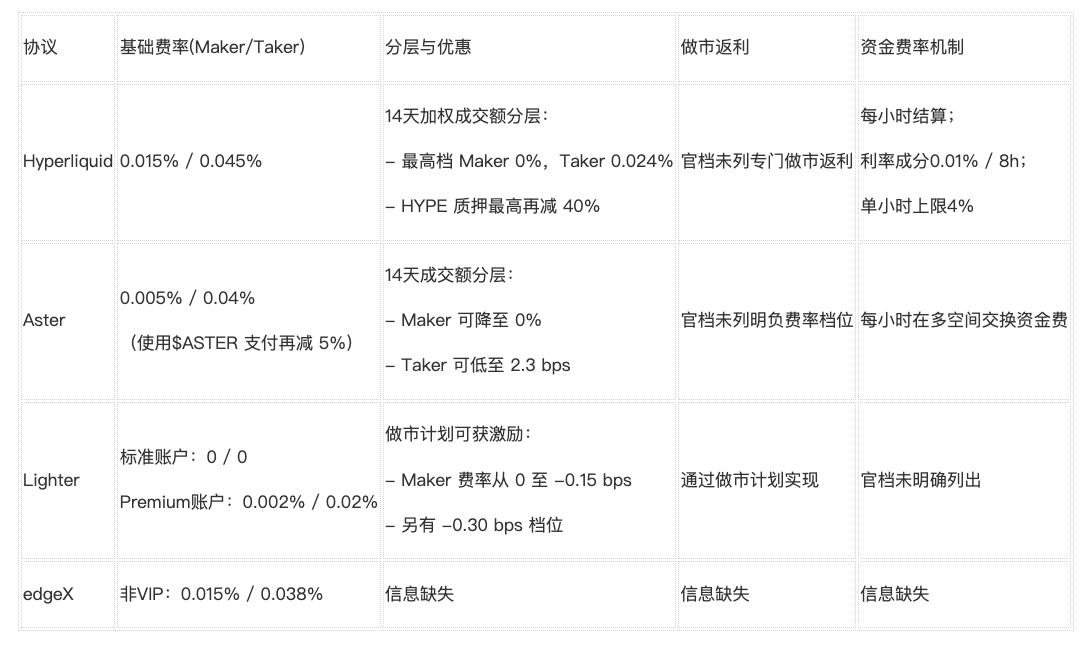
● Fee Comparison: Comparing fee structures across perpetual DEXs allows for differentiated choices based on user profiles: Lighter’s zero-fee standard account is most attractive to retail and low-frequency traders; its Premium account, with very low taker fees, suits high-frequency traders better. For passive market making and large orders, Aster and Hyperliquid are preferred due to advantageous tiered mechanisms and maker rebates. For users sensitive to funding rate volatility, Aster and Lighter offer more suitable mechanisms. In contrast, edgeX shows no clear competitiveness in its current fee structure.
V. Regulatory Challenges: The Sword of Damocles Hanging Above
The breakneck growth of Perp DEXs faces mounting pressure from accelerating global regulatory frameworks, making compliance a key determinant of long-term survival.
5.1 Clarification of Global Regulatory Environments
● United States: The U.S. CFTC and SEC jointly signaled in September their commitment to provide “innovation exemptions” for DeFi venues, explicitly including crypto derivatives like perpetual contracts in safe harbor pilot programs. They also announced roundtable discussions on 24-hour markets, portfolio margining, and coordinated DeFi regulation—indicating regulators are shifting from pure enforcement to constructive framework development.
● European Union: While MiCA regulations apply only to spot crypto assets, any perpetuals, swaps, or other derivatives offered to EU clients automatically qualify as MiFID II financial instruments. ESMA’s final guidance issued in December 2024 explicitly warned that merely operating an English frontend accessible from the EU could invalidate reverse solicitation exemptions—requiring derivatives DEXs to either geo-block or obtain investment services licenses.
● Asia-Pacific Region: Regulatory frameworks in Asia-Pacific are also rapidly improving. Singapore’s MAS requires any platform offering leveraged crypto products (including DEXs) to hold a license under the Payment Services Act; if derivatives are involved, approval as an “organized market” under the Securities and Futures Act is also required. Hong Kong SFC’s roadmap indicates digital asset derivatives trading will be available only to “professional investors,” with strict risk management and off-exchange reporting rules.
5.2 Specific Risks and Responses Facing Projects
● User Jurisdiction Risk: Platforms like Hyperliquid serve many U.S. users, but whether their front-end IP blocking of U.S. addresses can withstand rigorous SEC scrutiny remains highly uncertain. Moreover, their business model heavily depends on user loyalty and sustained revenue growth. If future regulations require KYC/AML implementation, or if macro conditions worsen and trading revenue falls short, their ecosystem sustainability could be compromised.
● Red Lines in Asset Innovation: Products like stock perpetuals explored by various platforms directly enter the deep waters of traditional securities regulation, making them highly vulnerable to coordinated global regulatory crackdowns.
● Exploring Solutions: The industry is actively developing RegTech solutions—on-chain KYC modules, zero-knowledge identity proofs, regulatory sandboxes—to strike a balance between decentralization ideals and regulatory demands.
VI. Future Outlook: Endgame Reflections from Traffic Chaos to Value Reconstruction
In the current Perp DEX traffic battle, the market is gradually shifting from disorderly expansion to structural consolidation. This evolution reflects not only deepening competition but also signals a reconstruction of value creation mechanisms. Below, we explore potential endgame scenarios from perspectives of long-term competitive integration, growth model transformation, institutionalization, regulatory impact, architectural convergence, and value capture.
6.1 Long-Term Competitive Integration Beyond Market Share Battles
The early stage of the Perp DEX market is dominated by traffic-driven fierce competition, but in the long run, this model will evolve unsustainably toward oligopoly and ecosystem synergy. Data from 2025 shows the sector’s trading volume has surpassed $1 trillion, with annual growth exceeding 138%, yet dominant platforms are rapidly concentrating market share among a few leaders. By 2027, DEX perpetual contract trading volume is expected to account for over 50% of the entire derivatives market.
This consolidation won’t happen through simple acquisitions, but via network effects and liquidity aggregation: leading platforms will achieve “winner-takes-all” dynamics through cross-chain bridges and protocol interoperability. A few platforms will dominate over 80% of liquidity, while marginal players will be sidelined or absorbed into ecosystem alliances. This process mirrors oligopolization in traditional finance, pushing the industry from fragmented competition toward scaled collaboration, reducing resource waste and enhancing overall efficiency.
6.2 Evolution from Incentive-Driven Growth to Sustainable Organic Models
Current Perp DEX expansion heavily relies on airdrops, points, and short-term incentives—effective for quick traffic acquisition but prone to bubbles and user churn. In the future, the industry will gradually shift to organic growth models anchored in real yields, with protocol fee buybacks and burns becoming core pillars. For example, some platforms already allocate 99% of revenue to token buybacks, transitioning from speculative incentives to value anchoring.
This evolution will depend on stable fee generation and long-term incentives for liquidity providers. By 2028, organic user retention is projected to rise from today’s 40% to over 70%. By reducing reliance on emissions and strengthening sustainable fee-sharing mechanisms, Perp DEXs will move from “traffic games” to “value cycles,” enabling them to withstand market cycles and achieve endogenous growth.
6.3 Institutional Adoption Trajectory and Market Maturity Indicators
Perp DEXs are currently driven mainly by retail and quantitative traders, but institutional adoption will be a key catalyst for market maturity. 2025 data shows institutional inflows into DEXs have risen from 10% to 25%, thanks to improved risk management and compliance tools on platforms.
Future progress will be gradual: initially attracting hedge funds and asset managers via permissioned access (e.g., KYC/AML options), then scaling integration through standardized APIs and custody solutions. Key maturity indicators include open interest (OI) consistently exceeding $100 billion, institutional trading占比 reaching over 40%, and optimized TVL-to-volume ratio (currently ~0.3, moving toward 0.5). This shift will mark Perp DEXs’ evolution from “retail playgrounds” to “institutional infrastructure,” enhancing market depth and stability.
6.4 Regulatory Framework Reshaping Business Models
Evolving regulatory environments will reshape Perp DEX business models. Current uncertainty has already caused some platforms (e.g., OKX’s DEX project) to delay launches, but in the long term, clear frameworks will foster hybrid models: platforms will need to integrate TradFi elements like licensed compliance and risk disclosure to gain institutional access.
By 2027, major jurisdictions (e.g., EU MiCA and U.S. CFTC rules) are expected to require DEXs to implement optional KYC and AML mechanisms, reshaping revenue models—from pure fee-based to compliance service fees. Meanwhile, regulation will curb high-risk leverage products, pushing platforms toward lower-risk, transparent derivatives. Overall, this transformation will eliminate non-compliant players but provide legitimacy for sustainable models, accelerating integration of Perp DEXs from the “gray zone” into mainstream finance.
6.5 Convergence Trends in Technical Architecture
Perp DEX technical architectures will evolve from diverse experimentation toward standardization, addressing liquidity fragmentation and execution latency. Currently, CLOB (Central Limit Order Book) models dominate, and future developments will further integrate Intent Layers and ZK proofs to achieve cross-chain unified liquidity and privacy protection.
By 2026, 80% of platforms are expected to adopt multi-chain aggregation architectures combined with HyperEVM-like EVM-compatible layers, enhancing composability and settlement speed (approaching millisecond-level from current seconds). This convergence will reduce bridging risks and drive a shift from “isolated on-chain islands” to a “unified execution layer,” supporting trillion-dollar-scale trading volumes.
6.6 Ultimate Value Capture Mechanisms Determining Long-Term Winners
The long-term winners in Perp DEXs will be determined by efficient value capture mechanisms, not mere trading volume. The core lies in closed-loop fee-sharing designs: leading platforms anchor token value and user loyalty through 99% revenue buybacks and burns, ve (vote-escrow) governance models, and PnL sharing in liquidity vaults (HLP). In the future, value capture will emphasize ecosystem closure—integrating lending, staking, and derivatives to enable compound yields, driving the industry from “traffic capture” to “value reconstruction” as the endgame.
Conclusion
The Perp DEX sector has successfully passed the technical validation phase and entered a new stage of ecosystem and model competition. While Aster and Lighter have demonstrated the power of aggressive short-term strategies, their data authenticity and model sustainability face scrutiny. Hyperliquid, in contrast, showcases the advantages of combining technical performance with sustainable economics. The ultimate winners will be ecosystems that establish comprehensive strengths in technology, user experience, economic models, asset innovation, and regulatory response. Despite numerous challenges ahead, the overarching trend of Perp DEXs driving finance toward greater openness and transparency is irreversible, with long-term value firmly grounded and rich in potential.
Join TechFlow official community to stay tuned
Telegram:https://t.me/TechFlowDaily
X (Twitter):https://x.com/TechFlowPost
X (Twitter) EN:https://x.com/BlockFlow_News
 @bitfoxdotai