Bitcoin White Paper 17th Anniversary: Half Sea, Half Flame
TechFlow Selected TechFlow Selected
Bitcoin White Paper 17th Anniversary: Half Sea, Half Flame
From cold-start chasing VC to betting on narratives during favorable trends, traders act independently, yet each interprets the meaning of "using Bitcoin" in their own way.
 Navigating Web3 tides with focused insights
Author: Ethan, Odaily Planet Daily
On October 22, top-tier venture capital firm a16z released its "State of Crypto Report 2025," offering a vivid commentary on the current market maturity. The report paints a picture of a thriving ecosystem: the cryptocurrency market continues to expand, traditional financial institutions are systematically embracing this new asset class, and stablecoins have evolved into a significant force within the global macroeconomic system. Meanwhile, advancements in blockchain infrastructure and deep integration with cutting-edge technologies like AI are opening a new golden era for the crypto industry.
Beneath these broad trends lies the participation and choices of countless individuals. Their shared "underlying consensus" can be traced back 17 years to Satoshi Nakamoto's nine-page Bitcoin whitepaper. The peer-to-peer electronic cash system, proof-of-work mechanism, and distributed ledger structure first proposed in that document formed the foundational trust layer of today’s crypto ecosystem. The whitepaper was not merely a technical proposal, but a social experiment—one centered on decentralization, transparency, and self-sovereignty. Today, that technological ideal has transformed into market reality, becoming the starting point for the behavioral patterns of tens of thousands of traders.
On the 17th anniversary of the whitepaper’s release, rather than simply revisiting that technological revolution, we aim to explore: how have these ideals gradually shaped today’s market behaviors? And who continues to carry forward its rhythm?
To this end, Odaily partnered with Bitget from October 24 to October 30, conducting a survey through community outreach and targeted invitations among traders dealing with major coins, altcoins, meme coins, and other asset types. The goal was to capture, at a micro level, an answer to one question—how do real traders think, make decisions, and adapt to volatility within a crypto world woven together by grand narratives and market desires?
No Philosophy in Trading: Human Nature and Volatility in a Questionnaire
This is a group of genuinely vibrant traders. They cannot depict the complete picture of the crypto market, yet they serve as individual windows into personal worlds. Through the collected survey responses, we see not cold numbers, but vivid portraits of traders whose stories intertwine to form a mosaic of investment behavior in this era.
The overall profile is clear: predominantly young people under 35, with 1–3 years of futures trading experience, most having cross-asset investment backgrounds (such as stocks and gold), frequent trading activity, but win rates generally hovering around “fifty-fifty.”
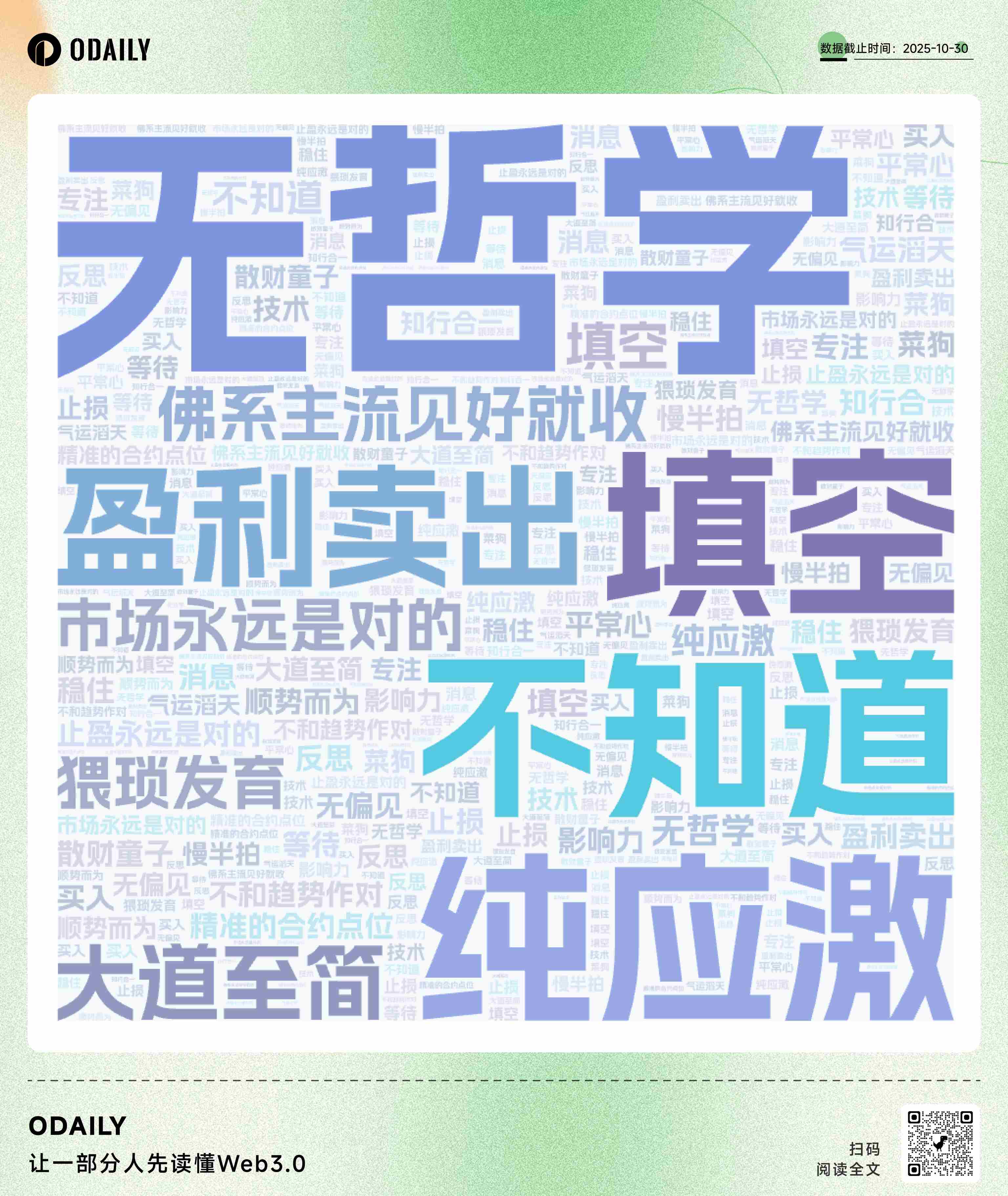
Keywords in trading philosophy
Yet one striking feature stands out—a widespread state of “no philosophy.” When asked about their trading philosophy, a staggering 80% of respondents chose “no philosophy, pure reflex.” This slightly self-mocking phrase accurately captures the reality for most: their decisions heavily rely on “market sentiment/news,” and their actions resemble instinctive reactions to market fluctuations rather than systematic judgments.
Against this common backdrop, individual differences become especially vivid. Jack Wang (pseudonym) perfectly embodies the core traits of a “reflexive” trader. Despite coming from logical, rigorous fields such as tech or internet industries and having one to three years of futures experience, Jack’s trading behavior shows a stark contrast: he relies intensely on market sentiment and news for high-frequency operations (trading more than once daily), with an extremely short decision-making cycle. This pattern turns his trading journey into a high-speed rollercoaster—he once “went all-in on Bitcoin and made 10,000 U,” but also suffered the painful experience of having all leveraged positions liquidated during the “October 11 crash.” He summarizes his win rate as “half sea, half flame,” and his overall return as the helpless “lost it all.”
Facing the extreme volatility of October 11, his initial reaction of “watching/waiting, confused” reveals the real dilemma of most sentiment-driven traders: even with diversified portfolios including gold and stocks outside crypto, systematic risk controls often give way to instinct when confronted with the high volatility of futures.
Outside trading, he strives to maintain a “regular person’s routine,” using “foot baths and massages” to relieve stress. This oscillation between intense tension and attempts to relax makes him a clear, authentic footnote in the crypto world—a regular person constantly seeking balance between a rational professional background and a nonlinear market.
In contrast, Melody Li presents a more complex psychological profile. Like Jack, she comes from the tech or internet sector and brings analytical skills into her trading decisions: focusing on altcoins, relying on fundamental analysis, and maintaining a trading frequency of several trades per week. This rational framework brought her success—she began accumulating ORDI when it was only $5–8, witnessing it rise to $96.
Yet the source of her success also became the root of regret. She laments “not exiting when the momentum was strong,” failing to lock in profits. The rollercoaster-like remorse becomes more agonizing than mere losses. Even during the October 11 crash, her response was contradictory: on one hand “watching/waiting, confused,” on the other hand entertaining thoughts of “adding positions to catch the bottom,” reflecting the common tug-of-war between hesitation and greed among traders.
More importantly, trading has deeply infiltrated her life. Focused solely on cryptocurrency with no other investment interests, this full immersion has gradually altered her lifestyle: her sleep schedule is inverted, and she admits “I have no hobbies outside trading.” This candid confession reveals the invisible pressure new traders face adapting to the high-intensity rhythm of the market—not just financial volatility, but the erosion of personal routines and space.
Melody’s image thus transcends simple profit-and-loss narratives, exposing the real struggles many transitioning from technical fields to crypto trading encounter: even with rational analytical frameworks, emotional disturbances remain hard to avoid, and the pursuit of Alpha continuously blurs the boundaries between life and trading.
Of course, the spectrum also includes brighter figures. Ricardo Ge, a poker enthusiast and seasoned Meme coin trader with over three years of experience, exemplifies an alpha information seeker who favors Bitget’s primary market insights, new project tracking tools, and GetAgent for decision support. With a keen sense of market sentiment, he achieved a 10x return on AIOS, earning 200,000 U. His story portrays a skilled player profiting in high-risk domains through experience and courage.
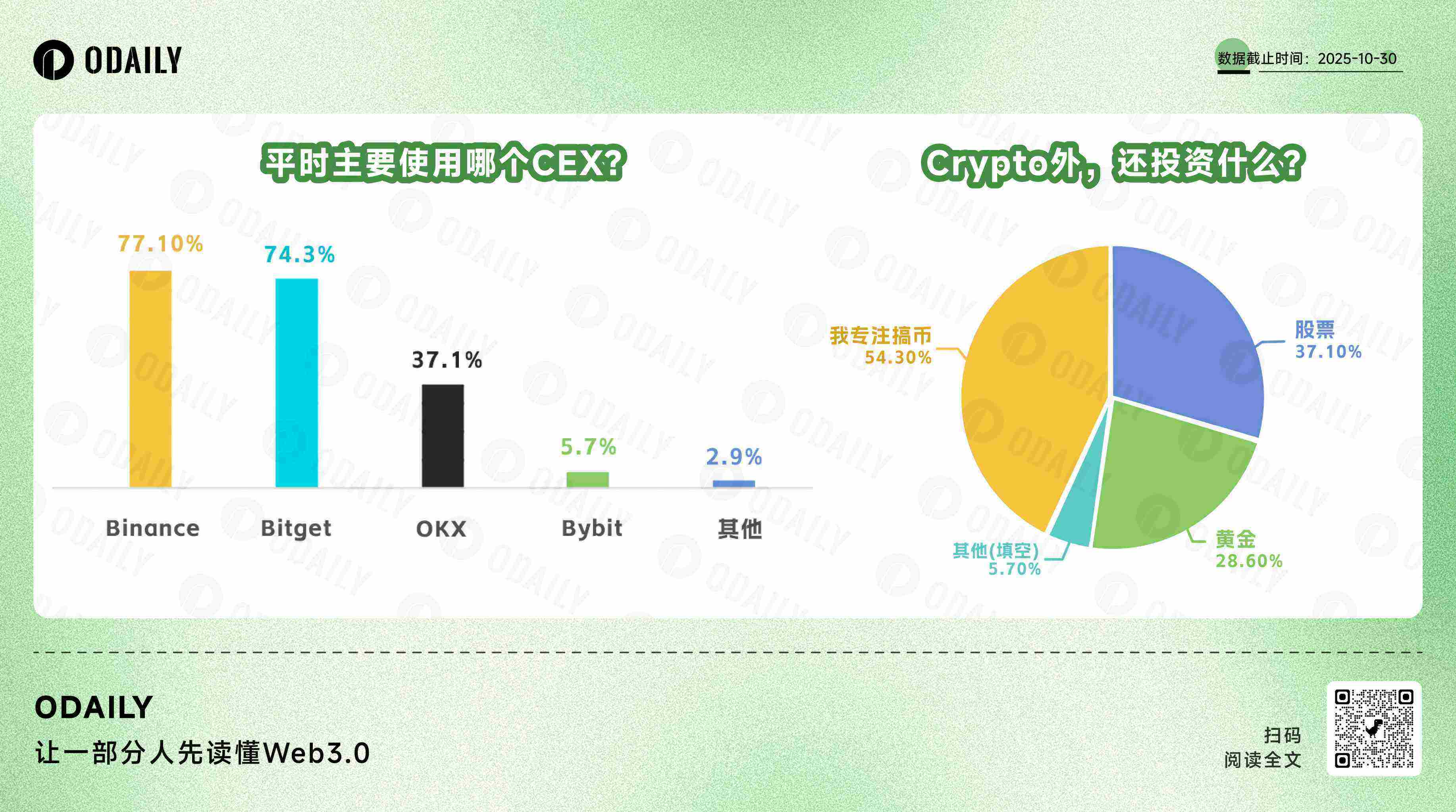
CEX preferences and external investment targets (first question allows multiple selections)
Meanwhile, participant Mark (pseudonym) represents another path—a full-cycle insider “old-timer” with over three years of trading experience, focusing on major coins. His journey is representative: from small spot gains during the “mining rig era” to consistently losing in futures, and personally experiencing multiple black swans like the “September 4 incident.” He distills his trading philosophy into “simplicity is supreme, knowledge and action must align,” embodying a reflective explorer striving to transform complex experiences into simple rules amid market volatility.
Surveying these profiles—from bewildered “pure reflex” traders, to stressed introspectors, to temporarily successful players and those seeking balance—the internal tensions of the crypto trading ecosystem are evident. This world amplifies human weaknesses while testing extreme rationality. It reveals a deeper paradox: participants equipped with cognitive ability and focus often make highly emotional decisions in a market that demands strict discipline.
This disconnect between rational cognition and reflexive behavior may be the most authentic and cautionary essence of crypto trading.
Market浮世绘: Five Traders’ Strategies, Philosophies, and Lives
No one can teach you how to survive in the crypto world—every trader must write their own script. In this chaotic theater, we’ve gathered five low-key yet distinct实战players to paint a “Market浮世绘”—their strategies, philosophies, and lives collectively form a user manual beyond the whitepaper.
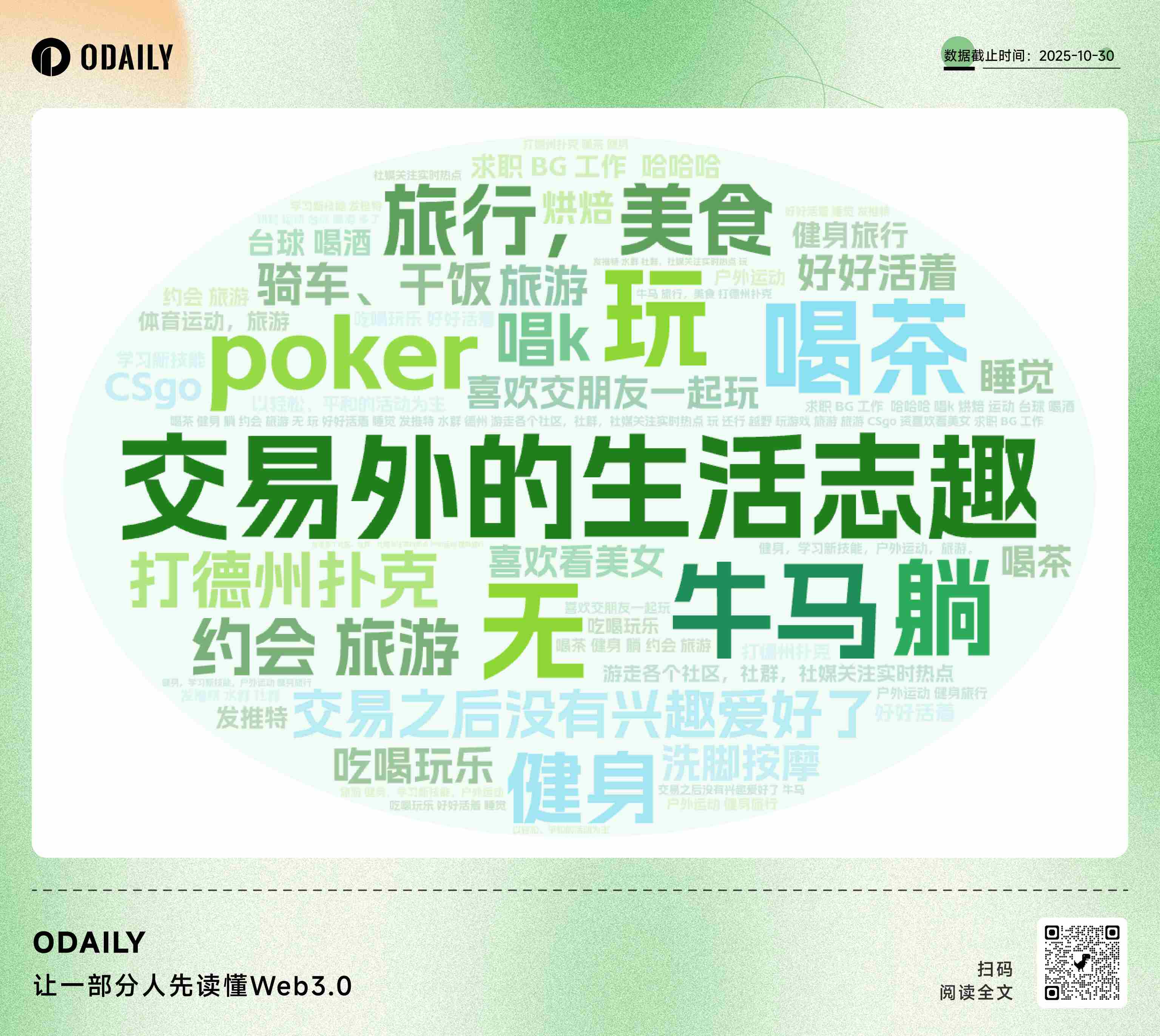
Surveyed traders’ life interests outside trading
Respondent One Profile: One Cannot Stare Only at Charts—Sometimes You Must Look at the Sky
Full-time research and trading analyst Biqiu Huangmu (@HM010169), focusing on altcoins with over three years of futures experience. His world consists of two dimensions—system and epiphany. Within the system, he is an ultra-calculating architect; in moments of epiphany, he becomes an observer awakened by life.
When evaluating early-stage projects, he uses a “four-dimensional scale”: team (35%), sector (25%), economic model (25%), community (15%). Team is paramount—he trusts only founders with solid track records, strong execution, backed by entities like YZi Labs or a16z. He prefers high-potential sectors, especially emerging ones with fundamental demand like AI Infra, RWA, and DePIN. The economic model is treated like a math problem—team allocation ≤20%, private sale ≤25%, ecosystem ≥40%, tied to real utility, ideally with linear vesting and buyback mechanisms. Even with the lowest weight, community standards are strict: organic growth, multilingual penetration, high interaction frequency.
For information gathering, he follows a nearly obsessive “Alpha Hunting Three-Step Method”: Step one, trust only original sources—project teams, VC wallets, builder movements—not secondhand info. Step two, cross-verify using on-chain data, official statements, and community热度—only act if two out of three align. Step three, test the natural fermentation of news across multilingual communities, with the rule—“real news grows on its own, fake news needs shouting.”
For VC project trading strategy, he favors precision-based positioning. On TGE day, he locks in 30–40% profit as a take-profit buffer, then evaluates holding based on unlock schedules, order book depth, and narrative热度, usually deciding to add or exit by day seven. For example, $VULT: low FDV, high circulation, Kraken listing, strong热度, perfect narrative timing—this kind of coin can justify a 60–70% mid-term position, provided VCs don’t dump, tweets continue, and the ecosystem activates; otherwise, immediate full exit.
This process is precise and cool, almost mechanical. But in reality, he once had a period where he was held hostage by market moves. He once joked, “I can’t do anything but stare at charts,” until one morning, sunlight hit his coffee cup and the aroma rose, suddenly making him realize: the market can drain you dry, but life can slowly heal. Since then, he set personal life rules: brew coffee each morning—not for caffeine, but for a few minutes away from screens; run two kilometers in the afternoon to reset his brain; watch the market when it moves, but without emotion—“if I get liquidated, I shut down the computer, light a cigarette, and move on.”
He says: “Crypto taught me volatility; life taught me to let go.” His ultimate insight isn’t found in charts or models, but in that moment of looking up after endless screen-staring—“one cannot only stare at charts; sometimes you must look at the sky.”
Respondent Two Profile: Discipline as Blade—The Mainstream Coin Hunter
A seasoned实战trader with extensive live trading experience, Mandy (@mandywangETH) is the type who trusts rules, not luck. Focusing on major coins, her style is calm and decisive, summarized in one sentence: markets cannot be predicted, but reactions must be precise.
Her trading system eliminates all “feelings”—she watches only price action, uses data as confirmation, and keeps emotions entirely outside the system. What is an exit signal? Not vague thoughts like “it seems to be reversing,” but the complete breakdown of major support levels plus failed rebound confirmation—once confirmed, she exits immediately, without hesitation. She says: “The market is always right; my job is not to question, but to obey.”
In bull markets, she identifies key levels and holds tight, riding the full trend; in bear markets, she hides in the shadows, waiting for hunting signals. “Cycles dictate strategy, discipline ensures execution.” She doesn’t chase news, trust KOLs, or believe stories—only structural analysis builds her trading order.
She has no illusions about future market directions—she doesn’t believe in predictions. The only things she can control are her own rules and reaction speed.
Her lifestyle is equally simple—outside trading, she “eats, drinks, plays,” but maintains clear boundaries, never indulging. Once a typical crypto “workhorse,” burning midnight oil, emotionally driven orders, repeated liquidations, she now survives through a clear system, no longer fantasizing about getting rich quick or dancing randomly with the market.
She won’t tell you the best entry point, but she always knows when to exit. Because she’s not someone guessing the future, but a hunter obeying reality. In her world, emotion is a trap; certainty is the weapon.
Respondent Three Profile: Cautious and Sharp—The “Play Small, Grow Slow” Trader
CryptoPainter_X (@CryptoPainter_X), a “painter” who checks Bitget for market updates even while traveling, is a classic “adjust strategy based on conditions”实战player. He doesn’t cling to a single logic, but flexibly adjusts strategies according to different coin characteristics. For profitable, fundamentally strong major coins, he leans toward long-term holding; for sentiment-driven assets, he focuses on short-term speculation.
Behind this flexible approach lies a deep understanding of market structure and risk management. Stablecoin supply ratio and futures-spot spread are his two most referenced indicators—the former measuring off-exchange capital inflow willingness, the latter reflecting sentiment intensity and directional momentum. To him, data isn’t decorative “support,” but a foundational constraint of his trading system, used to calibrate emotion and intuition. His overall style is calm and pragmatic: supported by indicators, with feedback loops built in.
He calls his trading philosophy “play small, grow slow”—not self-deprecation, but an active choice born of mature cognition. High win-rate strategies aren’t about chasing explosive bets, but about controlling uncertainty. Don’t chase highs, don’t gamble on lows; when trends are unclear, reduce position size, observe, wait—trade space for time, preserving strength for the next offensive.
When judging trend reversals, he rejects “gut-feeling” decisions, relying instead on structural signals—whether higher highs and lower lows show alternating decline. This logic was validated during the “October 11 crash”: adding positions in strong coins, cutting losses in weak ones, executing both directions simultaneously. That wasn’t bravery—it was structurally sound execution.
Coming from tech and internet industries, he retains a programmer’s rationality in trading. Now more like a data-driven market veteran—never shouting “All in,” not trusting KOLs—but relying on self-built systems and strict discipline. That system once delivered a 52x return on principal, embodying his belief: “The real enemy isn’t volatility, but arrogance and impulsiveness.”
In a market that frequently hypes “opportunity windows,” calm players like him—who don’t win big once, but consistently avoid catastrophic losses—form the most overlooked yet most stable force in the crypto market.
Respondent Four Profile: Using Quant to Play a Game of Freedom
UNICORN (@UnicornBitcoin), with a background in traditional finance and experience across stocks, gold, and crypto, over three years of futures trading, achieving over 100x returns—this quant trader speaks softly but backs everything with hard data.
His trading system runs like a continuously operating “factor machine”: centered on cyclical regression, constantly iterating effective factors, eliminating noise and obsolete variables. It’s not one model forever, but an endless “probability experiment”—which factors still work, which must be retired—all decided by backtesting.
Facing market crashes, he doesn’t rely on mysticism or bravado. His operational structure is clear: large capital uses zero leverage, prioritizing survival; small capital takes high leverage, but with precise stop-loss and take-profit settings. During the sharp drop on October 11, the moment the model signaled, he immediately added positions to catch the bottom—no hesitation, no ambiguity.
UNICORN is one of the few traders who has seriously read the Bitcoin whitepaper, holding a rare conviction in “free, supranational currency.” He doesn’t treat this as a slogan, but embeds it into his strategy’s foundation, viewing crypto as a parallel narrative to traditional systems.
This system is calm, clean, replicable—and leads him to summarize his trading philosophy in two words: game life, game trading. He enjoys competitive gaming and raising pets, creating breathing room beyond risk curves.
When asked if he believes “this time is different,” he simply replies: “In front of cycles, nothing is different.”
No emotional peaks, no philosophical footnotes—just a continuously self-calibrating system writing its own annotations in every wave of volatility.
Respondent Five Profile: Finding Coins Through Networks, Winning Through Luck
xiaoyufu (@Cryptostartup11) is a classic “luck-based” trader. He doesn’t stick to technical models or data-driven methods, but integrates information sources, personal networks, and market intuition into a highly personalized trading system.
In evaluating early projects, his framework is straightforward yet essential: team background carries the highest weight, followed by economic model and narrative. He doesn’t complicate it, but the logic is clear—the true determinant of a project’s success is always the people. He values individuals, circles, and information sources. Alpha isn’t mined from charts, but filtered from “friends’ trading styles” and “valuable private channels.” For instance, a Testnet address mentioned by a VC friend at dinner became a launchpad for a hot new coin days later—he calls this a “serendipity” signal trigger.
This method may not be standardized, but it’s profoundly real. He doesn’t seek certainty, but uses intuition and experience to capture fuzzy signals in the crypto market. As he puts it: “Crypto is a world unfolding in two dimensions of data and three dimensions of dreams.” He acknowledges effort and research as foundations, but what truly propels people forward is “overwhelming luck.”
His trading philosophy is exactly these four characters: overwhelming luck. This isn’t blind faith in fate, but a coping mechanism for extreme uncertainty—in the cracks between black swans, irrational bull runs, and community speculation, rationality and mysticism sometimes blur.
Outside trading, he enjoys fitness, travel, and learning new skills—seemingly unrelated to crypto—but he understands clearly: emotional management and physical well-being are the foundation for “receiving signals.” And those “signals” might hide in a dinner conversation, a group chat, or an obscure, unliked Alpha tweet.
Not everyone can replicate his path. But in a market where information is highly skewed and sentiment drives prices, he thrives by valuing serendipity, incorporating networks and luck into his system. This system isn’t written in any whitepaper, yet exists authentically in the “gray zones” of the crypto world.
Summary:
From disciplined “structuralists” to fate-embracing “luck-seekers,” these five traders showcase five distinct survival strategies. Yet in stark contrast to their rich strategies is a general detachment from the original Bitcoin doctrine: among the five, only one has deeply studied the whitepaper, three have skimmed it, and one has never even opened it.
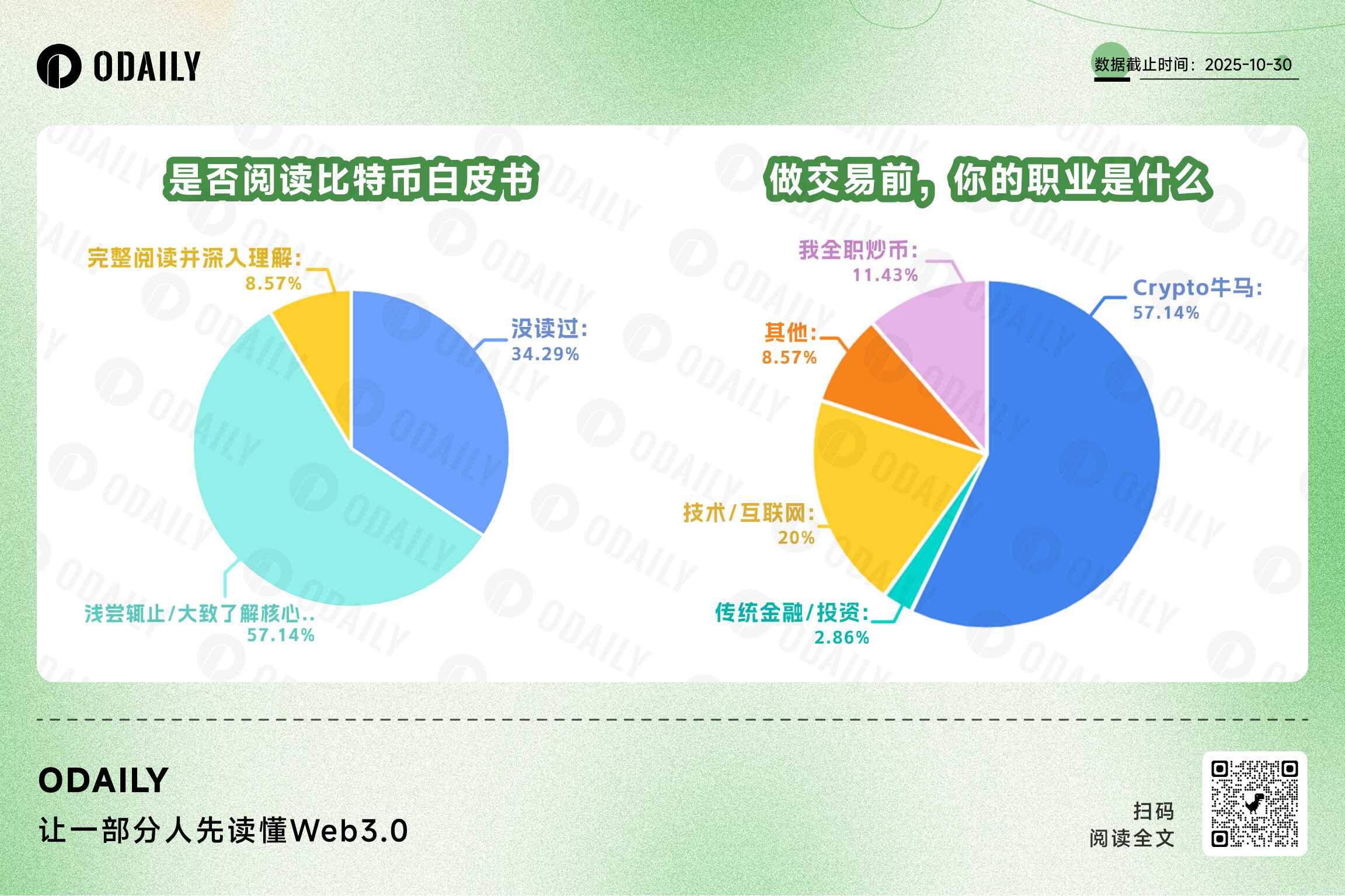
Pie chart: Bitcoin whitepaper reading vs. pre-trading profession
Among all surveyed traders, over half have only superficially engaged with the Bitcoin whitepaper. This indicates that what drives this market is far from a consensus on original theory. Without exception, they are all using real money, emotions, and trial-and-error to add living footnotes to that nine-page document. If Satoshi’s blueprint is an idealistic script, then each of their entries and exits is a tangled, improvisational performance in reality.
They may not all understand the whitepaper, but each is continuing its real-world version in their own way.
17 Years Later, Bitcoin’s Story Is Being Continued by Countless People After Satoshi
In autumn 2008, Satoshi Nakamoto posted a PDF whitepaper to the cypherpunk mailing list. With calm, concise language, it described a “peer-to-peer electronic cash system,” without foreseeing how this protocol would reshape people’s wealth logic, daily rhythms, and worldviews.
Seventeen years on, Bitcoin is no longer just a technical protocol or investment vehicle. It has become an anchor, a bedrock of consensus: some use it to build models, others learn to cut losses; some achieve transformation through it, others seek order amid wipeouts. Some see it as a symbol of free will, while others treat it merely as an unavoidable “job.”
In this “Trader Habits Survey,” questionnaires collected within just one week brought together some of the most authentic participants in the crypto market. Scattered across countries and platforms, handling assets ranging from major coins to meme coins, employing strategies from high-frequency to long-term, with trading experience from six months to a decade. Some review trades from Dubai skyscrapers, others monitor charts in Chongqing teahouses, and some remain hidden deep within Discord channels.
We cannot reconstruct their full images from a single form, but hope these fragments leave an unfiltered, authentic annotation for the market. Perhaps many have never read the Bitcoin whitepaper cover to cover, are unfamiliar with “zero-knowledge proofs” or “elliptic curve cryptography,” and cannot even explain how a “peer-to-peer system” works. But without doubt—they are the most real, most indispensable active users of this system.
Every open position, take-profit, liquidation, and review, every emotional fluctuation and strategic choice, is a rewriting of this system. Together, they are co-authoring a “user manual” beyond the whitepaper—one not published on GitHub, without a unified format, existing only in the practice of each individual.
This manual is sometimes chaotic, sometimes radical, filled with human warmth and noise, but its writing has never ceased. Perhaps this is Bitcoin’s deeper meaning after 17 years: it is no longer just a protocol about “what it is,” but a long marathon about “how we coexist with it.”
Join TechFlow official community to stay tuned
Telegram:https://t.me/TechFlowDaily
X (Twitter):https://x.com/TechFlowPost
X (Twitter) EN:https://x.com/BlockFlow_News
 Odaily