








From trustless BTC to tokenized gold, who is the true "digital gold"?
TechFlow Selected TechFlow Selected
From trustless BTC to tokenized gold, who is the true "digital gold"?
The RWA wave is accelerating the "digitalization" of real gold.
 Navigating Web3 tides with focused insights
Author: imToken
Have you noticed that more and more people around you are talking about "gold" lately?
Yes, I mean physical gold. Amid rising geopolitical risks and global macroeconomic uncertainty, the total market value of gold (at one point) surpassed 30 trillion USD, firmly securing its position as the top asset class globally.
Meanwhile, something fascinating is happening in the crypto world: beyond Bitcoin, widely regarded as "digital gold," physical gold is rapidly going on-chain. Tokenized gold, represented by Tether Gold (XAUT), has gained new capabilities—divisibility, programmability, and even yield generation—through the RWA wave.
This development is challenging a narrative long dominated by Bitcoin: "Who truly deserves the title of digital gold?"
BTC: A Decade of Evolving Narratives
Is BTC currency or an asset? Is its core function payment or value storage? Or is it more like a risk asset akin to tech stocks?
Since its inception in 2009, this question has persisted throughout Bitcoin's entire history.
Although Satoshi Nakamoto clearly defined BTC as "Electronic Cash" in the whitepaper, its evolving scale has led to constant shifts in narrative and endless debates within the community over the past decade—ranging from early payment methods to "value storage" and "alternative assets."
Especially with the approval of spot ETFs in 2024, a narrative turning point emerged. Fewer now believe Bitcoin will become a "global currency" for transactions and payments. Instead, an increasing number view Bitcoin as a consensus-based store of value—i.e., "digital gold":
Like gold, it has a fixed supply and predictable, steady issuance, while also offering advantages gold cannot match: superior divisibility (1 satoshi = 0.00000001 BTC), portability (cross-border transfers in seconds), and liquidity (a 7×24 market).
As a result, Bitcoin has gradually become the third global store-of-value paradigm after the US dollar and gold within the macro monetary system.
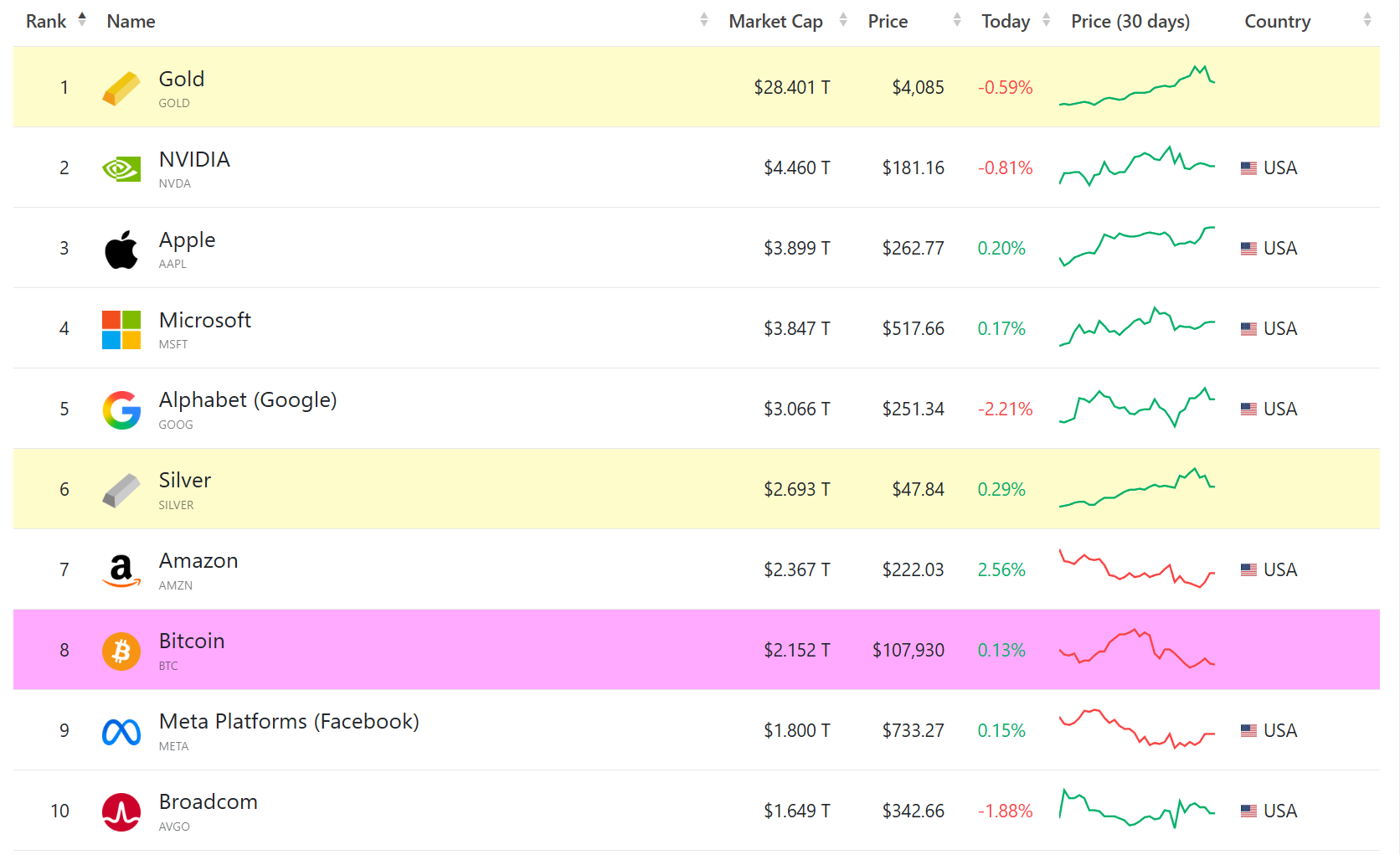
Source: companiesmarketcap.com
According to statistics from companiesmarketcap, gold currently holds an absolute lead among the Top 10 global assets, with a total market cap (28.4 trillion) exceeding the combined value of the next nine (26 trillion).
Even with BTC surpassing 100,000 USD, its total market cap is only about 2 trillion—roughly 1/15 that of gold. This gap is precisely the underlying motivation for the BTC community’s persistent push of the "digital gold" narrative: targeting the largest and oldest store-of-value asset in traditional finance.
Interestingly, just as BTC strives to embody the "digital gold" narrative, gold itself is undergoing "digitization."
The most direct catalyst is the repeated all-time highs of physical gold prices, coupled with the recent RWA wave, which has propelled tokenized gold products like Tether Gold (XAUT) and PAX Gold (PAXG) into rapid growth.
Backed by physical gold—each issued token corresponds to an equal amount of physical reserves—these "digital gold" products represent a new financial species for both the crypto and traditional finance (TradFi) worlds.
The Rising Wave of Gold-Backed RWAs
Saying tokenized gold has "emerged unexpectedly" may not be entirely accurate.
Strictly speaking, neither XAUT, the current market leader, nor PAXG, its close follower, are newly launched viral products. Rather, the current RWA wave and macro market conditions have elevated their strategic significance and visibility.
Take XAUT as an example: its earliest concept dates back to late 2019, when Bitfinex and Tether CTO Paolo Ardoino revealed plans for a gold-backed stablecoin, Tether Gold. The XAUT whitepaper was officially published on January 28, 2022.
The whitepaper clearly states that each XAUT token represents ownership of one troy ounce of physical gold. Tether guarantees equivalent physical gold reserves, all stored in "high-security Swiss vaults."
At the time of writing, XAUT’s total issuance exceeds 1.55 billion USD, representing approximately 966 gold bars (totaling 11,693.4 kilograms) in physical reserves.
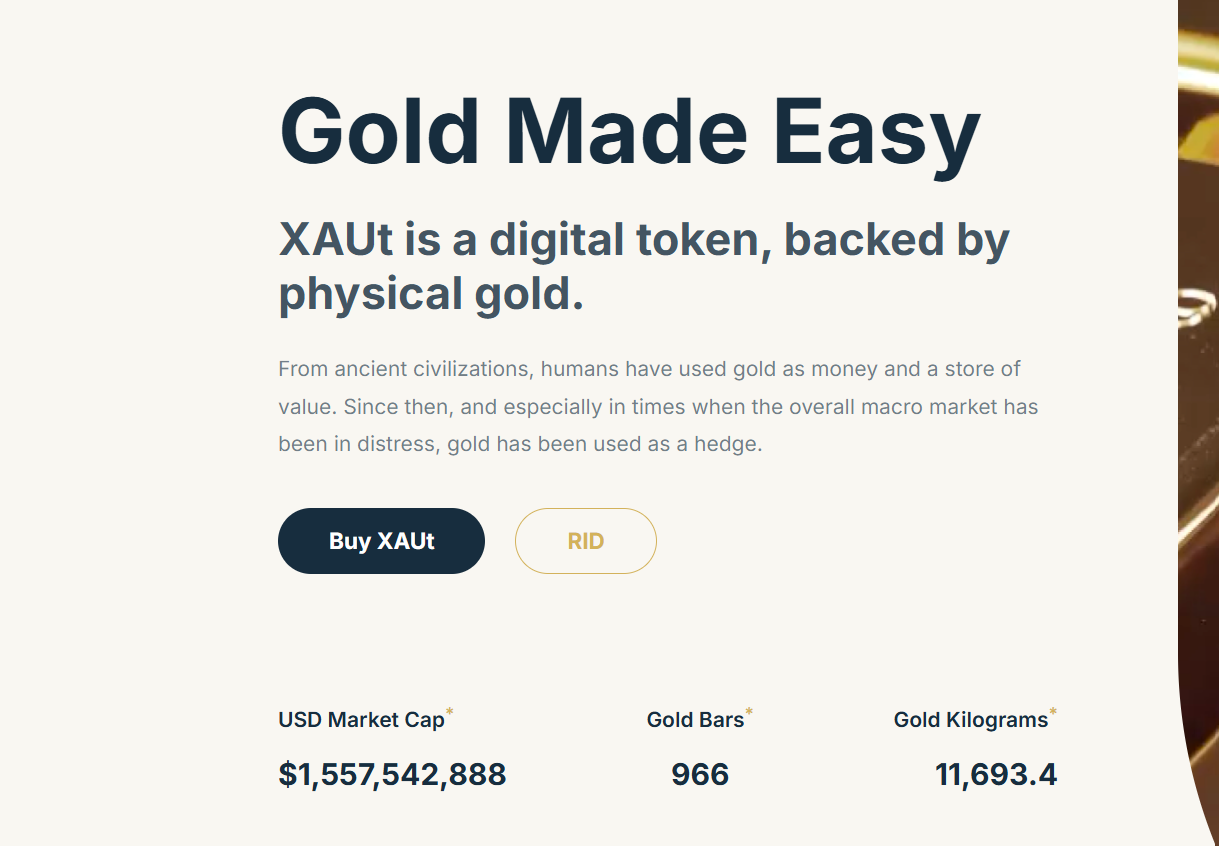
Source: Tether
The Tether Gold whitepaper clearly outlines its key advantages:
-
Compared to physical gold, "gold stablecoins" allow precious metals—which are hard to divide—into smaller denominations, making them easier to carry and transport, significantly lowering the barrier to individual investment;
-
Compared to gold ETFs, they enable 7×24 trading without custody fees, greatly improving transfer speed and efficiency;
In other words, Tether Gold allows users to retain exposure to physical gold while gaining high liquidity and divisibility.
To put it differently, tokenization grants real gold the unique "digital attributes" previously exclusive to BTC, fully integrating it into the digital world as a freely transferable, composable, and computable asset unit. This step transforms tokenized gold products like XAUT from mere "on-chain gold certificates" into gateways to vast on-chain opportunities.
Of course, this trend prompts a reevaluation: when both gold and BTC exist as on-chain assets, are they competitors or collaborators?
Digital Gold vs. Tokenized Gold: A Critical Distinction
Overall, if BTC’s core narrative is "scarce consensus in the digital world," then tokenized gold (XAUT/PAXG) differs fundamentally in that it "brings scarce consensus into the digital world."
This subtle yet essential distinction lies in BTC creating trust entirely from scratch, while tokenized gold digitizes traditional trust structures. As CZ recently tweeted:
"Tokenized gold isn't truly on-chain gold; it relies on trust in the issuer’s ability to fulfill obligations. Even in extreme scenarios—such as management changes or war—users still depend on the continuity of this trust system."
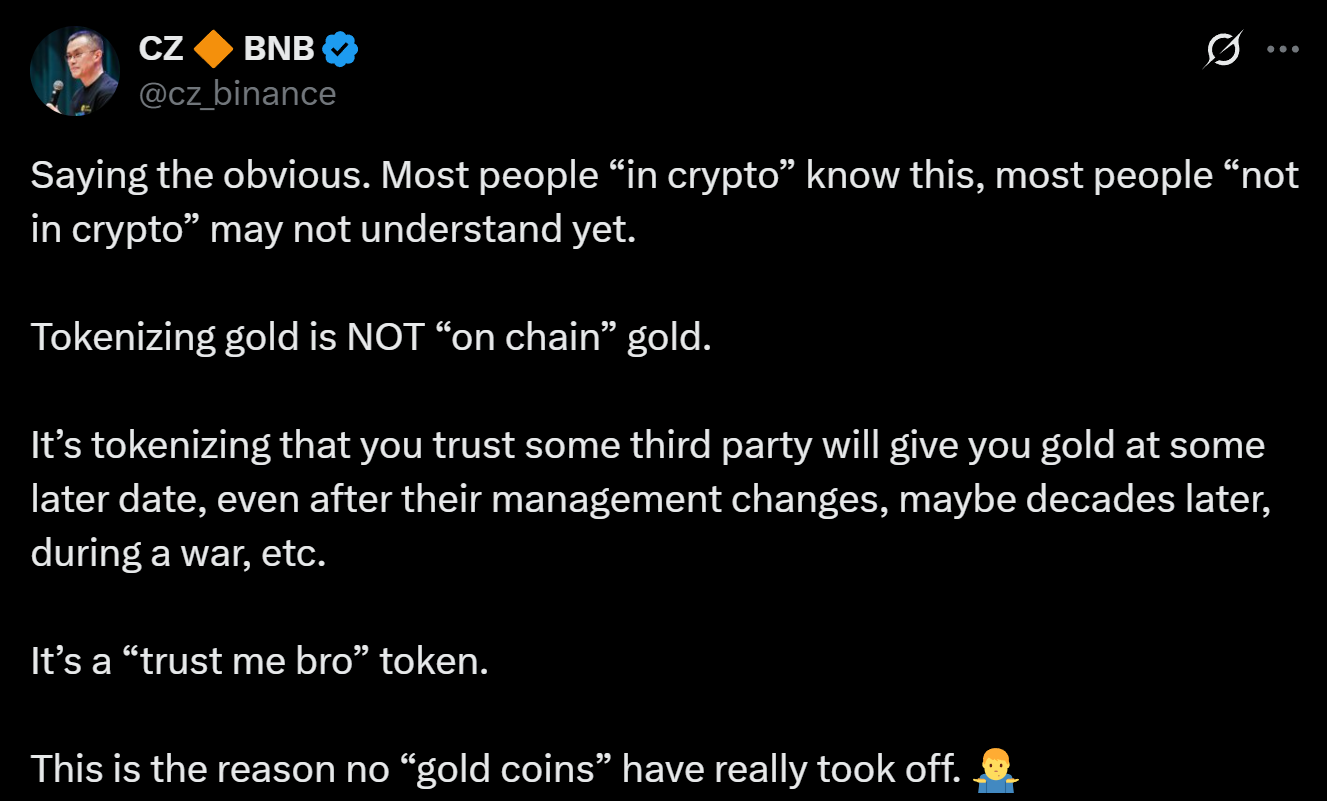
This highlights the fundamental difference: Bitcoin’s trust stems from algorithmic consensus, with no issuer or custodian, whereas tokenized gold relies on institutional credit—requiring trust that Tether or Paxos will strictly honor their reserve commitments.
This means Bitcoin is a product of "trustlessness," while tokenized gold is an extension of "re-trust."
From a value-add perspective, within traditional finance, gold’s core value lies in hedging and preservation. But in the blockchain context, tokenized gold gains programmability for the first time:
-
It can serve as collateral in DeFi protocols like Aave and Compound, allowing users to borrow stablecoins for leverage or yield management;
-
It can be integrated into smart contract logic, enabling interest-bearing gold ("Yield-bearing Gold");
-
It can freely circulate across networks via cross-chain bridges, becoming a stable, liquid asset across multi-chain ecosystems;
The essence of this transformation is turning gold from a static store of value into a dynamic financial unit. Through tokenization, gold acquires Bitcoin-like digital attributes—verifiable, transferable, composable, and computable—meaning gold is no longer just a symbolic value sitting in vaults, but an active asset on-chain capable of generating yield and credit.
Objectively speaking, in an environment of tightening liquidity and weak alt assets, the rise of the RWA wave brings traditional assets like gold, bonds, and stocks back into the crypto spotlight. The growing interest in tokenized gold reflects the market’s search for a more stable and certain on-chain value anchor.
From this perspective, the accelerated development of tokenized gold under the RWA wave does not aim to (nor can it) replace BTC. Instead, it perfectly complements BTC’s "digital gold" narrative, emerging as a new financial species combining the efficient liquidity of digital assets with the risk-hedging certainty of traditional gold.
Join TechFlow official community to stay tuned
Telegram:https://t.me/TechFlowDaily
X (Twitter):https://x.com/TechFlowPost
X (Twitter) EN:https://x.com/BlockFlow_News
 @imTokenOfficial


