Solana Ecosystem RWA Data Scan: Government Bonds, Stocks, Commodities, and Real Estate Tokenization
TechFlow Selected TechFlow Selected
Solana Ecosystem RWA Data Scan: Government Bonds, Stocks, Commodities, and Real Estate Tokenization
An in-depth exploration of Solana's current status in the RWA sector, providing a comprehensive and systematic analysis for investors, developers, and industry observers.
 Navigating Web3 tides with focused insights
Writing: HY & Adam, Xianrang
The development history of blockchain has fully proven that only business scenarios related to financial transactions can survive in Web3, and RWA skillfully combines the respective advantages of real-world assets and on-chain transactions, attempting to reshape the global financial landscape. Through blockchain technology, RWA transforms traditional assets such as commodities, credit, and stocks into on-chain tokens, enabling efficient management and transfer of ownership while significantly lowering the transaction barriers for financial assets.
According to current data, the total market capitalization of RWA excluding stablecoins has surpassed $33 billion—but this is just the beginning. Boston Consulting Group (BCG) predicts that by 2030, the size of on-chain RWA will reach $16 trillion.
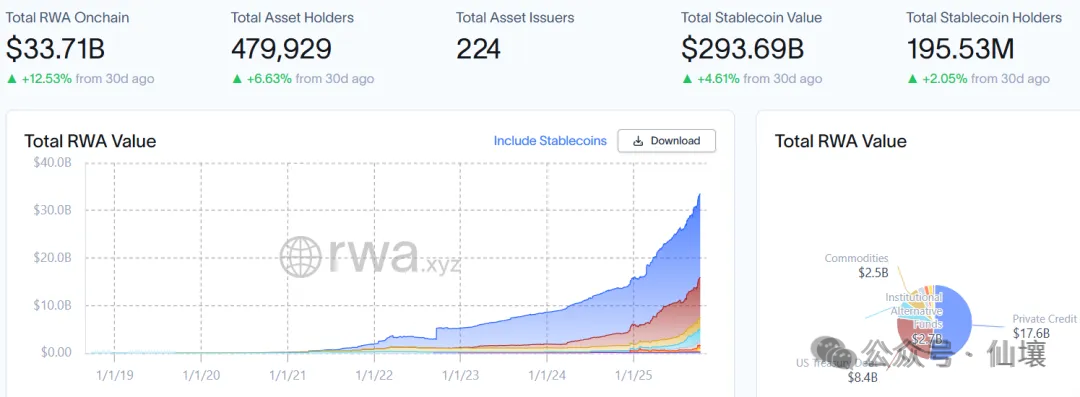
The potential of RWA is undoubtedly enormous. However, on which major public blockchain will mainstream RWA narratives first become a reality?
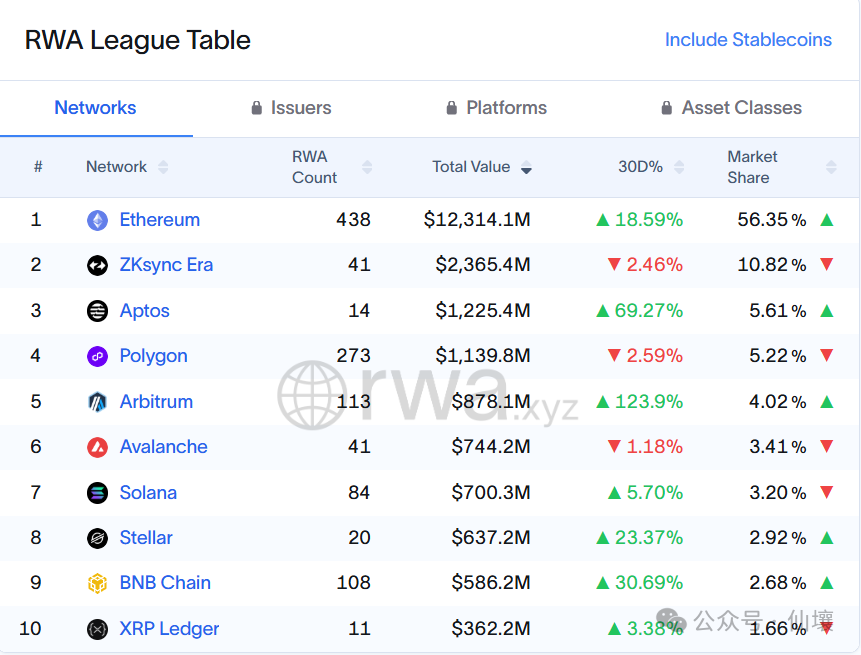
As the leading blockchain in the DeFi space, Ethereum holds over 50% of the RWA market share. Meanwhile, Solana, through aggressive ecosystem development, controls 3.2% of the RWA market, ranking seventh among all public blockchains—an achievement not to be underestimated. With giants like BlackRock bringing billions of dollars in RWA assets onto Solana via the Securitized platform, its RWA ecosystem has entered a phase of rapid growth.
In today’s article, we will conduct an in-depth exploration of Solana's current status in the RWA sector, offering comprehensive and systematic insights for investors, developers, and industry observers.
Comprehensive Analysis of RWA Projects in the Solana Ecosystem
Many users in the RWA market come from traditional stock or commodity markets. For these users, whether a platform can respond quickly to requests and deliver low-latency, low-cost trading experiences is a key factor.
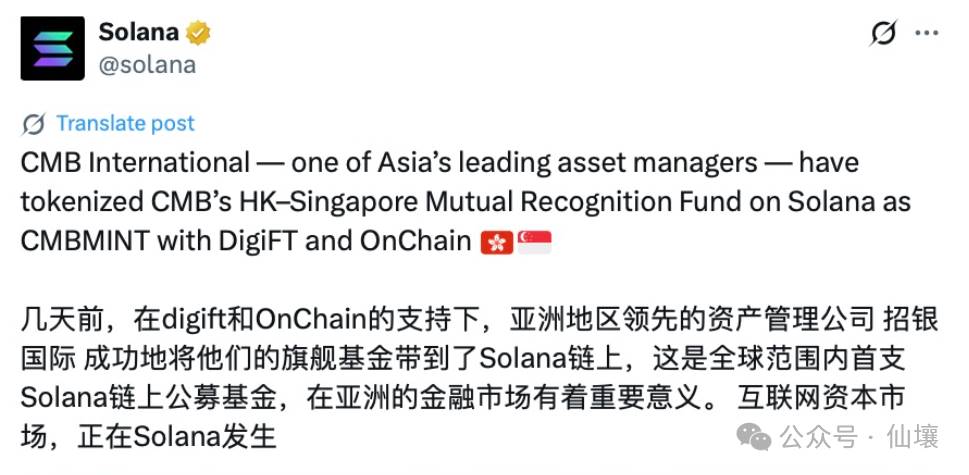
To address transaction latency, many RWA projects adopt a strategy of multi-chain deposit collection with single-chain settlement. Due to its high TPS, Solana is particularly well-suited to serve as an execution layer for RWA operations. The fact that CMB International’s on-chain RWA fund CMBMINT chose Solana for its initial launch underscores its appeal.
Additionally, RWA applications often involve numerous small transactions—such as rent distributions and interest payments—and high gas fees would severely erode yields. Take Homebase, a well-known real estate tokenization platform, as an example: it processes thousands of small rent disbursements each month. This micropayment model demands extremely low transaction fees, where Solana’s ultra-low fee structure offers a natural advantage.
Data-wise, although still in early stages, Solana’s RWA ecosystem has demonstrated strong growth momentum. According to RWA.xyz, there are currently 94 RWA assets within the Solana ecosystem, with a total market cap reaching $700 million. In the past 30 days alone, RWA transfer volume on Solana reached $18 billion, second only to Ethereum in transaction volume.
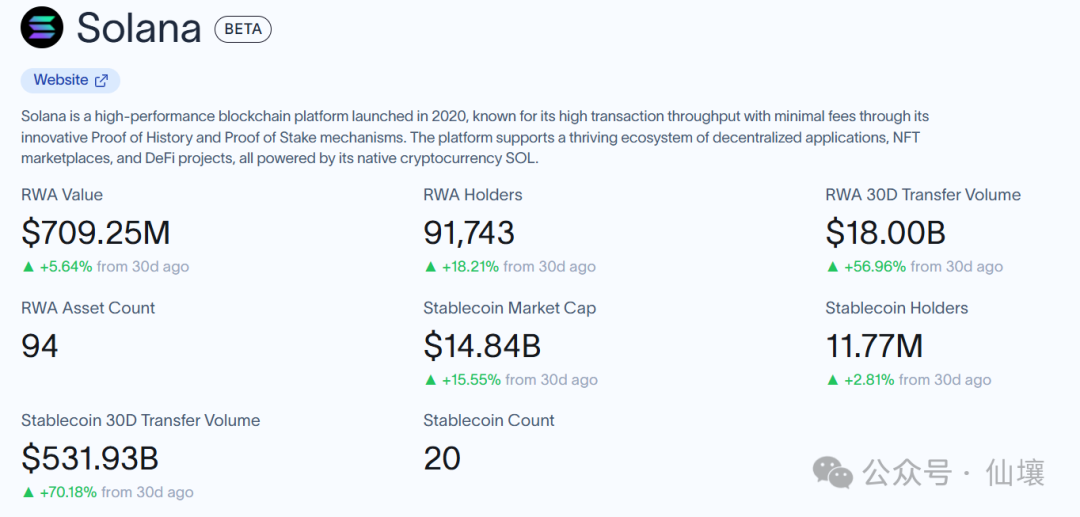
Currently, Solana’s RWA ecosystem has developed a diverse structure, covering a broad spectrum from physical assets to financial instruments. Below, we will categorize and introduce representative RWA project cases.
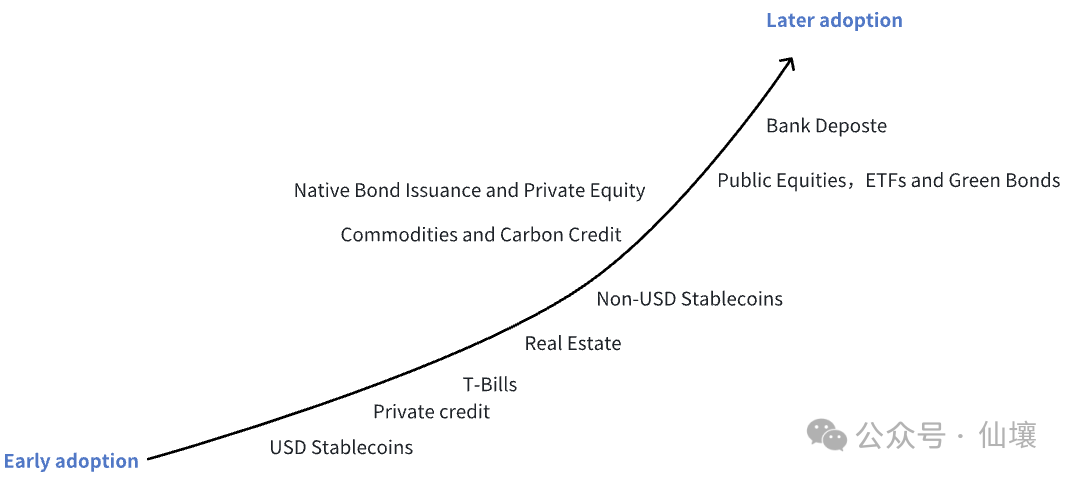
(RWA Project Landscape in the Solana Ecosystem)
Treasury Bonds
At present, tokenized treasury bonds are one of the most significant and popular types of RWA assets, prized in financial markets for their stable risk-free returns. Compared to traditional markets, tokenizing treasuries enables 24/7 trading, retail accessibility through fractionalization, and integration with DeFi ecosystems to enhance liquidity.
We will analyze several representative cases below. Note that yield-bearing stablecoins collateralized by treasuries essentially bring treasuries on-chain and capture their yields—such RWA products are also classified under treasury bonds in this article.
Maple Finance (USDC-SPL)
Maple is a prominent treasury-related RWA project on Solana, founded by Sid Powell and Joe Flanagan, focusing on institutional-grade lending and asset management. Since launching in May 2021, it has facilitated over $7 billion in loans and manages more than $1.7 billion in assets.
In May 2023, Maple launched the Maple Cash Management Pool, offering users a net APY of around 4.8% from treasury yields. Users can freely enter and exit the pool without lock-up or redemption fees, making it the first treasury-based RWA in the Solana ecosystem. While the product has since expanded to include USDC lending, due to its pioneering role in Solana’s RWA space, it remains documented here.
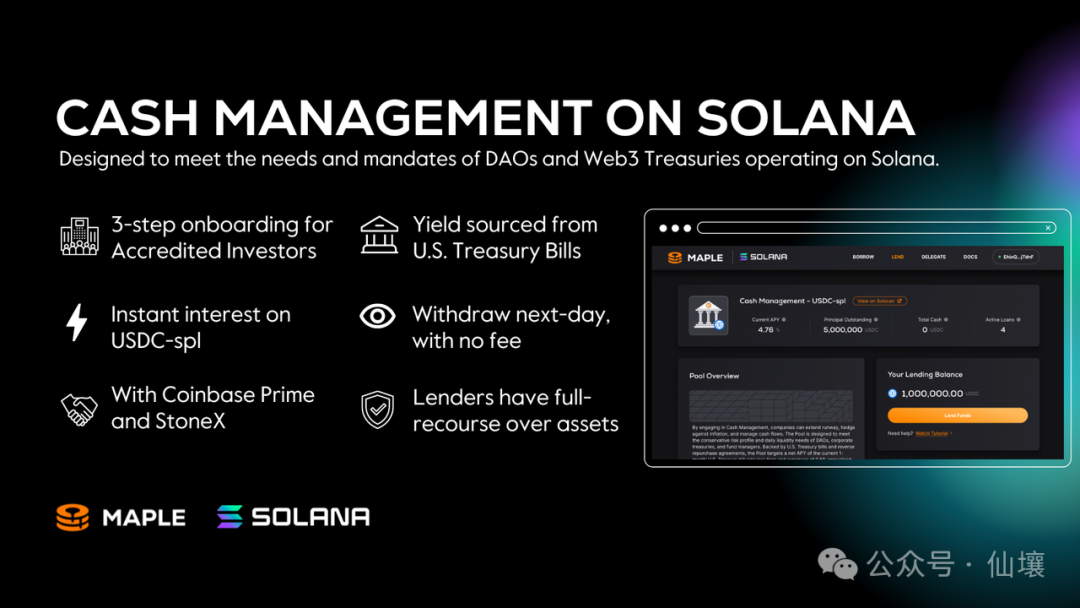
Based on the yield-generation mechanism of treasury RWA, Maple’s workflow can be broken down as follows:
-
Fund Deposit: Lenders deposit USDC into Maple Finance’s funding pool and receive LP tokens representing their share.
-
Loan Disbursement: The funding pool lends USDC to Room40 Capital’s Solana wallet, a U.S.-based crypto investment firm.
-
Treasury Investment: The borrowed USDC is converted to USD via Circle and invested in U.S. Treasuries. Room40 Capital, as the borrower, manages these investments to generate returns.
-
Yield Distribution: Returns from treasury investments flow back through the Maple platform to the funding pool, and lenders receive payouts proportional to their LP share.
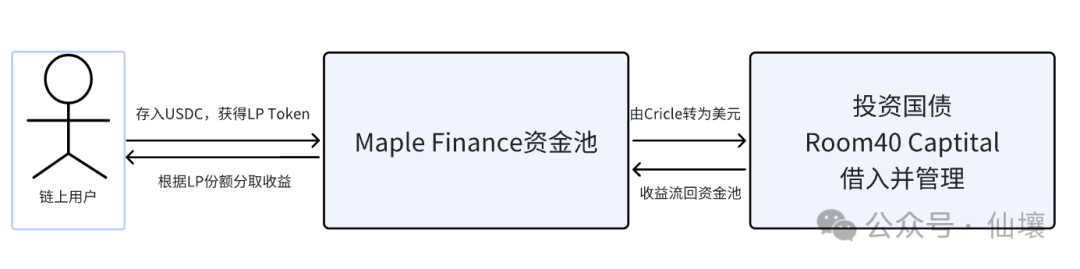
In this case, because on-chain data is transparent and immutable, Room40 cannot conceal the flow of USDC. Off-chain auditing firms regularly verify the performance of Room40’s investment portfolio. If the reported treasury yield mismatches the actual yield distributed on-chain, lenders can immediately detect anomalies.
To prevent misconduct by entities like Room40, Maple Finance requires KYC and AML verification for all participants, including lenders and borrowers, whose identities and operational backgrounds undergo rigorous due diligence by Maple. This combination of on-chain transparency and off-chain oversight effectively mitigates risks of fraud.
Ondo Finance (USDY & OUSG)
Ondo Finance has emerged as a leader in the RWA space. Its flagship products—USDY (Ondo USD Yield) and OUSG, a tokenized short-term treasury asset—are among the most representative RWA offerings in the Solana ecosystem, attracting substantial investor interest due to their high transparency, liquidity, and stable yields.
As of October 2025, USDY’s circulating supply has reached $250 million, ranking first among treasury RWA projects on Solana and currently being the largest non-stablecoin RWA asset by circulation on the Solana chain.
In operation, USDY works similarly to Maple: users deposit stablecoins like USDC into a pool via the Ondo platform. Ondo then invests these funds into U.S. Treasuries through regulated brokers. Treasury-generated yields are distributed proportionally to USDY holders in the form of the USDY token, with APY typically ranging between 4% and 5.2%.
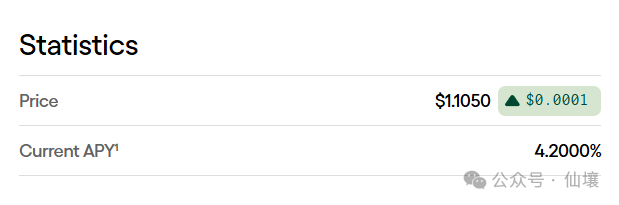
USDY not only provides a steady yield source but also allows holders to bridge USDY to other chains like Ethereum and Polygon, using it in DeFi protocols for lending, collateralization, or liquidity mining—effectively functioning as an interest-bearing stablecoin.
Besides USDY, Ondo’s other major product is OUSG. After collecting USDC, Ondo invests in short-term U.S. Treasury ETFs such as BlackRock’s SHV, with interest returns shared among OUSG holders. OUSG’s current circulation stands at $79 million. Unlike USDY, OUSG primarily focuses on short-term U.S. Treasuries.
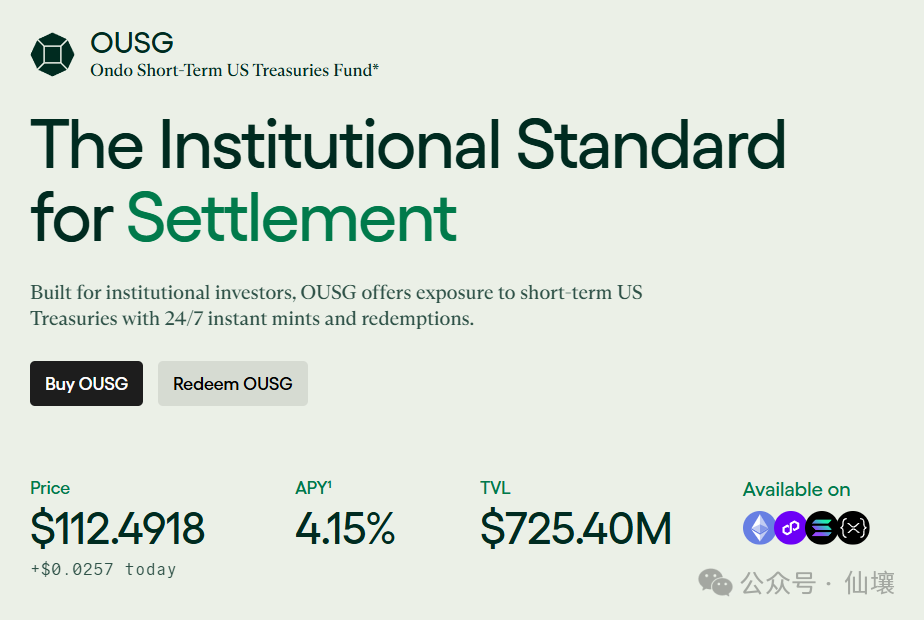
OUSG typically offers slightly lower annualized yields than USDY but is favored by institutional investors for its stability. The difference arises because USDY, in addition to treasuries, also invests in higher-yielding instruments such as bank time deposits, which carry marginally higher risk and return compared to treasuries.
Securitize (BUIDL & VBILL)
Securitize is the first company authorized to issue tokenized securities in both the U.S. and Europe. In January 2025, Securitize partnered with Wormhole to bring Apollo Global Management’s $1.3 billion credit fund $ACRED onto Solana.
Securitize’s two main RWA projects on Solana are BUIDL and VBILL, both backed by U.S. Treasuries. Leveraging Solana’s high throughput and low cost, they offer investors efficient and transparent yield-generating instruments.
BUIDL, jointly launched by BlackRock and Securitize, was BlackRock’s first tokenized fund, initially issued on Ethereum in March 2024 and extended to Solana in March 2025. VBILL, introduced through a collaboration between asset manager VanEck and Securitize, launched on Solana, Avalanche, BNB Chain, and Ethereum in May 2025. Currently, BUIDL and VBILL have market caps of approximately $175 million and $23 million respectively on Solana.


Etherfuse (TUSOURO & EUROB & CETES & GILTS)
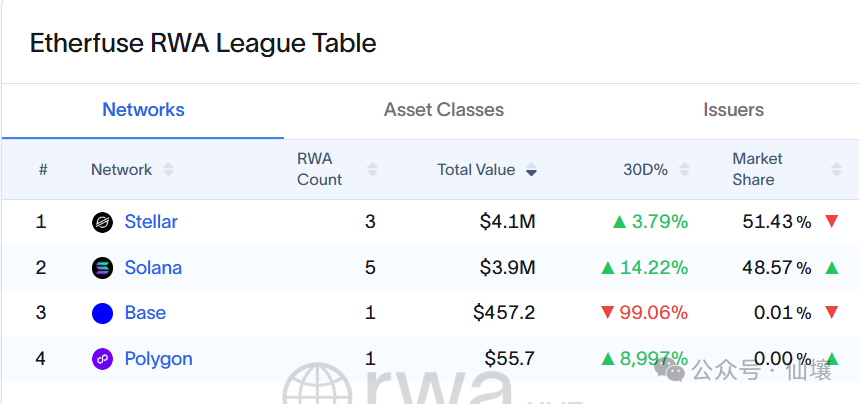
In 2024, Etherfuse launched the Stablebonds platform on Solana, focusing on tokenized government bonds from various countries. Its primary RWA offerings on Solana include TUSOURO (Brazilian government bonds), EUROB (EU bonds), CETES (Mexican government bonds), and GILTS (UK government bonds). The combined market cap of these products on Solana is approximately $3.9 million.
Stocks
xStock
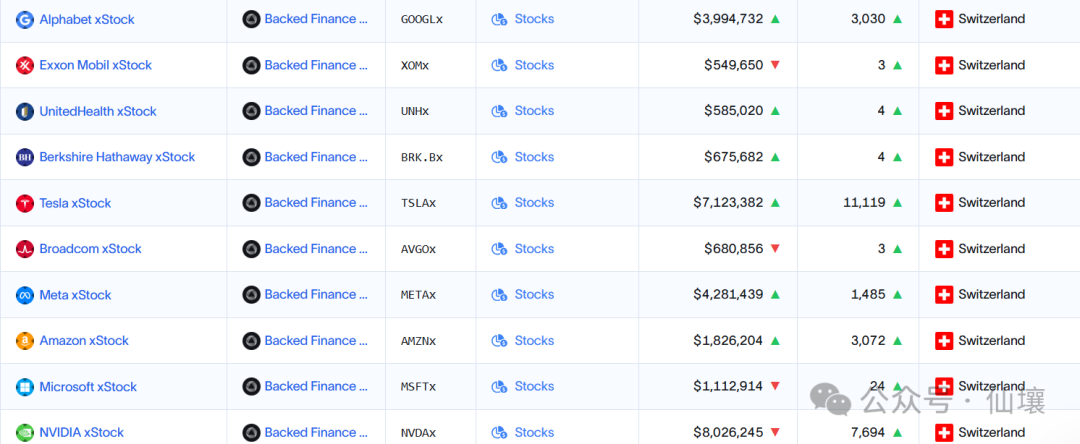
xStocks, a tokenized stock product launched by Backed Finance, dominates nearly the entire tokenized stock market on Solana. Within a month of launch, xStocks achieved over $300 million in total on-chain trading volume, clearly demonstrating strong market demand for stock tokenization.
Each xStocks token is pegged 1:1 to real-world stocks or ETFs, with actual shares held by regulated custodians to ensure token value alignment with underlying assets. Price data is synchronized to the blockchain in real time via Chainlink oracles, ensuring transparency and accuracy. Currently, xStocks covers over 60 stocks and ETFs, including Apple, Tesla, Nvidia, and S&P 500 ETFs—most blue-chip stocks are included.
Currently, xStocks’ total market cap exceeds $94 million.
Private Credit
Private credit is typically provided by non-bank institutions and targets borrowers with lower credit ratings, such as SME loans, accounts receivable financing, consumer credit, or supply chain finance. These loans offer higher yields but come with elevated risks.
After the 2008 financial crisis, private credit rapidly became one of Wall Street’s hottest investment vehicles, growing from $25 billion in 2010 to about $2 trillion by 2025. Currently, Credix Finance is the only major private credit project active on Solana. Others, such as Alloy X, attempted entry but failed to sustain operations.
Credix Finance
Founded in 2021, Credix Finance specializes in private credit RWA. Its model is straightforward: it acts as an intermediary between on-chain and off-chain worlds—collecting USDC from on-chain users, converting it into local currencies, and lending to various borrower entities, while providing yield to on-chain lenders.
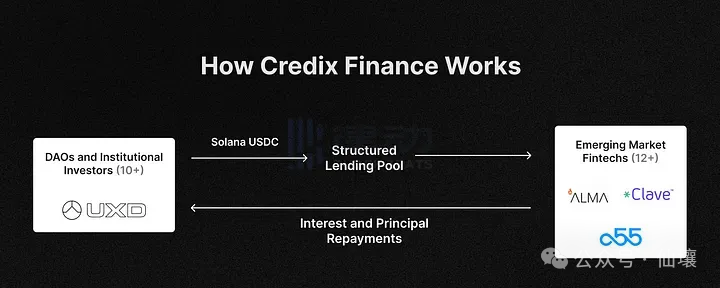
Notably, Credix’s Twitter account has posted only once since November 2024, and there has been almost no media coverage or updates over the past year.
Real Estate Tokenization
Real estate tokenization via blockchain has long been considered one of the core early use cases for RWA.
Among major blockchains, Solana has become the primary testing ground for real estate tokenization projects. Homebase, arguably the most well-known real estate RWA on Solana, allowed users to invest in NFT-ified properties with as little as $100. However, its official Twitter halted updates in August 2024, and there have been no news developments in over a year. Its website currently shows no available properties listed under “Available.”
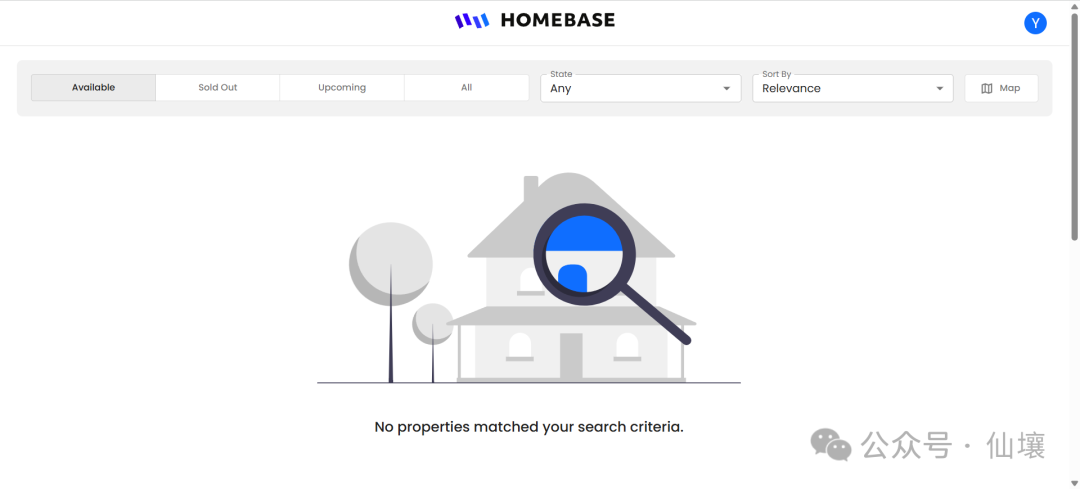
Currently, the active real estate RWA projects on Solana are Parcl and MetaWealth.
Parcl
Parcl is a real estate derivatives protocol focused on tokenizing real estate price indices, allowing users to gain exposure to property market movements.
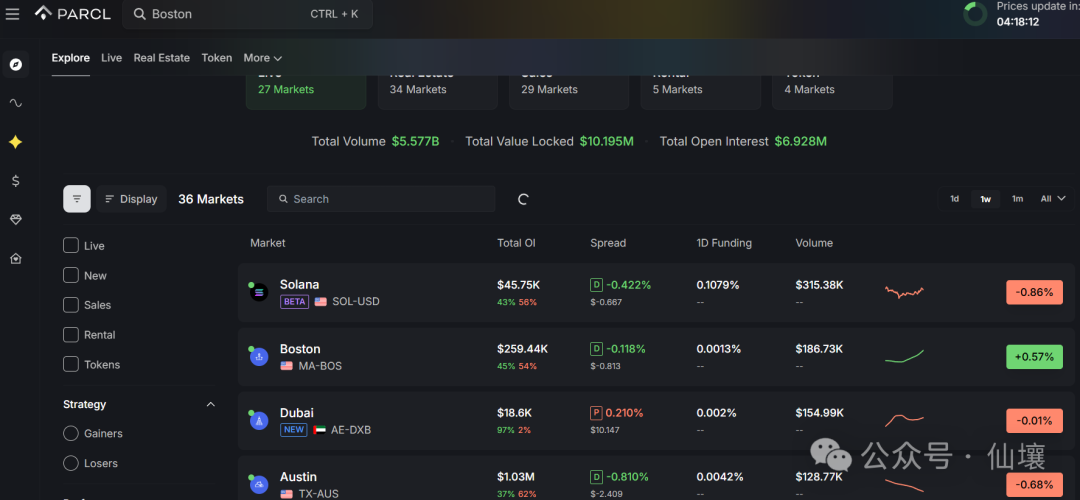
By creating City Indexes, Parcl enables users to invest in price volatility of real estate markets in specific geographic areas—similar to perpetual contracts allowing long or short positions on housing prices. These indexes are based on average residential prices per square foot or square meter, with data provided by Parcl Labs, updated daily and aggregated from millions of global data points to reflect real-time market values.
Parcl can be understood as a PerpDEX, except the underlying asset is real estate. Beyond long and short positions, users can provide USDC liquidity to pools and earn trading fees. Additionally, users can participate with as little as $1, drastically reducing the investment barrier.
As of now, Parcl’s TVL is approximately $7 million.
MetaWealth
MetaWealth is a real estate tokenization platform accessible to users in the EU and Canada, offering fractional ownership in income-generating properties.
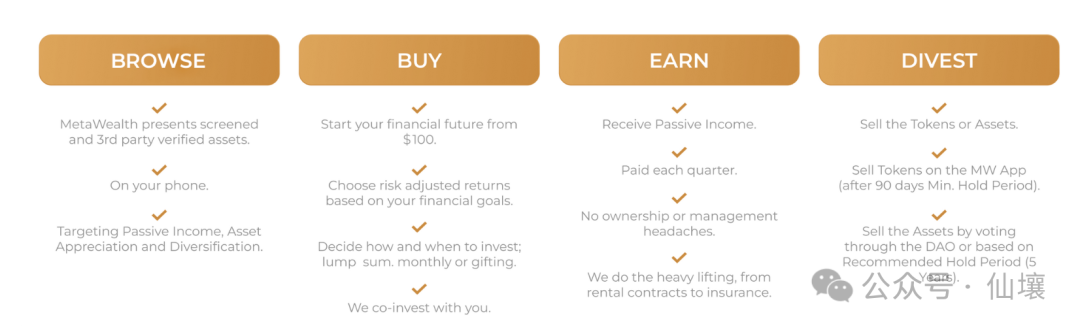
After completing audits and research with third-party quality assessment agencies, MetaWealth acquires qualified properties, rents them out, and fractionalizes ownership—enabling investment starting at just $100. Rent income is distributed proportionally based on each investor’s share of the total property value.
Currently, MetaWealth has tokenized 138 properties, generated $850,000 in revenue, serves 50,000 investors, and manages $36 million in real estate. In April 2025, MetaWealth launched three regulated RWA real estate bonds, becoming the first project in the Solana ecosystem to achieve this milestone.
In June 2025, Czech fund company APS, managing $1.37 billion in assets, purchased $3.4 million worth of tokenized Italian real estate through MetaWealth. Whether for retail or institutional investors, MetaWealth delivers an innovative, transparent, and efficient investment platform.
Commodities
Commodities typically refer to industrial raw materials, precious metals, or primary goods with wide commercial and industrial applications. The most common form of commodity RWA is gold tokenization, such as Paxos Gold, where each token represents one ounce of gold, primarily circulating on Ethereum. On Solana, notable commodity RWA projects include BAXUS (tokenizing premium wines), and Elmnts and Powerledger (energy tokenization).
BAXUS
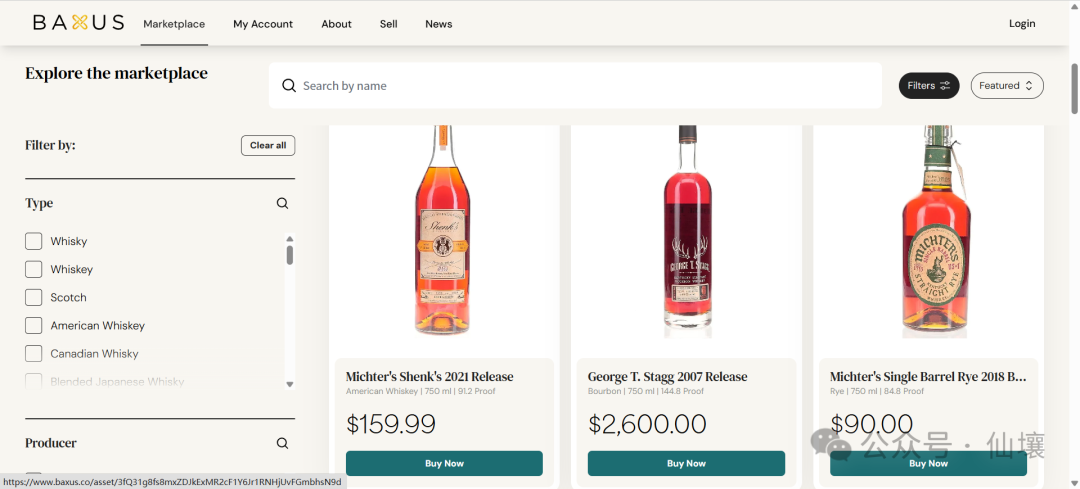
BAXUS stores premium wines (e.g., rare whiskies, vintage wines) in secure temperature-controlled vaults. Each bottle is assigned a unique NFT via blockchain technology, serving as a digital certificate of ownership that records provenance, authentication, and transaction history. It also operates a marketplace similar to Opensea, enabling direct trading of rare wines with support for USDC and traditional payment methods like credit cards.
Elmnts
Elmnts specializes in converting commodity assets such as oil and gas mineral rights into digital tokens on the blockchain. These tokens represent partial ownership in mineral rights, allowing investors to earn royalty income from oil and gas extraction. Tokenization makes traditionally high-barrier, illiquid mineral rights investments more divisible and tradable, lowering entry thresholds.
Powerledger
Powerledger is an Australian energy tech company founded in 2016, dedicated to using blockchain to decentralize and promote sustainability in the energy sector. Its platform enables tracking, trading, and traceability of renewable energy, supporting applications such as peer-to-peer (P2P) energy trading, virtual power plants (VPP), carbon credit trading, and renewable energy certificates (RECs).
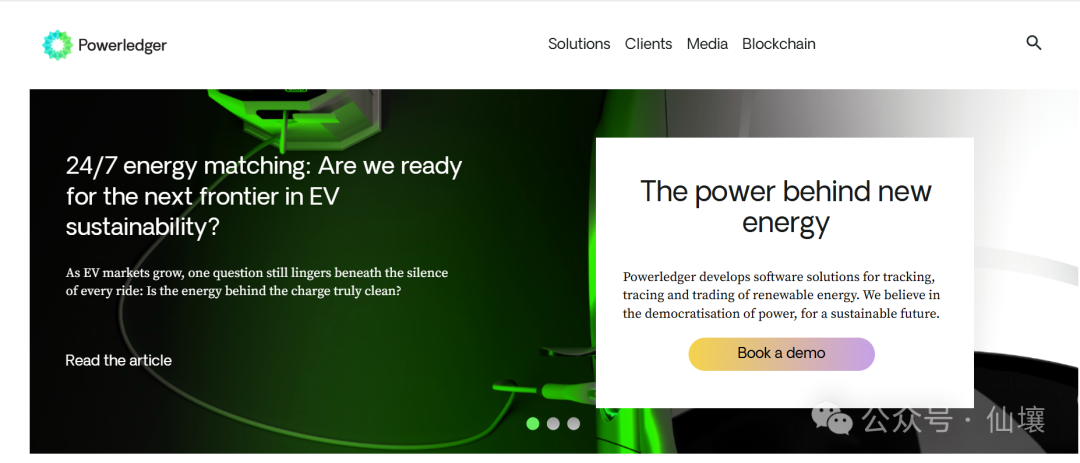
Powerledger leverages the Solana blockchain to tokenize renewable energy assets such as solar and wind power, issuing POWR or other tokens for trading and tracking. These tokens represent specific units of energy, carbon credits, or RECs, enabling users to conduct direct peer-to-peer transactions on the blockchain, reducing intermediaries and improving efficiency.
Conclusion
The RWA ecosystem on Solana spans five categories: stablecoins, treasury bonds, private credit, real estate, and commodities. Thanks to its high throughput and low costs, Solana has shown immense potential in the RWA space. However, challenges around network stability, regulatory compliance, and intense competition remain significant hurdles. Going forward, Solana must overcome these obstacles through technological optimization, compliance solutions, and ecosystem expansion to become a key bridge between traditional finance and blockchain, achieving long-term sustainable growth.
Join TechFlow official community to stay tuned
Telegram:https://t.me/TechFlowDaily
X (Twitter):https://x.com/TechFlowPost
X (Twitter) EN:https://x.com/BlockFlow_News
 @godrealmx