








Crypto Meets Offshore Finance: Jersey's Tax and Regulatory Regime for Crypto Assets
TechFlow Selected TechFlow Selected
Crypto Meets Offshore Finance: Jersey's Tax and Regulatory Regime for Crypto Assets
Jersey's regulatory response to crypto assets is not radically innovative, but rather reflects a cautious, tiered, and compatibility-oriented approach.
 Navigating Web3 tides with focused insights
Author: FinTax
1. Introduction
Jersey has an independent tax system separate from the United Kingdom and is long known for being "low-tax, clear in structure, and simple in design," making it one of the world's most attractive offshore financial centers. Its tax regime maintains local governance while meeting international compliance standards, offering a flexible and stable tax environment for traditional financial services, wealth management institutions, and the emerging crypto economy.
Unlike other jurisdictions, Jersey’s regulatory response to crypto assets is not radically innovative but rather cautious, layered, and oriented toward compatibility. On taxation, it continues its traditional model of exempting capital gains and maintaining low corporate tax rates, while retaining flexibility in determining whether activities are “commercial” or “purpose-driven.” On regulation, it extends existing legal boundaries to include virtual assets within standard frameworks such as anti-money laundering (AML), transaction disclosure, and licensing systems—rather than creating a standalone crypto-specific legal code.
2. Jersey’s Crypto Tax Regime
2.1 Jersey’s Tax System
Jersey is a Crown Dependency of the UK with a high degree of autonomy and maintains its own independent tax and financial regulatory system. The island’s tax system is renowned for simplicity, stability, and low taxation, aiming to provide an attractive fiscal environment for global investors and high-net-worth individuals. Key taxes and rates include:
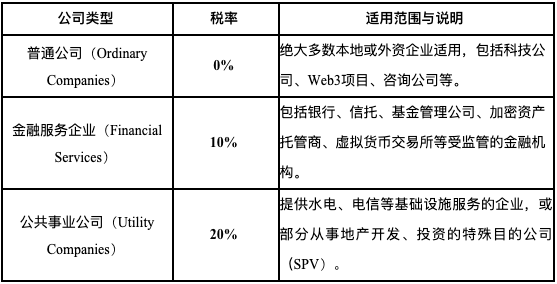
① Corporate Tax: Jersey employs a "0-10-20" tiered rate structure: the standard corporate income tax rate is 0%, financial services companies are taxed at 10%, and utility companies at 20%.
② Personal Income Tax: A flat rate of 20% applies, with no progressive brackets. There is a basic personal allowance (around £17,000, adjusted slightly each year), and no taxes on capital gains, inheritance, or gifts.
③ Goods and Services Tax (GST): Introduced in 2008, GST is levied at a flat 5% rate. Similar to VAT but narrower in scope, it primarily applies to local goods and services transactions. Financial services and export-oriented services are typically exempt.
This tax framework not only supports traditional finance but also creates policy space for crypto-related businesses, becoming one of the key factors attracting Web3 enterprises to register and operate in Jersey.
2.2 Jersey’s Crypto Tax Policy
2.2.1 Classification of Crypto Assets
From a regulatory standpoint, Jersey treats crypto assets as “assets,” not legal tender, nor automatically as securities or financial products. This means that, legally and fiscally, crypto assets do not have legal tender status and are not automatically subject to financial instrument regulations. Instead, their classification depends on specific use cases:
The Jersey Financial Services Commission (JFSC) defines crypto assets as “a digital representation of value that can be traded or transferred and used for payment or investment,” but explicitly excludes them from being considered legal currency. When crypto assets are held for investment or appreciation, they are treated similarly to “personal property” and are subject to tax rules applicable to ordinary assets.
According to JFSC’s 2018 ICO Guidance Note, tokens exhibiting features such as entitlement to profits or assets of an issuer, redemption rights, voting rights, or return expectations may be classified as securities. If they display characteristics of pooled investment, they may be treated as a “collective investment scheme” and assessed case by case based on their equity structure. Income derived from mining or providing on-chain services may be considered “business income” or compensation for services rendered, thus falling within the scope of income or corporate tax.
Jersey’s regulators emphasize risk-based and purpose-driven classification principles for crypto assets. Rather than applying a blanket regulatory approach, they categorize different behaviors—including trading, holding, circulating, and service provision—to determine whether existing financial regulations or AML obligations apply.
2.2.2 Tax Policies Related to Crypto Assets
Although Jersey has not enacted dedicated crypto asset tax legislation, its tax authority, Revenue Jersey, has incorporated crypto assets into the existing tax framework through interpretative guidance and practical precedents. Overall, Jersey applies a principle of purpose-driven classification, attribute determination, and risk alignment. Different taxpayers and activity scenarios are subject to differentiated tax rules. Key scenarios include:
(1) Individual Holding and Trading
For individuals, gains from holding crypto assets for long-term investment or occasional trading are generally treated as capital gains and are not taxable in Jersey. However, if trading is frequent and commercial in nature—for example, involving leverage or continuous liquidity provision—the resulting income may be classified as business income and subject to 20% personal income tax. In assessing whether activity constitutes “trading,” Jersey follows HMRC’s UK “Badges of Trade” principles (BIM20205). Additionally, non-capital income such as staking rewards, airdrops, and node incentives are typically treated as taxable income and must be reported accordingly.
(2) Corporate Holding and Operations
Companies engaged in crypto-related businesses—such as operating exchanges, digital wallet custody, mining, token issuance, or DeFi protocol development—must treat their operational income as taxable business income. Under Jersey’s "0-10-20" corporate tax structure: general technology or platform companies may qualify for the 0% rate; those engaging in financial services (e.g., crypto custody, trading facilitation, structured product issuance) may be taxed at 10%; entities classified as public utilities or real estate investment companies face a 20% rate.
(3) Mining Activities
Jersey has not specifically legislated to prohibit or exempt mining from taxation. As stated in official documents such as Cryptocurrency Tax Treatment, if mining is “incidental or non-commercial,” it does not constitute a taxable event. However, if mining is ongoing, profit-driven, and organized, the mined crypto assets are treated as taxable income, valued at market price upon receipt.
(4) Crypto Payments and GST
Although Jersey imposes a 5% Goods and Services Tax (GST), the tax authority has clarified that the act of using crypto assets as a payment method does not itself create a GST liability. In other words, when users purchase goods with Bitcoin or Ethereum, or exchange one cryptocurrency for another or for fiat, no GST arises from the exchange itself. However, if a merchant accepts crypto payments for taxable goods or services, the underlying sale remains subject to GST. In this context, crypto is viewed merely as a payment medium, functionally equivalent to cash or credit cards.
3. Development and Refinement of Jersey’s Crypto Regulatory Framework
Jersey’s crypto asset regulatory framework is led by the Jersey Financial Services Commission (JFSC), which oversees, regulates, and develops the island’s financial services sector—including virtual assets. Its main responsibilities include:
① Developing regulatory policies and guidelines: The JFSC issues guidance and documentation outlining how virtual assets are regulated in Jersey, including rules and licensing requirements for virtual currency exchanges.
② Registration and licensing: Enterprises operating in the virtual asset sector in Jersey must register with the JFSC and obtain all necessary licenses or authorizations.
③ Supervision and enforcement: The JFSC supervises regulated entities to ensure compliance with Jersey’s anti-money laundering (AML) and counter-terrorism financing (CFT) laws, as well as other regulatory requirements. It also has the authority to take enforcement actions against entities violating these rules.
④ Setting compliance and oversight standards: The JFSC establishes compliance and audit standards for the virtual asset industry. For example, firms must employ personnel with appropriate skills and experience, including a designated Money Laundering Reporting Officer (MLRO), Deputy MLRO, and key staff responsible for compliance and internal monitoring. The JFSC also monitors whether virtual asset service providers comply with the “Travel Rule” and international crypto tax reporting standards.
⑤ International cooperation: The JFSC collaborates with other regulators and international bodies, exchanging information to promote global consistency and coordination in virtual asset regulation.
Jersey has not created a standalone legal code for crypto assets. Instead, it incrementally brings virtual assets and service providers under supervision by expanding definitions, broadening the scope of existing laws, and implementing registration mechanisms within its established financial regulatory and AML systems. The following are key laws and regulatory instruments currently relevant to crypto assets:
① Financial Services (Jersey) Law 1998
This is Jersey’s foundational financial regulation law, requiring any entity providing specified financial services in Jersey to register or obtain a license from the JFSC. In 2016, the JFSC clarified that virtual currency exchanges fall under this law and must register as a “Money Service Business.”
② Proceeds of Crime (Jersey) Law 1999
This is Jersey’s core AML and CFT legislation, applicable to all high-risk sectors including crypto businesses. It mandates that virtual asset firms conduct customer due diligence (CDD), maintain transaction records, and report suspicious transactions to the Jersey Financial Crime Unit (JFCU).
③ Virtual Currency Exchange Regulations
Issued by the JFSC in 2016, these regulations require virtual currency exchanges to implement strict AML/CFT controls and establish sound internal governance and control structures, effectively bringing crypto trading platforms into substantive regulatory oversight.
⑤ Initial Coin Offerings Guidance Note
Published by the JFSC in 2017, this guidance clarifies the regulatory treatment of ICOs in Jersey. It emphasizes case-by-case evaluation, where the nature of the issued token determines whether existing financial services regulations apply. Tokens with security-like features or those constituting collective investment schemes require licensing and regulatory oversight.
⑥ Information Accompanying Transfers of Funds (Jersey) Regulations 2017 (revised in 2023)
These regulations implement FATF’s “Travel Rule,” requiring all Virtual Asset Service Providers (VASPs) to collect and share sender/receiver identification data during virtual asset transfers—an important step in enhancing transparency of cross-border crypto transactions.
⑦ Crypto-Asset Reporting Framework Regulations (2024–2025)
Jersey joined the OECD’s CARF agreement in 2024 and will implement local regulations in 2025, requiring all crypto asset service providers to collect and report customer tax information and engage in automatic information exchange with other jurisdictions.
In Jersey, crypto-related tax and regulatory arrangements are built upon the Financial Services Law and the Proceeds of Crime Law, progressively refined through scenario-specific rules and international cooperation clauses. The Financial Services Law establishes licensing requirements for emerging activities like crypto exchanges under the “Money Service Business” category, while the Proceeds of Crime Law sets the baseline AML/CFT obligations—covering CDD, recordkeeping, and suspicious activity reporting—for all virtual asset activities. The ICO Guidance provides functional classification for token offerings, clarifying when issuances should fall under securities or collective investment regulation. The Information Accompanying Transfers of Funds Regulations and CARF further enhance transparency in cross-border flows and tax reporting, ensuring Jersey maintains its flexible tax advantages while aligning with international compliance standards.
4. Conclusion and Outlook
Leveraging its simple, flexible tax system and incremental regulatory strategy, Jersey is gradually building a crypto asset regime that balances attractiveness with compliance. On taxation, Jersey retains its traditional strengths—no capital gains tax and low corporate rates—providing favorable conditions for the crypto industry. However, it does not encourage speculative or arbitrage-driven structures. Instead, through the tax classification of “commercial activities,” it draws clear boundaries while preserving regulatory discretion. This deliberate ambiguity is, in fact, a source of its flexibility.
Looking ahead, Jersey will inevitably face increasing pressure from tightening international rules—particularly the implementation of the OECD’s CARF framework and FATF’s transparency requirements for VASPs—which will gradually narrow its policy buffer zone. The real challenge for Jersey may not lie in “attracting more crypto firms,” but in maintaining institutional autonomy while cultivating a credible regulatory image that remains flexible without over-conforming.
Join TechFlow official community to stay tuned
Telegram:https://t.me/TechFlowDaily
X (Twitter):https://x.com/TechFlowPost
X (Twitter) EN:https://x.com/BlockFlow_News
 TaxDAO






