








The Illusion of Belief and the Collision with Reality: The Rise and Fall of the DATCO Model
TechFlow Selected TechFlow Selected
The Illusion of Belief and the Collision with Reality: The Rise and Fall of the DATCO Model
Your cryptocurrency shouldn't sit idle.
 Navigating Web3 tides with focused insights
By: Thejaswini M A
Translated by: Block unicorn
Introduction
Reality has a peculiar habit of manifesting itself at the most inconvenient moments.
Consider the nature of belief. Not religious faith or political conviction, but something stranger and more fundamental. It is the collective consensus that holds civilization together. Every morning we wake up pretending that colored paper has value, that invisible numbers in computer systems represent wealth, that corporations are people, people are consumers, and consumers are rational actors making optimal choices.
These shared illusions are remarkably stable. They can last for decades, even centuries, simply because enough of us are willing to keep pretending. A dollar bill is valuable because we agree it is. Stock prices reflect reality because we agree markets are rational. The system works precisely because everyone believes it does.
But belief itself is fragile. It requires constant maintenance, like a garden or a marriage. If too much care is neglected, weeds take root. If too many assumptions are questioned, the entire structure begins to wobble. And when enough people stop believing at once, reality reasserts itself with the force of water breaking through a cracked dam.
The most fascinating moments in financial history aren't the formation of new beliefs. New beliefs form gradually, almost imperceptibly. The truly interesting moments are the death of old ones.
When the collective hypnosis breaks and everyone suddenly sees the emperor's nakedness at the same time.
These moments reveal the arbitrariness of value itself, and the gossamer threads binding our monetary fictions together.
As the market dynamics that once favored Digital Asset Treasury (DAT) companies shift, DATs are undergoing a challenging transformation. These firms continue to operate, though under conditions vastly different from those that initially fueled their expansion.
For some time, there existed a market illusion: that Bitcoin becomes more valuable when held by public companies rather than private wallets. This premium persisted not for any logical reason, but because enough people believed it should.
What happens when shared financial dreams collide with stubborn arithmetic? The answer is being written in real time—in balance sheets and merger documents, boardrooms and trading floors—as the industry grapples with the gap between what the market is willing to pay and the actual value of the assets.
All this high-minded talk about belief and reality is really just my way of avoiding an obvious question: Why have syringe makers and biotech firms ended up adopting Bitcoin treasury strategies?
Anatomy of Financial Innovation
Digital Asset Treasury (DAT) companies represent a fundamental departure from traditional corporate structures. Unlike ordinary firms that might hold crypto as a side investment, DATs make accumulating and managing cryptocurrencies their core business function.
The model operates via what insiders call the "premium flywheel." When a DAT’s stock trades above its net asset value (NAV), the company can issue shares at a premium and use the proceeds to buy more cryptocurrency. Here’s how it works:
Suppose a DAT holds $200 million worth of Bitcoin. If the market values the entire company at $350 million, that creates a 75% NAV premium. This premium becomes the engine of exponential growth. The company can issue $50 million in new shares—diluting existing shareholders by roughly 14%. But here’s the magic: that $50 million can be used to purchase another $50 million in Bitcoin, increasing the firm’s crypto holdings to $250 million.
This is accretive dilution. Yes, existing shareholders own a smaller percentage of the company, but each share now represents more underlying Bitcoin than before.
If you previously owned 1% of a company holding $200 million in Bitcoin, your stake was backed by $2 million in Bitcoin (1% × $200M = $2M). After a dilutive share issuance, you now own 0.86% of a company holding $250 million in Bitcoin—meaning your stake is backed by $2.15 million in Bitcoin (0.86% × $250M = $2.15M).
When repeated, the flywheel accelerates. As long as the market maintains the premium, the company can keep issuing shares above NAV, buying more crypto, and increasing per-share crypto exposure. Strategy perfected this approach, relentlessly executing the flywheel to grow its Bitcoin holdings from around 38,000 in 2020 to over 639,000 by 2025.
The model depends on three key assumptions: sustained premiums, access to frequent equity financing, and a generally rising crypto price. When any of these conditions break, the flywheel can reverse into a vicious cycle—making fundraising difficult and potentially forcing asset sales to meet obligations.
Strategy (formerly MicroStrategy) refined the model, growing its Bitcoin holdings from 38,250 in August 2020 to 639,000 by September 2025, valued at $72 billion. The company now controls approximately 3% of Bitcoin’s total supply.
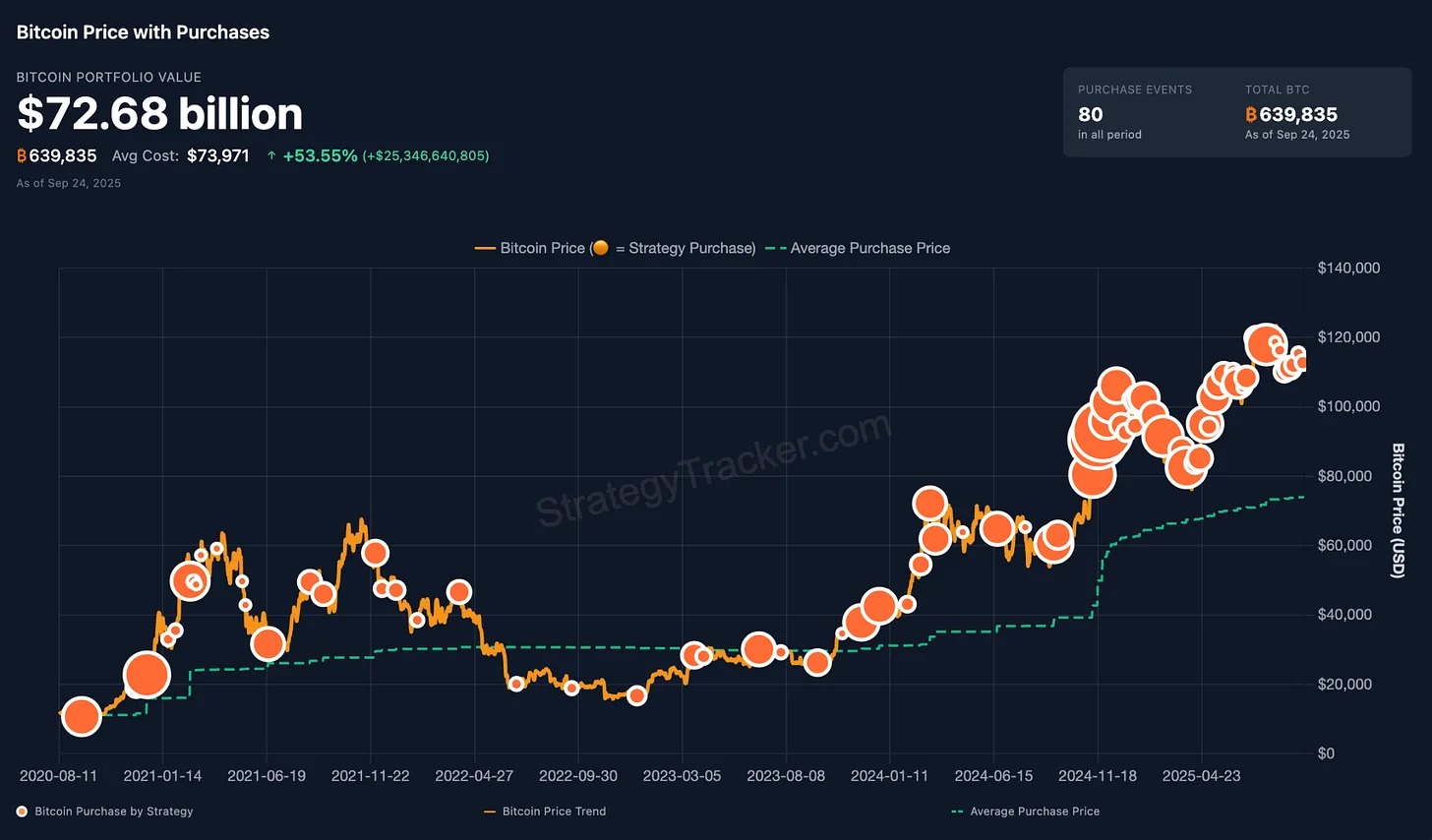
For investors, the appeal of DATs lies in regulated access to crypto exposure without the hassles of wallets, exchanges, or custody. For institutions barred from holding crypto directly, DATs offer a compliant backdoor into digital assets via familiar stock markets.
The Boom
2025 marked the peak of the DAT frenzy. Companies collectively raised over $20 billion in fresh capital, turning biotech firms, toy manufacturers, and others into crypto fund managers. The market mania spawned strange corporate pairings: a syringe maker becoming a Solana treasury firm, a cleaning products company accumulating Dogecoin, a health firm hoarding BONK tokens.
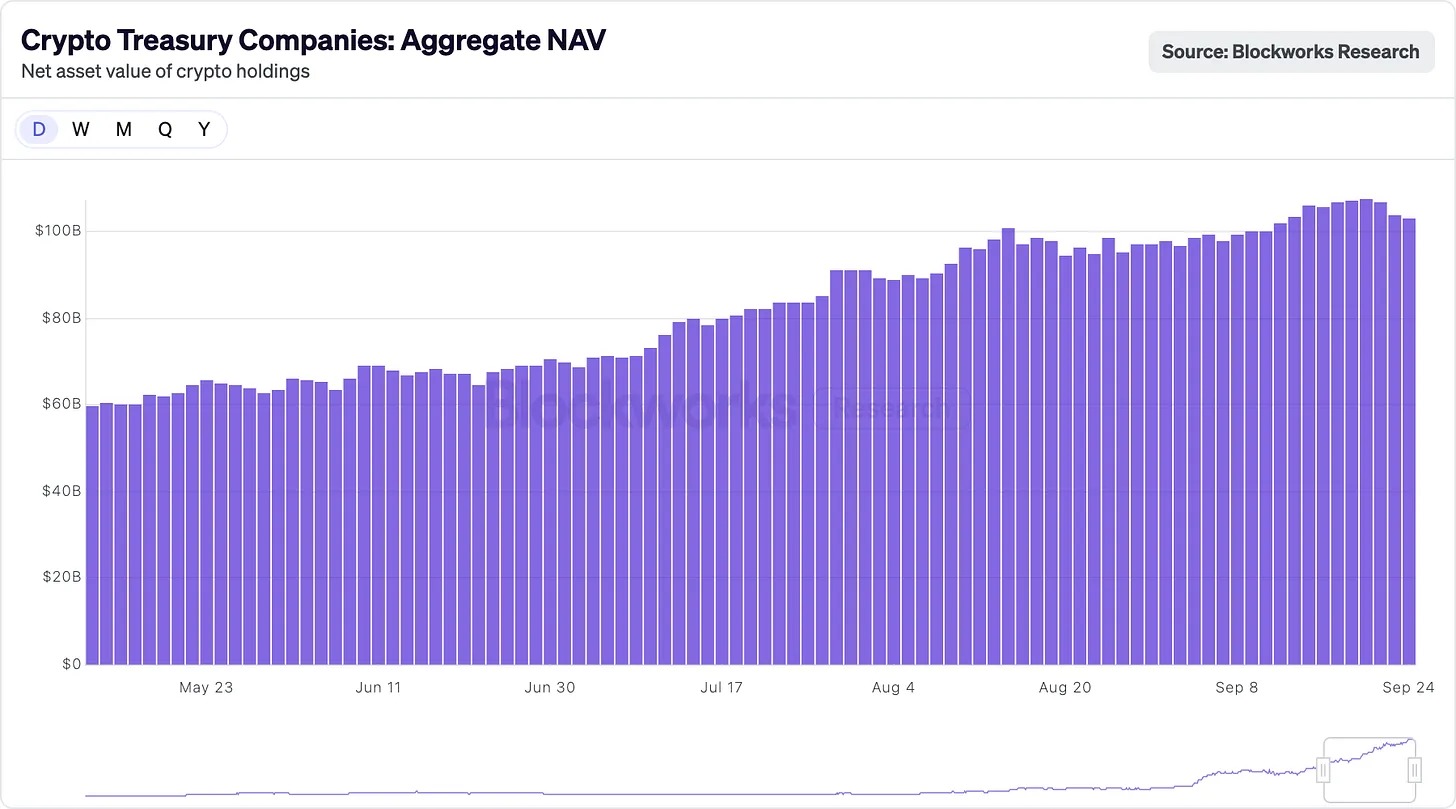
Multiple crypto-linked public companies traded at significant premiums to their NAV. MicroStrategy traded at roughly a 75% premium to its Bitcoin NAV.
Metaplanet, dubbed "Japan’s Strategy," traded at an extreme premium—reportedly around 384% above its Bitcoin NAV—driven by investor appetite for growth potential and capital markets access. Smaller players like Blockchain Group also saw premiums exceeding 200%, reflecting speculative demand.
A traditional IPO on a securities exchange takes over a year. SPAC deals might shorten that to six months. But with the premium window closing fast, firms took the fastest route: reverse mergers into already-public shells.
"If you don’t build an actual operating business beyond accumulating crypto assets, you’re excluded from the Russell indices," explained analyst Paul McCaffery. For firms reliant on trading above NAV, such exclusion can be fatal—index inclusion mandates institutional buyers to purchase around 17% of free float shares.
The result was a wave of questionable business combinations. Take Sharps Technology: despite zero revenue and $2 million in operating losses, it pivoted into a Solana-focused DAT. Its accounting firm resigned due to the company "not meeting internal risk tolerance criteria." Yet, the crypto-focused entity pledged to keep the syringe business—not for strategic reasons, but because maintaining operational activity was necessary for compliance.
In September 2025, Strive acquired Semler Scientific for $1.34 billion—a watershed moment. This was survival-driven consolidation.
Both companies traded at or below NAV, unable to raise further capital at attractive prices. By combining their Bitcoin holdings (5,886 BTC + 5,021 BTC), they hoped to achieve sufficient scale to reignite a trading premium. The merger was essentially two drowning companies tying themselves together, hoping to stay afloat.
The deal structure revealed a new reality: minimal premiums, limited synergies, and a focus on scale over growth. Is this the template for an impending wave of DATCO consolidation? Let’s unpack that idea.
When the Music Stops
The DATCO model contains several structural vulnerabilities that become catastrophic when markets turn.
The Premium Evaporation Problem
The entire DATCO edifice rests on sustaining a stock premium over net asset value (NAV). When those premiums vanish—as happened with most small DATCOs in 2025—the flywheel reverses.
Companies trading at or below NAV face a brutal choice: issue dilutive shares, effectively reducing per-share Bitcoin value, or halt growth entirely. Many chose a third path: borrowing to buy back their own stock, artificially propping up the premium.
The Death Spiral Dynamic
When crypto prices fall and premiums evaporate simultaneously, DATCOs enter what analysts call a "death spiral." Here’s how it unfolds:
-
Crypto correction: Bitcoin/Ethereum prices drop 30–50%.
-
Stock跌幅扩大: Due to leverage, DATCO stocks fall 50–70%.
-
Premium collapse: Shares trade below the already-lowered NAV.
-
Financing crisis: Unable to raise equity capital without severe dilution.
-
Debt pressure: Convertible bonds and credit lines come under stress.
-
Forced selling: Firms liquidate crypto to meet obligations.
-
Chain reaction: Forced selling further depresses crypto prices.
During Bitcoin’s early-2025 correction, several smaller DATCOs experienced similar dynamics—stock drops exceeding 60% alongside 40% Bitcoin declines. Metaplanet’s stock fell over 60%, far outpacing Bitcoin’s ~40% drop, sliding from around $457 in July 2025 to a low of $328.
Desperate Buybacks
Recent reports show at least seven DATCOs are borrowing to fund stock buybacks—a sign the model is breaking. Consider what buybacks mean in this context. Instead of issuing shares at a premium to buy more crypto (the original flywheel), companies now borrow against their crypto holdings to reduce share count. ETHZilla borrowed $80 million against Ethereum after its stock dropped 76%, using the funds for a $250 million buyback. Empery Digital raised $85 million in debt for share repurchases. These are defensive moves.
Buyback strategies expose three critical flaws. First, these firms can no longer access equity markets on favorable terms. When your stock trades below NAV, issuing new shares destroys value, not creates it. Second, management teams are betting financial engineering can restore a premium erased by fundamental market forces. Third, borrowing against volatile crypto assets to fund buybacks introduces new risks. If crypto prices fall while debt remains fixed, companies may face forced liquidation.
The M&A “Musical Chairs” Game
The consolidation wave signals that the original DATCO thesis is unsustainable. Mergers aren’t driven by compelling strategic synergies, but by the need for scale to remain competitive in an oversaturated market.
If 200 companies all try to be proxies for Bitcoin, the scarcity premium underpinning the original model vanishes. Consolidation may help, but it also reveals that many DATCOs were built on the flawed assumption of perpetual market premiums.

With increased regulatory scrutiny, M&A processes have grown more complex. The U.S. Securities and Exchange Commission (SEC) demands greater disclosure on crypto holdings, valuation methods, and risk factors. Investment banks preparing fairness opinions must navigate asset valuation complexities, synergy assessments, NAV-based premium justification, and the impact of crypto volatility on deal certainty.
This regulatory attention makes M&A execution more challenging—but also potentially more credible, reducing the excessive speculation seen in early DAT activity.
The Bitcoin-Ethereum Divide
While Bitcoin DATs dominate headlines, Ethereum-focused treasury firms are evolving distinct strategies. Ethereum’s proof-of-stake (PoS) consensus allows DATs to earn 3–5% annual yield through staking, creating income streams beyond simple asset appreciation.
BitMine Immersion Technologies exemplifies this approach, holding over 2.4 million ETH, worth about $9 billion—more than 2% of Ethereum’s total supply. The company actively stakes via institutional providers like Figment, generating steady returns even if ETH prices stagnate.
SharpLink Gaming employs a similar strategy, holding 837,230 ETH worth $3.7 billion, nearly all staked to maximize yield. This productive asset model addresses a core limitation of Bitcoin DATs: the inability to generate income from idle holdings without external lending or derivatives.
SharpLink Gaming adopts a similar strategy, holding 837,230 ETH worth $3.7 billion, almost entirely staked to maximize yield. This productive asset strategy solves a fundamental limitation of Bitcoin DATs: the inability to generate income from idle holdings without external lending or derivatives.
Ethereum’s treasury model also benefits from the expanding decentralized finance (DeFi) ecosystem. Firms can participate in lending protocols, provide liquidity to decentralized exchanges, or invest in tokenized real-world assets—all while maintaining their core ETH reserves.
However, Ethereum strategies carry additional risks.
Staking involves technical complexity and slashing risks. DeFi participation brings smart contract vulnerabilities and regulatory uncertainty. The trade-off between Bitcoin’s simplicity and Ethereum’s productivity has given rise to distinct DAT models pursuing different risk-return profiles.
The Weight of Numbers
In the end, math always wins. Not because numbers are truer than stories, but because when stories cease to make sense, numbers are harder to ignore.
The DAT phenomenon promised to transcend the ancient tension between narrative and arithmetic. It created a world where belief could literally embody value, where collective trust in a corporate structure could double the worth of the assets it contained. For a brief, intoxicating moment, the market seemed to discover a new financial alchemy—turning belief into capital through pure collective imagination.
Yet market forces eventually reassert themselves. No matter how we perceive ice, water freezes at 0°C. No matter how we deny Newton’s laws, gravity pulls objects to the ground. Ultimately, company valuations reflect fundamentals, not the stories we invent about their uniqueness.
The problem arises when everyone embraces the same beautiful dream. The dream loses its discriminative power. When fifty companies offer similar Bitcoin exposure, the collective fiction sustaining the premium disappears—not because it was false, but because it was no longer rare.
All financial innovation may mature this way. It begins as poetry—an elegant solution to impossible problems, sustained by the collective belief that “this time is different.” It often ends as prose—a functional tool operating within the boundaries of economic reality, generating returns sufficient to justify its existence, but no longer transcending it.
The next wave of builders may understand more clearly what the market will and won’t accept. Their focus may shift away from financial engineering toward real engineering. Less premium capture, more value creation. Fewer stories justifying price, more attention to fundamentals supporting it.
What comes next remains to be seen. Companies that adapt may thrive in the new environment. But what exactly will that adaptation look like?
Join TechFlow official community to stay tuned
Telegram:https://t.me/TechFlowDaily
X (Twitter):https://x.com/TechFlowPost
X (Twitter) EN:https://x.com/BlockFlow_News






