Delphi Digital Research Report: Plasma, Targeting a Trillion-Dollar Market Opportunity
TechFlow Selected TechFlow Selected
Delphi Digital Research Report: Plasma, Targeting a Trillion-Dollar Market Opportunity
A stablecoin blockchain with zero transaction fees targets the trillion-dollar settlement market.
 Navigating Web3 tides with focused insights
Author: Delphi Digital
Translation: TechFlow
The Fastest-Growing Settlement Layer for the Dollar
Stablecoins are not just another crypto primitive—they represent the world’s closest approximation to a globally universal currency. By wrapping the U.S. dollar (and other fiat currencies, to a lesser extent) into a digital bearer form, stablecoins simplify transfer and settlement processes. Clearing and settlement can be completed atomically and confirmed nearly instantly.
This feature makes stablecoins the on-chain functional equivalent of “Eurodollars.” Stablecoins are portable dollars that operate outside the traditional banking system, avoiding the friction of correspondent banks, credit card networks, or wire transfers.
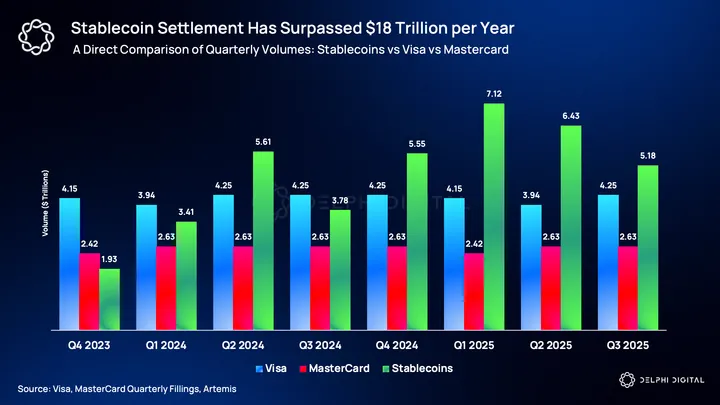
Adoption has already been staggering. As of mid-2025, over $245 billion in stablecoins circulate across public blockchains, with approximately 62% being USDT and about 23% USDC. In 2024, on-chain settlement volume exceeded $15 trillion, surpassing Visa’s $14.8 trillion.
Today, one of the primary uses of stablecoins is as a quote asset across exchanges (both centralized and decentralized), and to provide leverage for investors. But stablecoins have rapidly evolved from a niche settlement layer for traders into a payment channel now rivaling major credit card networks. In Q1 2025, stablecoin clearing volume exceeded $7 trillion, briefly overtaking the combined total of Visa and Mastercard. In each subsequent quarter, they maintained a strikingly close gap against the cumulative settlement volumes of the two major payment processors.
The growth trajectories of the two are sharply contrasted. Credit card networks continue steady growth, albeit at a slowing pace. In comparison, stablecoins grow at a much faster compound rate—just a few years ago barely visible in transaction volume, they now rival the scale of traditional payment channels.
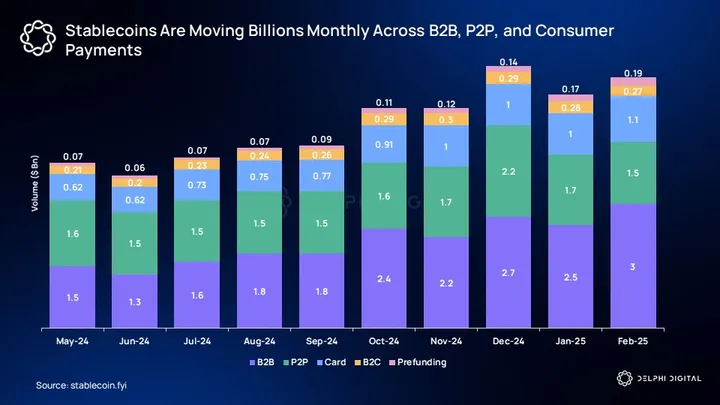
Originally serving as collateral for crypto trading, stablecoins have gradually evolved into cash flows serving remittances, merchant settlements, and B2B payments. Especially in markets with unstable local currencies or weak banking infrastructure, on-chain dollars are not only more functional but also relatively better as a store of value. Compared to pure payment processing networks like Visa and Mastercard, stablecoin networks support a broader range of financial activities, meaning we should expect their market share to continue rising in this context.
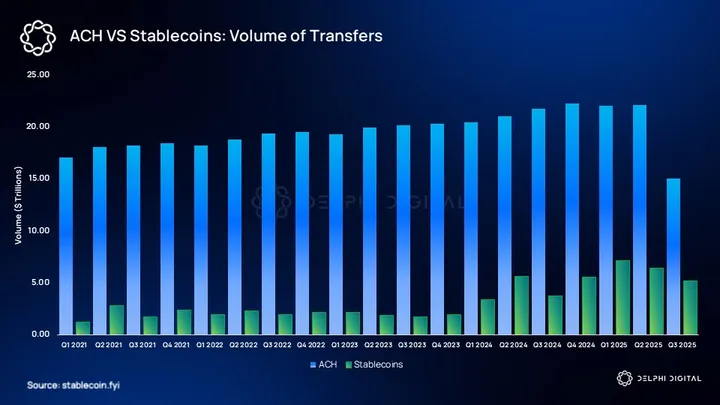
The U.S. interbank transfer system ACH still clears around $20 trillion per quarter, but stablecoins are beginning to catch up. Nearly negligible in 2021, stablecoins now process over $7 trillion per quarter, gradually eroding ACH’s share of digital dollar settlements.
Plasma: The Present Opportunity to Build the Future of Payments
Despite their importance, stablecoins remain second-class citizens on the blockchains that host them. Platforms like Ethereum, Tron, and Solana were designed as general-purpose smart contract platforms, not dedicated monetary payment rails. As a result, stablecoin transfers are subject to volatile gas prices, MEV (miner extractable value) attacks, and fee models denominated in speculative native tokens. This mismatch leads to inefficiencies: users pay billions annually in fees for simple ledger updates.
Plasma completely rethinks this model. It is a Layer-1 blockchain purpose-built for stablecoin finance, treating USDT and other fiat-backed tokens as the network’s primary workload—not just another application on top. By optimizing consensus, fee policy, and economic incentives for high-frequency, low-margin traffic, Plasma positions itself as the settlement layer for the global dollar economy. In doing so, it intelligently addresses the trillion-dollar opportunity in cross-border payments, remittances, and merchant settlements, where cost sensitivity and finality speed are paramount.
Plasma Architecture Overview
Plasma’s design draws on lessons from a decade of L1 experimentation. At its core, it runs on HotStuff-based BFT consensus (PlasmaBFT), offering fast finality and high throughput. On mainnet launch day, TPS will exceed 1,000, eventually scaling beyond 10,000 TPS. Built atop this is an execution layer based on Reth, ensuring full EVM equivalence and compatibility with existing tools and contracts.
Key design choices include:
-
Stablecoin-centric fee model: USDT transfers are zero-fee, while non-stablecoin transactions follow a modified EIP-1559 burn mechanism that returns value to the XPL token. This applies only to transfers, not other transaction types such as swaps.
-
Validator security via XPL staking: XPL serves as Plasma’s reserve collateral, ensuring economic security and aligning long-term incentives.
-
Liquidity alignment with USDT: USDT is natively integrated at genesis, with issuers and trading partners providing immediate depth to settlement pools.
-
Cross-asset bridges: A native Bitcoin bridge positions Plasma as the intersection point for the two most widely used on-chain asset classes—BTC and stablecoins.
Plasma isn’t about adding another L1 blockchain—it’s more about how a chain designed around stablecoins can anchor the next phase of global dollar settlement.
Zero-Fee USDT Transfers: Plasma’s Strategic Breakthrough
One of Plasma’s boldest design choices is making USDT transfers free at the base layer. At first glance, this seems counterintuitive. Blockchains typically profit from transaction fees, and stablecoins—especially USDT—are the highest-frequency use case in crypto today. Why would a new chain choose to give away its most valuable traffic?
The answer lies in how Plasma captures value. Stablecoins already clear over $10 trillion quarterly. The real opportunity isn’t marginal fees on transfers, but becoming the default ledger for these flows. Just as internet companies offer free email, messaging, and search to monetize downstream activities enabled by those services, Plasma uses zero-fee USDT transfers as a customer acquisition strategy for global dollar flows.
For example, PayPal nurtured its early network by offering free P2P payments, later profiting from merchant checkout fees and FX spreads. Google followed a similar path, distributing Android for free to capture revenue from search and app stores. Plasma is replicating this strategy in the stablecoin space: offering the most basic service for free to attract traffic, applications, and developers, then monetizing higher-value layers like settlement, liquidity, and financial services.
It’s important to note that zero-fee transfers apply only to simple USDT send/receive actions, akin to transferring money on Venmo. Any other interaction involving USDT—such as swapping, lending, or contract calls—still incurs standard fees. This exemption is deliberately narrow, designed to make the most frequent, commoditized operations feel frictionless while preserving validator incentives and the integrity of the broader fee model.
The paradox of giving away the most commonly used functionality is intentional. By eliminating friction at the base layer, Plasma aims to become the cheapest and fastest platform for USDT transfers across wallets, exchanges, and settlement channels. This appeal is particularly strong for high-frequency participants most sensitive to transfer costs—market makers, CEX exits, PSPs, and remittance operators.
The ultimate vision: if USDT flows begin concentrating on Plasma, liquidity deepens, balances accumulate on-chain, and USDT activity migrates from fragmented multi-chain footprints toward a single gravitational hub.
Plasma does not expect to profit directly from USDT transfers themselves. The free transfer layer is the entry point to draw traffic into the system; profits come downstream through fee-generating DeFi trades, FX conversions, and settlement services. The long-term bet is simple: XPL will capture value by securing the infrastructure supporting these flows, rather than taxing simple transfers.
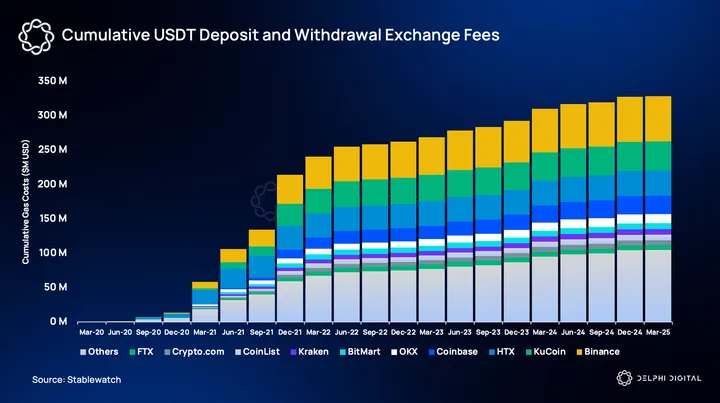
In the past five years, users have spent over $300 million on CEX withdrawals/deposits of USDT. This strongly demonstrates how free USDT transfers could powerfully incentivize users to choose Plasma as the USDT hub over any other chain.
Plasma One: How to Monetize Traffic?
The next question is how to capture and monetize this traffic. This is where Plasma One—the new kind of stablecoin-native bank—comes in.
Plasma One is designed as the gateway for users, merchants, and enterprises. It extends the advantage of zero-fee transfers into a daily money experience. Users can save in dollars, earn yield, spend at merchants with a card, and send instant free payments. For merchants, Plasma One offers direct USDT settlement, eliminating intermediaries and FX costs. Developers and institutions can also access Plasma’s distribution network through Plasma One.
The economic model shifts from taxing every transfer to monetizing layers above the transfer. Plasma One has the potential to capture value in three ways:
-
Card interchange and merchant settlement: Each swipe or payment generates fees, similar to traditional card networks, but at lower cost and broader reach.
-
FX and conversion spreads: Converting between USDT, local currencies, and other stablecoins naturally creates spreads, which Plasma can capture through its integrated FX system.
-
Yield capture: User deposits on Plasma One can be deployed into on-chain money markets, with generated yield shared with users or partially retained by the ecosystem.
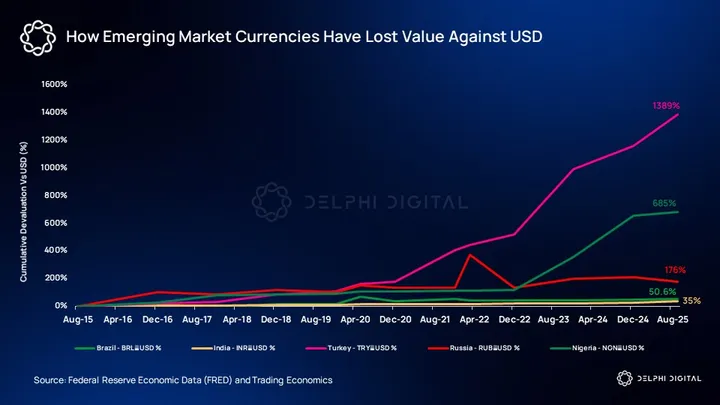
This value proposition becomes even stronger as Plasma targets emerging markets where local currencies continue to depreciate against the dollar and euro.
By owning both the blockchain and a new kind of bank, Plasma creates a closed loop between infrastructure and distribution. Zero-fee transfers attract traffic, while Plasma One gives that traffic a home and monetizes it through expectations of banking services—but delivered via stablecoin rails.
Plasma’s Position in the Stablecoin L1 Competition
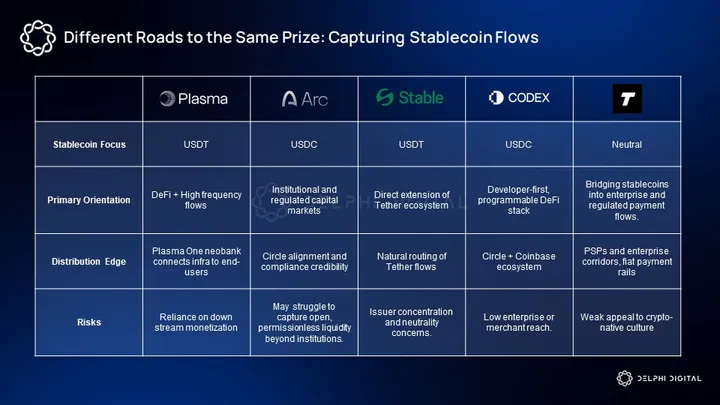
Over the past year, blockchain projects focused on stablecoins have proliferated, as each recognizes dollar settlement as crypto’s killer application. Some, like Arc and Codex, work closely with Circle and naturally favor USDC, though they remain open to inflows of other stablecoins like USDT. Their messaging emphasizes regulatory transparency and institutional adoption, positioning themselves as compliant rails for capital markets.
Others, like Stable, position themselves as platforms for USDT circulation, lacking issuer neutrality. Tempo sits in between, emphasizing regulated channels and compliance-first integrations with enterprises and PSPs. While these issuer-centric or compliance-focused models offer strong enterprise alignment, they risk recreating silos that limit experimentation and composability.
Plasma takes a different stance. By anchoring to USDT while maintaining issuer neutrality and full EVM programmability, Plasma positions itself as a more accessible platform for DeFi and organic stablecoin applications. It aims to absorb complex, high-frequency flows—remittances, trading, merchant settlements—that drive real liquidity, rather than serving curated institutional pipelines.
Stablecoins already clear trillions in value each quarter; blockchains that maintain liquidity and composability are more likely to become true settlement hubs. Neutrality, not corporate alliances, may be the stronger foundation for capturing the next wave of stablecoin adoption.
XPL Tokenomics
At the heart of Plasma is XPL, the native token powering the network.
XPL is the native token of the Plasma blockchain, analogous to ETH on Ethereum and SOL on Solana. XPL serves as the gas token for transactions and smart contract execution, the staking asset for network security, and the reward token for validators.
As noted earlier, Plasma’s architecture allows end users to conduct gas-free stablecoin transfers, but any more complex interaction—contract deployment, advanced dApp usage—requires XPL as gas or automatically converts part of a stablecoin into XPL to pay fees.
Like most Layer1s, XPL has no fixed supply cap and follows a programmed inflation schedule similar to ETH or SOL. At mainnet Beta launch, XPL’s initial supply will be 10 billion, with a 5% annual inflation rate rewarding validators. Thereafter, the inflation rate will decrease by 0.5% annually, eventually stabilizing at 3% in the long term.
-
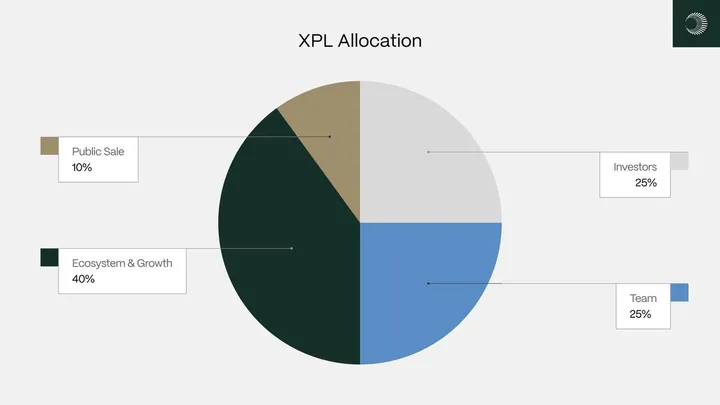
Public Sale: 10% (unlocked at TGE for non-U.S. investors; U.S. investors unlocked on July 28, 2026)
-
Ecosystem and Growth: 40%
-
Team: 25% (1-year lock-up + 2-year linear release)
-
Investors: 25% (1-year lock-up + 2-year linear release)
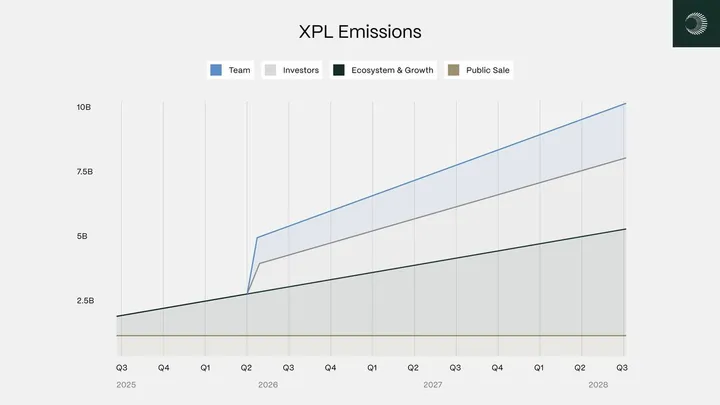
Plasma adopts Ethereum’s EIP-1559: base transaction fees are burned. Network growth will exert deflationary pressure on token issuance. In practice, heavy usage could make XPL a net-deflationary token.
The initial circulating supply at mainnet launch will include public sale tokens (10% minus allocation for U.S. investors), all unlocked ecosystem tokens (8% immediately unlocked), and possibly a small portion allocated to strategic partners. Team and investor tokens (combined 50%) are locked at genesis. Thus, the initial circulating supply is relatively limited, expected to reach around 18% of total supply at TGE.
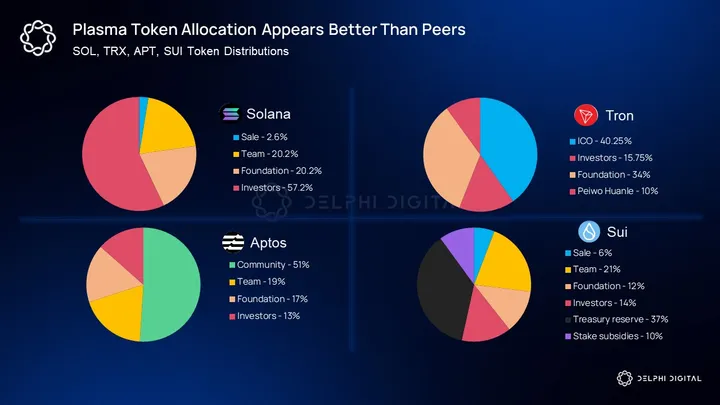
For L1 tokens, token distribution is critical. While this is often discussed in terms of governance, L1 tokens must balance public interest, decentralized infrastructure, and commodity value. Aggressive or predatory token distributions echo throughout a blockchain’s lifecycle. From this perspective, XPL’s overall token distribution is very healthy compared to other L1 tokens.
It remains unclear how XPL’s token distribution compares to more ideal peers like Tempo and Arc. We’ll continue monitoring as more details emerge.
Why XPL Has Value
Plasma’s value proposition is tightly linked to the idea of stablecoins as crypto’s killer application. As previously mentioned, stablecoins achieved an astonishing $27.6 trillion in on-chain transaction volume in 2024, exceeding the combined volume of Visa and Mastercard that year. Crypto innovation, especially DeFi, has hit a bottleneck. Bridging traditional money with blockchain rails is key to driving the next wave of innovation.
When evaluating L1 tokens, analysts typically use two frameworks:
-
Realized Economic Value (REV) – fees + MEV (maximal extractable value). This treats the token as equity with claims on cash flows.
-
Monetary premium – this treats the token as money valued based on utility and network effects.
For a new chain like Plasma, initial fee capture is low—especially since Plasma offers zero or near-zero fees to bootstrap usage. Therefore, valuing Plasma based on REV is unrealistic. Other new chains like Aptos and Sui have never been priced by the market on this basis either.
The monetary premium aspect is more relevant for XPL at this stage. People value XPL not because it pays large staking rewards or dividends immediately, but because they expect Plasma to become essential infrastructure in a stablecoin-dominated future.
Staking rewards and deflationary pressure from burns will help measure progress and validate this thesis. Monetary policy is crucial for L1s, helping establish perception as an effective store of value. However, a deflationary issuance mechanism is unlikely to be the core driver of Plasma’s valuation, especially initially.
The market for new L1 tokens tends to price closer to the perceived potential of the chain than its Day-One fundamentals.
For example, excitement around MoveVM and Solana-rivaling throughput drove attention toward alternative high-throughput chains like Sui and Aptos—this desire for faster chains outweighed anything else in driving their valuations.
Since Plasma centers on crypto’s most fundamental use case—stablecoins—the primary source of XPL’s value will stem from its perceived monetary premium. As the chain and its ecosystem launch and solidify, we expect REV and core economic metrics to begin growing as well.
Current Competitive Landscape
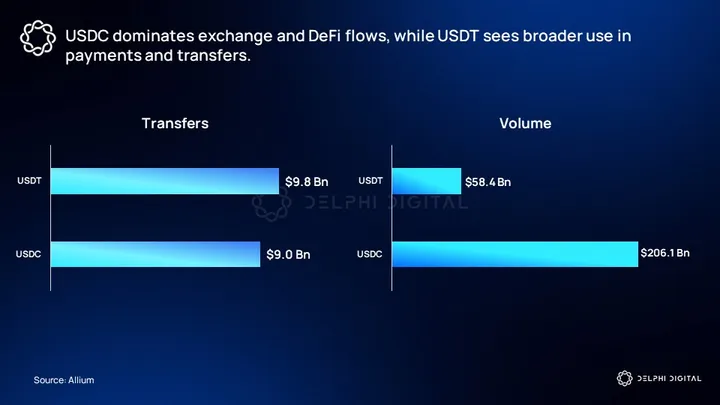
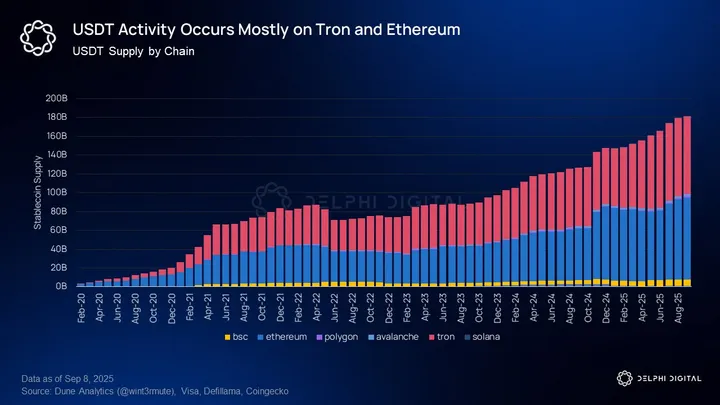
USDT is the largest and most liquid stablecoin on centralized exchanges (CEX). USDC is favored in DeFi, with numerous integrations, serving as the primary DEX liquidity pair, and gaining strong momentum in payments. Despite expanding design space and growing market interest, USDT continues to consolidate its market share, with supply nearing $200 billion.
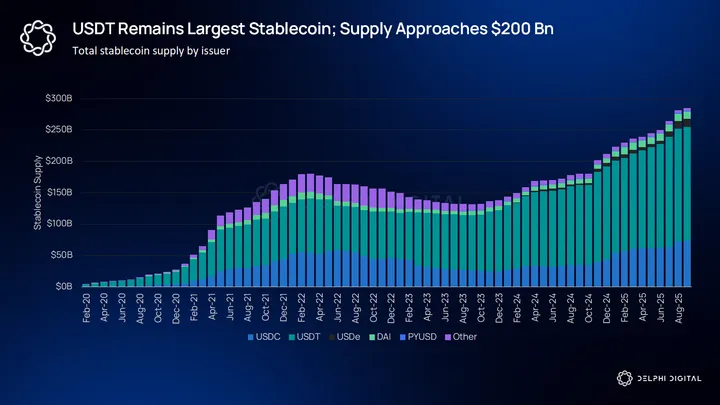
Ethereum, with its strong grip on DeFi innovation and activity, remains the primary liquidity center for stablecoins. Although Solana, Aptos, and Sui receive significant attention, these chains have yet to attract substantial stablecoin volumes like Ethereum and Tron.
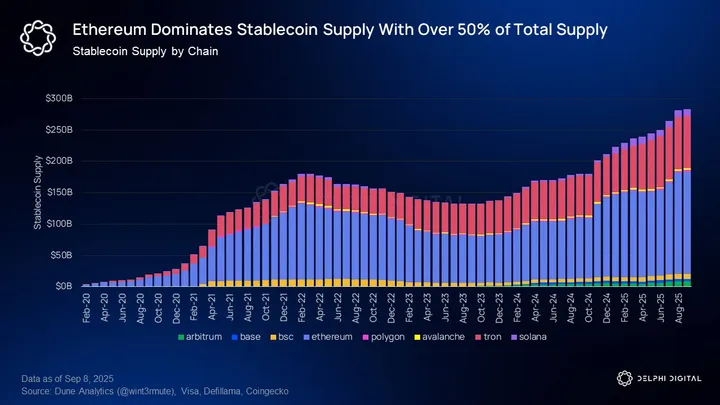
Tron ranks second in stablecoin supply among public chains and has become the de facto public chain for USDT transfers. Beyond USDT, Tron has limited stablecoin and DeFi activity, but its market share is impressive: Tron’s $83 billion USDT supply is very close to Ethereum’s $87 billion.
Stablecoin transaction volume is more widely distributed across ecosystems. Ethereum lags far behind Layer2s and competing Layer1s. Tron, Solana, Base, and BSC all have higher stablecoin transaction volumes than Ethereum. High throughput theory is best demonstrated here, as Ethereum’s mainnet gas fees are too high for everyday stablecoin use. Thus, Ethereum is primarily used for complex, high-risk DeFi instruments.
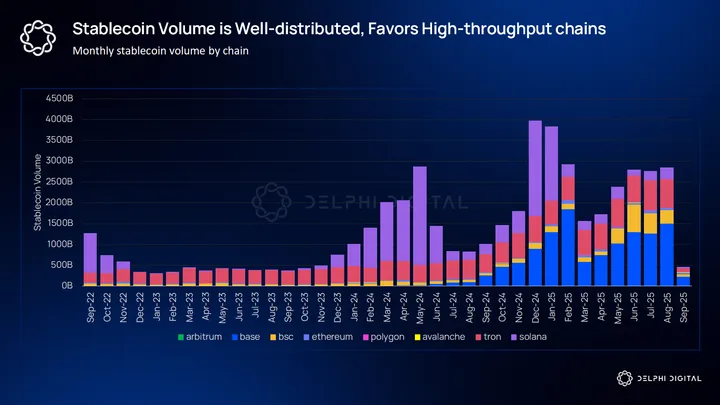
Plasma’s zero-fee USDT transfers openly position it as Tron’s “killer.” While Tron has found product-market fit for a USDT chain, it has failed to build an active DeFi ecosystem around it—at least not one matching its $83 billion USDT supply.
Plasma’s goal should be to partner with major DeFi teams to move beyond the remittance-chain niche and simultaneously gain TVL and transaction volume. Currently, significant progress has already been made.
The Binance Earn on Plasma product is a fully on-chain USDT yield product, with $1 billion committed prior to mainnet Beta launch. Users can stake USDT through Binance Earn, which will deploy these USDT onto Plasma-operated infrastructure rails to generate yield. The product is similar to native USDC yield on Base.
In addition, Plasma has announced partnerships with Aave, Fluid, Wildcat, Maple Finance, and USD.AI. These partnerships strike a balance between crypto-native applications (Aave, Fluid, USD.AI) and institution-facing fintech applications (Maple Finance, Wildcat, USD.AI). Positioning Plasma as a blockchain where users can conduct business as usual, while fintech apps have greater opportunity to achieve product-market fit, is a reliable strategy to win sustained usage and build a real moat.
Theoretical Valuation Model
The most reasonable comparables for Plasma are Stable, Arc (Circle), and Tempo (Stripe). However, these blockchains lack liquidity so far. Currently, high-throughput, DeFi-dominant chains like Tron, Solana, Ethereum, Aptos, and Sui are the best benchmarks.
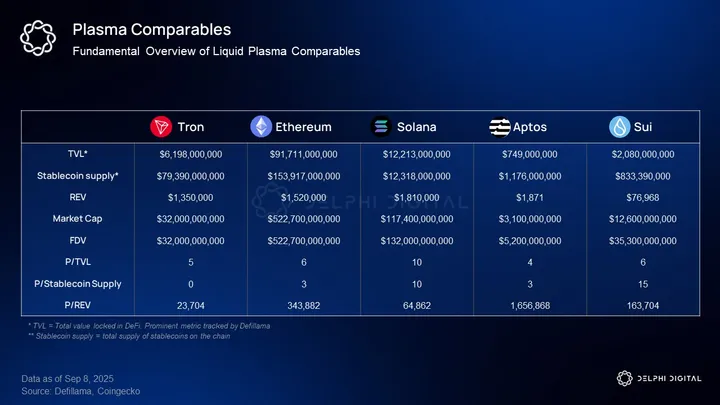
REV is an intuitive metric and a meaningful mental model for understanding Layer 1 value capture. However, it clearly has little correlation with market pricing and is unrelated to current L1 valuations. Solana’s REV is attractive because its ecosystem draws many active users. TVL remains the most common metric for measuring blockchain appeal, while stablecoin supply provides a useful supplementary data point.
These two metrics show reasonable consistency in valuation multiples across the sample group, mostly below 15 and typically in the mid-single digits.
Tron has a niche use case, limited growth prospects due to low DeFi penetration, and lacks the technological premium typical of next-gen blockchains. Thus, its 0.4 ratio of stablecoin price to supply may be an outlier.
By making reasonable assumptions about how the market might react to varying levels of traction, we can perform a scenario analysis on XPL’s valuation for Plasma.
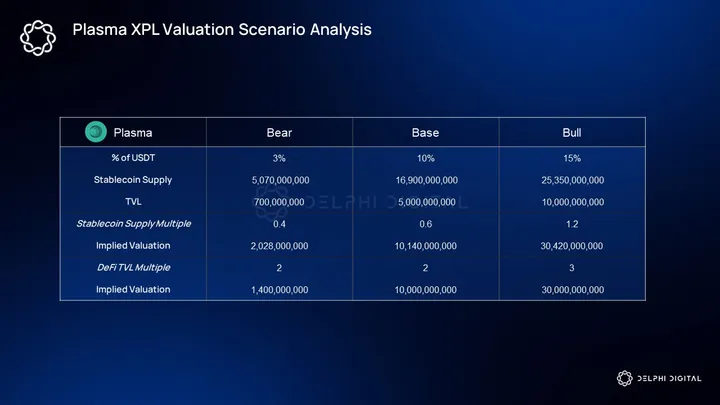
Our bear, base, and bull cases assume USDT supply market shares of 3%, 10%, and 15%, respectively.
Important caveats in these assumptions:
-
Downside risk: Corporate-chain narratives may saturate, with these chains cannibalizing each other’s usage and attention, compressing multiples. For this reason, we apply a lower stablecoin supply multiple in the bear case, using Tron’s 0.4 outlier.
-
Upside potential: Our USDT market share assumes a fixed total supply. For instance, Tether issues no additional USDT, and Plasma itself has no influence on new USDT issuance. Both scenarios are unlikely, making this an extremely conservative assumption. If market share continues growing at current rates, Plasma could achieve the same outcome even at lower market share numbers.
XPL’s pre-market valuation aligns largely with this network valuation approach. Upside potential here depends heavily on narrative-driven attraction fueled by partnerships and milestones. The biggest risk is a flood of similarly branded chains entering the market. Plasma’s vision is compelling, and its underlying narrative appears foundational to the cycle.
Conclusion
The development of Tether and Circle as issuers, the absolute quantity of stablecoins used on chain, the emergence of next-generation products like Ethena and Wildcat, and broad acceptance by traditional payment firms like PayPal and Stripe—all signal one thing: the stablecoin opportunity is undeniable.
At the same time, we must continue to uphold crypto’s core ethos. Permissionless use, decentralization, and grassroots community building remain central. As stablecoin L1s rise—some potentially in the form of corporately adopted blockchains—Plasma appears best positioned in this regard. With strong day-one integrations while maintaining distance from centralized operators, Plasma perfectly combines the strengths of stablecoins with the ideals of on-chain capital markets.
The L1 race has become increasingly commoditized. High throughput is now table stakes. The real battle lies in ecosystem building and user acquisition.
Plasma firmly believes stablecoin transfer costs should ultimately trend toward zero, with real value coming from enabling higher-risk activities like lending/funding and trading. In short, Plasma’s true business model is rooted in becoming the central hub for stablecoin liquidity. And one of the simplest ways to achieve this is by offering users free access to high-frequency use cases—like simple payments/transfers.
From Plasma One to the various DeFi protocols soon deploying on-chain, Plasma views distribution as its true differentiator, not just technical architecture. As the world embraces stablecoins, Plasma is committed to becoming one of the leading platforms where developers and users converge around stablecoin products.
Join TechFlow official community to stay tuned
Telegram:https://t.me/TechFlowDaily
X (Twitter):https://x.com/TechFlowPost
X (Twitter) EN:https://x.com/BlockFlow_News
 Delphi Digital