








Digital Asset Treasury (DAT) Track: Comprehensive Analysis and Strategic Response
TechFlow Selected TechFlow Selected
Digital Asset Treasury (DAT) Track: Comprehensive Analysis and Strategic Response
A comprehensive analysis of the DAT sector, covering its concept, origin, current status, key cases, and future prospects.
 Navigating Web3 tides with focused insights
Author: Manqin
Executive Summary
The Digital Asset Treasury (DAT), or DATCO, has evolved from a pioneering financial experiment into an undeniable force within global capital markets.
This article provides a comprehensive analysis of the DAT sector's concept, origins, current landscape, key case studies, and future outlook, offering clear strategic guidance for market participants. It traces how DAT has developed from its initial "coin accumulation" model—where public companies hold digital assets as core reserves—into a sophisticated financial engineering strategy.
We examine the "financial flywheel" model pioneered by MicroStrategy, analyze the current market structure led by public companies with over $100 billion in total holdings, and explore Hong Kong’s unique position and opportunities amid this trend.
By dissecting local cases such as Boyaa Interactive and studying ecosystem builders like HashKey Group, we reveal strategic divergences within the DAT space.
Finally, we explore the vast potential of integrating DAT with real-world asset (RWA) tokenization, providing systematic strategic recommendations on risk management, compliance, and capital operations for enterprises and investors navigating this emerging domain.
Conceptual Framework: A New Paradigm of "Coin-Stock Convergence"
1.1 Core Definition of DAT
A Digital Asset Treasury (DAT) is a strategic approach adopted by publicly listed companies that make accumulating digital assets their central and primary business function. This definition clearly distinguishes DAT companies from those that merely hold small amounts of cryptocurrency incidentally on their balance sheets, where digital assets are not core to strategy. For DAT firms, corporate value, strategic direction, and market narrative revolve entirely around their digital asset holdings.
This model represents the first level of "coin-stock convergence"—using public equities to accumulate crypto, thereby bridging liquidity between traditional stock markets and the crypto asset market. Its core value proposition lies in offering regulated, accessible exposure to cryptocurrencies for institutional investors (such as pension funds and family offices) who may be restricted by compliance, custody, or investment mandates from direct crypto purchases.
1.2 Strategic Drivers
Corporate adoption of the DAT strategy stems from responses to macroeconomic pressures and forward-looking positioning toward technological trends.
Store of Value and Inflation Hedge: Viewing limited-supply digital assets like Bitcoin as "digital gold" to hedge against fiat currency inflation and macroeconomic uncertainty remains the original driving force.
Transition to Web3: For many companies, especially in tech and gaming, acquiring and holding cryptocurrencies serves as a foundational step and strategic pivot toward Web3 business development.
Asset Diversification: Incorporating digital assets into treasury reserves optimizes corporate asset allocation, captures growth potential from emerging asset classes, and signals forward-thinking leadership to the market.
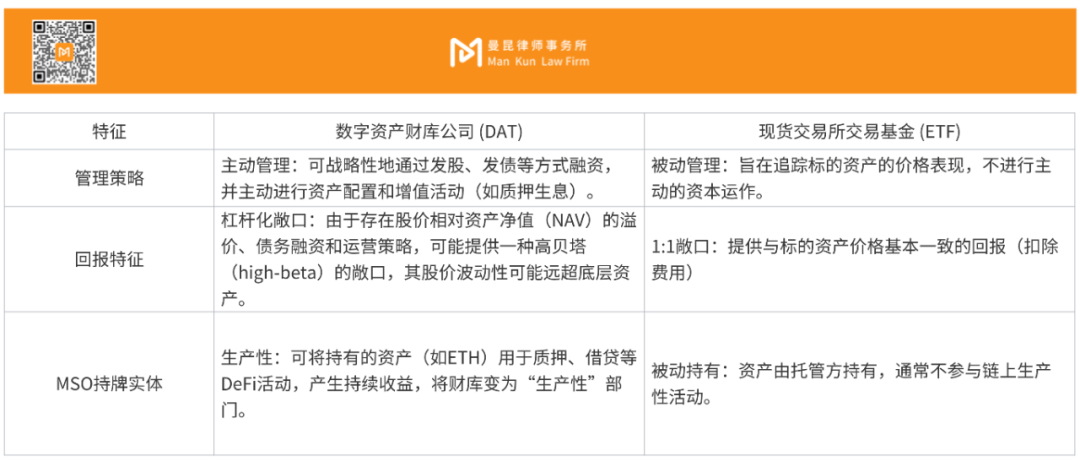
1.3 Comparison Between DAT and Spot ETFs
While spot ETFs offer direct exposure to crypto assets, DAT companies differ fundamentally in strategy, making them active investment vehicles.
Origins and Evolution — From Bitcoin Pioneer to Diversified Ecosystem
2.1 Origin: MicroStrategy’s "Financial Flywheel"
The birth of the modern DAT movement can be credited to MicroStrategy under Michael Saylor. In August 2020, the company made a groundbreaking decision to purchase $250 million worth of Bitcoin as its primary reserve asset, viewing Bitcoin as a superior store of value compared to cash.
The core of MicroStrategy’s success lies in a carefully designed "financial flywheel" model—a self-reinforcing positive feedback loop:
1. Hold Bitcoin: The company holds a large amount of Bitcoin on its balance sheet, forming its core value base.
2. Generate Stock Premium: Due to providing convenient, compliant Bitcoin exposure, its stock begins trading at a premium above its Bitcoin net asset value (NAV).
3. Leverage Premium for Financing: The company uses its inflated stock price to raise capital through low-interest convertible bonds or equity offerings.
4. Buy More Bitcoin: Raised funds are used to acquire additional Bitcoin.
5. Reinforce Narrative and Premium: Growing Bitcoin holdings further strengthen its market narrative as a "Bitcoin proxy stock," maintaining or increasing the stock premium and enabling further financing cycles.
2.2 Evolution: From Single Asset to Diversified Treasury
The initial DAT wave was Bitcoin-centric, but as the market matured, it expanded to include multiple digital assets serving distinct strategic purposes.
Ethereum (ETH): As a yield-generating asset, ETH attracts companies seeking cash flow. Through staking, firms gain both capital appreciation and steady block rewards. Companies like SharpLink and BitMine have transformed into pure Ethereum holding and staking entities.
Solana (SOL): With high performance and attractive staking yields of around 6–8%, SOL has drawn interest from companies like DeFi Development.
SUI and XRP: Some companies partner with specific blockchain foundations (e.g., Mill City Ventures with the Sui Foundation) or focus on tokens with strong application potential in payments (e.g., XRP), leading to more specialized treasury strategies.
Current Market Landscape — Global Expansion and the Rise of Hong Kong
3.1 Global Market Overview
As of mid-2025, the total value of digital assets held collectively by global DAT companies exceeds $100 billion. Bitcoin treasuries dominate, totaling over $93 billion; Ethereum-focused treasuries have rapidly grown to over $4 billion.
The total number of Bitcoins held by public companies approaches 1 million, representing approximately 4% of circulating supply. Geographically, the U.S. remains the epicenter of DAT activity, but the rise of Japanese firm Metaplanet and several Hong Kong-based companies indicates rapid diffusion of the DAT model into major Asian capital markets.
3.2 Hong Kong’s Unique Opportunities
In an increasingly stringent global regulatory environment, Hong Kong has emerged as fertile ground for DAT companies and funds, thanks to its clear regulatory framework and strong government support for the Web3 industry.
Regulatory Certainty: Hong Kong has established a clear licensing regime for virtual asset trading platforms and approved the listing of spot Bitcoin and Ethereum ETFs, offering institutional participants robust compliance safeguards.
Policy Support: The Hong Kong government views Web3 development as a key strategy to enhance its status as an international financial center, creating a favorable business environment for related enterprises.
Institutional Concentration: A growing cluster of licensed financial institutions, family offices, and tech companies in Hong Kong provides abundant capital sources and use cases for the development of the DAT model.
Case Studies
4.1 Web3 Transformation Pioneer in Hong Kong: Boyaa Interactive (0434.HK)
With 20 years as a listed developer of online card games, Boyaa Interactive exemplifies a traditional Hong Kong company undergoing full transformation into Web3.
Strategic Shift: The company explicitly defines “building a pure and leading Web3-listed company” as its strategic goal. Acquiring and holding cryptocurrencies is seen as a “critical foundation and initiative” in executing this transformation.
Asset Allocation: Since 2023, Boyaa has engaged in large-scale digital asset purchases. As of 2025, it holds approximately 3,670 Bitcoins and 15,445 Ether. At one point, digital assets accounted for up to 75% of its total assets, reflecting its strong commitment to transformation.
Dual Logic: The company treats Bitcoin as “digital gold” and a core strategic reserve to hedge macro uncertainties and achieve long-term value preservation and appreciation. Simultaneously, these assets lay the groundwork for future Web3 game development and ecosystem building.
Financing and Compliance: Cryptocurrency purchases were authorized by shareholders and funded using the company’s idle cash reserves, fully complying with public company regulations.
4.2 Ecosystem Builder: HashKey Group’s DAT Fund Model
HashKey, Asia’s leading digital asset financial services group, demonstrates a higher-dimensional DAT strategy—evolving from direct "coin accumulation" to ecosystem construction.
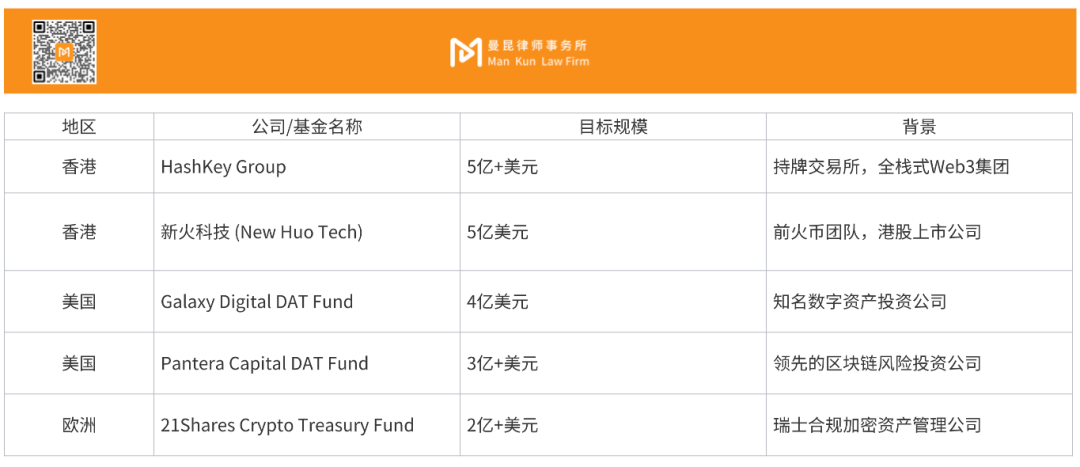
Fund Model: In September 2025, HashKey announced the launch of Asia’s largest multi-currency DAT ecosystem fund, with initial fundraising exceeding $500 million, focusing on investments in top global DAT projects, initially targeting Bitcoin and Ethereum ecosystems.
Beyond Financial Investment: Unlike passive investing, HashKey’s strategy involves deep engagement in the operations and ecosystem development of DAT companies. It aims to create a closed-loop "capital investment – ecosystem application – market cap capture – liquidity exit" flywheel.
"Using Coins" Vision: Leveraging its licensed exchange, public chain, cloud services, and other diversified businesses, the market expects HashKey’s DAT fund to go beyond mere coin accumulation, deeply integrating with its own operations to innovate in "using coins"—for example, incorporating platform tokens into the fund and reinvesting in its public chain ecosystem.
Compliance Bridge: HashKey positions itself as an "institutional bridge" connecting traditional financial capital with on-chain assets. Its DAT strategy is grounded in compliance, fully leveraging Hong Kong’s regulatory advantages.
4.3 The Global Wave of DAT Funds
2025 saw a surge in DAT fund launches, signaling that DAT has evolved from isolated corporate actions into an asset strategy recognized by mainstream investment institutions.
Future Outlook — Toward Productive Treasuries and RWA Tokenization
The future evolution of the DAT sector will move beyond passive asset accumulation toward more productive activities and broader asset categories.
5.1 From Passive Holding to Active Value Generation
Future DAT companies will participate more actively in on-chain economies, transforming treasuries from static value containers into dynamic engines generating continuous cash flows. This includes:
-
Staking: Staking PoS tokens (e.g., ETH, SOL) to earn network rewards.
-
Liquidity Provision: Providing liquidity on decentralized finance (DeFi) protocols to earn transaction fees.
-
On-Chain Governance: Using governance tokens to participate in protocol decisions and influence ecosystem development.
5.2 Trillion-Dollar Opportunity: Real-World Asset (RWA) Tokenization
The tokenization of real-world assets (RWA)—converting ownership rights of traditional assets such as real estate, private credit, bonds, and art into digital tokens on blockchains—is considered the next blue ocean. Projections suggest this market could reach $16–19 trillion by 2030–2033.
DAT companies, with their experience in compliance, secure digital asset custody, and capital market operations, are ideally positioned to become primary vehicles in this emerging market. Future DAT firms may no longer just hold cryptocurrencies but manage diversified portfolios of tokenized government bonds, real estate funds, and private equity, becoming key bridges between traditional economies and the future tokenized economy.
Strategic Responses
Facing the opportunities and challenges of the DAT sector, both transitioning enterprises and institutional investors must adopt deliberate and clear strategies.
6.1 Strategic Recommendations for Enterprises
Clarify Strategic Intent and Governance Framework:
Define Objectives: Boards must clearly articulate the strategic rationale for holding digital assets—is it short-term hedging, long-term value storage, or a full Web3 business transformation?
Establish Policies: Institutionalize strategic intent by formulating formal treasury policies covering asset types, risk exposure limits, acquisition, custody, and disposal procedures, with shareholder authorization.
Build a Robust Risk Management System:
Security and Custody: Digital asset security is paramount. Institutions must establish enterprise-grade security, including multi-signature wallets, cold storage solutions, and partnerships with reputable licensed custodians to mitigate hacking and internal risks.
Market Risk: High volatility in digital asset prices is the biggest risk for DAT models. Companies must prepare for bear markets and avoid excessive leverage to prevent a reversal of the "financial flywheel" leading to liquidity crises.
Compliance Risk: Closely monitor global regulatory developments. Exchanges like Nasdaq have begun intensifying scrutiny of public companies’ crypto investments. Operating in jurisdictions with clear regulation, such as Hong Kong, offers significant compliance advantages.
Select Appropriate Capital Operation Models:
Flexible Financing: Evaluate various financing tools—including equity issuance, convertible bonds, and PIPEs—to identify the optimal mix aligned with corporate goals and market conditions.
Leverage Hong Kong’s Capital Markets: Hong Kong-listed companies can follow Boyaa Interactive’s example by initiating with existing cash reserves and raising further funds via placements to support future Web3 initiatives.
Explore Ecosystem Integration: Move beyond "coin accumulation": Inspired by HashKey, consider how digital asset treasuries can integrate with core business operations to create synergies, build closed-loop ecosystems, and transition from "holding coins" to "using coins."
6.2 Strategic Recommendations for Investors
Conduct Thorough Due Diligence: Investment decisions should not rely solely on stock premiums relative to NAV. Deeply assess management expertise, capital structure, risk management capabilities, and the sustainability of the business model during bear markets.
Differentiate Strategic Archetypes: Understand the differing risk-return profiles among DAT companies. "Accumulators" are essentially leveraged bets on asset prices, while "yield generators" and "ecosystem builders" focus more on on-chain cash flows and long-term ecosystem value.
Monitor Regulatory Developments: Regulatory shifts can instantly alter investment theses. Close attention to regulatory changes in the company’s jurisdiction is essential.
Focus on Long-Term Value: View DAT companies as strategic instruments for participating in the future digital economy and the RWA tokenization wave, rather than mere short-term trading vehicles.
Conclusion
The Digital Asset Treasury (DAT) sector is moving from the periphery of innovation into the mainstream, reshaping traditional corporate treasury management and opening new pathways for convergence between traditional capital markets and the Web3 world. From MicroStrategy’s bold Bitcoin bet to today’s global, multi-asset, multi-strategy landscape, the evolution of DAT reflects the growing maturity of digital assets as an emerging asset class.
Especially in Hong Kong, clear regulations and forward-looking industrial policies have created unprecedented opportunities for DAT. Transformative firms like Boyaa Interactive and ecosystem builders like HashKey jointly demonstrate Hong Kong’s immense potential in this field.
Looking ahead, the scope of DAT will continue to expand—from passive value storage to active value creation—and may ultimately become the core vehicle managing trillions in tokenized real-world assets (RWA). For all market participants, now is the critical moment to understand and position themselves in this space. By developing clear strategies, establishing sound risk management systems, and embracing compliant innovation, enterprises and investors can secure advantageous positions in this digital asset-led revolution in corporate finance.
Join TechFlow official community to stay tuned
Telegram:https://t.me/TechFlowDaily
X (Twitter):https://x.com/TechFlowPost
X (Twitter) EN:https://x.com/BlockFlow_News






