Are these two meme coins profiting from human suffering?
TechFlow Selected TechFlow Selected
Are these two meme coins profiting from human suffering?
Deeply reviewing Iryna and Charlie, the huge differences in understanding between China and the West.
 Navigating Web3 tides with focused insights
Written by: Cookie
On August 22, Iryna Zarutska was murdered on a light rail train. On September 10, Charlie Kirk was fatally shot during a speech. Two tragedies occurred in the United States within less than a month, shocking the entire nation and drawing global attention.
These two cases are not directly causally related. However, as both evolved from widely noticed "violent murders" into "politicized events," it becomes difficult to discuss them separately.
Within the crypto community, two meme coins—$IRYNA and $CHARLIE—briefly became speculative assets surrounding these incidents. From the perspective of Chinese-speaking participants, understanding of these tokens differs significantly from that of English-speaking players (especially those in the U.S. crypto space), leading to confusion. For example:
Was the impact of Charlie Kirk's case really smaller than that of Iryna Zarutska? Why did $CHARLIE never reach the market cap peak achieved by $IRYNA?
Even with public statements from figures like Musk and Trump, could poor on-chain market conditions explain why the token failed to reach $PNUT's level?
By reviewing how these events unfolded and observing the massive controversies on Twitter, we may be able to answer these questions more comprehensively.
The incident involving Iryna Zarutska’s murder on the subway occurred on August 22, but the $IRYNA token wasn’t deployed until September 6. Moreover, during September 6 and 7, $IRYNA’s market cap didn’t even exceed $1 million at its peak.
If we search for discussions about the case on Twitter immediately after it happened, we can see significant attention emerged right away. On August 26, Musk replied under a related post asking, “Why wasn’t the perpetrator already in prison?”
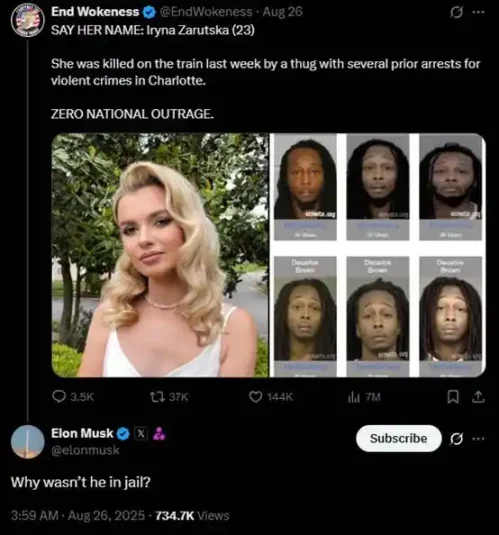
The main tweet where Musk commented received over 37,000 retweets and 144,000 likes
At this point, however, video footage of the attack had not yet been released—this explains the “gap period” between the crime and the token deployment. The surveillance video was disclosed on September 6 according to Beijing time, after which discussion surged on Twitter.
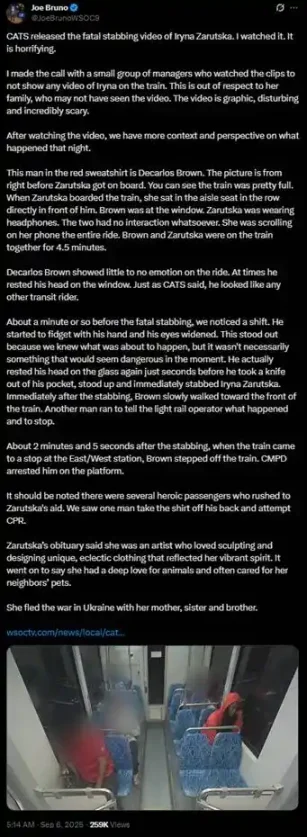
The above tweet was posted at around 5 a.m. Beijing time on September 6, but still over ten hours before the token was actually deployed. During this short second “gap,” the surveillance footage was widely shared across Twitter and quickly went viral.
On September 7, when questioned by reporters about the case, Trump described it as “horrendous” and promised full oversight. On September 8, while speaking at the Museum of the Bible in Washington D.C., he linked the incident to his plan to send federal agents and National Guard troops to Chicago and other Democrat-controlled cities. In addition to expressing condolences to the victim’s family, he stated, “Evil is out there, and if we don’t deal with it, our country will cease to exist.”
Trump also posted on Truth Social: “The blood of this innocent woman drips from the knife of the murderer—and now her blood falls upon Democrats who refuse to lock up criminals.”
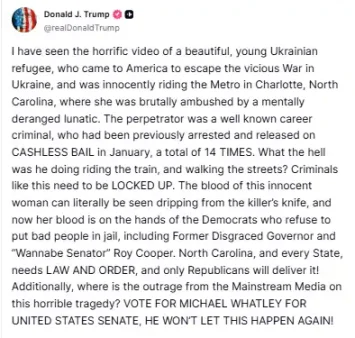
In that post, he specifically targeted Roy Cooper, calling him a “former lame-duck governor” and “someone aspiring to be a senator.” Of course, Trump doesn’t criticize without motive—the post ended with a call to support Republican Michael Whatley.
At this point, the event had transformed from an isolated violent murder into a politicized issue.
A counterintuitive aspect of the $IRYNA token is that Trump likely played a smaller role in driving its price than Musk did.
Looking at the candlestick chart, the hour with the highest trading volume occurred at 3 p.m. on September 10, reaching nearly $17 million in volume. The token’s market cap surged from $9.5 million to nearly $34 million.
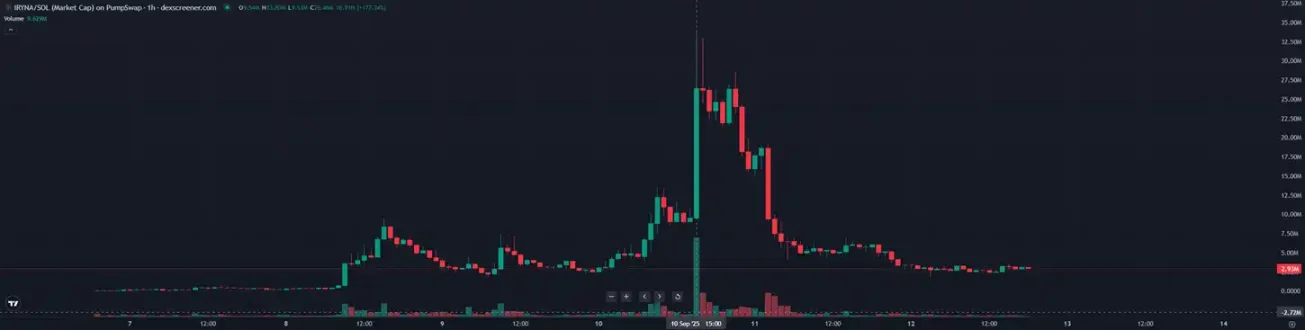
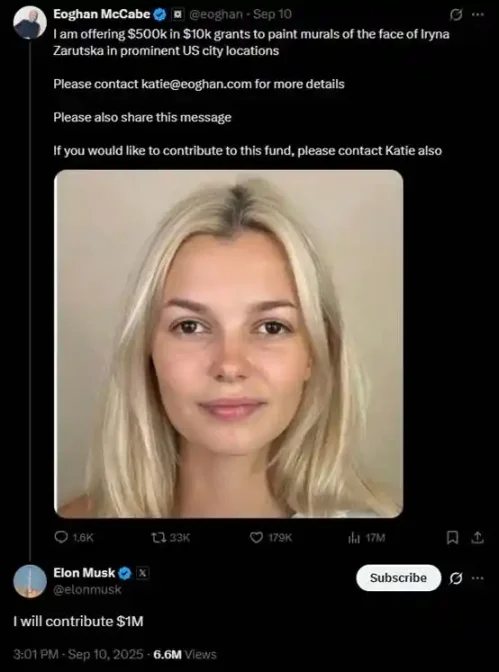
Exactly at 3 p.m. on September 10, Musk announced on Twitter that he would donate $1 million to fund mural projects honoring Iryna Zarutska in major U.S. cities.
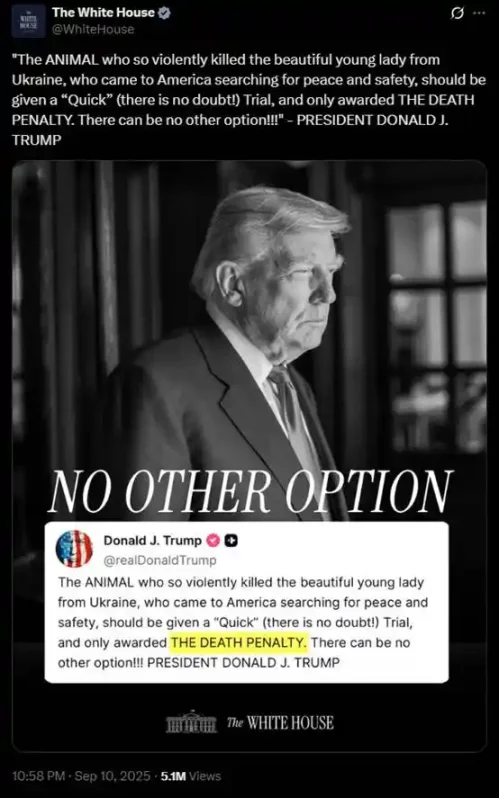
Later that evening, when the official White House account retweeted Trump’s statement calling for the death penalty for Iryna’s killer, $IRYNA showed no reaction whatsoever on the market.
About three hours after that White House tweet, Charlie Kirk was shot. Roughly two hours later, Trump announced Charlie Kirk’s death.
The Iryna case evolved from an isolated act of violence into a politicized matter, whereas the killing of Charlie Kirk was inherently a “political assassination” from the moment it occurred—because Charlie Kirk himself was a prominent figure in American right-wing politics. There’s no need to elaborate extensively on his political influence; reactions from various parties after the incident speak volumes: Utah Governor Spencer Fox labeled it a “political assassination”; Trump ordered the U.S. flag to be flown at half-staff for four days and posthumously awarded Charlie Kirk the Presidential Medal of Freedom; foreign leaders including the UK Prime Minister, Israeli Prime Minister, and Argentina’s President expressed mourning on social media.
Within half an hour of news breaking about Charlie’s death, $IRYNA dropped sharply by 50%, falling from nearly $18 million in market cap to around $9 million. Since then, $IRYNA has never regained upward momentum and currently holds a market cap of approximately $900,000.
Yet, capital chasing $CHARLIE failed to replicate $IRYNA’s market performance—$CHARLIE never exceeded $20 million in market cap and currently sits at just around $260,000.
Now that we’ve traced the sequence of events, let’s attempt to answer the initial question raised at the beginning of this article—why didn’t such a major “hot topic” lead to a successful meme coin?
Non-Comparable Political Memes
Some players have drawn parallels between $CHARLIE and $PNUT, citing their shared connection to politics and political discourse. However, this comparison has several flaws.
First is the difference in the “subject of death.” While animal deaths evoke sympathy or reflect dissatisfaction with current political realities, they ultimately do not touch on the sanctity of human life. Even the manner of death plays a role—$PNUT’s squirrel was euthanized peacefully, whereas the image of Charlie Kirk being shot was horrifying for everyone: the bullet struck his neck, causing blood to gush out violently.
The debate over “profiting from human tragedy” isn’t new to the Chinese-speaking community—it previously surfaced around $AI171, a meme coin tied to the fictional crash of Air India Flight 171.
Second, the timing of Charlie’s murder coincided precisely with the ongoing public outrage over the Iryna case, occurring when societal polarization and conflict in the U.S. were already near a boiling point—a kind of national trauma difficult for Chinese-speaking audiences thousands of miles away to fully grasp.
How intense is the political division in American society? This brings us back to a key point made earlier: although the Iryna and Charlie cases aren’t directly causally linked, they cannot be easily separated in discussion.
Charlie Kirk held very strong views on the Iryna case, arguing it was racially motivated. He posted frequently and aggressively about it on Twitter, even clashing publicly with CNN political commentator Van Jones.
Charlie supported his argument using the surveillance footage, in which the attacker was heard saying, “I got that white girl,” after the stabbing. On Twitter, this quote fueled severe racial backlash against Black people. Searching the keyword “TND” reveals numerous posts, some of which gained considerable traction.
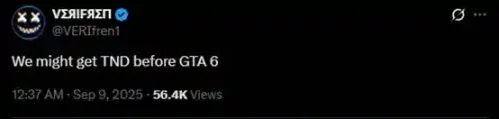
“We might see TND happen before GTA 6 launches”
“TND” originally stands for a deeply racist phrase: “Total N***** Death.” Radical U.S. Twitter users began using “TND” or “Totally Nice Day” as euphemisms to spread racist rhetoric without triggering platform bans.
In such an environment, any defense of meme coins appears weak. When $IRYNA was rising, some argued it provided financial support to the victim’s family. But by the time $CHARLIE emerged, English-speaking communities overwhelmingly condemned it as “profiting from human blood,” with few defenses beyond “this is just how meme markets work—you don’t have to trade it.” At that point, it wasn’t really a defense at all.
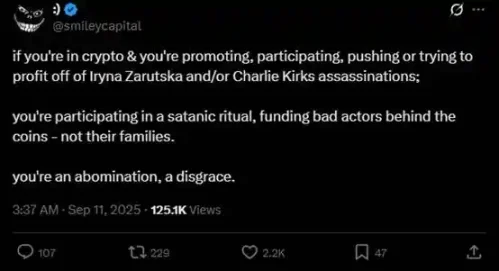
“If you promote, launch, or try to profit from the murders of Iryna and Charlie, you are a deeply shameful and despicable person”—this tweet received over 2,200 likes, and many similar posts exist
Even some English-speaking KOLs faced backlash for insensitive jokes related to the two cases. A notable example is Rasmr, whose token $rasmr dropped about 30% immediately after he posted the following tweet:
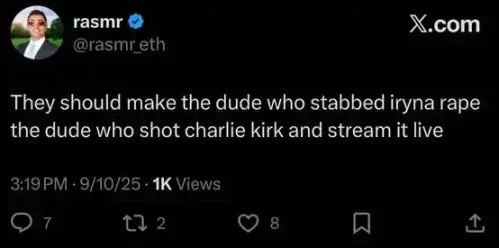
“We should livestream the Iryna case perpetrator killing the Charlie case perpetrator.” Rasmr has since deleted this tweet
Lexapro also came under fire for tweeting, “I am profiting from racial conflict and violence.” He has since deleted the post. As seen in the screenshot below, Lexapro previously displayed an affiliate badge from meme trading app Padre, which has now removed him from its affiliate program.

Thus, in English-speaking circles, both $IRYNA and $CHARLIE are largely morally condemned—going far beyond mere “hot-topic speculation.”
Finally, the $CHARLIE token was deployed almost immediately after news of Charlie Kirk’s death broke, unlike $PNUT, which had a buffer period allowing public emotion to cool slightly, making the meme coin speculation somewhat more acceptable. This makes $CHARLIE resemble merchants who jacked up mask prices at the very start of the pandemic—no one pauses to consider whether it’s “rational speculation”; they simply perceive it as cold and heartless.
Poor on-chain market conditions or the refusal of large exchanges like Binance and OKX to list Solana-based meme coins may be secondary factors. Especially given the intense backlash in English-speaking communities and the gravity of the political context, neither $IRYNA nor $CHARLIE would have stood a chance of being listed on major CEX platforms regardless.
In essence, $IRYNA began as a “trending play,” evolved into a “political play,” and then, alongside $CHARLIE, entered a realm entangled with notions of “political correctness.” The circumstances surrounding these two tokens are unprecedented since last year’s meme coin bull run. Combined with the vast divergence in perception between overseas Chinese-speaking communities and English-speaking (especially American) players, this has led to significant discrepancies in interpretation and price performance.
Even if this reflects “humanitarian concern” driven by political correctness, I hope such concern becomes a standard principle in the meme coin market.
This world sees countless events every day—fortunate joys and profound tragedies. Beyond politics, the deaths of Iryna and Charlie remind us that life is fragile and unpredictable.
When tragedy strikes, we must first remember we are human beings—only then are we crypto traders. There are endless things to speculate on; why must we fixate on matters of life and death?
Join TechFlow official community to stay tuned
Telegram:https://t.me/TechFlowDaily
X (Twitter):https://x.com/TechFlowPost
X (Twitter) EN:https://x.com/BlockFlow_News
 BlockBeats