Bhutan, the Third Largest Sovereign Holder of Bitcoin: An Overview of Cryptocurrency Taxation and Regulatory Regime
TechFlow Selected TechFlow Selected
Bhutan, the Third Largest Sovereign Holder of Bitcoin: An Overview of Cryptocurrency Taxation and Regulatory Regime
The country has accumulated 12,062 bitcoins since 2020, making it the world's third-largest sovereign holder of bitcoin.
 Navigating Web3 tides with focused insights
Author: Gao Xian, FinTax
1 Introduction
In recent years, Bhutan has leveraged its hydropower energy advantages and a state-driven strategic development model to continuously build Bitcoin mining facilities, sparking a "green mining revolution." According to data released by Arkham Intel on June 27, 2025, the country has cumulatively held 12,062 Bitcoins since 2020, making it the third-largest sovereign holder of Bitcoin globally. This reserve amounts to approximately 40% of Bhutan's Gross Domestic Product (GDP), positioning it among the nations with the highest exposure to cryptocurrency assets. In July 2025, Bhutan launched a nationwide cryptocurrency payment system, allowing tourists to pay for visas, flights, and local goods using digital currencies, becoming one of the first countries to enable crypto payments across its entire tourism ecosystem. Richard Tang, CEO of Binance, wrote to Bhutan praising its innovative path in cryptocurrency and building national vision upon trust. However, in stark contrast to Bhutan’s rapidly growing cryptocurrency industry stands its relatively crude and nascent cryptocurrency taxation and regulatory framework.
2 Bhutan's Classification of Cryptocurrency and Basic Tax Policies
2.1 Classification of Cryptocurrency
Bhutan maintains a cautious stance toward cryptocurrencies, not recognizing them as legal tender but treating them instead as regulated assets. Nevertheless, this does not prevent Bhutan from gradually adopting a more open attitude toward crypto assets. Notably, in January 2025, Gelephu Mindfulness City (GMC), a special administrative zone in Bhutan, announced plans to include Bitcoin (BTC), Ethereum (ETH), and Binance Coin (BNB) into its strategic reserve framework (at the regional level)—a pioneering initiative whose legal details and implementation are still underway. This signifies that Bhutan’s classification of cryptocurrencies goes beyond ordinary commodities or property, elevating them to the status of strategic national reserve assets.
2.2 Basic Tax Policy and International Comparison
2.2.1 Overview of Bhutan's Tax System
Bhutan began modernizing its tax system relatively late. The government started introducing monetized taxation in the 1960s. The Income Tax Act of the Kingdom of Bhutan in 2001 established a modern comprehensive income tax regime covering individuals and enterprises, while the Sales Tax, Customs and Excise Act of 2000 standardized indirect tax collection. Currently, Bhutan’s tax system primarily includes personal income tax, corporate income tax, sales tax, and customs and excise duties. Recently, new legislation—including the Income Tax Bill of Bhutan 2025 (hereinafter referred to as the “Income Tax Bill”) and the Goods and Services Tax Bill of Bhutan 2025 (hereinafter referred to as the “GST Bill”)—has been passed to further modernize the tax system. Presently, sales tax, customs, and excise duties are enforced under the 2000 Sales Tax, Customs and Excise Act, with specific rates published by the Ministry of Finance (currently at 7% for sales tax). However, Bhutan plans to implement a 5% Goods and Services Tax (GST) starting January 2026 to replace the current sales tax. As the new laws will take effect on January 1, 2026, this article will focus on the upcoming legislation.
2.2.2 Personal Income Tax
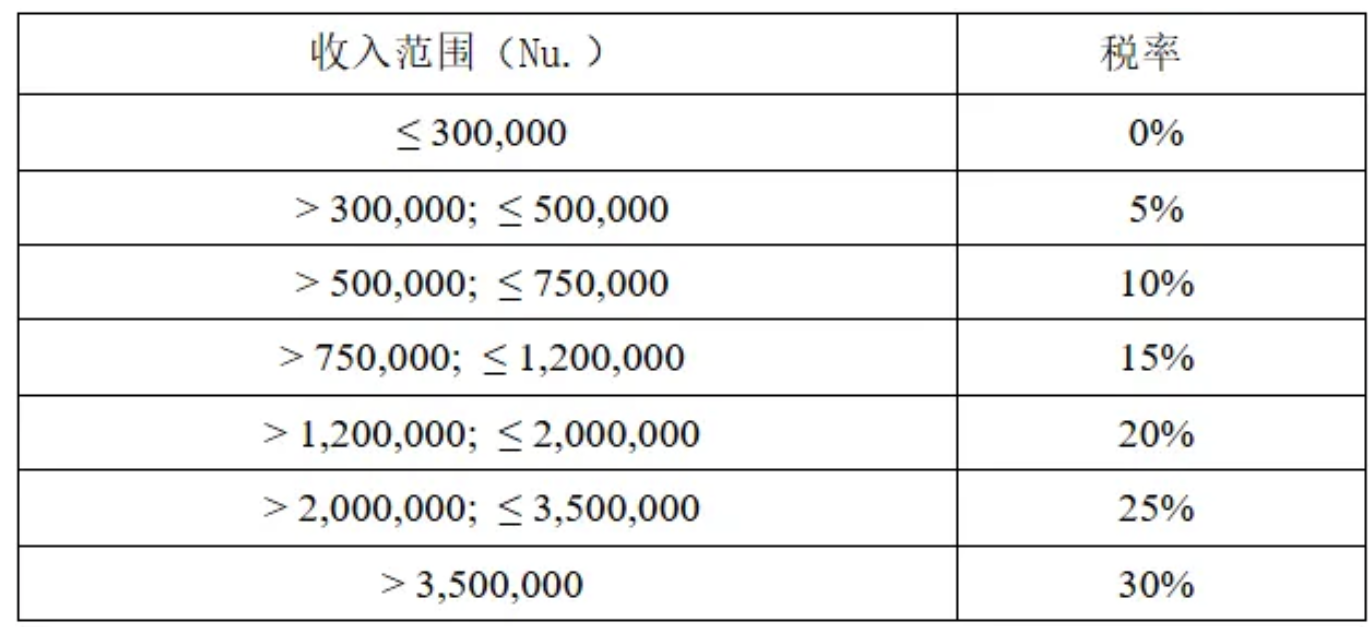
Bhutan applies a progressive tax rate structure for personal income tax, ranging from 0% to 30%, applicable to citizens, residents, and other individuals earning income in Bhutan with annual earnings exceeding 300,000 Ngultrum. The 2025 Income Tax Bill consolidates the previous Personal Income Tax (PIT) and Business Income Tax (BIT) into a unified personal income tax category to simplify the tax structure. Under the new law, the specific tax brackets for personal income are as follows:
2.2.3 Corporate Income Tax
Corporate income tax in Bhutan applies to companies, associations, and entities with significant economic presence. According to the new Income Tax Bill, the rate is set at 22%, reduced from the previous 30%, aiming to attract investment and support business growth.
2.2.4 Sales Tax and Upcoming Goods and Services Tax (GST)
Currently, Bhutan imposes a 7% sales tax on most goods and services. However, Bhutan plans to introduce a 5% Goods and Services Tax (GST) in 2026 to replace the existing sales tax, thereby unifying the tax system, simplifying compliance, and aligning with international standards.
2.3 Cryptocurrency Tax Policies and Recent Developments
Bhutan has not enacted specific tax provisions targeting Bitcoin or other cryptocurrencies. While the country participates in cryptocurrency mining and supports digital infrastructure, it does not recognize cryptocurrencies as legal tender nor offers specific tax incentives. Under Bhutan’s current tax legislative framework, potential taxable events related to cryptocurrencies—such as income generated from crypto mining, investment, or trading (sale or exchange), receiving cryptocurrencies as payment for goods or services, or even merely holding digital assets—may trigger application of existing tax rules.
During the revision of the 2024 Income Tax Law, mainstream domestic media reported that officials from the Department of Revenue and Customs indicated the update would consider digital assets like cryptocurrencies as sources of personal income. However, the new Income Tax Bill does not explicitly define cryptocurrency as taxable income. Instead, it specifies four categories of taxable income: Income from Employment, Income from Business, Income from Investment, and Income from Other Sources. Cryptocurrencies are only recognized as a form of "supply of digital assets," constituting "digital services." Thus, Bhutan remains cautious regarding cryptocurrency taxation, with regulations still relatively vague. It is clear, however, that businesses providing crypto-related services will be subject to a 22% income tax rate. Additionally, typically when cryptocurrencies are treated as property for tax purposes, capital gains tax may apply. Through interpretation of the current Income Tax Bill, Bhutan may still classify related gains based on holding period and transaction nature under either "Income from Investment" or "Income from Other Sources." Regarding goods and services tax, the new law does not explicitly clarify whether cryptocurrency transactions are taxable.
3 Bhutan's Regulatory Framework for Cryptocurrency
3.1 Basic Structure of Cryptocurrency Regulation
Bhutan’s regulatory approach has evolved from pilot programs to broader implementation. Cryptocurrency regulation in Bhutan is primarily overseen by the Royal Monetary Authority (RMA), operating under the "Cryptocurrency Mining Regulatory Sandbox Framework" issued by RMA in 2019, which emphasizes strict compliance oversight for crypto-related businesses. This framework aims to ensure mining activities comply with national laws, protect investors and consumers, and support innovative technological applications. More specifically, the framework requires cryptocurrency mining enterprises to adhere to KYC and AML standards and obtain various forms of approval from the RMA to prevent misuse of cryptocurrencies for illicit activities and mitigate financial risks. In 2024, Bhutan further strengthened its regulatory regime by requiring crypto firms operating in the country to obtain licenses and conduct comprehensive risk disclosures to safeguard cryptocurrency investors. This framework emphasizes anti-money laundering and investor protection, aligning not only with FATF standards but also with global concerns about the security and integrity of financial transactions in the cryptocurrency sector.
3.2 Recent Developments in Cryptocurrency Regulation
Bhutan maintains a positive and open attitude toward cryptocurrencies, embracing them as part of its national development strategy—particularly through establishing a Bitcoin sovereign reserve, utilizing its hydropower resources for green mining, and leveraging crypto as a tool for economic diversification. Throughout this process, Bhutan continues to refine its cryptocurrency regulatory framework.
According to the latest notice issued by the Royal Monetary Authority of Bhutan on May 30, 2025—"RMA’s Regulatory Stance on Crypto Currency"—the RMA will adopt a phased, focused regulatory strategy for cryptocurrencies, supporting responsible innovation while safeguarding citizen rights and financial stability. Based on this principle, while continuing to monitor industry developments and strengthen national cryptocurrency capabilities, the RMA formally announces the following positions:
(1) Cryptocurrency mining and trading operations are limited to entities registered in Gelephu Mindfulness City (GMC) and their partner companies, all of which must comply with the GMC regulatory framework;
(2) Cryptocurrency transactions conducted through domestic banks regulated by the RMA will continue to be restricted.
The latest regulations indicate that despite certain limitations, Bhutan’s future policies may continue to support the development of cryptocurrencies. It should be noted that given Bhutan’s renowned concept of "Gross National Happiness," its cryptocurrency policy is likely to remain cautious, emphasizing investor protection, sustainability, and social benefits to balance economic innovation with financial stability.
4 International Comparison and Future Outlook
4.1 International Comparison
A brief comparison between Bhutan and other countries focusing on cryptocurrency development reveals several macro-level differences: First, in terms of monetary systems, El Salvador has adopted Bitcoin as legal tender across its entire economy, promoting crypto with greater legal enforceability, whereas Bhutan has not declared any cryptocurrency as legal tender and has not disrupted its existing fiat currency system. Second, in terms of driving forces, unlike Switzerland where blockchain adoption is driven by private innovation and market dynamics, Bhutan involves state-owned entities such as Druk Holding & Investments and DK Bank, integrating cryptocurrencies into national development plans—a strategy somewhat similar to the United States’ ongoing legislative efforts regarding digital assets. Third, in terms of global positioning, while countries like the UAE and the US aim to become global crypto hubs, Bhutan takes a distinctly different approach. Its crypto strategy does not seek global centrality but focuses on empowering domestic objectives—enhancing regional connectivity, openness, and financial inclusion through widespread adoption of crypto payment systems to support tourism development.
At the level of tax system details, Bhutan’s tax regime also exhibits distinctive features. Bhutan’s tax policy is relatively lenient, allowing cost deductions and employing progressive tax rates, reflecting its friendly stance toward small and medium investors. In contrast, India—also in South Asia—imposes a flat 30% tax rate on cryptocurrency income and disallows offsetting losses against other income, resulting in a comparatively stricter tax environment. Yet compared to European countries like Portugal that offer tax incentives to attract crypto users, Bhutan does not widely provide tax breaks. Instead, it focuses on promoting everyday use of cryptocurrencies through merchant payments and digital tools for local populations. Moreover, comparing Bhutan with the United States—one of the major sovereign holders of Bitcoin—the U.S. demonstrates relatively sophisticated, transparent legislation in cryptocurrency taxation and regulation, clearly aiming to maintain its leading position. In contrast, Bhutan lacks a dedicated crypto tax category, distributing crypto-related income across existing tax types and categories, with a relatively simple regulatory framework and a cautious regulatory posture.
4.2 Future Outlook
In terms of regulation, Bhutan’s cryptocurrency regulatory system reflects a combination of caution and openness to innovation, particularly through an AML- and investor-protection-focused regime aligned with international standards. However, transparency in regulation remains insufficient, specific details require refinement, and uncertainties persist. Specifically, according to recent announcements from the competent authorities, geographic restrictions and controls on relevant businesses will continue. Going forward, Bhutan may emerge as a global model for green cryptocurrency development, with policies continuing to support the sector while focusing on capacity building, risk isolation, and sovereign control, along with further optimization of regulatory details.
In terms of taxation, Bhutan’s tax system is undergoing transformation. Recent adjustments to personal and corporate income taxes reflect the government’s balancing act between economic growth and social equity, while the introduction of GST will further streamline the tax structure. Nonetheless, due to the absence of specific laws or guidelines, Bhutan’s stance on taxing cryptocurrencies remains somewhat ambiguous, leaving related tax matters in a gray area. In the future, Bhutan’s tax policy may continue evolving toward greater transparency and efficiency. Regarding cryptocurrency taxation, however, the status quo may persist for the foreseeable future—on one hand offering flexibility in handling crypto-related tax issues, and on the other introducing uncertainty and risks. We believe that Bhutan’s positive attitude toward cryptocurrencies will drive it to establish a favorable tax framework conducive to the development of the crypto industry in the near term.
Join TechFlow official community to stay tuned
Telegram:https://t.me/TechFlowDaily
X (Twitter):https://x.com/TechFlowPost
X (Twitter) EN:https://x.com/BlockFlow_News
 TaxDAO