Bitget Wallet Research Institute: Unveiling Solana's "Invisible Whales": How Proprietary AMMs Are Reshaping On-Chain Trading?
TechFlow Selected TechFlow Selected
Bitget Wallet Research Institute: Unveiling Solana's "Invisible Whales": How Proprietary AMMs Are Reshaping On-Chain Trading?
Take you into this silent revolution, analyzing the rise of proprietary AMMs and their industry impact.
 Navigating Web3 tides with focused insights
Author: Lacie Zhang, Researcher at Bitget Wallet
Within the Solana ecosystem—renowned for its high speed and low costs—we are observing a new trend rapidly emerging: a group of "invisible" giants with no official websites or marketing campaigns—proprietary automated market makers (referred to hereafter as "prop AMMs")—are swiftly rising. They are reshaping the trading landscape in a more professional and efficient manner, becoming a new engine driving on-chain capital flows. In this article, Bitget Wallet Research will guide you through this silent revolution, analyzing the logic behind the rise of prop AMMs and their industry impact.
Invisible Giants: The Operating Logic of Prop AMMs
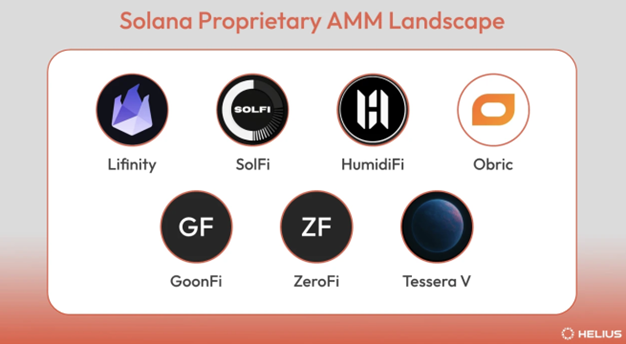
Image source: Helius
According to Blockworks, in August 2025 alone, prop AMMs collectively processed approximately $47 billion in spot trading volume on Solana, accounting for 31% of total DEX trading volume on the chain. This trend is even more pronounced in high-liquidity pairs such as SOL-stablecoins—since May 2025, prop AMMs have consistently captured over 60% of the SOL-stablecoin trading volume each month, with even higher shares seen in stablecoin-to-stablecoin pairs.
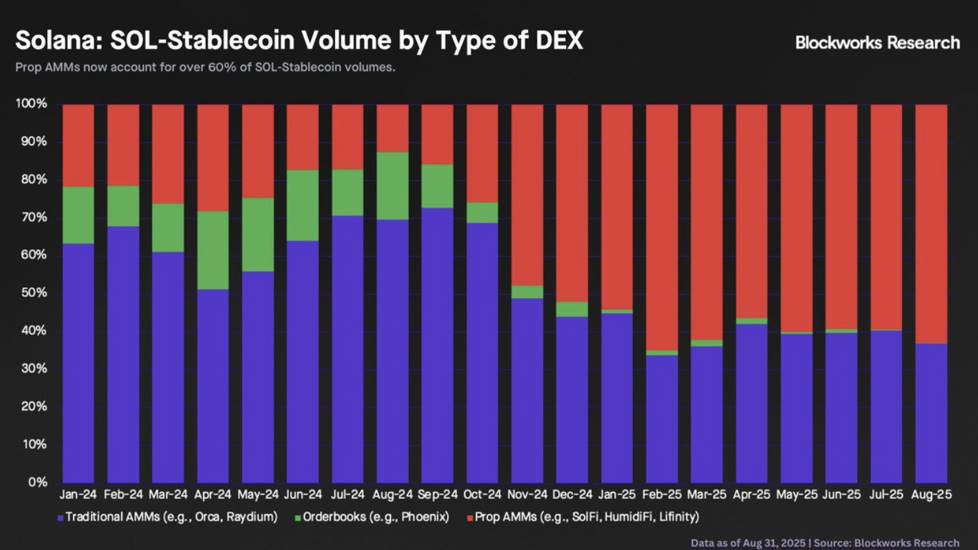
Source: Blockworks Research
To understand this transformation, we must first clarify the definition of a prop AMM. Simply put, it is an on-chain market maker operated by a small number of professional teams using their own capital, without opening liquidity participation to ordinary users. This stands in stark contrast to familiar platforms like Uniswap and other traditional AMMs: while traditional AMMs allow anyone to become a liquidity provider (LP) and earn fees, enabling a "crowdsourced" liquidity model, prop AMMs return market-making power to specialized teams, prioritizing ultimate efficiency and risk control. Their operational model features the following characteristics:
-
Invisible access: Most prop AMMs lack user-facing websites; ordinary users cannot directly interact with them.
-
Proprietary algorithms: Market-making algorithms and parameters are strictly confidential, resulting in significantly lower transparency compared to traditional AMMs.
-
Reliance on aggregators: To obtain trading orders, they connect directly to aggregators (such as Jupiter), which route user trade requests to the platform offering the best quote.
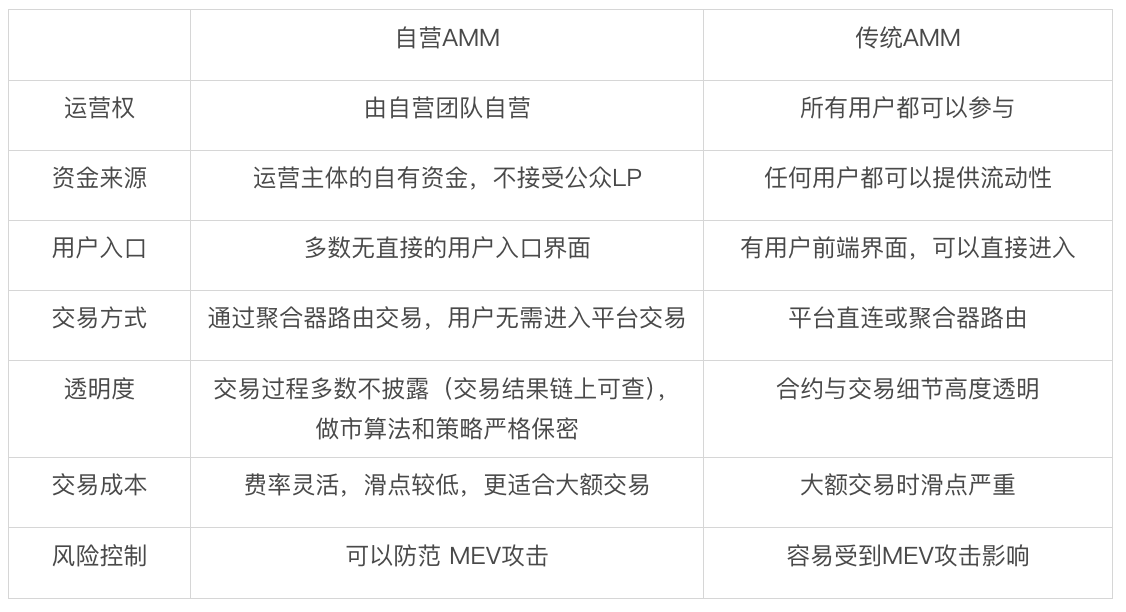
Comparison table of operating models between prop AMMs and traditional AMMs
Note: A few prop AMMs (e.g., Lifinity) offer user frontends, but their liquidity still primarily comes from team-owned capital, and trades are executed via routing through aggregators.
This business model is built purely on execution efficiency, not brand or community. Traditional DeFi projects must invest heavily in marketing and community building to attract users and liquidity. In contrast, prop AMMs convert all their "marketing budget" into tiny price advantages passed on to users, ultimately capturing massive trading volumes. This also reflects the growing maturity of the DeFi market, where participants increasingly behave as rational economic agents—following the principle of "best price wins"—rather than being solely idealistic advocates of decentralization.
Conceptual Clarification: Are They “Dark Pools” or “Proactive Market Makers”?
With the rise of prop AMMs, related terms such as “dark AMMs” and “proactive market makers (PMMs)” have emerged frequently. It's crucial to distinguish among them. In fact, these concepts are not mutually exclusive—they emphasize different aspects of the same phenomenon.
-
Dark AMM: The core lies in information concealment. It describes a trading method that hides order intent during the matching phase, aiming to reduce information leakage and price impact.
-
Proactive Market Maker (PMM): The core lies in active pricing. It refers to dynamically adjusting quotes through mechanisms like oracles and proactive inventory management to achieve higher capital efficiency.
-
Proprietary AMM (prop AMM): The core lies in fund ownership and operator identity. It defines a model where the operator uses their own capital for market making.
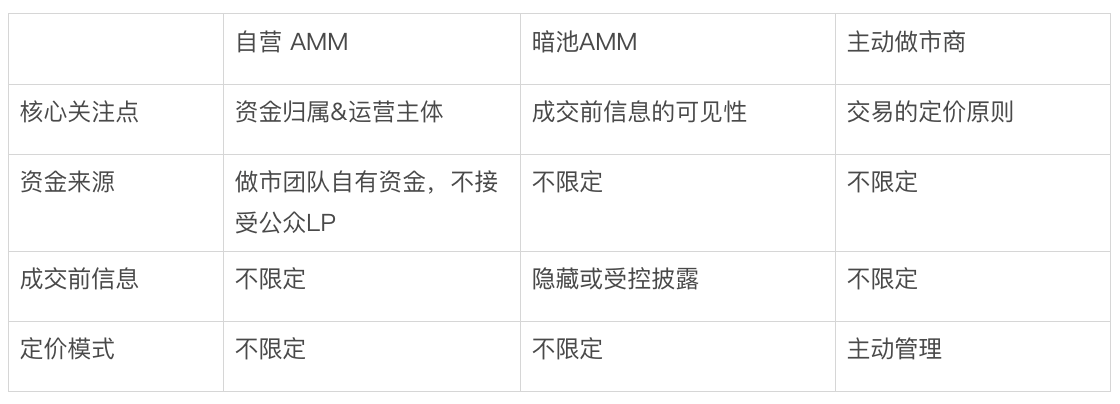
Definition breakdown table of the three AMM concepts
Once defined clearly, it becomes evident that these three concepts do not exclude one another but rather describe different dimensions of the same financial entity. In reality, a typical prop AMM, in pursuit of maximum efficiency and security, usually employs a "dark pool" trading mechanism and most likely adopts a "proactive" pricing strategy—even if undisclosed.
Therefore, although mainstream media may sometimes use these terms interchangeably, the term "prop AMM" cuts to the core from a foundational perspective: who controls the capital and who bears the risk. Compared to "dark AMM" or "proactive market maker," which describe technical features, "prop AMM" more accurately reveals the essence of this emerging force from the standpoint of business model and operator identity.
Efficiency Revolution: Why Is Solana the Ultimate Testing Ground?
The rise of prop AMMs stems from their precise targeting of the core weaknesses of traditional AMMs. The passive design of traditional liquidity pools inevitably leads to high slippage when handling large trades, and they constantly suffer from impermanent loss and MEV attacks (e.g., sandwich attacks). Prop AMMs, through fine-grained management and active quoting strategies by professional teams, almost perfectly resolve these issues. They can offer users tighter spreads, lower slippage, and more stable trading outcomes—especially for large swaps, delivering an experience nearly indistinguishable from top-tier centralized exchanges.
All this is made possible by Solana’s unique blockchain architecture. First, Solana’s high throughput and ultra-low transaction fees make the economically intensive, high-frequency quote updates required by this "proactive" model viable. Second, the dominant role of aggregators in the Solana ecosystem—particularly Jupiter—creates a "one-stop distribution channel" for these market makers. Without needing to build their own brand, website, or user community, they can focus all resources on their sole competitive advantage: execution and pricing. This extreme specialization greatly simplifies their business model and reduces operational costs.
In essence, prop AMMs did not simply choose Solana—their existence is symbiotic with Solana, forming a native market structure. It represents a perfect example of co-evolution between a high-performance base-layer blockchain and the business models of upper-layer financial applications.
Future Outlook: The Wave of Specialization and the Ghost of “Centralization”
The rise of prop AMMs signals that on-chain markets are evolving toward greater specialization and increasing polarization, gradually forming a clear "dual-track market."
-
Mature asset markets: High-liquidity pairs such as SOL-stablecoins will increasingly be dominated by prop AMMs capable of offering optimal spreads.
-
Long-tail asset markets: Assets such as newly launched meme coins will continue to rely on permissionless traditional AMMs like Raydium for early price discovery and liquidity bootstrapping.
This trend marks a victory of mechanistic efficiency, indicating a profound wave of specialization in on-chain market making. The market structure is shifting from open, crowdsourced liquidity to professionalized market making by a select few teams—greatly enhancing the execution efficiency and security of on-chain trading and setting new industry benchmarks.
Yet, on the flip side, concerns about the re-emergence of the "centralization" ghost persist. While users enjoy superior execution quality, they are simultaneously making a subtle trade-off: sacrificing core DeFi principles such as high transparency, permissionlessness, and decentralization in exchange for ultimate efficiency. When the majority of order flow is directed to a few anonymous "black boxes," even though settlements occur on-chain, the opacity introduced during the process undeniably creates new trust risks and weakens the auditable foundation upon which DeFi was built.
From a broader perspective, the dominance of prop AMMs is reshaping and reinforcing Solana’s ecosystem positioning. It further strengthens Solana’s image as a "Nasdaq of blockchains"—a venue purpose-built for high-performance, institutional-grade financial applications, where execution speed and capital efficiency reign supreme. This gives Solana a differentiated edge in the public chain competition, making it the preferred deployment platform for innovative protocols seeking to combine CEX-like performance with DeFi’s core values.
Conclusion
The rapid rise of prop AMMs on Solana is no accident—it is a logical, even inevitable, evolution of the DeFi market in its pursuit of ultimate capital efficiency. While it sparks important debates about the future of decentralization, this proactive and efficient liquidity provision model has already elevated industry performance to new heights. Regardless of how the final landscape unfolds, this silent revolution has already written the prelude to the next chapter of on-chain finance.
Join TechFlow official community to stay tuned
Telegram:https://t.me/TechFlowDaily
X (Twitter):https://x.com/TechFlowPost
X (Twitter) EN:https://x.com/BlockFlow_News
 @BitgetWallet