If the next big thing comes from prediction markets, how should one choose the most promising platform?
TechFlow Selected TechFlow Selected
If the next big thing comes from prediction markets, how should one choose the most promising platform?
A platform with sound mechanisms, ample liquidity, and a vibrant, trustworthy community is more likely to deliver value in profitable trading opportunities and accurate predictions.
 Navigating Web3 tides with focused insights
Author: Marvellous
Translation: AididiaoJP, Foresight News
Introduction:
Prediction markets are trading platforms where participants bet on the outcomes of future events, gaining increasing popularity in the cryptocurrency and finance sectors.
However, not all prediction markets are the same. Determining whether a specific platform is "worth" your time or money depends on a combination of three key factors:
-
Its market design
-
Economic environment
-
User-related factors
These factors are crucial in determining whether a prediction market can provide accurate forecasts, sufficient liquidity, and a trustworthy trading experience.
Market Design: Structure, Mechanisms, and Clarity
The concept of market design refers to how a prediction market is structured and operates, including its trading mechanisms, contract rules, and outcome resolution methods. A good design must align incentives and ensure smooth market operation:
Trading Mechanisms:
Prediction markets use different mechanisms to match trades. Some, like @Polymarket and @Kalshi, use order books, while others like @ZeitgeistPM employ automated market maker models such as LMSR.
Model Overview:
-
Order Book: Efficient under high liquidity but performs poorly in illiquid markets.
-
Constant Product Market Maker (CPMM, x*y=k): Simple, but suffers from high slippage in extreme cases.
-
Logarithmic Market Scoring Rule (LMSR): Limited loss and probability normalization, but sensitive to parameters.
-
Dynamic LMSR (DLMSR) or pm-AMM: Newer models addressing liquidity and slippage issues.
Contract Types and Clarity:
Well-designed markets must have clearly defined contracts and outcome resolution criteria. Contracts are typically binary options (yes/no outcomes, paying $1 if the event occurs), but can also be multi-outcome or scalar contracts (payouts varying based on numerical results).
Note: The betting question must be unambiguous and verifiable. Research indicates that "markets with clear resolution criteria and well-defined questions" are key to effective prediction markets.
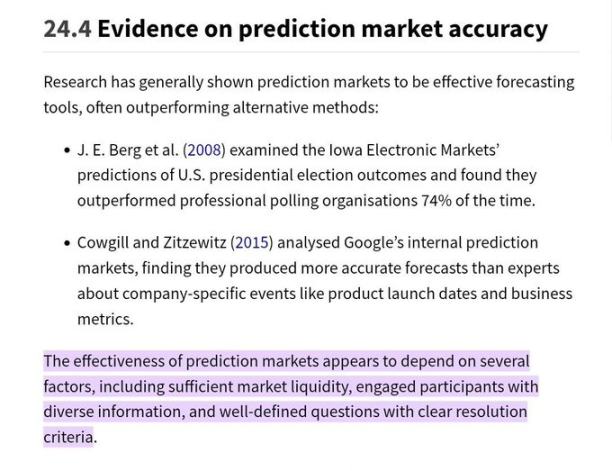
This is because if market questions are vague or outcomes subjective, traders will lack confidence, fearing their bets won't be fairly resolved.
Outcome Resolution and Oracles:
Design must ensure trust in the outcome resolution process. Traditional prediction markets rely on platform operators or third parties to declare results and distribute payouts, while crypto-based prediction markets use oracles to feed real-world data into smart contracts.
For example, @Polymarket uses @UMAprotocol to provide real-world data for market resolution.
A robust resolution mechanism prevents disputes and manipulation, preserving market integrity. Therefore, when evaluating a platform, consider:
-
Does it have reliable oracles or arbiters?
-
Could disputes arise? If so, how are they handled?
Fees and Technical Design:
High transaction costs or slow systems can kill a platform's usability.
Recall early decentralized markets like Augur (launched on Ethereum in 2018 as a pioneer), which faced high gas fees, low liquidity, and poor user experience—barriers that prevented mainstream adoption.
Therefore, consider which chain a product is deployed on—for example, @GroovyMarket_ launched on @SeiNetwork, @Polymarket on @0xPolygon, and @triadfi on @solana.
A common trait among these platforms I've mentioned is that their underlying chains ensure lower transaction fees and faster speeds.
Additionally, simplified user interfaces matter. For instance, Polymarket runs on Polygon (an Ethereum sidechain) and uses dollar-pegged stablecoins for trading, offering fast and stable transactions without exposing users to volatile crypto prices. It also charges 0% trading fees, enabling frictionless trading. Compared to first-generation platforms, such design choices greatly enhance usability.
Also assess the fees charged by these platforms (market creation fees, trading fees, deposit/withdrawal fees, profit fees, etc.).
In summary, a prediction market is worth it if its design provides a clear and fair structure: an efficient trading mechanism with sufficient liquidity provision, transparent rules, and trusted outcome resolution.
Poor design (slow trading, unclear rules, or untrusted outcomes) may be directly rejected by the market.
Economic Factors: Liquidity, Pricing, and Incentives
I believe every strong design requires a sound economic model, as key economic factors determine whether a prediction market can effectively aggregate information and reward participants accordingly.
Liquidity and Market Depth:
Liquidity refers to having enough active trading and capital in the market so traders can buy and sell at fair prices without significant slippage.
Sufficient liquidity has long been a critical consideration.
Research shows that the effectiveness of prediction markets depends on "adequate market liquidity" and a large number of traders. If only a few people trade, prices may swing wildly or stagnate, failing to reflect true probabilities. Hence, balance is needed.
Look for platforms with high trading volume or deep liquidity pools. For example, Polymarket has become the largest decentralized prediction market, accounting for about 94% of total market volume in 2024 and processing over $8.4 billion in wagers, despite new challengers emerging this year.
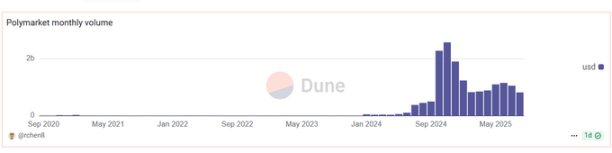
Such massive liquidity—especially during major events like U.S. elections—means odds are backed by substantial market depth, making it harder for any single user to manipulate prices.
Accurate Pricing (Information Aggregation):
The core idea behind prediction markets is that market prices reveal the collective belief of the crowd regarding the probability of an event. When economic mechanisms are sound—i.e., many informed traders with skin in the game participate—market prices become highly accurate predictors.
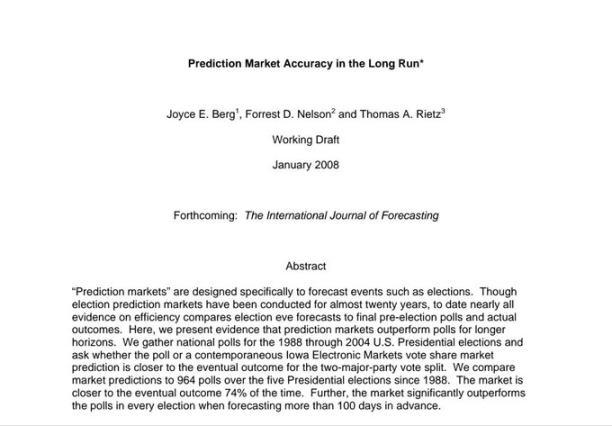
In fact, well-run markets outperform opinion polls. Recall:
-
The Iowa Electronic Market's election predictions beat professional polling firms in 74% of cases.
-
Google's internal prediction market made more accurate forecasts than company experts.
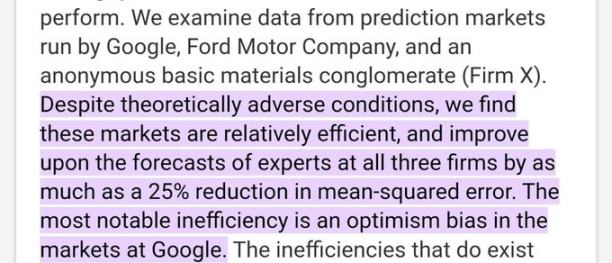
However, if a market lacks liquidity or is dominated by uninformed bets, prices may be less reliable.
Therefore, always consider a platform’s track record:
-
Has the platform had instances where its odds correctly predicted outcomes when others failed?
Notably, during the 2024 U.S. election, Polymarket’s odds were closely watched and even outperformed traditional polls, attracting attention from figures like Elon Musk—an important area to consider.
Incentive Alignment:
Economic design should also cover how traders are rewarded and the cost of participation. Low or zero fees are a major advantage, as high fees deter frequent trading or arbitrage, both of which help maintain price accuracy.
Platforms like Polymarket charge no trading fees, and some markets even subsidize participation through token rewards or yield. Additionally, some markets reward information discovery, offering prizes or reputation to top forecasters to encourage knowledgeable participants.
A healthy prediction market economy makes it profitable for traders to correct mispriced odds, so attempts to manipulate prices are often self-correcting. For example, if someone irrationally places a bet, others have an economic incentive to take the opposite position, pushing the price back toward rational levels. In very small markets, wealthy manipulators might temporarily influence odds, so scale matters again.
Risk and Regulatory Costs:
Another economic consideration is the risks involved—not just losing bets, but counterparty and regulatory risks. In crypto prediction markets, smart contract security is critical (since funds are held in code).
On centralized platforms, you depend on the solvency and integrity of the company.
Note that regulatory crackdowns can impose sudden costs. For example, after settling with the U.S. Commodity Futures Trading Commission (CFTC) and paying a $1.4 million fine, Polymarket had to geo-block U.S. users due to operating unregulated event markets.
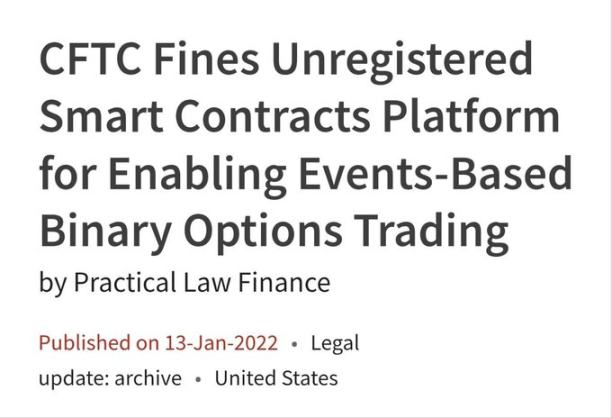
During this period of excluding U.S. users, liquidity in certain markets reportedly declined. Similarly, some countries outright ban prediction markets.
By the end of 2024, France, Singapore, and Thailand all blocked access to Polymarket. These factors can economically impact a platform—reducing its user base or forcing compliance costs.
Therefore, a "worthwhile" market should have a stable legal foundation or contingency plans. Otherwise, participants face economic risks such as sudden shutdowns or inability to cash out.
Essentially, the economics of a prediction market must ensure sufficient stakeholders and smooth trading. The best markets will have ample participation, low transaction costs, and mechanisms that incentivize accurate forecasting.
User and Community Factors: Engagement, Trust, and Experience
Regardless, I like to consider user-related factors—the human side of markets—because the effectiveness of prediction markets depends on their users and surrounding communities.
Key evaluation points include:
Engagement Scale:
Prediction markets rely on scale. The more individuals participating, the more effective they become. A large and active user base means diverse information and perspectives are brought to the table.
Diversity of viewpoints is crucial.
If all traders think alike (or collude), the market cannot aggregate independent information. Therefore, pay attention to metrics such as:
-
Number of active users
-
Number of bets placed
-
Open interest, etc.
Overall, a platform with thousands of actively engaged traders is far more robust than one with only a handful of users. Actively participating users with diverse information backgrounds are one of the key drivers of prediction market accuracy.
For example, Augur was fully decentralized, but its early versions had very few active users, limiting its effectiveness despite novel technology.
In contrast, Polymarket achieved critical user scale by offering markets on popular topics (elections, sports, cryptocurrency prices) and making entry easy (global access without KYC, simple web interface). This level of engagement greatly enhances the "wisdom of the crowd" effect.
User Experience and Accessibility:
User experience matters even for crypto-native users. Platforms that are too complex or require complicated wallet setups can deter users.
Pay attention to emerging prediction markets that prioritize smooth onboarding—clean interfaces, helpful charts, and clear odds display attract more users, which in turn improves market quality.
Conversely, cumbersome processes—such as needing to manually acquire and stake specific tokens to place bets, or enduring long waits for transaction finality—may make traders feel the market isn’t worth the effort.
Therefore, always consider how easy it is to use a platform.
-
Can you deposit funds easily?
-
Is mobile support available?
-
If problems arise, is there customer support or community assistance?
Reputation and Community Trust:
When real money is involved, trust is paramount. Trust can come from transparency (open-source code, audited contracts, reputable backers) or a history of fair operations.
Check whether the platform has had scandals or failed to pay out. Community-operated and decentralized markets like Polymarket appear trustless, while others like Kalshi build trust through full regulation and compliance. As we saw in 2024, Kalshi became the first CFTC-regulated exchange to offer legal event contracts in the U.S., even winning a lawsuit allowing election betting.
This stamp of regulatory approval lends credibility and signals to users that the platform operates within legal boundaries.
Meanwhile, platforms operating in gray areas are red flags. Either you're decentralized with audited code, or you're fully regulated.
User Incentives and Behavior:
Another human factor is why users participate. Are they amateur gamblers, profit-seeking traders, or domain experts hedging risk? I believe markets with a strong community of skilled forecasters may produce better insights.
A platform’s culture—whether it feels more like gambling or a serious forecasting tool—will influence whether it suits your purpose. When deciding if a prediction market is worth using, evaluate the community:
-
Is it active and serious?
-
Do they hold opposing views?
The presence of "actively engaged participants with diverse information" is one of the key success factors for prediction markets.
I believe a constructive community supports meaningful markets with properly resolvable outcomes, while a poorly managed community may indulge in poorly defined markets.
In short, user factors boil down to the quantity and quality of participants. A platform with a large, diverse, and actively engaged user base that has earned their trust is more likely to deliver valuable experiences.
If a market has almost no users or community, you may want to avoid it regardless of its underlying technology. After all, prediction markets are a form of crowdsourcing—without a "crowd," there’s little to participate in.
Final Summary:
When evaluating a prediction market, always return to these three core considerations:
-
Market design
-
Economic viability
-
User factors
A platform with sound mechanisms, sufficient liquidity, and a vibrant, trustworthy community is more likely to deliver value in terms of profitable trading opportunities and accurate predictions.
Join TechFlow official community to stay tuned
Telegram:https://t.me/TechFlowDaily
X (Twitter):https://x.com/TechFlowPost
X (Twitter) EN:https://x.com/BlockFlow_News
 @marvellousdefi_