From Trump to CZ, Why Are Billionaires Betting on "Prediction Markets"?
TechFlow Selected TechFlow Selected
From Trump to CZ, Why Are Billionaires Betting on "Prediction Markets"?
Power restructuring in probabilistic games.
 Navigating Web3 tides with focused insights
Author: Chain Revelation
Imagine a place where you can bet on anything: Who will be the next U.S. president? Will the Federal Reserve cut interest rates next month? Or even, will your favorite actor win this year's Oscar?
In 2025, this market experienced literal "explosive growth." Just in October, trading volume surged 91% month-on-month to an astonishing $8.4 billion. Weekly volume broke the $2 billion mark for the first time in history—the entire market is scorching hot. This isn't slow evolution; it's a sudden gold rush.
Behind this explosion are three powerful forces impossible to ignore. When political leaders, Wall Street, and the crypto core circle simultaneously turn their attention and capital toward the same destination, we must ask one question: What exactly are they seeing?
The answer splits into two entirely different, yet equally compelling narratives
Chapter One: Big Players Enter – The Rules of the Game Are Changing

Character One: Trump’s “Truth Predict” — Social Media Meets Financial Betting
This week, Trump Media & Technology Group (TMTG), led by Donald Trump, announced its entry into prediction markets via the Truth Social platform, officially launching the “Truth Predict” service.
A new form of political marketing: a carefully crafted blend of “social + finance.”
Imagine this scenario: You see a post on Truth Social about the Federal Reserve's rate decision. With a few clicks, you can convert “Truth gems”—rewards from the platform—into CRO tokens to place a bet. This is no longer the traditional model of “form an opinion, then bet.” Instead, it’s a brand-new paradigm: “bet while socializing.”
Truth Predict’s ambitions go even further:
-
User focus: Aiming to “democratize information” for its 6.3 million users
-
Betting scope: From political elections and sports events to commodities and Federal Reserve decisions
-
Viral spread: Every bet could become social content, creating a self-reinforcing cycle of dissemination
More importantly, the platform uses binary contracts regulated by the CFTC, skillfully avoiding the legal definition of “gambling.” Once again, Trump’s team shows sharp instincts in navigating regulatory gray zones.
*Truth Predict’s beta testing will soon launch on Truth Social, available to U.S. users, supporting wagers on elections, economic indicators, sports, and commodity prices.
Character Two: CZ’s Decentralized Play — From Behind the Scenes to the Front Lines
Compared to Trump’s high-profile move, crypto figurehead CZ’s strategy is more discreet but equally precise.
Through YZi Labs (formerly Binance Labs, founded in 2018), CZ has invested in two key projects: Opinion Labs and APRO Oracle. The former builds a decentralized “truth oracle,” while the latter is a “decentralized oracle network dedicated to the Bitcoin ecosystem.”
CZ’s statement on Twitter was telling: “Prediction markets urgently need specialized oracles,” and “although only minority investors, we will do our best to help add strategic value.”
This reveals a crucial signal: What CZ values isn’t just the prediction market itself, but the underlying data infrastructure behind it. In other words, when prediction markets become mainstream applications, verifying the authenticity of data becomes critically important. Whoever controls the verification of data truth indirectly holds话语权 in the new ecosystem.
*Opinion Labs launched its mainnet on BNB Chain on October 16, 2025, currently in invite-only beta phase, with cumulative trading volume exceeding $300 million (testnet + mainnet beta). APRO Oracle began its beta testing on October 28, initially targeting developers on BNB Chain and Bitcoin Layer2, with AI verification node registration now open.
Character Three: Wall Street’s Bet — ICE’s $2 Billion Wager
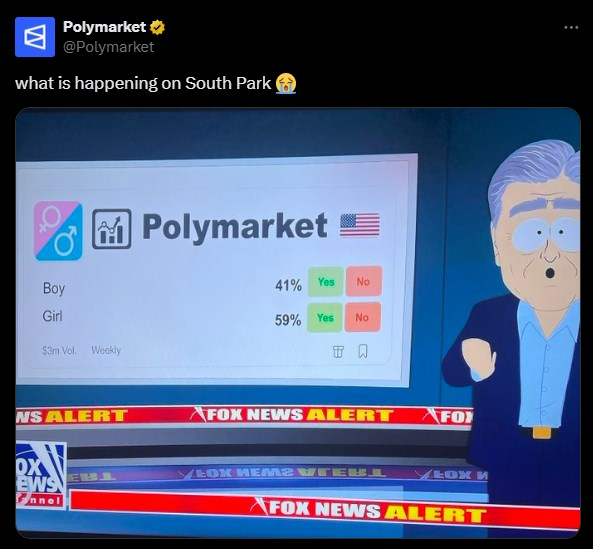
The most shocking development is ICE—the parent company of the New York Stock Exchange—investing $2 billion in Polymarket. This is not merely an investment; it’s traditional finance giving an “official endorsement” to prediction markets.
$2 billion is no small sum for Wall Street, especially for an institution known for its conservatism. ICE has always favored “hardcore finance”: In 2013, it spent around $11 billion acquiring NYSE Euronext, the parent company of the New York Stock Exchange. In 2018, it launched the crypto asset platform Bakkt, with an initial investment of just $180 million. Viewed together, these figures tell a clear story: ICE is betting on a fundamentally different future.
Why? Because what prediction markets aggregate isn’t just capital—it’s dispersed human judgment. In an era dominated by algorithms, data is already saturated. What’s truly scarce now is human signals. When traders, programmers, professors, and gamblers all place bets on the same platform, they unintentionally generate an extremely valuable metric—collective expectation.
This investment may mark a turning point: When mainstream financial institutions begin treating prediction markets as information sources rather than novelties, the coordinates of the financial world subtly shift. Algorithmic trading, risk models, and investment strategies could all be recalibrated based on these “marketized prophecies.”

*CNBC, as a leading global financial media outlet, covered this event primarily due to its significant financial and market implications
Chapter Two: The Billionaires’ Motives — Two Radically Different Stories

Crypto Perspective: DeFi’s “Unexpected Holy Grail”?
The first narrative perfectly addresses a long-standing embarrassment in the crypto world: How can DeFi (decentralized finance) become usable for the general public?
For years, the promise of “DeFi mass adoption” has been seen as crypto’s holy grail. But the reality is that complex wallets, confusing private key management, and abstract yield mechanics have acted like a high wall, keeping 99% of ordinary people out. DeFi has remained an insider game for “crypto-native” users.
Yet prediction markets might be the “unexpected breakthrough.” They could become the first DeFi product to achieve mass-scale adoption, precisely because they completely reinvent the user experience:
They’re intuitive and fun, not mentally taxing: Participation feels like “guessing,” betting on your understanding of the real world—not requiring knowledge of “liquidity pools” or “impermanent loss.” Guessing whether the next Marvel movie will gross over $1 billion is far more intuitive than calculating complex DeFi yields.
They’re tightly coupled with the real world, not abstract: Prediction market topics are real-world, verifiable events—presidential elections, sports matches, policy changes. This directly links abstract blockchain value to everyday life, giving it unprecedented “tangibility.”
They’re becoming “idiot-proof,” not just for tech geeks: Platforms are simplifying access through credit cards and email sign-ups, hiding complex blockchain technology entirely behind the scenes. You don’t even need to know what a wallet is to bet on the next Super Bowl.
In this narrative, prediction markets are the “Trojan horse” for DeFi’s mainstream breakthrough. Using universally relatable elements like “guessing” and “gossip” as its outer shell, it quietly brings blockchain technology to the fingertips of tens or even hundreds of millions of users. This isn’t just growth—it could be the decisive step for Web3 to evolve from “on-chain economy” to “real-world participation.”
Political Perspective: Democracy’s “Secret Weapon”
Yet the flip side tells a story about power and public opinion.
What is politics really about? It’s not just winning votes—it’s shaping voters’ “expectations.” And prediction markets are the perfect “expectation-generating machines.”
Imagine this: On the eve of an election, a candidate’s odds soar to 78% on prediction markets. That number alone becomes headline news. Media outlets cite it (“Markets predict XX will win decisively”), social networks amplify it, voters see it. This “inevitable victory” aura, backed by real money, spreads like a virus—shaking up swing voters, demoralizing opponents, and potentially creating a self-fulfilling prophecy of collapse.
Even more alarming, this offers power a new, untraceable tool of influence. In the past, politicians had to sway public opinion through media or direct speech. Now, all you might need is enough capital and the “right” platform.
By placing large bets, politicians can temporarily “buy” favorable odds, then let media and the public magnify that signal. When challenged, they can simply shrug and say: “I didn’t lie—I was just making a legal investment.”
When we see Donald Trump Jr. become an advisor to Polymarket, and capital linked to him pouring tens of millions into the platform, we should ask: Is this really just a simple investment?
In this story, prediction markets are no longer a “crystal ball” gathering wisdom—they become a “secret weapon” capable of shaping public opinion.
Conclusion: Power Reconfiguration in a Game of Probabilities
So, are prediction markets DeFi’s “unexpected holy grail,” or democracy’s “secret weapon”?
The answer may be: both.
They hold the potential to become an unprecedented information aggregation tool, allowing the “wisdom of the crowd” to shine with unmatched efficiency. Yet they could also devolve into舆论 battlegrounds captured by massive capital and political power, where the “deepest pockets” define what counts as “truth.”
Currently, Kalshi and Polymarket dominate the vast majority of the market share, with the former holding around 60–66% and the latter about 34%. When platforms like Robinhood open event contract trading to their 20 million users, the market’s influence will grow exponentially.
The next 12–24 months will be critical. Can prediction markets achieve mass adoption while preserving decentralization ideals? Can they remain innovative while accepting regulation? Can they succeed commercially while serving the public good?
The answers to these questions will determine whether prediction markets become tools for societal progress—or weapons that deepen inequality and manipulation.
And each of us will be both participants and witnesses in this game of probabilities.
“Be strong and keep playing your cards!”
Join TechFlow official community to stay tuned
Telegram:https://t.me/TechFlowDaily
X (Twitter):https://x.com/TechFlowPost
X (Twitter) EN:https://x.com/BlockFlow_News