New Trends in Crypto Treasury Strategies: Is Buying SOL More Efficient Than HODLing ETH?
TechFlow Selected TechFlow Selected
New Trends in Crypto Treasury Strategies: Is Buying SOL More Efficient Than HODLing ETH?
SOL inflation, DAT, and future investment strategies.
 Navigating Web3 tides with focused insights
Author: Nom
Translation: TechFlow
TL;DR
- SOL's Digital Asset Treasury (DAT) will be more efficient than ETH or BTC DATs in accumulating current tradable supply.
- The recently announced $2.5 billion SOL DAT is equivalent to a $30 billion raise for ETH or $91 billion for BTC.
- SOL from the FTX estate is about to exit the market, but its narrative impact still needs further digestion.
- SOL's inflation remains a headwind to price appreciation, roughly three times the size of unlock volume, and needs to be addressed promptly.
Do you really want to read the full content? Then let’s start with a few key points:
-
I won't debate whether inflation is good or bad—I've spent enough time on that already—and I'm looking forward to upcoming changes.
-
I hold spot SOL, staked SOL, and locked SOL (thanks to SPV on Estate SOL), so my views may be biased. I naturally want my holdings to appreciate, and price stagnation is negative for me.
Negative Factors: FTX Estate and Market Pressure
Like many well-known blockchains, Solana sold tokens to investors through multiple funding rounds. A large portion went to FTX. According to reports by @CoinDesk's @realDannyNelson, FTX held 41 million SOL at bankruptcy, mostly sold during several funding rounds, with primary buyers including Galaxy and Pantera, at strike prices of approximately $64 and $102 (plus associated fees). At the current SOL price of around $190, these investments are already significantly profitable.
Based on analysis of staking accounts, approximately 5 million units of "FTX estate SOL" remain to be unlocked, worth about $1 billion in total.
Why does this matter?
Recently, Galaxy and Pantera announced $1.25 billion and $1 billion SOL DAT plans respectively, plus $400 million from Sol Markets, totaling approximately $2.5 billion (after fees). However, this may not materially impact Solana's price because the currently locked SOL can be purchased or allocated by these entities. According to data from @4shpool (gelato.sh), there are still about 21 million SOL scheduled to unlock by 2028, worth approximately $4 billion. A rough calculation (more detailed modeling could be provided by professional financial analysts) shows that "FTX estate SOL" accounts for about a quarter of the remaining unlock volume.
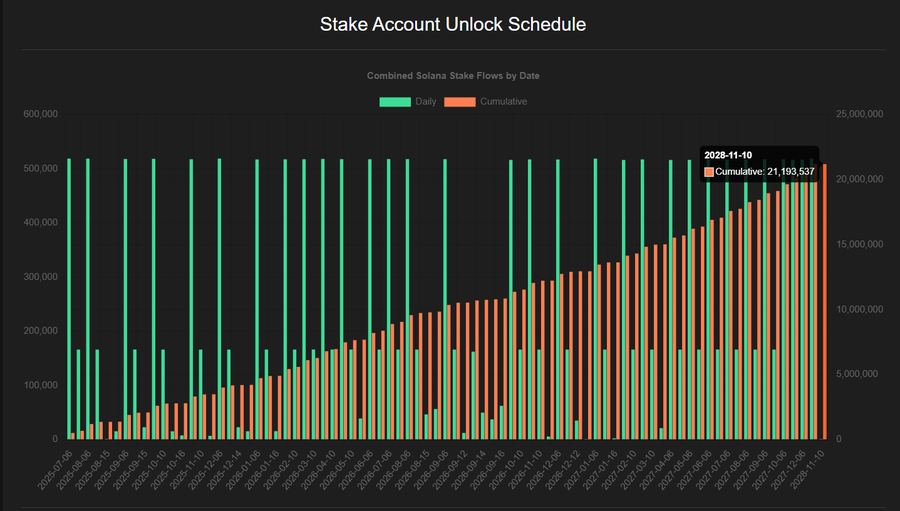
On another front, Solana's inflation issue also deserves attention. Inflation is commonly cited as 7-8%, but actual inflation is closer to 4.5% of circulating supply. This means that starting from a cycle 839 supply of approximately 608 million SOL, one year later supply would increase by about 27.5 million (inflation) and 10 million (unlocks), reaching a total circulation of approximately 645.5 million, resulting in an inflation rate of about 6.2%. Again, this is purely theoretical math—I’ll let more experienced analysts review it and provide you with more accurate charts.
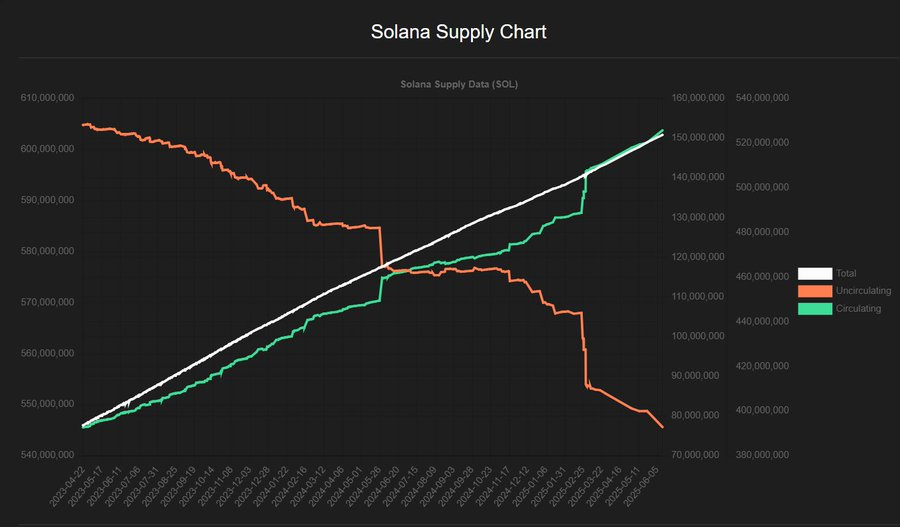
From the sharp growth in circulating supply, it's clear that a "static" inflation rate isn't accurate—it spikes at certain points and remains low at others. We’ve already passed the remaining major unlock milestones.
We need to focus on one key number: the daily amount of SOL entering the market. If someone receives tokens for free (e.g., via staking inflation or unlocks) or at a discount (e.g., FTX estate SOL), we can expect a portion to be sold. I assume that all 37.5 million SOL of inflation over the next year will be sold. If I want prices to rise, this is bad news—see point 2. Therefore, we need inflows, which can come from DATs or ETFs (e.g., $SSK) (shoutout to the @REXShares team for creating and filing the BONK ETF, full disclosure: strong endorsement). Ideally, every dollar spent buying SOL should enter the market and push prices up. But when discounted or locked SOL is available, this method becomes less efficient. So, let’s assume greedy DAT actors will buy these tokens before they unlock.
Is That Bad?
Short answer: No, not necessarily. To offset 37.5 million SOL of annual supply (assuming $200 per SOL, idealized expectation), the market needs about $7.5 billion in inflows, or roughly $20.5 million per day (this is simplified, excluding weekends and bank holidays). If DATs can purchase tokens at a discount from FTX estate SOL or other locked SOL sources, this increases the efficiency of capital inflow.
For example, raising $400 million to buy SOL at a 5% discount equates to $420 million in effective inflow, clearly better than injecting $400 million directly into the market. The only question is how to assess the time value between buying SOL today versus reducing future sales.
SOL's inflation over the next three years will exceed unlock volumes (until the lockup schedule ends in 2028), while FTX estate SOL represents only a quarter of remaining unlocks. Therefore, prioritizing estate SOL purchases over market purchases won’t have a significant overall market impact. Either Galaxy or Pantera alone could absorb the remaining supply (assuming all estate SOL is sellable), not to mention existing DATs like @defidevcorp, @solstrategies_, or @UpexiTreasury (and existing ETPs).
The Good News: Tradable Supply vs Circulating Supply
Funds spent on SOL are more efficient than those on ETH or BTC for two main reasons.
Tradable Supply
First, circulating supply does not equal tradable supply, especially with staked assets. Staked SOL cannot be bought directly, but liquid staking token derivatives (LSTs) can. According to data from the @solscanofficial team, Solana currently has 608 million SOL, with 384 million staked (63.1%). LSTs represent 33.5 million SOL, meaning actual tradable supply is about 57.5% (around 350 million SOL are non-tradable, with at least a two-day delay). In contrast, ETH has a staking ratio of 29.6% and LSTs at 11.9%. Higher market supply makes price movement harder, whereas SOL’s lower tradable supply supports price appreciation.
Relative Capital Efficiency
Solana’s market cap is far below ETH and BTC—approximately $104 billion compared to $540 billion for ETH and $2.19 trillion for BTC. Therefore, each dollar invested in a SOL DAT is roughly 5x more effective than in an ETH DAT and 22x more effective than in a BTC DAT. When factoring in staked supply, this efficiency increases to 11x and 36x respectively.
The benefit of these DATs is that they remove supply from the market, earn tokens via staking yields (already accounted for in inflation above), and make subsequent tools like ETFs more effective in driving the market. SSK has seen about $2 million in daily inflows since launch, but the inflation schedule requires 10x that amount—potentially achievable with approval of more ETFs.
Why read this?
I never signed up for Elon bucks, so this remains a mystery to all of us.
Summary:
- Compared to ETH or BTC DATs, SOL DATs will more efficiently accumulate current tradable supply (not circulating supply). Currently, less than 1% of supply is managed by SOL DATs. With new programs launching, this is expected to rise to 3%, possibly reaching 5% in the future.
- The recently announced $2.5 billion SOL DAT is equivalent to a $30 billion raise for ETH or $91 billion for BTC. SOL DAT needs a figure like Michael Saylor or Tom Lee to drive the narrative.
- SOL from the FTX estate is即将 exiting the market, but its narrative impact still needs further digestion.
- SOL's inflation issue remains unresolved, with scale roughly triple that of unlock volume.
- Current ETF inflows are insufficient, but with larger financial instruments expected to be approved, SOL is likely to become a focal point for institutional interest starting Q4.
- Buy $BONK (not investment advice, do your own research).
- If you're only here looking for investment advice from posts like this, consider hiring a professional quant analyst to manage your assets.
Join TechFlow official community to stay tuned
Telegram:https://t.me/TechFlowDaily
X (Twitter):https://x.com/TechFlowPost
X (Twitter) EN:https://x.com/BlockFlow_News
 @TheOnlyNom