Bitcoin Plunges, $900 Million Liquidated: Prelude to the September Curse?
TechFlow Selected TechFlow Selected
Bitcoin Plunges, $900 Million Liquidated: Prelude to the September Curse?
The consensus is: September is not the moment when the bull market turns upward, but rather a test that must be faced.
 Navigating Web3 tides with focused insights
Author: BitpushNews
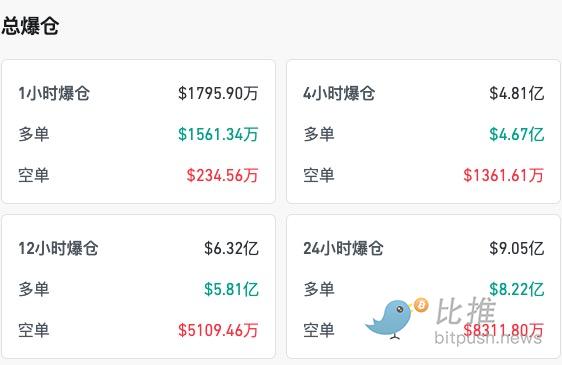
On Monday, crypto market volatility intensified. Bitcoin briefly dropped below the $110,000 mark, hitting a low of $109,324—the lowest level since early July. Ethereum briefly fell below $4,400, down nearly 8% in 24 hours. This downturn triggered massive liquidations across the market: according to CoinGlass data, over $900 million was liquidated in 24 hours at the time of writing, with Ethereum longs losing approximately $322 million and Bitcoin longs losing $207 million.
The market reacted swiftly, pressuring major altcoins across the board: Solana plunged over 8% in a single day, XRP dropped 6%, while mid- and small-cap tokens such as PENDLE, LDO, and PENGU recorded double-digit losses, falling as much as 13% within 24 hours.
Historical Pattern: The September "Curse"
Investor caution is not unfounded. Statistics from CoinGlass show that September is one of the weakest months for both Bitcoin and Ethereum.
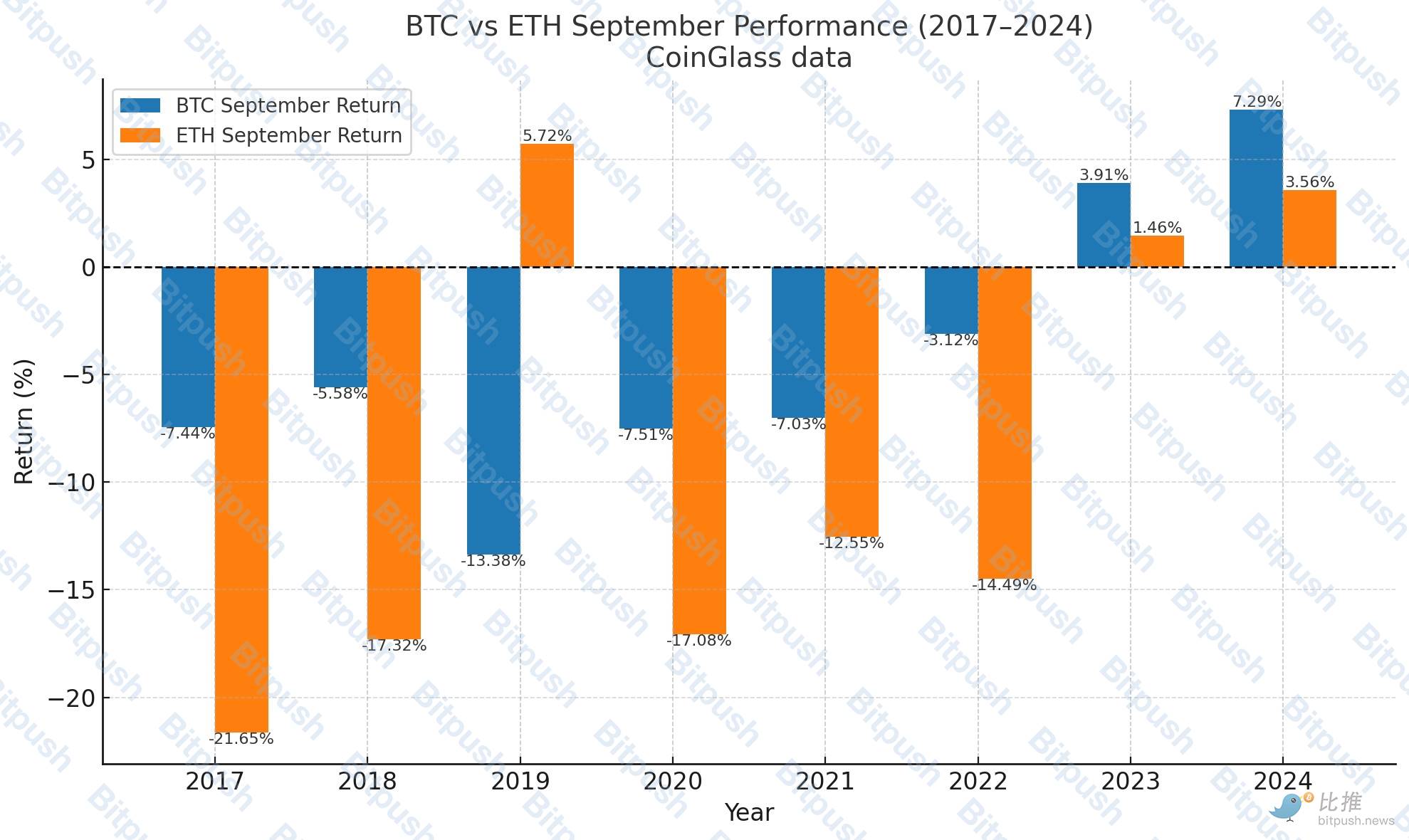
The chart above compares the actual price changes of BTC and ETH in September from 2017–2024, revealing the following:
-
BTC has posted negative returns in most Septembers, with only 2023 (+3.91%) and 2024 (+7.29%) recording gains.
-
ETH typically sees larger declines in September, significantly underperforming BTC in 2017 (–21.65%), 2020 (–17.08%), and 2022 (–14.49%).
-
Only in 2019 (ETH +5.72% vs BTC –13.38%), 2023, and 2024 did ETH outperform BTC during September.
This "September curse" has appeared in every past bull cycle. In 2013, 2017, and 2021, Bitcoin experienced strong summer rallies followed by sharp corrections in September.
Analyst Views: Short-Term Trend Reversal
Prominent analyst Benjamin Cowen noted that the strength seen in July–August often reverses in September, with Bitcoin highly likely to test the bull market support zone near $110,000. He also warned that Ethereum may briefly reach new highs before dropping 20–30%, while altcoins could fall even deeper by 30–50%.
Another active market analyst, Doctor Profit, added a more pessimistic macro and psychological perspective. He believes that the Federal Reserve's rate cut in September may be less of a catalyst and more of a trigger for uncertainty. Unlike the "soft landing" rate cuts in 2024, this could mark a true "major turning point," leading to synchronized corrections in both stock and crypto markets.
On the price front, he emphasized that the BTC chart still features a CME gap at 93k–95k, where significant liquidity is concentrated, while retail investors mostly entered positions in the 110k–120k range or higher. To shake out these "weak hands," prices must fall into their "maximum pain zone."
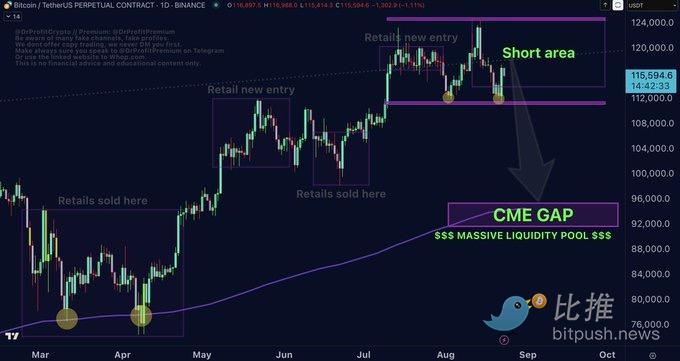
In his strategy, he stated he has gradually reduced BTC and ETH spot holdings and shifted toward short-term short positions.
Latest capital flow data shows cooling interest in ETFs. According to SoSoValue, last week saw $1.17 billion in outflows from spot Bitcoin ETFs—the second-largest weekly net outflow on record—and $237.7 million in outflows from spot Ethereum ETFs, the third-largest on record. This suggests institutional capital is entering a phase of观望 (observation), weakening support in the spot market.
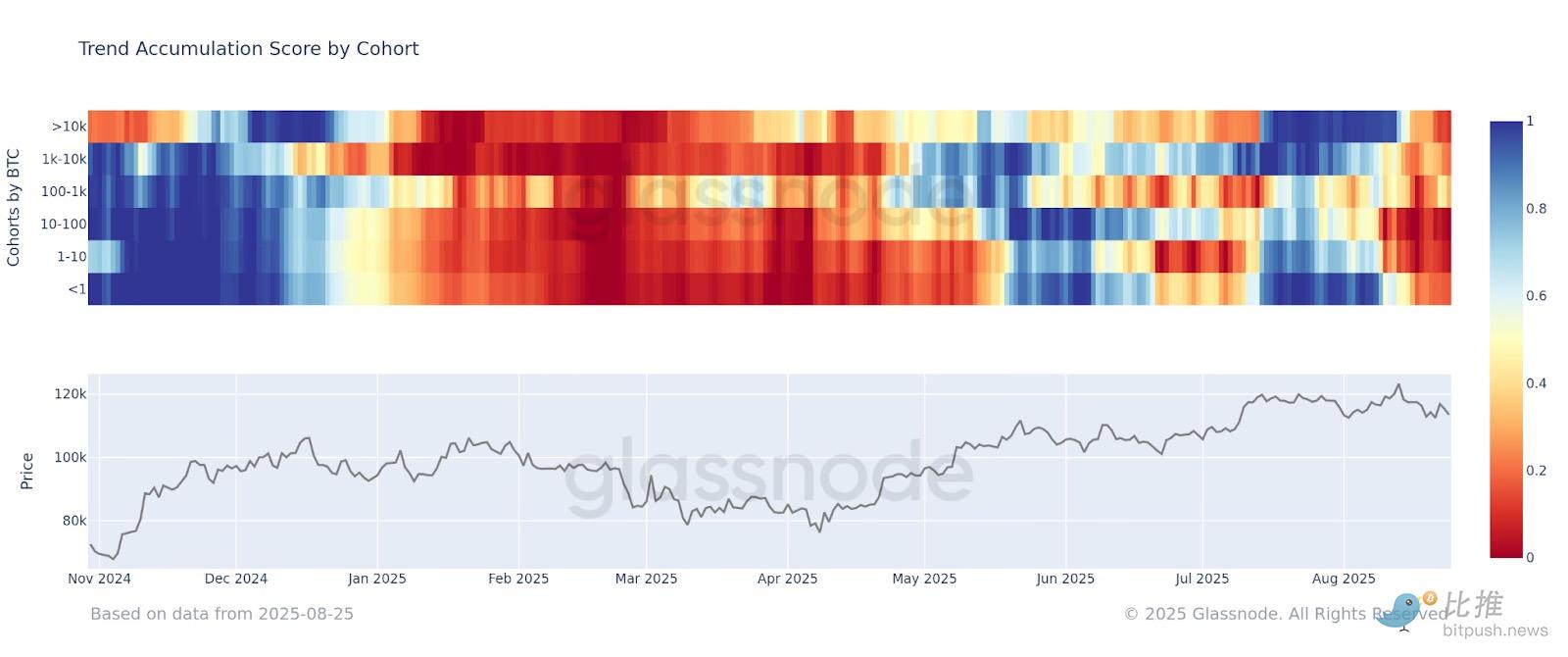
On-chain data also reveals structural signals. Glassnode指出 (points out) that all Bitcoin holder cohorts have collectively entered a distribution phase, indicating broad-based selling pressure across the market. After reaching a new high of $4,946, Ethereum pulled back, with the MVRV ratio rising to 2.15, meaning investors hold an average unrealized profit of over 2x. Historically, this level resembles December 2020 and March 2024—periods that preceded high volatility and profit-taking.
Macro Factors: Fed and Rate Risks
Macroeconomic uncertainty further intensifies market tension. Last Friday, Fed Chair Powell hinted at a potential rate cut in September, briefly boosting market optimism. However, both Cowen and Doctor Profit cautioned that rate cuts don't necessarily benefit risk assets—they could instead push long-end Treasury yields higher, weighing on risk assets. This mirrors the situation in September 2023, when a rate cut marked a bond market bottom, followed by a surge in yields. Additionally, Benjamin Cowen pointed out that recent Producer Price Index (PPI) data shows inflation is "hotter than expected," adding further pressure on markets. With inflationary pressures not yet fully eased, the Fed's policy shift could spark renewed market turmoil.
Outlook and Conclusion
Taking into account historical patterns, analyst views, and macro conditions, several layers of pressure face the crypto market in September:
-
Seasonal downtrend — historically, September averages significant losses;
-
Macro uncertainty — the Fed’s policy could become a market inflection point;
-
Imbalanced capital structure — institutional outflows paired with retail buying at elevated levels;
-
Intensifying on-chain selling pressure — all holder groups entering distribution, with whale transactions disturbing the market.
While Cowen and Doctor Profit differ in their estimates of the correction magnitude, they agree: September is not a month for bullish breakthroughs, but rather a necessary test.
However, from a longer-term perspective, this purge may be a necessary step for the bull market to continue. The market needs to clear overheated positions in the "maximum pain zone" to create space for the next upward leg. If the cleansing process is thorough, BTC could still reach new highs in the subsequent cycle, and ETH's long-term bullish thesis remains intact.
Join TechFlow official community to stay tuned
Telegram:https://t.me/TechFlowDaily
X (Twitter):https://x.com/TechFlowPost
X (Twitter) EN:https://x.com/BlockFlow_News
 比推 BitpushNews