Which of the three main players in tokenized U.S. stocks will take the lead?
TechFlow Selected TechFlow Selected
Which of the three main players in tokenized U.S. stocks will take the lead?
Explaining the differences between StableStocks, xStocks, and Robinhood.
 Navigating Web3 tides with focused insights
Author: @BlazingKevin_, Researcher at Movemaker
Under the expectation of "deregulation" potentially brought by Trump, the long-dormant tokenized stock sector is reigniting in 2025 under the new guise of RWA. Bringing the world's most liquid assets—U.S. stocks—into the crypto industry, enabling global crypto users to trade anytime and anywhere, is undoubtedly a grand and enticing narrative.
However, this path is far from smooth. From early STO concepts to synthetic asset experiments during DeFi Summer, and then to brief attempts by FTX and Binance, the history of tokenized stocks has been full of twists and turns. Now, with subtle shifts in the regulatory environment, a new round of competition has begun.
In this race, three forces are emerging, representing three distinctly different paths: the "downgraded strike" by internet brokerage giant Robinhood, the "open Lego" approach of xStocks (issued by Backed Finance, distributed by Kraken, etc.) native to DeFi, and the "hybrid model" pursued by the mysterious newcomer StableStocks backed by Matrix Partners and other institutions.
This article will deeply analyze these three major players, detailing their legal foundations, business models, core differences, and explore who is most likely to emerge victorious in this high-risk game.
1. Four Waves of Tokenized Stocks
To understand today’s competitive landscape, we must look back at history. The development of tokenized stocks has roughly gone through four stages:
-
STO Germination Period (2017–2018): The concept of STO (Security Token Offering) emerged, aiming to bring traditional securities onto the blockchain in a compliant manner. However, due to lack of unified standards, high compliance costs, and insufficient secondary market liquidity, this attempt quickly fizzled out.
-
Synthetic Asset Experimentation Period (DeFi Summer 2020): Projects represented by Synthetix and Mirror Protocol attempted to mint "synthetic assets" pegged to U.S. stock prices by over-collateralizing crypto assets. This model bypassed the regulatory hurdles of directly holding stocks but ultimately failed due to lack of product-market fit. Insufficient on-chain trading demand left market makers unmotivated, leading to liquidity collapse. Most projects eventually delisted related assets citing "regulatory considerations."
-
CEX Trial Period (2020–2021): Centralized exchanges like FTX and Binance launched centrally custodied tokenized stocks through partnerships with licensed financial institutions. This model briefly attracted significant trading volume (FTX reached $94 million in monthly volume in October 2021), but soon faced heavy regulatory pressure for directly competing with traditional exchanges like Nasdaq. Binance discontinued its service after just three months, while FTX's operations ended with the collapse of its empire.
-
RWA Renaissance Period (Present): Under new regulatory expectations, the sector is restarting. This time, the core narrative centers on RWA, emphasizing issuing tokens backed 1:1 by real stocks through compliant legal structures, prioritizing asset security and transparency.
2. Overview of the Current Market Landscape
According to data from RWA.xyz, the current total issuance of stock-based RWA is approximately $374 million, but growth remains slow. The market landscape is fragmented:
-
Exodus (EXOD): Largest market cap (~$258 million), but its model is largely symbolic. Users can migrate EXOD shares listed on the NYSE to the Algorand chain, but this creates only a "digital twin" without any on-chain rights or tradability.
-
Dinari: A model case for regulatory exploration. Registered in the U.S., it holds a valuable broker-dealer license. However, to meet strict regulations, its issued dShares cannot be freely traded on-chain; all trades must go through its website during U.S. market hours. This gives it no user experience advantage over traditional brokers like Futu, making it more like a traditional brokerage using crypto as an on-ramp. As a result, its market size remains limited.
-
Montis Group: A UK-based digital asset issuer with a market cap of about $55 million, focusing on bringing European stocks and bonds on-chain. Like Exodus, Montis has so far only tokenized its own stock, and these tokens cannot be freely traded on-chain. For Web3 investors seeking liquidity and composability, this model holds little practical value at present.
It is against this backdrop that the entry of Robinhood, xStocks, and StableStocks brings three more imaginative paradigms to the market.
3. The Three Horsemen—Deep Deconstruction of Three Models
We will break down these three major players across three dimensions: legal foundation, business model, and composability.
1. Robinhood: Derivatives Contracts + B2C + Controlled Ecosystem
-
Legal Foundation and Compliance Path: While many companies globally are exploring the integration of "crypto + stocks," Robinhood's approach stands out. Instead of issuing tokens representing stock ownership, it enters the market more flexibly via derivatives. Its European product is not technically a stock security but an OTC financial contract issued under the EU's MiFID II framework. In other words, users aren't buying "stock tokens" but digital instruments tracking specific stock price movements. This legal design allows Robinhood to bypass complex securities compliance barriers and enter overseas markets with minimal friction.
-
Technical Architecture and the "Walled Garden":
-
Base Layer Choice: Technically, Robinhood uses Arbitrum as its deployment network. Compared to Ethereum mainnet, this offers higher performance, lower transaction costs, and inherits Ethereum's mature security. It deployed hundreds of tokens with gas fees under a few dollars, clearly demonstrating efficiency advantages.
-
Permission Control: However, this system is not an open DeFi playground. Smart contracts embed strict whitelisting rules, requiring verification that recipients have passed Robinhood’s compliance checks. In short, it's a typical "controlled zone"—users must complete KYC to participate, and the ecosystem is tightly controlled by Robinhood, sacrificing interoperability with the broader DeFi world.
-
Future Ambition: More intriguing is Robinhood’s next move. The company is preparing to launch its own Layer 2 network—Robinhood Chain—based on the Arbitrum tech stack. This isn’t merely about cost reduction; it signals a stronger intent: Robinhood wants control over the underlying technology to create a tailor-made environment for its large-scale RWA strategy.
-
Strategic Depth and Vision: Viewing this model simply as a "walled garden" underestimates Robinhood’s ambition. CEO Vlad Tenev has repeatedly stated the company’s vision of "Capital as a Service." Tokenization is not a gimmick but a key tool in democratizing finance, especially for illiquid assets long locked up among high-net-worth individuals. Imagine if ordinary users could gain exposure to pre-IPO giants like SpaceX or OpenAI through derivative tokens—the power structure of capital markets would be reshuffled.
Of course, reality isn’t entirely optimistic. Top private firms rarely lack capital, so they’re unlikely to willingly "invite retail in." This means tokenization schemes must bypass traditional issuance logic to reach average investors. But this model carries risks: after launching OpenAI-related tokens, Robinhood quickly issued a statement clarifying no affiliation, exposing a potential gap in transparency and investor understanding with derivative models.
Compared to other platforms, Robinhood’s approach differs from traditional on-chain securities efforts (like Synthetix’s synthetic assets or Polymarket’s prediction markets). It doesn’t emphasize full DeFi openness but rather captures market share through a combination of "strong compliance + high user experience." Its logic resembles a fintech platform extension rather than thorough on-chain fundamentalism.
If regulators tacitly accept or gradually embrace this model, Robinhood could become the first super gateway connecting retail investors, compliance, and RWA—possibly the primary entry point for European and American retail into tokenized finance.
One-sentence review: Robinhood’s effort isn’t just about "putting stocks on the blockchain," but an experiment in reshaping traditional derivatives distribution using crypto. It leverages blockchain to enhance product delivery and compliance efficiency, targeting not just the crypto space but the redefinition of the entire global financial system.
2. xStocks: Asset-Backed Tokens + B2B2C + Full Composability
-
Legal Foundation and Compliance Path: In the tokenized stock space, xStocks occupies a unique position. Unlike platforms offering only price-tracking derivatives, it maps physical assets fully. The architecture is built by Swiss-compliant team Backed Finance under Switzerland’s DLT legal framework, using an SPV in Liechtenstein to custody real stocks. This SPV has one sole purpose—to hold the underlying assets—and is legally isolated from the issuer and trading platform. Even if the operator fails, investor rights remain protected. Investors don’t get a "contract paper" but a senior secured debt instrument tied to real assets.
-
Technical Architecture and Transparency:
-
Base Layer Choice: Technically, xStocks issues tokens on Solana. The reasons are clear: high throughput, low cost, and near-instant confirmation—ideal for frequent trading and DeFi composability.
-
Transparency Foundation: To assure investors that tokens are truly backed, xStocks integrates Chainlink’s Proof of Reserves, allowing anyone to verify reserves on-chain at any time—adding a layer of transparency credibility to its "asset tokens."
-
Open Contracts: As standard SPL tokens, xStocks tokens circulate freely on Solana and seamlessly integrate with native DeFi protocols like Jupiter and Kamino, enabling full composability.
-
Strategic Depth and Vision: Commercially, xStocks follows a B2B2C distribution model rather than a direct-to-consumer closed loop. Institutional entities handle primary market minting and redemption via Backed Finance, while secondary trading occurs on exchanges like Kraken and Bybit. This attracts both professional institutions and retail users through established platforms, unlocking liquidity within an open ecosystem. Data already shows promise: after gaining support from mainstream platforms, its daily trading volume once exceeded $6 million. The long-term vision is to evolve into "Tokenization-as-a-Service," providing standardized tools for financial institutions to tokenize assets.
xStocks contrasts sharply with Robinhood. Robinhood’s model resembles "digitizing financial derivatives," locking users via controlled whitelists; xStocks, however, brings real assets on-chain while maintaining full interoperability with DeFi. This makes it naturally aligned with Web3’s "open Lego" narrative, but also exposes it to regulatory gray zones and risk spillover in open environments.
The success of this model hinges on two factors:
1.Whether it can establish deep liquidity. If tokenized assets are only unidirectionally issued without sufficient counterparties or arbitrage mechanisms, their market significance will be minimal.
2. Whether it can earn long-term regulatory tolerance. While the current SPV structure achieves legal isolation, global recognition of "tokenized securities" remains inconsistent. Regulatory conflicts could trigger major ecosystem disruptions.
Notably, xStocks’ model may inspire broader applications. It offers a replicable template for "asset-backed tokens" beyond stablecoins, suitable for tokenizing bonds, ETFs, or even art funds. Unlike exchange-specific "controlled tokens," it emphasizes free composability with DeFi modules, injecting new liquidity sources into the entire crypto ecosystem.
One-sentence review: xStocks isn’t reshaping exchanges but providing DeFi with a new asset base. It aims to bring traditional financial value onto the chain transparently and shape new market ecosystems through open composability. If Robinhood’s direction is "business on-chain," xStocks’ logic is closer to "assets on-chain."
3. StableStocks: Proxy Shareholding + B2C + In-platform Composability
-
Legal Foundation: StableStocks employs a unique "proxy shareholding + beneficiary" model. It sets up dedicated SPVs and partners with licensed brokers (e.g., Australia’s HABIT TRADE) to open institutional accounts, buy, and custody stocks. End investors don’t directly hold shares but enjoy corresponding rights as beneficiaries. This setup allows StableStocks to operate within a compliant framework via partners, balancing compliance and flexibility without holding a full brokerage license.
-
Business Model: StableStocks follows a classic B2C model, bundling deposits, trading, custody, and derivative features within its own platform. Unlike B2B2C approaches, StableStocks prefers direct end-user service. It is closely tied to Binance and the BNB Chain ecosystem.
-
Composability: StableStocks’ key distinction lies in not pursuing full external composability but building a closed-loop system with internal composability. Stock equity tokens held by users can be deposited into the platform’s "StableVault" to mint stStock, a yield-bearing derivative. This is a "walled financial playground" logic—limited in玩法 but more controllable in experience.
From a systemic perspective, StableStocks’ model can be broken down into five key components:
Stock Acquisition and Sourcing: Real stocks from licensed brokers:
-
Australian Habit Trade (70% stake) handles U.S. stock channels
-
Traditional banks (e.g., ANZ, DBS) provide fiat settlement and funding channels.
-
Stock sources are real, not synthetic assets.
Settlement and Custody Mechanism: Stocks are uniformly custodied by SPV, isolating risks;
-
Partnership with Nasdaq clearing agents ensures compliant and stable underlying asset transfers.
-
Ensures 1:1 correspondence, reducing counterparty default risk.
Tokenization and On-chain Issuance: StableStocks maps custodied stocks into stock tokens;
-
Tokens run on BNB Chain, supported by Binance wallet and trading ecosystem;
-
Each token is backed by real assets, making them standard asset-backed tokens.
Stablecoin and Crypto On-ramp: Integrated with Coinbase’s stablecoin channel, allowing users to directly swap USDC for stock tokens;
-
Resolves the funding conversion barrier between fiat and crypto users.
End-user Usage and Expansion
-
Stock tokens can be held and traded in Binance Wallet;
-
Beyond investment, they can be embedded into StableStocks’ proprietary DeFi modules (staking, yield enhancement).
-
User experience resembles a hybrid of "Robinhood + DeFi-lite."
StableStocks takes a "middle road"—neither as closed as Robinhood (offering only trading), nor as open as xStocks (fully integrated with the DeFi Lego set), but instead builds a semi-open system. For traditional finance investors, it provides a new way into on-chain markets; for crypto users, it offers easy access to blue-chip stocks like Tesla, Apple, and McDonald's. Its core selling points are:
-
Compliance: Leverages licensed broker infrastructure;
-
Stability: Clearing agent + SPV custody;
-
Usability: B2C closed loop;
-
Innovation: Internal composable DeFi-lite.
One-sentence review: StableStocks represents a middle ground, attempting to balance Robinhood’s closed usability with xStocks’ open complexity. It bets that users want a "DeFi-lite" experience—enjoying DeFi-driven yield enhancements without bearing the full risks and complexities of open DeFi.
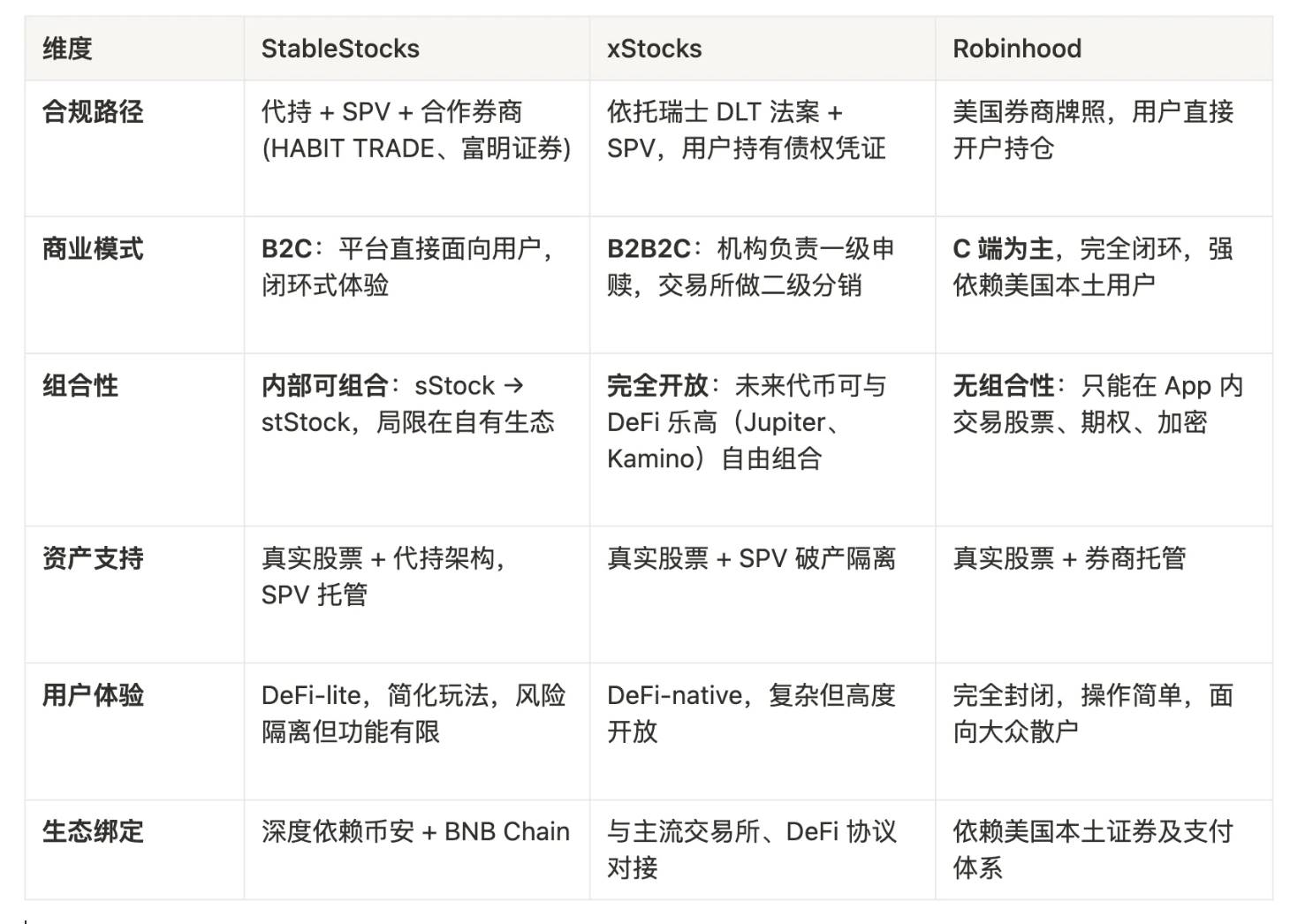
Triangular Comparison: StableStocks vs xStocks vs Robinhood
4. Unsurpassable Structural Barriers
Despite their differences, all current stock tokenization schemes face several common, hard-to-solve structural barriers in the short term:
-
Contradiction between Value Proposition and Actual Liquidity: All platforms face a classic "chicken-and-egg" dilemma. On one hand, for users who can already easily trade U.S. stocks, the value proposition of tokenized stocks is unclear. On-chain trading offers no better fees and, due to poor liquidity, often results in higher slippage, delivering a far inferior experience compared to mature online brokers. On the other hand, precisely because there’s no compelling value to attract large-scale users and capital, on-chain liquidity fails to deepen, creating a self-reinforcing negative feedback loop: no users mean no liquidity, and no liquidity means fewer users. Unless irreplaceable new utility is offered to existing users, breaking this deadlock will be difficult.
-
Structural Deficiencies: Current tokenized stocks are essentially "digital twins" of real stocks, but this replication has fundamental flaws. First, the promise of 24/7 trading is largely illusory. When underlying markets (e.g., Nasdaq) are closed, on-chain market makers cannot hedge their exposure and must either drastically widen spreads or withdraw liquidity entirely, severely undermining weekend and after-hours trading. Second, these tokens strip away full shareholder rights. Users gain economic claim rights, not full ownership including voting rights.
-
Centralized Risks Under a "Decentralized" Facade: Despite running on decentralized blockchains, the trust foundation of these RWA models is highly centralized in off-chain entities. Whether it’s the SPV issuing tokens, third-party banks holding assets, partner brokers executing trades, or bridges connecting fiat and crypto—each is a potential single point of failure. If any of these centralized entities fail operationally, face legal disputes, or go bankrupt, the on-chain tokens could instantly lose their value backing.
-
The Potential Paradox of DeFi Composability: For open models like xStocks, the ultimate vision is to become "money Legos" in the DeFi world. Yet this composability faces a serious paradox. When a DeFi lending protocol considers accepting TSLAx as collateral, it must assess not only Tesla’s stock volatility but also platform risk—the possibility of default by issuer Backed Finance or its custodian. This dual exposure ("asset risk + platform risk") makes DeFi protocols extremely cautious when integrating such RWA assets. Additionally, the ambiguous legal status of these tokens deters DeFi protocols, which fear regulatory crackdowns for "illegally operating securities businesses." This explains why no major DeFi protocol has adopted them as core collateral—its path to true composability remains long.
Conclusion: Which Model Will Win the Future?
The final outcome of this race may not depend on whose legal structure is more clever, but on who can first deliver irreplaceable value to users.
-
Robinhood’s path to victory lies in scale. If its goal is simply to offer a familiar asset class in a novel format to tens of millions of existing users, it may win in terms of user numbers.
-
xStocks’ path lies in ecosystem integration. If the "financial Lego" narrative takes hold and numerous DeFi protocols adopt it as core collateral or base assets to build options, lending, and structured products on-chain, it will win the future of Web3.
-
StableStocks’ path lies in user experience. If it proves that "DeFi-lite" is a real market, offering a one-stop, low-barrier "trading + yield" experience, it might carve out a blue ocean between mainstream and hardcore DeFi users.
At its core, so-called "on-chain U.S. stocks" remain in the experimental phase—more a financial packaging under regulatory gaps than a mature market tool. The real game-changer won’t be the first to achieve a proof-of-concept, but whoever can deliver a complete on-chain trading system integrating spot, shorting, leverage, and risk management. Only when the financial functionality and playability of on-chain stocks rival or surpass those of Wall Street’s legacy brokers will this transformation enter a substantive phase. For now, pioneers have only just placed their wheels on the track—the real race has yet to begin.
Join TechFlow official community to stay tuned
Telegram:https://t.me/TechFlowDaily
X (Twitter):https://x.com/TechFlowPost
X (Twitter) EN:https://x.com/BlockFlow_News
 @MovemakerCN