Circle and Stripe race to build chains: Is the "AWS moment" for payment infrastructure here?
TechFlow Selected TechFlow Selected
Circle and Stripe race to build chains: Is the "AWS moment" for payment infrastructure here?
Payment-native chains will become the monetary operating system of the AI era, reshaping the foundational architecture of global finance.
 Navigating Web3 tides with focused insights
Author: Simon Taylor
Translation: TechFlow
According to Fortune, Stripe and Paradigm may be collaborating on a payment-focused blockchain, though this has not been officially confirmed. Additionally, Circle has announced similar plans in its financial reports. What do these developments mean?
Let’s zoom out. Current payment infrastructure remains highly customized, fragile, and expensive to scale. If you believe AI will accelerate transaction volume and agree with the idea that “money is becoming software,” the conclusion is clear:
Payment-native blockchains are inevitable. Existing infrastructure—on-chain or off-chain—cannot meet future demands. Stablecoins, tokenized deposits, and on-chain finance are becoming reality.
The key question is: which network can standardize the underlying technology, allowing operators to compete through software?
Editor's note: The author is an advisor to Paradigm; views expressed are personal. This article aims to analyze the strategic logic of payment-native blockchains and their impact on industry participants.
The "AWS Moment" for Payments:
There is currently no AWS-like universal infrastructure in payment processing. Every processor rebuilds the same tech stack, lacking a shared public tooling layer. A common, neutral, high-throughput payment rail could drastically reduce fixed operational costs and shift competition to software and workflows. Imagine such infrastructure—but without Amazon involved, truly trustworthy and neutral.
Existing blockchains lack payment-native features. Picture a payment processing toolkit with equivalents of “EC2 for settlement,” “S3 for receipts,” and “IAM for compliance keys.” The real competition isn’t about lowering transaction fees—it’s about developer efficiency and solving pain points like fiat off-ramps.
High-throughput networks like Solana and Base are powerful, handling everything from memecoins to complex dApps, but their general-purpose nature can lead to congestion and degraded user experience in specific use cases. For example, if a president suddenly launches a new meme coin, it could disrupt normal operations. A Swiss Army knife is versatile, but not ideal as a machete.
We’re already seeing blockchain projects focused on stablecoins—Tether’s Plasma, and emerging firms like Codex and Conduit—attempting to solve these issues. Many teams are targeting the same pain points, and innovation in payment-native blockchains is expanding.
A successful blockchain must minimally offer:
-
High sustained transaction throughput (TPS) with predictable finality under peak load;
-
Backward compatibility with bank payment rails and messaging formats;
-
Coverage across existing merchant geographic footprints;
-
Native compliance interfaces and auditability;
-
Fees paid in fiat-denominated currency (e.g., USD);
-
Clear neutrality guarantees: shared governance, limited sponsor privileges, and broad interoperability.
Having major partners onboard at launch would be a powerful go-to-market strategy, especially if true neutrality can be achieved. And I believe it can. (Today, even JPMorgan collaborates with Coinbase on Base, which is no longer controversial.)
What About Tokenized Deposits, Banks, and Central Banks?
Stablecoins, tokenized deposits, and CBDCs will coexist, solving different problems for different users. All three will move on-chain.
-
Stablecoins offer new opportunities for unbanked institutions and organizations in the Global South to access USD more easily.
-
Tokenized deposits help larger organizations reintegrate into commercial banking systems.
-
Tokenized reserves enable large banks to settle with each other and central banks domestically and internationally.
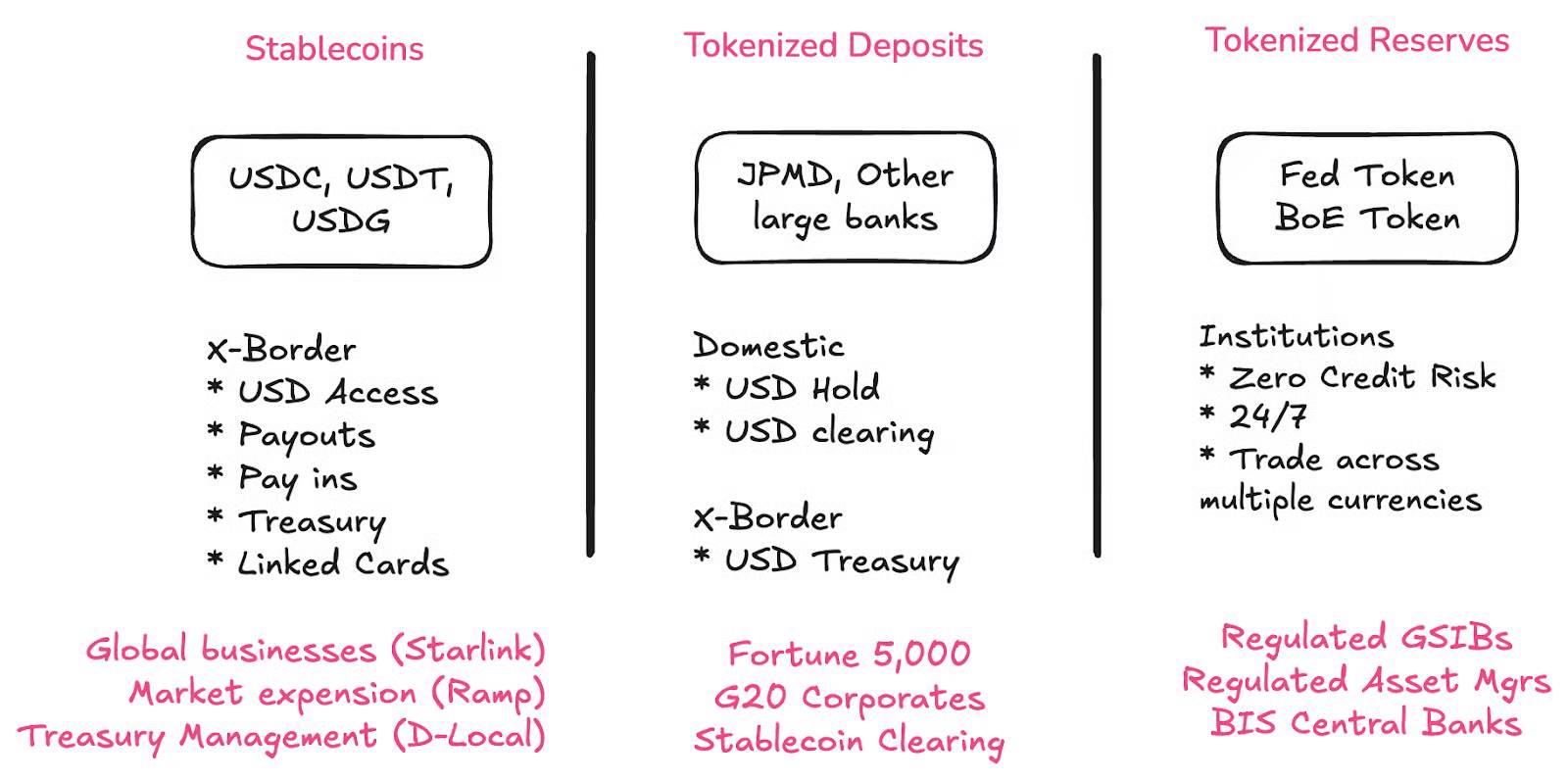
Stablecoin clearing presents massive opportunities for banks. This week, I heard a founder mention that partnerships with top-tier banks like Deutsche Bank, Wells Fargo, Bank of America, and JPMorgan provide stronger structural safeguards for their fiat off-ramp pathways.
Every bank should issue tokenized deposits: it’s the obvious choice. The future of payment infrastructure is on-chain, so your balance sheet should be too. I’ve spent significant time recently exploring how to achieve this—stay tuned for a future “Brainfood” column. Because the answer won’t come from a simple RFP.
Tokenized deposits will make stablecoins backward compatible with traditional finance (TradFi). If all banks offer tokenized deposits (i.e., deposits on-chain), fiat off-ramps become unnecessary. This is the key to backward compatibility.
This is distinctly different from the Bank-as-a-Service (BaaS) era. Back then, small banks engaged in “innovation” but became major risks for fintech and stablecoin ecosystems. Now, we have dedicated regulations for stablecoins, attracting large banks and fostering industry stability.
Yes, because it’s a business opportunity.
But crucially, this business opportunity operates within a clear regulatory framework.
Can Openness Survive on Branded Rails?
A major concern is that efforts like the “Stripe chain” or those by Robinhood and Coinbase might re-centralize the internet, seemingly contradicting the ethos of on-chain finance. However, Cristian Catalini offers a thoughtful counterargument.
Catalini argues: Platforms like Coinbase or Robinhood pay for decentralization because it protects them from platform monopolies.
New L1 payment chains need credible neutrality.
How can we assess whether a chain is credibly neutral? Three criteria:
-
Shared governance
-
Limited role for parent company
-
Wide and inclusive interoperability
As the Paradigm* project takes shape, these will be interesting topics to revisit.
Commoditizing Payment Processing—the Era of Software Competition
The incentive to commoditize payment infrastructure is emerging, though many may not yet recognize this trend. These “branded rails” are a deliberate strategy to turn fixed opex into a commodity, much like Amazon did with AWS.
When Stripe acquired Bridge, I argued Stripe was transforming into a software company. They’re not competing on low-cost processing, but creating value by solving workflow problems—like refunds, retries, and recurring logic. The reason? Payment infrastructure is broken, and these hidden flaws aren't obvious to outsiders.
Imagine if payment infrastructure were no longer fragmented.
What if you had a commoditized infrastructure capable of instant, 24/7 processing, purpose-built for ultra-high-volume, high-throughput payment companies and their customers? Clearly, existing blockchains cannot deliver this.
Yet the incentive problem remains: it always tempts players toward the “dark side”—building closed ecosystems to capture more economic value at the expense of becoming a truly open network. I agree—this is a real risk.
Circle Launching Arc the Same Week Is No Coincidence
This shows stablecoin leaders see the same trend as Stripe. Circle likely researched and developed Arc for years.
After strong performance in public markets, Circle now faces pressure from falling interest rates and needs new revenue streams (most of Circle’s income comes from Treasuries, 80% of which is passed to issuing partners).
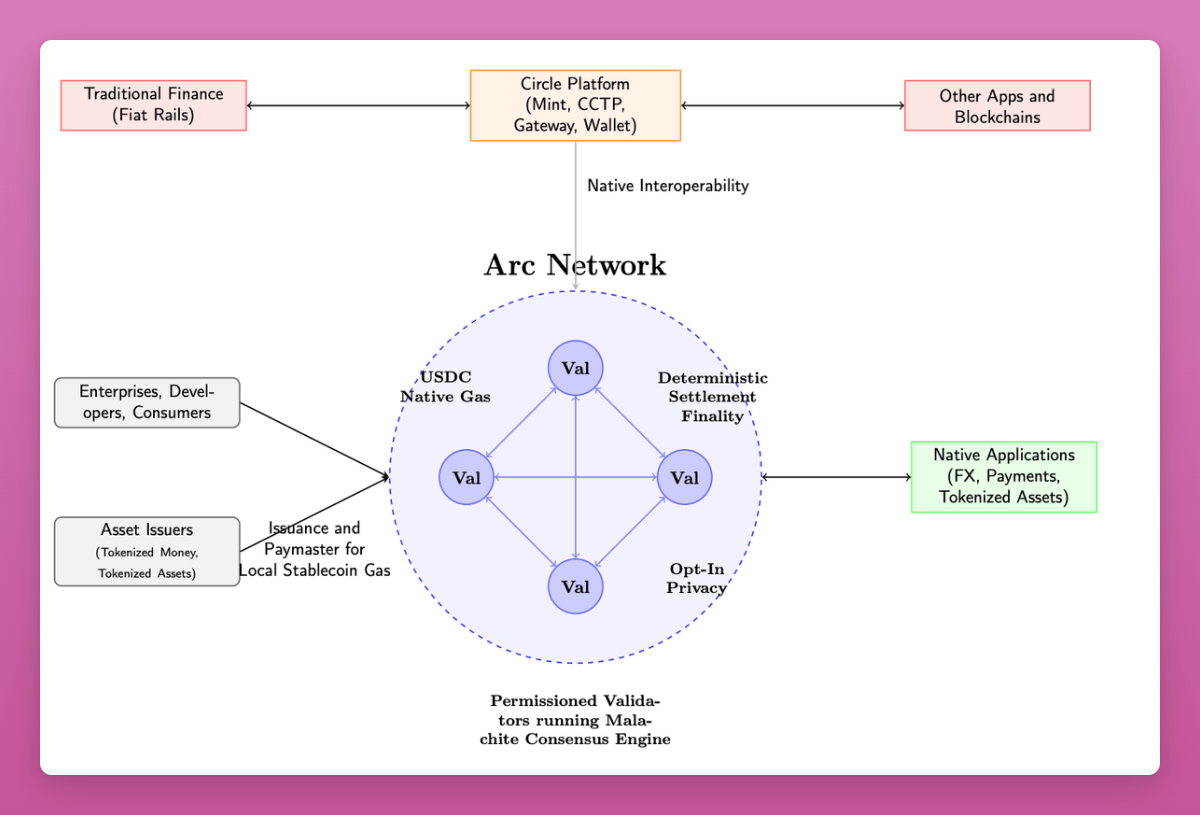
Compared to networks like Base, Ethereum, or Solana, Circle’s new chain offers multiple features friendly to financial institutions and payment providers.
Here’s the feature list from its whitepaper—not all will launch day one, but it clearly signals Circle’s strategic direction:
-
Pay transaction fees (Gas) in USDC
-
Validators operated by regulated entities
-
Higher throughput (3,000–10,000 TPS)
-
Optional privacy: payment amounts hidden; addresses visible but not publicly identifiable
-
Optional disclosure: regulators can access transaction data via “view keys”
-
Launch of USYC (Treasury-backed token): enabling on-chain collateral and margining
-
Bridging via Circle’s proprietary Gateway and CCTP: leveraging Circle’s existing support for USDC across many chains
-
Roadmap includes institutional-grade FX capabilities
-
Payment features: e.g., invoice attachments, on-chain refunds, and dispute resolution
This whitepaper reads more like a vision statement than a product spec, but it clearly outlines Circle’s intent and the industry’s trajectory.
My observations:
-
Many features target capital markets participants, such as collateral, margin, and regulators.
-
The language appeals heavily to risk management groups, using terms like “institutional-grade” and “consumer protection.”
-
Circle sacrifices issuance profits for distribution: they share most revenue with partners like Coinbase and Binance. New products could improve this.
-
But can Circle satisfy everyone? They have first-mover advantage and brand recognition, but do we need clearer functional specialization?
Rob Hadik of Dragonfly offers a pessimistic take:
To win now, Circle must either compete with Stripe in merchants or SMBs, or with Kinexys in enterprises—and win direct customer relationships? It’s hard to imagine how they pull that off.
—— Rob Hadik
(While Hadik invests in Circle’s competitors, his analysis is usually sharp.)
My view: the future of on-chain finance remains wide open. With its head start, Circle has every reason to aim big.
Winners will be few, and all players are wisely expanding their reach. Fortunately, we’ve moved past the phase of sacrificing infrastructure capable of supporting global scale for the sake of “decentralization theater.”
If you want decentralization, Bitcoin exists for that purpose.
If Every Company Builds Its Own Chain, Do We End Up Back Where We Started?
If every company builds its own chain, are we just recreating today’s reconciliation chaos with new tech?
No.
Tokenized value doesn’t depend on a single chain, but on scale and programmability.
Distribution is critical.
Circle gives up 80% of revenue for distribution. If Binance and Coinbase maintain dominance and successfully pivot to new revenue models, that makes sense. But others have their own distribution channels too.
Outcomes are rarely black and white.
Looking back at 2017 and 2021, I often felt the “another blockchain” fatigue. There were indeed many such cases (anyone remember EOS?).
But there was a time when Solana was just “another blockchain” too.
Innovation isn’t over. We’re facing one of the most revolutionary technological shifts in human history—the rise of AI.
Building Payment Infrastructure for the AI Explosion
With the rise of AI tools, subscription-based payments are being challenged.
-
High-frequency users break legacy models: Companies like Anthropic are imposing usage caps because a few heavy users generate massive costs, disrupting resource allocation.
-
Costs of AI tools are hard to track: Subscription pricing hides inference costs (GPU), cloud hosting, and model token usage. Tracking this is complex (companies like Lava Payments and Polar are tackling this).
-
Profitability crisis deepens: Many AI tools face huge losses; programming tools like Cursor and Windsurf reportedly operate at severe deficits.
AI model costs decrease over time, but cutting-edge models don’t. Subscriptions can’t cover heavy usage. To drive the AI revolution, we need more AI use—not less.
This means we must understand underlying transaction costs, but more importantly, we need an ultra-fast, ultra-low-cost, and programmable payment infrastructure.
AI will increase payment transaction volumes by an order of magnitude.
AI labs, VCs, and payment firms are preparing for a world where money moves faster than humans can comprehend. When AI agents pay each other for compute, tokens, and services, they’ll need a near-commodity payment system to support such high-frequency transactions.
The Ultimate Race for AI-Native Payments
Enter stablecoins.
Today, stablecoins often offer cost advantages in cross-border remittances, but domestically, traditional payments are usually faster, cheaper, or better. Most existing blockchains are designed for multiple use cases—and perform well accordingly.
The issue is that even Ethereum’s 15–30 TPS or Solana’s 3,000 TPS falls short of handling peak payment loads. If agent-to-agent payments become widespread, total payment volume (TPV) could grow 10x or even 100x.
These payment-focused blockchains are far more than “yet another blockchain”—they could become foundational to the market structure of AI-native payments.
The goal of AI-native financial infrastructure isn’t just maximal decentralization or speed, but building a system fast and decentralized enough to meet upcoming challenges. Believing this problem is already solved would be a grave mistake.
Interest in stablecoins is reaching fever pitch. Undoubtedly, like AI, we may be in a bubble phase short-term. But looking ahead, consider how infrastructure and partner ecosystems might evolve over the next 2–3 years.
-
Deposits will be tokenized: The traditional “off-ramp” becomes obsolete, as money will natively exist on-chain.
-
Stablecoin competitiveness will improve: Today’s limitations around speed and cost will fade.
-
Every digital bank, service provider, and traditional bank will integrate: Performance demands on stablecoins will rise sharply.
-
AI will require 10x to 100x more payment capacity: Today’s settlement infrastructure won’t suffice.
We need to build entirely new infrastructure for this new era.
That means, if you haven’t yet integrated stablecoins into your daily workflows,
or haven’t clearly mapped their role in your future roadmap,
if you still see stablecoins as speculative instruments, you’re missing the monetary value inherent in the OS upgrade itself.
Join TechFlow official community to stay tuned
Telegram:https://t.me/TechFlowDaily
X (Twitter):https://x.com/TechFlowPost
X (Twitter) EN:https://x.com/BlockFlow_News
 @sytaylor