The "1995 Moment" in the Crypto World: History Repeats, but the Script Has Changed
TechFlow Selected TechFlow Selected
The "1995 Moment" in the Crypto World: History Repeats, but the Script Has Changed
This transformation, unlike the 1990s internet revolution, is jointly driven by mainstream financial institutions and AI, making it more likely to give rise to open protocols rather than monopolistic platforms, marking an accelerated shift in technological paradigms.
 Navigating Web3 tides with focused insights
By Oliver, Mars Finance
We are at a moment of divergence in the crypto world. On one hand, there is unprecedented institutional enthusiasm: Wall Street giants like BlackRock and Fidelity are embracing Bitcoin with unparalleled vigor, their spot ETF products siphoning hundreds of billions of dollars in traditional capital like vacuum cleaners; sovereign wealth funds and national pension systems are quietly adding crypto assets to their massive portfolios. This wave makes the narrative of "crypto going mainstream" sound incredibly real.
On the other hand, for the general public, the crypto world has never felt more distant. Beyond extreme price volatility and stories of a few speculators, it has almost no presence in daily life. The once-booming NFT market has fallen silent, and Web3 games, once full of promise, have failed to break into the mainstream. This stark contrast creates a core contradiction: one side feasting at an elite financial banquet, the other observing from afar. How do we make sense of this disconnect?
It is against this backdrop that senior executives at Visa, including CEO Alfred F. Kelly Jr., have made a profound observation in multiple forums: cryptocurrency is at a stage analogous to "early 1990s e-commerce"—not yet fully understood by the masses, but with its underlying technology and ecosystem rapidly maturing, poised for a "super inflection point" in adoption. Research from institutions like Wells Fargo lends data support to this analogy. Their reports show that crypto's user adoption curve closely mirrors that of the internet in the early 1990s. Even though the internet was born in 1983, by 1995 less than 1% of the global population was using it—a figure strikingly similar to today’s crypto user penetration. History shows that disruptive technologies require a long, slow, and often confusing ramp-up phase before explosive growth.
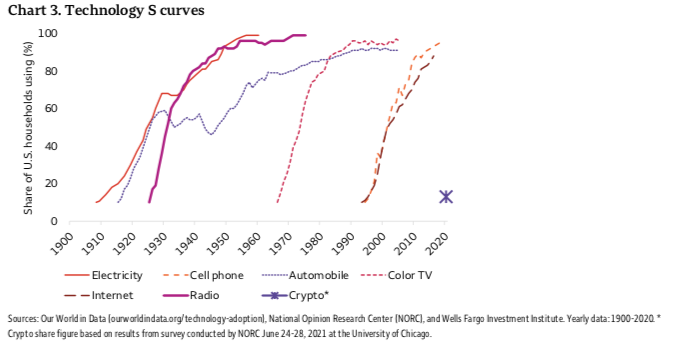
Yet this seemingly perfect analogy may obscure deeper truths. History does not simply repeat itself. Today’s crypto evolution is being fundamentally rewritten by two variables unimaginable back then—the entry of financial "mainstream forces" and the rise of artificial intelligence (AI). This is not mere repetition, but an accelerated and morphologically distinct evolution.
Old-world Giants, New-continent Pioneers
The e-commerce revolution of the 1990s was a classic "disruptor" story. Amazon, eBay, and PayPal were upstart newcomers rising from the fringes of mainstream commerce, challenging established titans like Walmart and Citibank with entirely new rules. It was a heroic era for garage entrepreneurs and venture capitalists, with the central theme being "disruption" and "replacement."
Today, the crypto narrative is markedly different. The most notable pioneers are no longer just hoodie-wearing cypherpunks, but also well-dressed financial "regulars" from Wall Street and Silicon Valley. They aren’t trying to destroy the old world, but rather to transplant the entire old world onto a new technological foundation. This "inside-out" transformation revealed its full breadth and depth in 2025.
BlackRock CEO Larry Fink’s vision of "tokenizing all assets" is accelerating into reality. Following the success of its spot Bitcoin ETF in 2024, BlackRock partnered with Securitize to launch BUIDL, its first tokenized fund on Ethereum—transforming shares of a traditional money market fund into tokens that can trade 24/7 on the blockchain. Meanwhile, the number of companies holding crypto as strategic reserves (known as DATCOs) has surged, with total crypto holdings on their balance sheets surpassing $100 billion for the first time in history.
An even more critical shift comes from changing U.S. government stance. After years of ambiguous or even hostile regulation, 2025 marked a decisive turning point. The U.S. government not only became a significant holder of Bitcoin (holding nearly 200,000 BTC via law enforcement seizures), but more importantly, began establishing clear "rules of the game." The July passage of the GENIUS Act created America’s first comprehensive federal regulatory framework for stablecoins, offering a compliance pathway for a market now exceeding $250 billion. Shortly after, an executive order allowing the $9 trillion U.S. retirement savings pool to invest in crypto and other alternative assets opened a massive new source of capital inflow. This top-down endorsement fundamentally altered the risk-reward calculus for institutional participation, making the foundation of this transformation exceptionally solid.
AI: A "New Species" Seeking Native Economic Soil
If the entry of financial giants has built a highway connecting the crypto world to the real economy, then the AI explosion is bringing the first true "native inhabitants" to this new continent.
The internet of 1995 solved the problem of connecting "people" with "information" and "people" with "goods." At its core, e-commerce digitized and moved human commercial activities online. The next era we are entering will be about how "AIs" economically collaborate with each other. As a new form of productivity, AI is creating digital content, code, designs, and even scientific discoveries at an unprecedented pace. These AI-generated values urgently need a matching, native economic system.
Cryptotechnology is perfectly suited for this role. Imagine a scenario: an AI design program autonomously creates a unique artwork. It can mint this work as an NFT (non-fungible token) via a smart contract, instantly securing verifiable, unique ownership. Then, another AI marketing agent discovers this NFT and autonomously decides to pay a tiny amount of cryptocurrency to promote it on social media. If an AI procurement agent from a clothing brand likes the design, it can directly interact with the NFT-holding smart contract, automatically paying a licensing fee to obtain permission to produce 1,000 T-shirts. The entire process requires no human intervention—value creation, ownership verification, transfer, and distribution—all completed instantly on-chain.
This is not science fiction. Ethereum co-founder Vitalik Buterin has noted that combining AI and crypto can solve each other’s core challenges: AI needs trustworthy rules and asset ownership, while crypto needs autonomous "users." This symbiotic relationship is already spawning new applications. For instance, decentralized computing networks like Akash Network allow AI developers to rent idle GPU power globally using cryptocurrency; on-chain AI models aim to build more transparent, censorship-resistant intelligent systems through token-based incentives.
The scale and speed of such AI-native economic activity could far exceed the sum of all human commercial activity. What it demands is a global, low-friction, programmable value settlement layer—the very essence of crypto’s value proposition, and a grand vision beyond what 1990s internet could achieve.
Are We Looking for the Next "Amazon" or the Next "TCP/IP"?
Faced with such transformation, investors and builders often ask: Who will be crypto’s "Amazon" or "Google"?
This question itself may be limited by historical precedent. Amazon’s success was built on the Web 2.0 platform economy model—a centralized company attracting massive users through superior services, ultimately achieving winner-takes-all network effects. Yet the core ethos of crypto lies in "protocols," not "platforms." Its goal is to create open, neutral, permissionless public infrastructure akin to TCP/IP, the foundational communication protocol of the internet.
Thus, the future winners may not be closed corporate empires, but open ecosystems or widely adopted base standards. We might see a Layer 2 network (like Arbitrum or Optimism) become the de facto hosting layer for most applications due to superior performance and developer ecosystem; or a cross-chain communication protocol (like LayerZero or Axelar) emerge as the "value router" connecting all blockchains; or a decentralized identity (DID) standard become the universal passport for every user entering the digital world.
The business models of these "protocol-layer" winners will differ sharply from Amazon’s. They won’t profit from high platform fees, but instead capture value from ecosystem growth through their native tokens. They resemble public utilities like city roads or water systems, not monopolistic supermarkets.
Of course, this doesn’t mean application-layer opportunities are absent. Great companies will still emerge atop these open protocols. But their key to success won’t be building closed moats, but rather leveraging open protocols to deliver unique user value.
Finally, returning to the quote: if you treat Visa’s CEO’s statement as a signal rather than a verdict, the more important question becomes "how do we turn signals into action?" For enterprises, it’s a comprehensive project spanning strategic alignment, compliance readiness, and product implementation; for individual and institutional investors, it means clearly distinguishing long-term vision from short-term volatility—neither blindly following nor passively avoiding—but seeking on-chain use cases that generate real economic value.
History gives us two things: a mirror, showing possible trajectories; and lessons, reminding us that ultimate winners are rarely the fastest speculators, but those who build durable, real demand and infrastructure capable of transcending cycles. Today’s crypto is writing both scripts simultaneously—the noisy short-term market drama and the slowly forming long-term infrastructure epic. If Visa’s assessment holds true, the next decade will be the critical period when the latter accelerates into the mainstream.
Join TechFlow official community to stay tuned
Telegram:https://t.me/TechFlowDaily
X (Twitter):https://x.com/TechFlowPost
X (Twitter) EN:https://x.com/BlockFlow_News