Hong Kong OTC Regulation's Three Evolutions: From "Crypto Shop Wild West" to Comprehensive Oversight
TechFlow Selected TechFlow Selected
Hong Kong OTC Regulation's Three Evolutions: From "Crypto Shop Wild West" to Comprehensive Oversight
In three years, Hong Kong's regulation has evolved from an OTC "vacuum zone" to full-chain oversight.
 Navigating Web3 tides with focused insights
By: BlockSec
In May 2025, Hong Kong police dismantled a virtual asset money laundering syndicate worth $15 million (approximately HK$117 million), with the criminal group primarily splitting and transferring funds through OTC channels located in Tsim Sha Tsui.
Earlier, in the high-profile JPEX case that shocked all of Hong Kong, the Commercial Crime Bureau (CCB) revealed that significant portions of illicit funds were exchanged and transferred via local OTC shops, making them a crucial link in the fraud chain.
In June 2025, the Hong Kong government released a public consultation document titled "Legislative Proposal to Regulate Dealing in Virtual Assets," proposing to bring all virtual asset dealing services—including OTC—under a unified licensing and regulatory framework. Although this proposal is still under consultation and has not yet become law, it outlines a clear roadmap for the next phase of Hong Kong's virtual asset regulation—from the initial licensing of VATPs, to the supervision of crypto shops, and ultimately to comprehensive coverage of VA Dealing services.
In one sentence: Over three years, Hong Kong’s regulation has evolved from an OTC "regulatory vacuum" to full-chain oversight.
Phase One (2023): VATP Regulation Introduced, OTC Becomes the "Loophole"
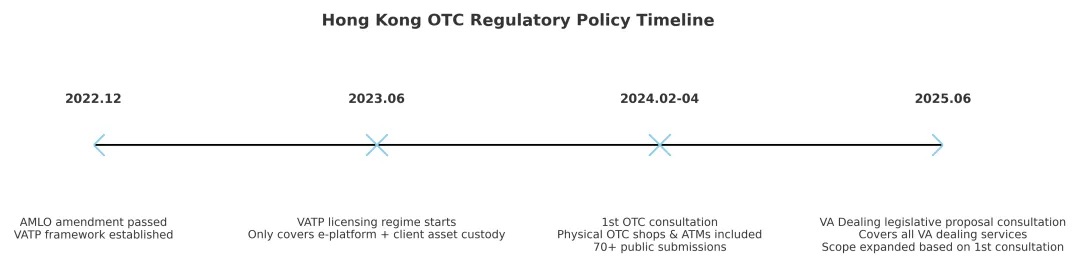
At the end of 2022, Hong Kong passed the Anti-Money Laundering and Counter-Terrorist Financing (Amendment) Ordinance, establishing a licensing regime for Virtual Asset Trading Platforms (VATPs) effective from June 2023, regulated by the Securities and Futures Commission (SFC).
VA Dealing Consultation Paper, 1.3: "In December 2022, ... a licensing regime for VA trading platforms ("VATPs") ... commenced operation in June 2023 ... must be licensed by the SFC unless otherwise permitted by the law." VADEALING_consultation_…
According to the definition of a VA exchange:
-
Facilitating virtual asset transactions between buyers and sellers through electronic systems;
-
Having access to customer assets (holding, controlling, or arranging custody)
Thus, the system at that time targeted only businesses involving "electronic platforms + access to customer assets." Physical crypto shops, counters, ATMs, and other OTC scenarios were not included, creating a regulatory gap.
Phase Two (2024): Customs Licensing Introduced – Crypto OTC Operators Now Require Licenses
From February to April 2024, the Financial Services and the Treasury Bureau (FSTB) launched the first round of consultation on the "Licensing Regime for Virtual Asset OTC Services," bringing physical OTC operations into regulatory scope for the first time.
Main points:
-
All individuals conducting spot trading of virtual assets (physical or online) in Hong Kong must hold a license;
-
Licensing responsibility assigned to Hong Kong Customs (CCE);
-
Covers fiat-to-crypto exchanges and transfers involving USDT, BTC, etc.;
VA Dealing Consultation Paper, 1.6(a)-(b): "Scope and coverage: Any person ... providing services of spot trade of any VAs ... would have to be licensed by the Commissioner of Customs and Excise ("CCE"). Eligibility: A licensee would be required to be a locally incorporated company ..."
Phase Three (2025): OTC Integrated into the VASP Ecosystem, Unified Oversight by SFC
In June 2025, Hong Kong released the second round of its "Legislative Proposal to Regulate Dealing in Virtual Assets," marking a dual upgrade in regulatory scope and depth:
-
Expanded scope: Includes complex services such as block trading, brokerage, settlement, exchange, and asset management;
-
Regulatory adjustment: Licensing handled by SFC, while HKMA supervises banking/SVF-related activities;
-
Guiding principle: Same business, same risk, same rules;
-
Exemptions: Issuers already authorized by HKMA for stablecoin issuance/redeeming solely in the primary market are exempted.
VA Dealing Consultation Paper, 1.10: "Under the proposed regime, any person ... providing the VA service of dealing in any VAs in Hong Kong is required to be licensed by or registered with the SFC... including conversion, brokerage, block trading..."
Reason for change: This round of proposals was developed based on over 70 written submissions received during the first consultation. The government stated in the document that feedback highlighted concerns about OTC's high-risk nature, cross-border money laundering vulnerabilities, and insufficient regulatory coverage. As a result, the original OTC-focused regulatory proposal was expanded into a broader "VA Dealing" framework.
VA Dealing Consultation Paper, 1.8: "Following the conclusion of the first round of consultation, we received over 70 written submissions from various stakeholders... We have refined our proposal to expand the scope to VA dealing services to better address AML/CFT risks."
Important note: The content of this phase is currently still under public consultation and has not been formally legislated; final details may be adjusted during the legislative process.
Drivers Behind Policy Evolution
The three-stage evolution of Hong Kong’s OTC regulatory policy did not occur in isolation but was driven by multiple converging factors, at least three core drivers:
Driver One: Frequent Major Cases Exposing Regulatory Gaps
In the May 2025 $15 million money laundering case, the suspects used OTC channels to split funds and bypass bank monitoring, completing multiple cross-border transfers rapidly. In the JPEX case, the Commercial Crime Bureau (CCB) found that many victims' defrauded funds were converted into cash or stablecoins via local OTC shops before being quickly moved to overseas wallets.
These cases exposed a key issue: even with tightened platform regulation, the anonymity and instant settlement features of offline OTC operations can still circumvent oversight, becoming a "last-mile" risk conduit.
Driver Two: International Regulatory Pressure and FATF Standards
Since updating Recommendation 15 in 2019, the Financial Action Task Force (FATF) has explicitly required jurisdictions to fully incorporate Virtual Asset Service Providers (VASPs) into anti-money laundering and counter-terrorist financing (AML/CFT) frameworks. While Hong Kong’s initial introduction of the VATP licensing regime met some FATF requirements, the exclusion of OTC services was repeatedly flagged by international evaluators and partners. To maintain its reputation as an international financial center, Hong Kong must close this gap and ensure that "same business, same risk, same rules" is effectively implemented.
If Hong Kong aims to become an international virtual asset hub, it must resolve AML/CFT risks.
Driver Three: Local Public Feedback Driving Policy Upgrades
During the first round of OTC consultation in 2024, the government received over 70 written submissions from banks, compliance firms, crypto enterprises, and law enforcement agencies. Most comments emphasized: high risks associated with anonymous OTC transactions; difficulties tracking cross-border fund flows; and the critical intermediary role played by OTC in fraud and money laundering cases.
In its 2025 "VA Dealing" legislative proposal, the government explicitly stated that based on this feedback, it expanded the original OTC-focused regulatory scope to cover the broader, end-to-end VA Dealing service chain.
VA Dealing Consultation Paper, 1.8: "Following the conclusion of the first round of consultation, we received over 70 written submissions from various stakeholders... We have refined our proposal to expand the scope to VA dealing services to better address AML/CFT risks."
Conclusion
OTC was once the "underground channel" of Hong Kong's cryptocurrency market, but now it is being brought into the light. From platform regulation in 2023, to crypto shop oversight in 2024, and the proposed 2025 end-to-end "VA Dealing" framework, Hong Kong’s virtual asset regulation is advancing toward systematization and international alignment. The latest chapter of this journey is currently open for public consultation, awaiting final legislative approval.
Join TechFlow official community to stay tuned
Telegram:https://t.me/TechFlowDaily
X (Twitter):https://x.com/TechFlowPost
X (Twitter) EN:https://x.com/BlockFlow_News
 @BlockSecTeam