From Telling a Good Story to Seeking Cash Flow: The Evolution of Speculation in the On-Chain Asset Market
TechFlow Selected TechFlow Selected
From Telling a Good Story to Seeking Cash Flow: The Evolution of Speculation in the On-Chain Asset Market
Institutional entry, speculation retreats, value rises.
 Navigating Web3 tides with focused insights
Author: Kyle
Compiled by: TechFlow
The term "Internet Capital Markets" carries multiple meanings. In today's context, it refers to an alchemical outcome entirely derived from the advantages of blockchain technology—a form of financial innovation that transcends geographical boundaries. From collateralized lending using "magic internet money," to tokenization of government bonds and private credit, to stablecoin applications—these are all seen as manifestations of "Internet Capital Markets" in today’s world where traditional finance intersects with digital assets.
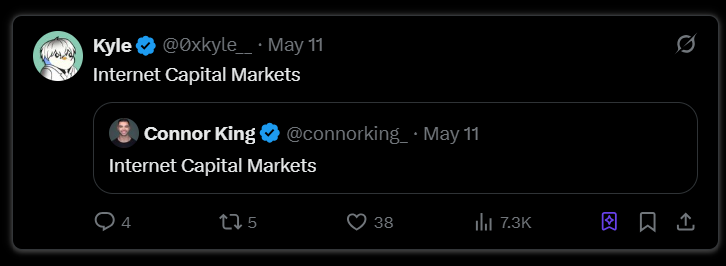
Original tweet link: Click here
However, for those of us who have been deeply involved in on-chain trading within this asset class over the past few years, "Internet Capital Markets" holds another meaning. It is not merely about "on-chain treasuries," but also encompasses NFTs, decentralized finance (DeFi), initial coin offerings (ICOs), and various speculative instruments, along with the token trading they generate. It all began with the deployment of the first smart contract on Ethereum in 2015, catalyzing countless innovations over the past decade.
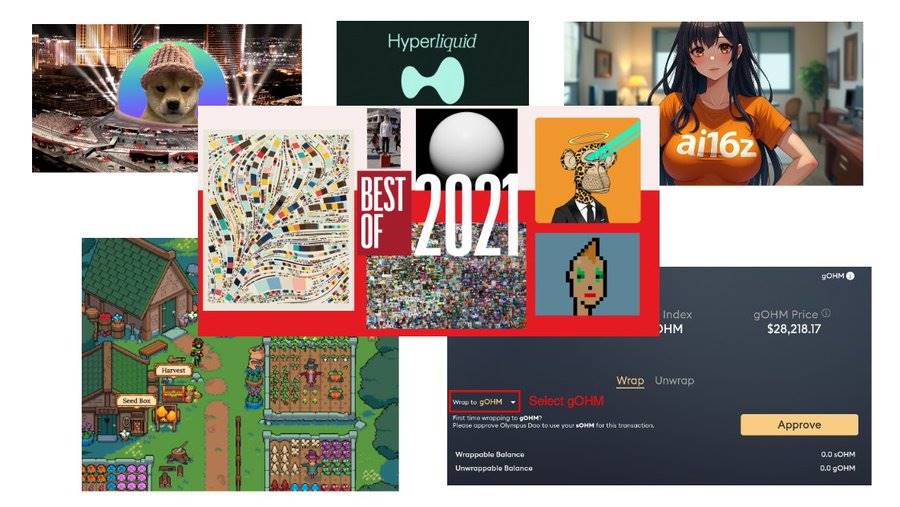
In this article, I want to dive deep into this side of Internet Capital Markets—focusing on tokens, narratives, 10x or even 100x returns, airdrops—mechanisms that formed the original core idea of Internet Capital Markets.
I believe we are on the brink of a new phase, which seasoned crypto players might call "a new meta." To explore this thoroughly, we must first examine these capital formation mechanisms and their resulting differences:
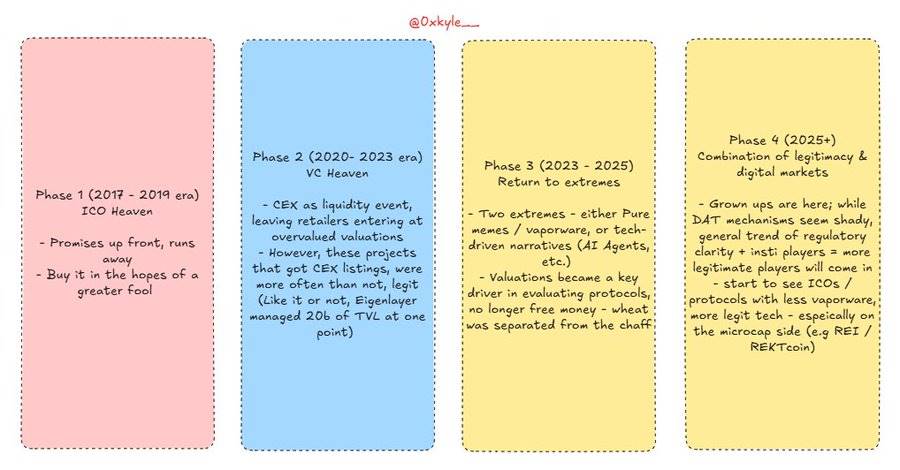
If the content appears too small, click the image to view details!
Over the past several cycles, we’ve witnessed constant shifts in market fundraising mechanisms—from Initial Coin Offerings (ICOs), to CEX alts on centralized exchanges, to meme-centric tokens. I’ve broken them down in the chart above, but in simple terms:
1. ICO Era (2017)
A mechanism based on promises, where investors hoped to find a "greater fool" to take over. Actual technological implementation was extremely rare; even when real tech existed, most projects struggled to achieve practical application or create real value.
Mostly, it resembled a game of "hot potato." Projects like Bitconnect and Dentacoin were classic examples of this period.
2. Venture Capital Paradise
The 2021 bubble brought massive institutional capital, which, in hindsight, severely damaged the industry. Sky-high valuations and poor incentive structures ("Who would work hard after receiving a $100M upfront payment?") led to recurring problems.
Yet, this wave also gave rise to more legitimate and mature products, so we can't completely dismiss the low-circulating-supply, high-FDV (fully diluted valuation) mainstream model. Despite their inflated valuations, these tokens helped launch and grow some of today’s most recognized protocols.
Take Ethena, for example—I really like it—but undeniably, the simple mechanism of “giving too much too early” weakened its ability to drive “token price appreciation” from the start. Still, there’s no doubt it’s one of the best products in crypto. This mirrors many other “double-edged sword” projects.
This era also birthed Solana, Uniswap, and many others. While operational controversies around these projects exist today, the fact remains: this era wasn’t entirely negative and shouldn’t be dismissed outright.
Could these issues have been avoided? Perhaps. But ultimately, these were growing pains—the aftermath of which we’re still feeling four years later.
3. Both Extremes—Back to the Edge
After the FTX collapse, the crypto space fell into an existential crisis, and the sentiment was palpable. Many began agreeing that "crypto is a scam," viewing most projects as mere get-rich-quick schemes. I once shared this view, but it's important to understand the nuances.
Although crypto has casino-like qualities, that doesn’t mean it’s purely a casino. Stablecoins and asset tokenization are proving significant real-world use cases beyond launching memecoins or serving as dollar pairs for long-tail assets.
In this era, incoming projects show clear divergence. On one hand are pure meme projects (like Dogwifhat, Pepe); on the other, more legitimate narratives such as AI agents. Even though valuations have dropped significantly, you might ask yourself, "Is it all just memes?" But just because something is labeled a meme doesn’t mean it will always remain one.
The space is undergoing a slow maturation process. Some projects have moved from meme entry points toward legitimacy—REI being one example.
Ultimately, the mindset that "everything is a meme" could be highly destructive in the coming years because:
4. Legitimacy Meets Digital Markets
We are entering a "mature era." Institutional capital has arrived and shown strong interest. Yet, perhaps because we’re too close to the "sausage factory"—knowing exactly how the "sausage is made"—it leads to confusing outcomes. For instance, crypto natives are bearish on Circle’s IPO because they know too well the underlying risks and negative bear-case theories.
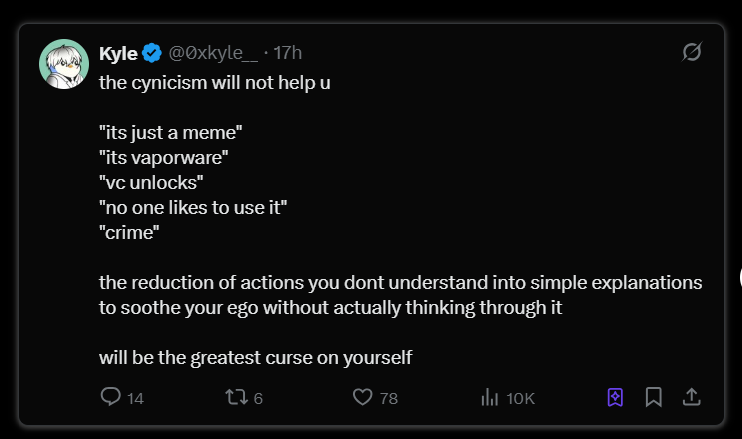
Original tweet link: Click here
Knowing too much can be a curse. That’s why the cynical “everything is a meme” mindset ends up being so destructive—it robs you of belief when you dismiss everything prematurely.
Take Ethereum, for example. It was once the worst-performing asset for two consecutive years, causing many large holders to exit. It was slapped with every negative label, making us genuinely believe decentralization had failed and Ethereum would never see a bright future again.
Now look at Ethereum today. Do you think Tom Lee knows—or cares—about that awkward video of Ethereum Foundation leaders dancing on stage? Do you think institutions like BlackRock—which have already launched tokenized funds on Ethereum—care about the so-called "weak mindset" of the Ethereum Foundation?
The answer is no. This is what we must internalize. Today, crypto seems to have forgotten how to dream, while traditional finance (Trad-Fi) is relearning how to chase dreams. As digital assets go mainstream and attract higher-quality developers, it will inevitably bring more opportunities.
This is what I mean by "Internet Capital Markets." We’re entering a phase of potential unseen in the past five years—a perfect convergence of regulation, technical strength, and capital. And part of this will inevitably move on-chain. Without exaggeration, I believe some of the most valuable companies in the coming years will choose to issue tokens on-chain.
In fact, this is already happening. Hyperliquid is the pinnacle of Internet Capital Markets. It accepted no venture capital (VC) funding—no equity structure, as far as I know—just a purely on-chain token, initially unlisted on any exchange.
Let me emphasize again: this is the true essence of Internet Capital Markets.
Hyperliquid is a $40 billion company with no business plan and no equity burden. It’s a pure on-chain giant that rose from nothing, dominated the market, and is now heading toward $1 billion in annualized revenue. This is the purest manifestation of how Internet Capital Markets operate.
But before you assume this is just a promotional piece for Hyperliquid, let me step back. I believe this isn’t just Hyperliquid’s story. In the coming years, we’ll see many more such cases.
Isn’t that exciting? We’re about to enter an era full of opportunity—don’t let cynicism destroy the dreams we once had. What saddens me most is that this is obvious to anyone truly observing the trend, yet we’re busy chasing 50% pumps on random altcoins because the past four years trained us to expect only that. It’s time to dream bigger—and the blueprint for success is already in front of us.
In a chance conversation, I discussed the following with @connorking_ (whom I’m lucky to call a close friend):
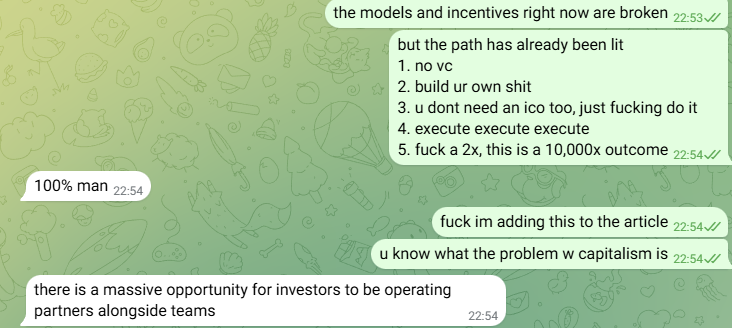
Massive opportunities are emerging: investors can fight alongside teams as operational partners.
The chains that once bound us are gone. For too long, people were constrained by traditional structures, but in the era of "Internet Capital Markets," owning 5%-10% of your own token and building a $100 million or $1 billion product can yield returns far beyond most expectations.
Yes, fundraising is still necessary; yes, doing an ICO isn’t wrong. But look again at Hyperliquid’s path—if you believe in your product, this is the direction worth emulating. Look at the founders’ wealth today: no VC dependency, just holding a large portion of their own product and listing it on the Internet Capital Market. The market, as the ultimate judge of truth, rewards those whose products it recognizes.
Do you know what’s wrong with capitalism? Most participants in capitalist markets are short-sighted. Capitalism can push innovation in the right direction, but not far enough. People often compromise for quick profits, when holding on for a few more years could yield vastly greater returns. This is the real power of compounding math.
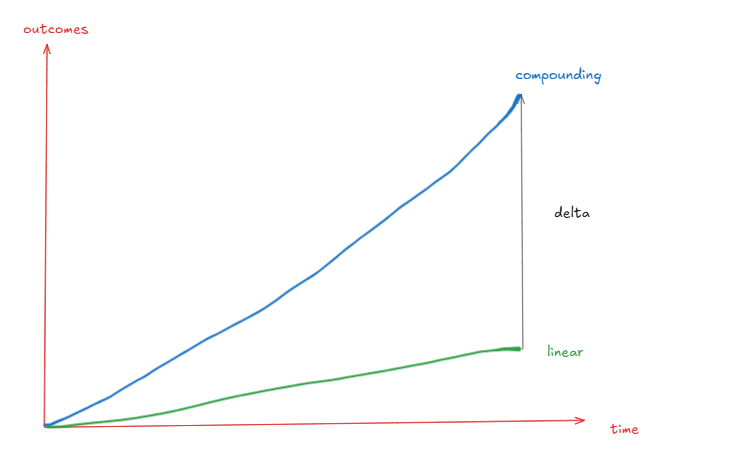
Long-term thinking typically leads to geometric rather than arithmetic results—for example, doubling in two years (2x), fivefold growth in four years (5x), tenfold in five years (10x).
Of course, you can make $10 million by quickly launching and abandoning a product, but if you’re willing to spend a few extra years refining it, you might earn $300 million.
Finally, I want to address market speculation. Undoubtedly, the market behaves more like a voting machine in the short term. We’ll still see price increases in “worthless” assets and “quality” assets priced far beyond fundamentals. Events like team dumps may still occur.
But the key point is: the coming wave of digitization will attract more truly exceptional founders into the arena—this shift, I believe, will drive the creation of many great on-chain products.
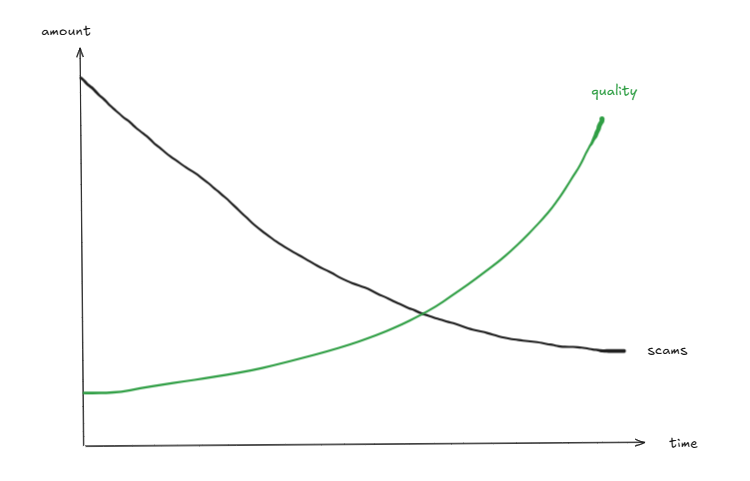
More S/A-tier founders involved = less attention on C-tier and below = less focus on “shit projects,” more emphasis on quality products capable of compounding growth.
Trends like the above will never go to zero—and don’t need to. Look at Hyperliquid, Ethena, Aave—$1B in annualized revenue, $10B in stablecoin TVL, $60B in net deposits. Look at Pengu and Rekt—197 trillion total views, 2 million toys sold globally, beverage brands on U.S. 7-11 shelves—all tokenized via blockchain.
Sure, we can debate whether they’re overvalued or undervalued. But I’d rather have these debates than return to an era where we could only invest in empty promises with zero tangible results. I’d rather own a piece of something real than pretend to play a game of "hot potato."

Another perspective—from @ImmutableSOL
If you insist every token is just a "meme," then this whole discussion becomes meaningless. Talented individuals like Hyperliquid’s Jeff issuing tokens is no longer science fiction. The next "Steve Jobs" might very well launch a token on-chain. Some of these assets will eventually become defining on-chain giants in future finance, and all of us have a chance to participate. Dismissing them simply as "just another meme project" might cause you to miss out on 1000x returns.
This is what I call the evolution of speculation. We’ve evolved from trading worthless vaporware to owning stakes in solid, enduring, and most importantly, on-chain assets—ones that will shape the world.
It’s time to believe. Believe in future possibilities, unburdened by the past. Break free from history’s chains and turn inner bearishness into ashes. The future is bright, friends. We must not let shadows of the past obscure our optimism for what lies ahead.
Ladies and gentlemen, in my view, this is what the future looks like: Internet. Capital. Markets.
Editor’s note on long-term outcomes:
Japan is renowned worldwide for its exceptional quality, but this didn’t happen overnight—it’s the result of decades of cultural, product, and lifestyle accumulation. If they had merely focused on “optimizing for profit,” they likely wouldn’t have reached today’s status. Because they maintained decades-long strategic visions, they now reap the rewards. The fruits of such long-term thinking can’t be fully measured in numbers—clean streets, cool vending machines—while not directly reflected in “GDP,” attract high-spending demographics and generate national income.
Join TechFlow official community to stay tuned
Telegram:https://t.me/TechFlowDaily
X (Twitter):https://x.com/TechFlowPost
X (Twitter) EN:https://x.com/BlockFlow_News
 @0xkyle__