Ancient whale's liquidation insights
TechFlow Selected TechFlow Selected
Ancient whale's liquidation insights
Ancient whales are cashing out, while institutions are gradually taking over.
 Navigating Web3 tides with focused insights
Author: Liu Jiaolian
The other day, Jiaolian mentioned that a so-called ancient whale from the Satoshi era had completed liquidating its 80,000 BTC. This event has been hailed by institutional trader Galaxy Digital as "one of the earliest and most significant exits in digital asset markets." What reflections and insights can we draw from this major exit event?
First, let's review the basic facts:
The BTC sold originated from accumulation in early 2011. In fact, this already belongs to the post-Satoshi era rather than the Satoshi era, as Satoshi had already withdrawn at that time.
The total amount sold was approximately 80,009 BTC, worth around $9 billion. The selling window spanned from July 16 to July 25, 2025.
The market impact of this sell-off was like a small splash. BTC price only dipped from a new high of $119k to $115k—a decline of just about 3.5%—and rebounded back to $118k the day after the liquidation ended.
What does this phenomenon signify?
It means the market absorbed roughly 0.4% of the total BTC supply within hours, without triggering any cascading liquidations or systemic collapse.
It appears the structure and resilience of the crypto market have quietly undergone a dramatic transformation. As some netizens put it, this is almost sending a strong signal to the market, proving that BTC now possesses extremely deep, institution-grade liquidity. This greatly enhances BTC's market resilience and absorption capacity.
Recall that just a year ago, from late June to early July 2024, the German government liquidated about 50,000 BTC (49,858 BTC), with an average selling price of $57.9k, realizing profits of approximately $2.88 billion.
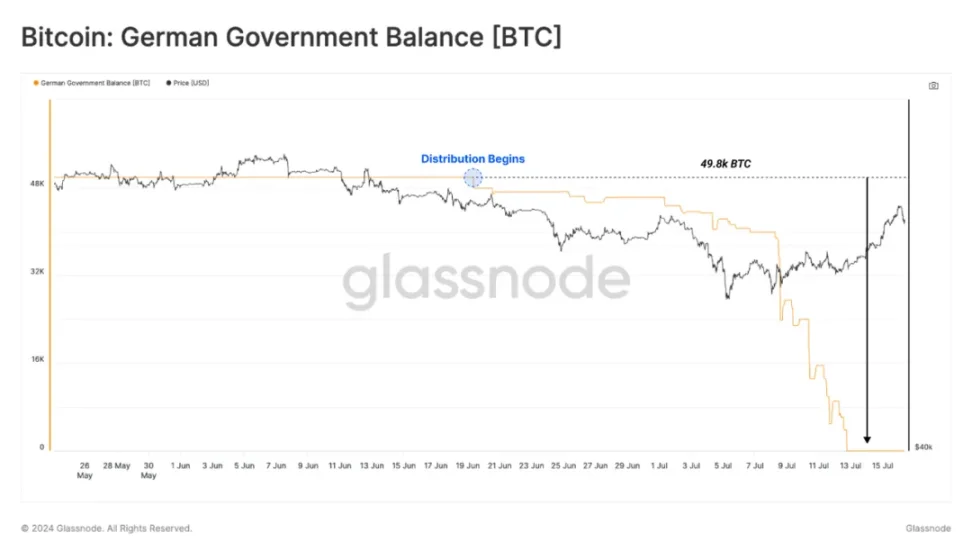
Notably, the German government’s liquidation occurred between June 19 and July 13, 2024—before Mt. Gox began distributing BTC repayments.
BTC dropped from $66k to a low of $53k during the German sell-off, nearly a 20% decline. Even when叠加 with the Mt. Gox distributions later, BTC only briefly touched $49k on August 5, 2024—the last low before BTC surged past $100k by year-end.
In contrast, BTC at $70k once required nearly a 20% drop to absorb 50,000 BTC in selling pressure, whereas BTC at $120k today needed only a 3.5% dip to absorb 80,000 BTC in selling. In other words, a $3 billion outflow once caused BTC to fall over 20%, while a $9 billion outflow now results in just a 3.5% dip, quickly recovering. How incredible!
Remember, the higher BTC’s price, the greater the selling pressure per coin. Selling one BTC at $70k requires $70k in market demand to absorb it; selling one BTC at $120k requires $120k.
Has BTC’s liquidity depth and absorption capacity really advanced so dramatically in just one year?
Another comparable classic case is the Luna/UST collapse in May 2022, when Do Kwon, the operator behind UST, was forced to dump 80,000 BTC into the market. According to the article "UST Depegs: The Algorithmic Stablecoin Curse Returns" published on May 11, 2022, in "Liu Jiaolian Pro": "On May 10, as UST severely depegged, student Do Kwon sold all assets except BTC but still couldn’t save it. Ultimately, he dumped over 80,000 BTC acquired earlier out of thin air to rescue UST."

This 80,000 BTC dump occurred right near the critical $30k level—the same level tested during the '512' crash in mid-2021—shattering hopes for a sustained bull rebound. A month later, BTC officially fell below the $30k bull-bear dividing line, marking the start of a deep bear market.
While we can't attribute the entire 2022 bear market decline—from $69k to $16k, nearly 77%—solely to the Luna/UST dump, even if we assign only the cliff-like drop from $30k to $20k between May and June 2022 to this event, that’s still a massive 33% fall.
This 80,000+ BTC dump was urgent; assuming an average price of $30k, it represented merely $2.4 billion in outflows.
From this, we can see how BTC market structure and liquidity absorption capacity have evolved in recent years:
In 2022 at $30k, 80,000 BTC sold, $2.4 billion outflow, accelerated entry into a deep bear.
In 2024 at $60k, 50,000 BTC sold, $2.8 billion outflow, followed by a bull rally by year-end, breaking $100k and reaching new historical highs.
In 2025 at $120k, 80,000 BTC sold, $9 billion outflow, market shrugged it off—so far, no major damage observed.
Of course, referencing the 2022 sell-off, internal damage might take over a month to surface, so it may still be too early to conclude definitively.
Judging from BTC balances on exchanges, this latest sell-off does appear to have been rapidly absorbed by buyers.

Netizens hold two views on this:
One believes that major holders who intended to sell have already done so, lightening the load, making future upward moves easier.
The other worries that long-term diamond hands are now selling, possibly signaling an impending wave of further sell-offs, or even a quiet shift in long-term conviction.
Either way, a new era for BTC may have quietly begun: ancient whales are handing over chips, and institutions are gradually taking over.
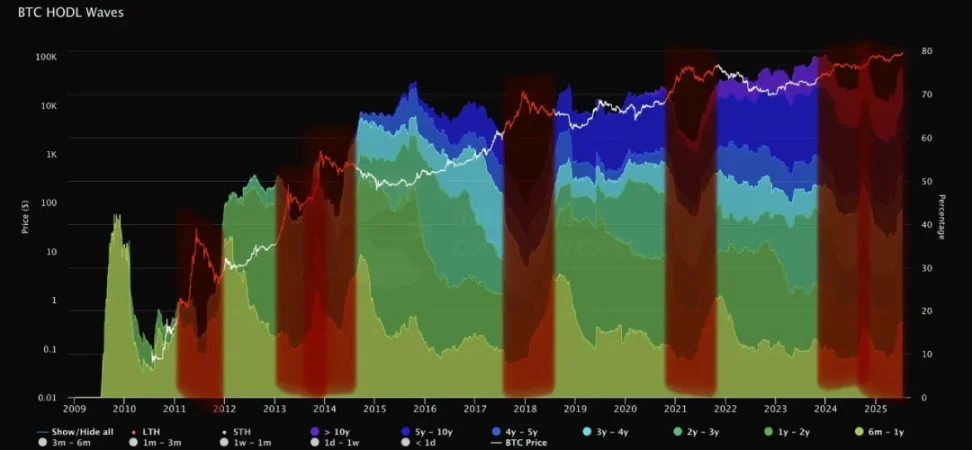
A new era needs fresh blood; a new phase requires new forces to lead. Only then can the younger generation push forward the tide, driving BTC forward relentlessly and endlessly.
Join TechFlow official community to stay tuned
Telegram:https://t.me/TechFlowDaily
X (Twitter):https://x.com/TechFlowPost
X (Twitter) EN:https://x.com/BlockFlow_News