








U.S. House Passes Three Crypto Bills, How Is the National Team's Bitcoin Staking Game Going?
TechFlow Selected TechFlow Selected
U.S. House Passes Three Crypto Bills, How Is the National Team's Bitcoin Staking Game Going?
Understanding the "national team's" crypto布局 might be a key step toward grasping the next wave of global financial trends!
 Navigating Web3 tides with focused insights
Author: Fairy, ChainCatcher
Editor: TB, ChainCatcher
Bitcoin is a hidden pawn in the new round of national competition.
This morning, the U.S. House of Representatives passed the GENIUS Act, the CLARITY Act, and the anti-CBDC surveillance nation bill one after another, officially kicking off an accelerated phase of cryptocurrency legislation.
When Bitcoin becomes national policy, sovereign states are no longer bystanders but participants, players, and even game-changers. As global monetary competition intensifies, understanding the "national teams'" crypto strategies may be a crucial step toward grasping the next wave of global financial trends.
This article provides an in-depth review of major countries' current Bitcoin holdings and policy developments, revealing the true landscape of this "national-level holding game."
⏰ Time-Saver Version|Overview of Countries' Bitcoin Holdings
Here’s the key data: the table below summarizes each country's Bitcoin holdings, sources, and policy stance—offering a quick look at the "national teams'" crypto asset map.
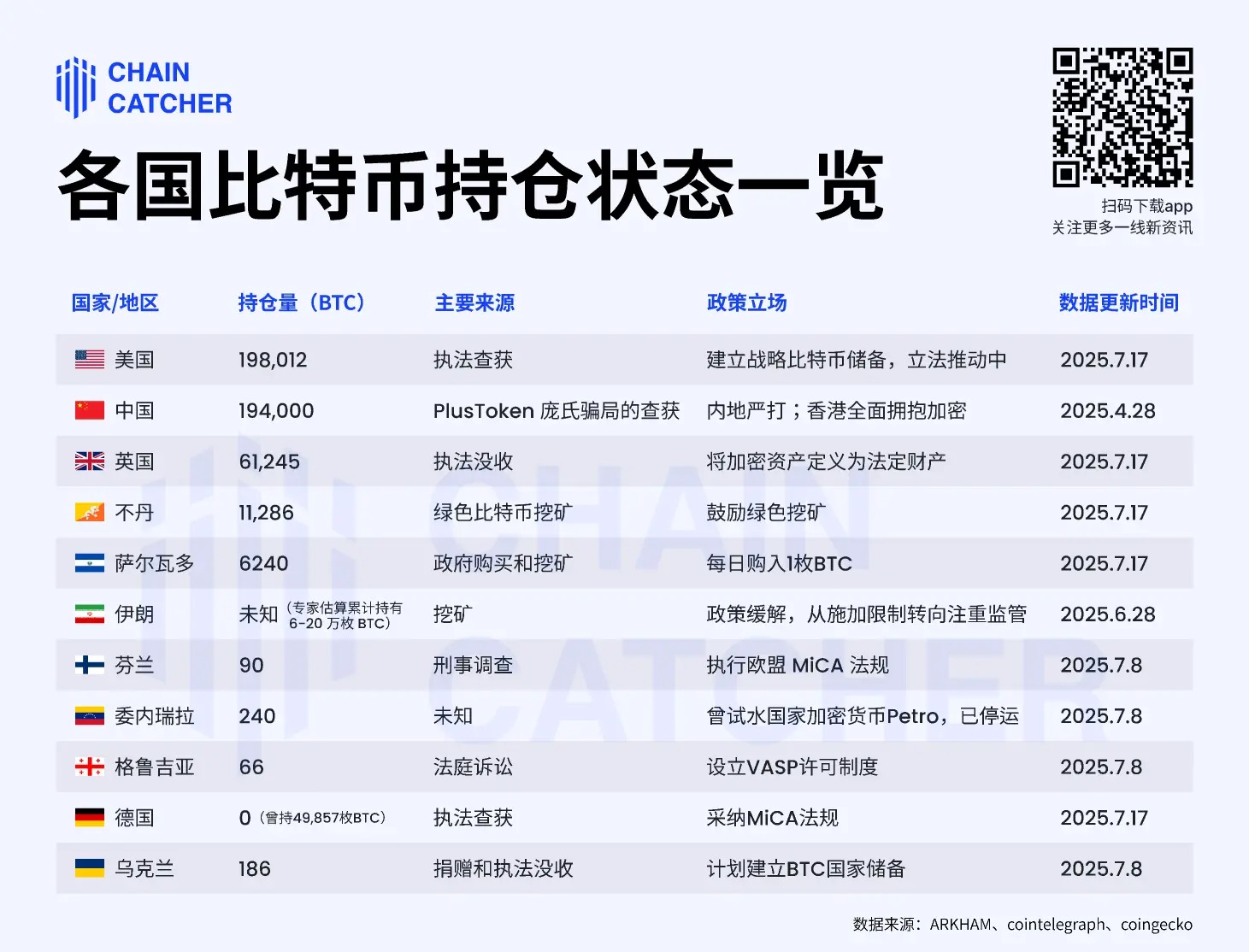
📝 Country-by-Country Breakdown|Who’s Accumulating? Who’s Selling?
United States
-
Holding amount: approximately 198,012 BTC
-
Main source: seized through law enforcement actions, including the Silk Road case and the Bitfinex hack
-
Strategic moves:
In March 2025, the Trump administration signed an executive order formally establishing a strategic Bitcoin reserve and digital asset reserve.
The current "Crypto Week" in the House sees three major crypto bills under concentrated review: the GENIUS Act, the CLARITY Act, and the anti-CBDC Act—targeting stablecoins, digital asset classification, and central bank digital currencies respectively.
All three bills have now been approved by the House. The CLARITY Act and the anti-CBDC Act will proceed to the Senate for deliberation, while the GENIUS Act is expected to be formally signed into law by Trump this Friday.
China
-
Holding amount: approximately 194,000 BTC
-
Main source: seizures from the 2019 PlusToken Ponzi scheme
-
Strategic moves:
In 2017, the People's Bank of China and six other ministries jointly issued a notice banning ICOs and cryptocurrency exchange operations; in September 2021, the central bank and nine other agencies jointly declared cryptocurrency trading as “illegal financial activity,” intensifying regulatory crackdowns.
Currently, local governments show signs of limited exploration into stablecoins: for example, Wuxi Municipal Party Committee discussed using stablecoins to empower foreign trade development; Shanghai SASAC held a study session on cryptocurrency and stablecoin trends and response strategies.
Meanwhile, Hong Kong maintains an open stance, fully embracing crypto. Hong Kong’s Stablecoin Ordinance will take effect in August, with over 50 companies in the region expressing interest in applying for stablecoin licenses.
United Kingdom
-
Holding amount: approximately 61,000 BTC
-
Main source: confiscated from money laundering and other criminal activities
-
Strategic moves:
In September 2024, the Digital Asset Property Bill was formally introduced, explicitly recognizing cryptocurrencies as legally protected personal property, providing clear judicial safeguards.
The UK Financial Conduct Authority (FCA) requires all virtual asset service providers to register and fully comply with anti-money laundering (AML) and counter-terrorist financing (CFT) regulations.
Bhutan
-
Holding amount: approximately 11,286 BTC
-
Main source: green Bitcoin mining powered by hydropower resources
-
Strategic moves:
In 2019, the Royal Monetary Authority of Bhutan launched the "Cryptocurrency Mining Regulatory Sandbox Framework," creating regulated conditions for mining. The government quietly established Bitcoin mining facilities, leveraging abundant hydropower to mine BTC, managed through its sovereign wealth fund, Druk Holding & Investments (DHI).
Previously, Bhutan held 12,574 Bitcoins from mining, equivalent to about 30%-40% of its GDP. However, Bhutan has also been intermittently selling—recently transferring 749.3 BTC to Binance over the past half-month, and currently holds 11,286 BTC.
El Salvador
-
Holding amount: approximately 6,240 BTC
-
Main source: government purchases and mining
-
Strategic moves:
In 2021, El Salvador became the first country to adopt Bitcoin as legal tender. It required all goods in the country to be priced in Bitcoin; all businesses to accept Bitcoin payments; exempted Bitcoin transactions from capital gains tax; and allowed taxes to be paid in cryptocurrency.
In early 2025, due to pressure from the International Monetary Fund (IMF), El Salvador adjusted its policy: Bitcoin no longer holds mandatory circulation status, shifting to “voluntary acceptance”; tax payments also no longer accept cryptocurrency settlements.
Currently, Bitcoin remains a key component of the country’s economic strategy, maintaining its policy of purchasing 1 BTC per day.
Iran
-
Holding amount: unknown, experts estimate cumulative holdings between 60,000 and 200,000 BTC
-
Main source: domestic mining
-
Strategic moves:
In 2019, the government officially legalized Bitcoin mining and required miners to sell part of their mined BTC to the central bank. According to Andrew Scott Easton, founder of Mastermined, Iran has mined over 60,000 BTC to date; Kent Halliburton, founder of Sazmining, estimates cumulative holdings could reach 100,000–200,000 BTC.
In December 2024, Iran shifted its stance on digital currencies—from imposing restrictions to focusing on regulation. Iranian Minister of Economic Affairs and Finance, Abdolnaser Hemmati, emphasized the government’s plan to mitigate economic risks posed by digital currencies while harnessing their potential benefits.
Finland
-
Holding amount: approximately 90 BTC
-
Main source: seized during criminal cases, particularly a major 2016 drug bust
-
Strategic moves:
Finland once held 1,981 BTC, mostly seized by Finnish Customs during criminal investigations. In 2022, the government decided to sell 1,890 of these BTC and donate the proceeds—amounting to “tens of millions of euros”—as humanitarian aid to Ukraine.
Since 2018, Finland’s Financial Supervisory Authority (FIN-FSA) has brought the crypto industry under the regulatory framework of the Virtual Currency Providers Act, requiring all exchanges, custodians, and wallet providers to register and comply with KYC/AML obligations.
Starting in 2025, Finland fully implements the EU’s MiCA regulations, covering stablecoins, DeFi, and crypto asset service providers, further aligning its regulatory framework with the EU.
Georgia
-
Holding amount: approximately 66 BTC
-
Main source: court litigation
-
Strategic moves:
In 2022, Georgia passed a revised financial regulatory framework, bringing digital asset trading and related activities under supervision.
Since 2023, Georgia has implemented the "Virtual Asset Service Provider (VASP) Registration Law," requiring crypto-related companies to register with the National Bank and obtain licenses, complying with FATF standards on AML and CFT.
Venezuela
-
Holding amount: approximately 240 BTC
-
Main source: unknown
-
Strategic moves:
Venezuela was among the earliest countries globally to incorporate crypto assets into its national governance toolkit. In 2018, the government issued the "Constitutional Decree on Cryptographic Assets and Related Activities," covering mining, trading, custody, platform operations, and asset issuance, and established SUNACRIP as the dedicated regulator.
In the same year, it launched the national sovereign digital currency Petro (PTR), claimed to be backed by oil and mineral resources and built on the DASH blockchain, but it consistently lacked transparency and market trust. In 2023, a $3 billion corruption scandal involving SUNACRIP led to the complete collapse of the regulatory system, and Petro was officially discontinued in 2024.
Facing persistent inflation, more Venezuelans are turning to stablecoins for protection. By December 2024, experts noted that stablecoin transactions accounted for nearly half of Venezuela’s total cryptocurrency transaction volume.
Ukraine
-
Holding amount: approximately 186 BTC
-
Main source: global donations during wartime, law enforcement seizures
-
Strategic moves:
Since the outbreak of the Russia-Ukraine war in 2022, Ukraine became the first country to widely adopt Bitcoin out of wartime necessity rather than ideological motivation. With traditional financial channels blocked, Ukraine quickly transformed cryptocurrencies into cross-border "digital military funding."
In March 2022 alone, Ukraine raised over $100 million in cryptocurrency donations through online platforms, briefly holding up to 46,351 BTC. These funds were rapidly deployed toward military equipment procurement, humanitarian aid, infrastructure repair, and wartime logistics.
In May 2025, Ukraine is developing a legal framework to hold Bitcoin in its national reserves, with a special parliamentary committee led by finance officials finalizing the legislative draft.
Germany
-
Holding amount: approximately 0 BTC
-
Main source: seized from the illegal movie piracy website Movie2k.to, totaling 49,857 BTC
-
Strategic moves:
In January 2024, the German government seized 49,857 BTC from the illegal movie piracy website Movie2k.to through law enforcement action. Just six months later, Germany chose to sell the entire batch.
In 2021, Germany passed new legislation allowing around 4,000 existing institutional investment funds to invest in crypto assets, enabling fund managers to allocate up to 20% of their portfolios to digital assets. In December 2024, Germany fully adopted the EU’s Markets in Crypto-Assets Regulation (MiCA), regulating stablecoins, ICOs, and DeFi to ensure market transparency and consumer protection.
Join TechFlow official community to stay tuned
Telegram:https://t.me/TechFlowDaily
X (Twitter):https://x.com/TechFlowPost
X (Twitter) EN:https://x.com/BlockFlow_News
 ChainCatcher 链捕手


