








Gold as a shield when the market falls, Bitcoin as a spear when it rebounds
TechFlow Selected TechFlow Selected
Gold as a shield when the market falls, Bitcoin as a spear when it rebounds
If history is any guide, you should hold gold during market pullbacks and bitcoin during market recoveries.
 Navigating Web3 tides with focused insights
Authors: Juan Leon, Mallika Kolar
Translation: AididiaoJP
The ongoing depreciation of the U.S. dollar has led many investors to ponder whether they should allocate to gold or Bitcoin. Historical experience suggests they might want both.
Ray Dalio, founder of Bridgewater Associates and one of the most influential figures in hedge fund history, recently made headlines by suggesting investors allocate 15% of their portfolios to gold and Bitcoin.
Why? Soaring federal debt and persistent deficit spending signal continued dollar weakness. This environment makes it more important than ever to hold assets that enhance portfolio resilience and protect against loss of purchasing power.
This naturally caught our attention. So we decided to stress-test Dalio’s recommendation. We analyzed major market downturns over the past decade, examining a traditional 60/40 portfolio (60% stocks, 40% bonds) and several variations—each allocating 15% to either Bitcoin, gold, or both.
The results were striking: in every case, combining gold and Bitcoin outperformed holding either asset alone, emerging as one of the strongest complements to a traditional 60/40 portfolio.
"Cushion" and "Spring"
If you examine every major stock market decline over the past decade—the 2018 sell-off, the 2020 pandemic crash, the 2022 bear market, and the 2025 tariff war—gold consistently provided an effective buffer during market corrections.
In 2018, escalating U.S.-China trade tensions, concerns about global slowdown, and the Fed's hawkish monetary policy caused equities to plunge 19.34%. Bitcoin also dropped sharply, falling 40.29%. In contrast, gold rose 5.76%.
In 2020, the pandemic brought the global economy to a standstill, sending equities down 33.79%. Bitcoin fell again, declining 38.10%. Gold also declined, but only by 3.63%.
The 2022 market downturn was driven by multiple factors, including runaway inflation, aggressive Fed rate hikes, and lingering pandemic-related supply chain disruptions. Markets reacted violently, with equities dropping 24.18%. Bitcoin fared even worse, tumbling 59.87% amid the unique complexities surrounding FTX’s collapse. Gold clearly outperformed both, declining only 8.95%.
In 2025, when markets corrected due to President Trump’s announcement of new tariffs and escalating trade wars, a similar pattern reemerged. Equities fell 16.66%, Bitcoin dropped 24.39%, while gold rose 5.97%.
So should you just hold gold and abandon Bitcoin? Not so fast. See what happens during market recoveries:
After bottoming at the end of 2018, equities rose 39.89% over the following year. Gold gained 18.14%, while Bitcoin surged 78.99%.
In 2020, after massive government stimulus calmed pandemic-driven panic, equities rebounded 77.80%, and gold climbed 111.92%. But Bitcoin exploded, rallying 774.94%.
In 2023, as inflation cooled and expectations grew for a Fed pivot to rate cuts, equities rose 22.82%, gold climbed 17.53%, and Bitcoin gained nearly 40.16%.
Since recovering from the 2025 tariff scare, equities have risen 38.65%, and gold has jumped 44.79%. Bitcoin currently lags behind, up only 14.04%; however, the one-year recovery period won’t conclude until April 2026, leaving months for Bitcoin to reclaim its lead.
What’s the key takeaway? If history is any guide, you want gold during market downturns—and Bitcoin during recoveries.
Examining the Full Cycle
Looking at these numbers, it’s easy to think the answer is obvious: simply hold gold going into a downturn, then precisely switch to Bitcoin the moment the market hits bottom. But of course, that’s impossible. In fact, if you truly knew a downturn was coming, the best move would be to exit the market entirely and sell everything—including stocks.
A more practical approach is to evaluate performance across full market cycles. And here, the data is conclusive: historically, adding both gold and Bitcoin provides the optimal balance between cushioning drawdowns and enhancing upside returns during recoveries. Statistically speaking, a portfolio including both gold and Bitcoin delivers a Sharpe ratio of 0.679—nearly three times that of the traditional portfolio’s 0.237, and significantly higher than the 0.436 of a portfolio with gold alone (but no Bitcoin). While a portfolio with Bitcoin alone (no gold) has the highest Sharpe ratio (0.875), it also exhibits significantly higher volatility than the gold/Bitcoin combination.
Portfolio Performance with Gold, Bitcoin, and Both
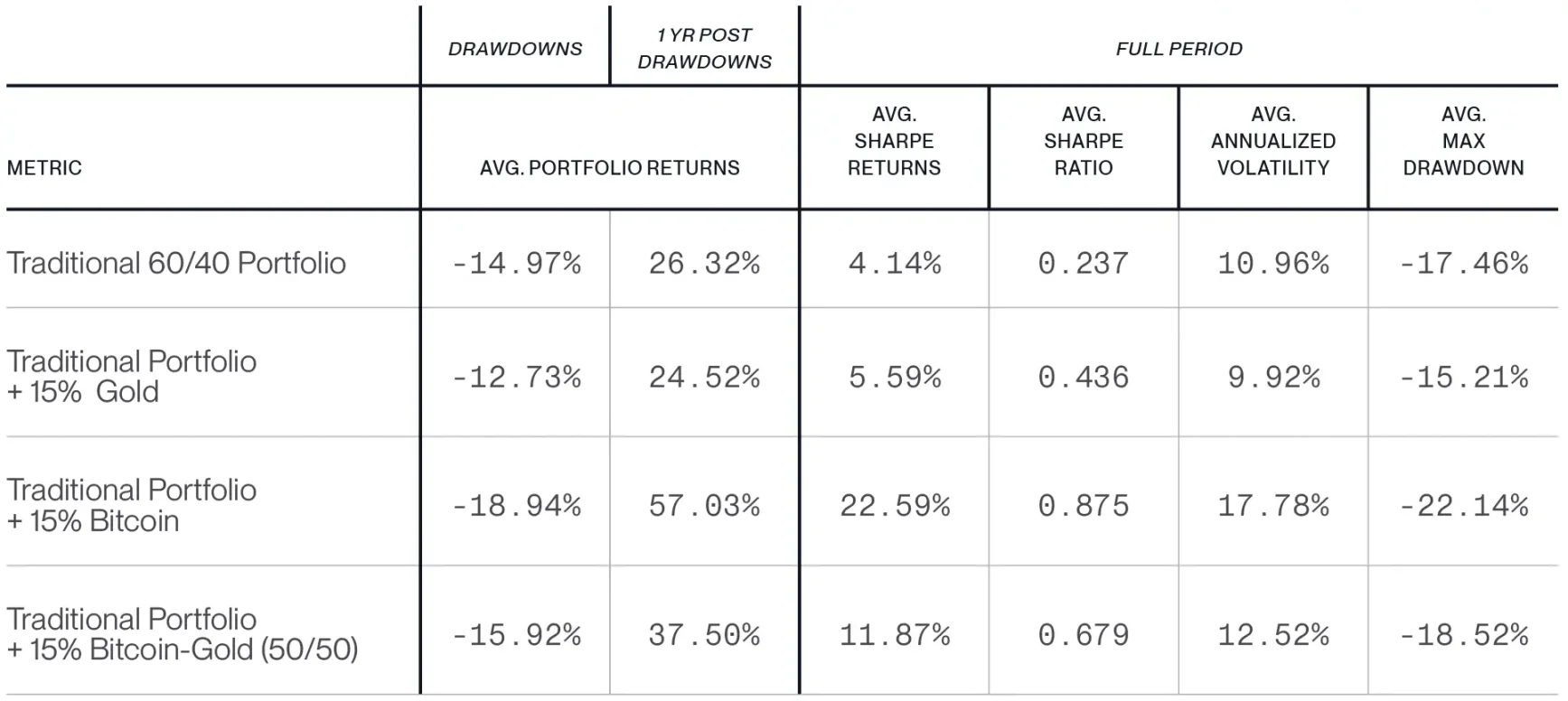
Source: Bitwise Asset Management, data from Bloomberg. Note: The reported “One Year After Downturn” and “Full Cycle” metrics include complete 12-month periods following the 2018, 2020, and 2022 downturns. These metrics do not include the post-2025 downturn cycle.
By holding both assets throughout the cycle, portfolios benefit from gold’s defensive strength during downturns and Bitcoin’s offensive potential during rebounds. The gold versus Bitcoin debate is often framed as an either/or choice. As the data shows, historically, the best answer is “both.”
Join TechFlow official community to stay tuned
Telegram:https://t.me/TechFlowDaily
X (Twitter):https://x.com/TechFlowPost
X (Twitter) EN:https://x.com/BlockFlow_News
 @BitwiseInvest


