








Understanding "Exit Test": The Final Mile to Decentralization Without Relying on Others
TechFlow Selected TechFlow Selected
Understanding "Exit Test": The Final Mile to Decentralization Without Relying on Others
If the project team disbands or the platform becomes unreachable, can users still securely withdraw assets and complete interactions?
 Navigating Web3 tides with focused insights
Written by: imToken
Earlier this month at EthCC in France, Vitalik Buterin presented a seemingly alarmist warning: "If Ethereum fails to achieve true decentralization, its future will face an existential crisis."
To address this, he proposed three key tests to evaluate whether a protocol possesses sustainable decentralization: the Walk-Away Test, the Insider Attack Test, and the Trusted Base Test.
Among these, the "Walk-Away Test" is the most fundamental and critical component—it directly addresses a core question: if the project team disbands or the platform goes offline, can users still securely withdraw their assets and perform on-chain interactions?
01 What Is the "Walk-Away Test"
In simple terms, the Walk-Away Test examines whether a project allows users to independently exit, withdraw assets, and interact on-chain even if the development team completely disappears.
From this perspective, it functions as a safety net—not focused on day-to-day functionality, but rather testing whether a protocol is truly trustless under the most extreme conditions.
As early as 2022, Vitalik criticized the "training wheels" architecture used by most rollups in a blog post, pointing out their reliance on centralized operations and manual interventions for security. Regular users of L2Beat are likely very familiar with this issue—the site prominently displays a key metric on its homepage: Stage.
This framework classifies rollups into three stages of decentralization: "Stage 0," which relies entirely on centralized control; "Stage 1," which has limited dependency; and "Stage 2," which is fully decentralized. This reflects the degree to which a rollup depends on human-managed "training wheels."

🔺 Image source: L2Beat
One of the most important indicators in evaluating the Stage level is whether users can independently withdraw funds without cooperation from the operator.
This question may seem simple, but it's actually a potentially fatal flaw.
For example, while mainstream rollups today often include "escape hatches" or similar mechanisms, many projects still retain "upgradable contracts" or even "super administrator" privileges. Though intended for emergencies, these features can become potential risk vectors.
A team could use multi-sig control to change logic contract addresses—despite claims of immutability. As long as backdoors exist, malicious logic injected during an upgrade could legally transfer user funds.
This means that if user funds are frozen, recovery would be nearly impossible without the project team. A true Walk-Away Test demands the complete elimination of such dependencies and intervention pathways, ensuring users can always operate independently and maintain full control—even if the core team vanishes or the platform shuts down unexpectedly, users must retain full sovereignty over their assets, free from lock-in or third-party seizure.
In short, the Walk-Away Test is the litmus test for whether a protocol is genuinely decentralized. It’s not just about censorship resistance—it’s about whether users retain asset sovereignty in worst-case scenarios.
02 The End Goal of Decentralization Is "Exit Capability"
Why are BTC and ETH the top choices for new individual and institutional entrants?
Because Bitcoin and Ethereum can continue operating perfectly even without Satoshi Nakamoto or Vitalik. Objectively speaking, for new users or institutions entering Web3, the most crucial decision factor is simply: "Can I take my money out whenever I want?"
The Walk-Away Test provides the direct answer. It represents the final mile of blockchain decentralization—the practical verification of the principle "Not your keys, not your coins."
If users must rely on a specific frontend interface or development team to withdraw assets or interact, then it remains a centralized custodial relationship in essence. In contrast, protocols that pass the Walk-Away Test allow users to independently perform all operations using on-chain tools and third-party frontends—even if every node goes offline and every operator abandons the project.
This is more than a technical concern—it's a commitment to the core ideals of Web3.
That’s why Vitalik has repeatedly emphasized that many DeFi or L2 projects that appear decentralized actually contain centralized backdoors: upgrade mechanisms, hidden logic, freeze capabilities. If abused, these features leave user assets entirely at the mercy of others.
The Walk-Away Test identifies and demands the removal of such mechanisms. Only when a user’s exit path requires no reliance on any party can the protocol be truly trusted.
03 The "Walk-Away Test": A Turning Point Toward Real Decentralization
Moreover, when viewed from another angle, the "Walk-Away Test"—while serving as a core evaluation standard for Ethereum and especially rollup security—has already seen broad implementation across other areas of Web3:
Take wallets, for instance. As the primary tool for asset management, they must offer high levels of security and transparency—including factors like randomness in seed phrase and private key generation (true random number generators) and open-source firmware. Nearly all major Web3 wallets allow users to export private keys or seed phrases, enabling seamless migration of assets to any other wallet software or hardware device.
This is, in fact, a natural form of "exit design": users don't need to trust the wallet company itself to maintain permanent control over their funds. It transforms users from mere "users" of Web3 products into true "owners" of their digital assets.
From this perspective, the three core tests proposed by Vitalik form a complete, self-contained framework:
-
Walk-Away Test: Ensures users can自救 (self-rescue) after a project ceases operations.
-
Insider Attack Test: Assesses whether the system can resist malicious behavior or collusion from internal developers.
-
Trusted Base Test: Evaluates how minimal and auditable the amount of code users must trust actually is.
Together, these three tests constitute the foundational decentralization framework necessary for Ethereum’s long-term sustainability—fully embodying the principle of "Don’t Trust, Verify."
At its core, the "trustless trust" of the Web3 world stems from verifiability. Only through transparent mathematics and algorithms can users continuously "Verify" the system and feel confident—without worrying about external factors like the moral integrity of the project team.
🔺 Image source: CoinDesk
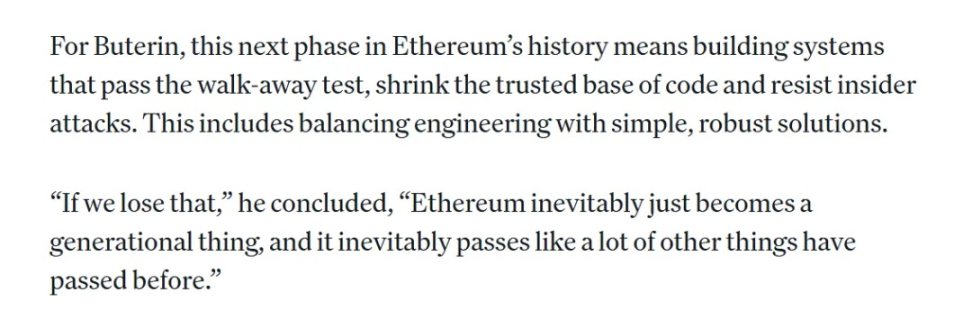
As Vitalik said at the end:
"If we fail to achieve this, Ethereum will ultimately become nothing more than a memory of a generation—a once-brilliant phenomenon that faded into obscurity, forgotten by history."
Join TechFlow official community to stay tuned
Telegram:https://t.me/TechFlowDaily
X (Twitter):https://x.com/TechFlowPost
X (Twitter) EN:https://x.com/BlockFlow_News
 @imTokenOfficial






