Why is the tokenization of U.S. stocks considered the beginning of blockchain devouring the world?
TechFlow Selected TechFlow Selected
Why is the tokenization of U.S. stocks considered the beginning of blockchain devouring the world?
Over a decade since the birth of blockchain technology, we are finally witnessing the beginning of "blockchain eating the world."
 Navigating Web3 tides with focused insights
By: Blockchain Knight
In 2011, Marc Andreessen, founder of a16z, published an article titled "Why Software Is Eating the World" in The Wall Street Journal, arguing that software was transforming the world at an unprecedented speed and scale.
Over the past decade, we've witnessed the rapid rise of the internet, spawning numerous companies with market capitalizations exceeding hundreds of billions of dollars. Even today, that statement remains relevant—AI is now reshaping the world in new ways, with some even suggesting that AI is eating software. Yet, it all seems to have started in 2011, the year when widely used platforms like Weibo and WeChat experienced explosive growth.
Now, more than a decade after the birth of blockchain technology, we are finally witnessing the beginning of "blockchain eating the world"—and this beginning is marked by the tokenization of U.S. stocks.
While stock tokenization is not entirely new—even defunct FTX had partially implemented it—the current wave is different. The players entering now are no longer just crypto-native firms, but established internet giants like Robinhood.
Last week, Robinhood announced the launch of its stock token trading service in Europe on the Arbitrum network, tokenizing shares of private companies including OpenAI and SpaceX. The news sent shockwaves through the financial industry and propelled Robinhood's stock price to a record high.
The total market cap of the current cryptocurrency market is approximately $3.4 trillion, while the global stock market stands at around $135 trillion—nearly 40 times larger.
Put another way, the ultimate ceiling for stock tokenization could reach $135 trillion, and as that market continues to grow, so too will the potential ceiling.
Currently, however, the market share may be less than 0.1%. It won't be until it surpasses 3% that the industry can truly be said to have entered explosive growth.
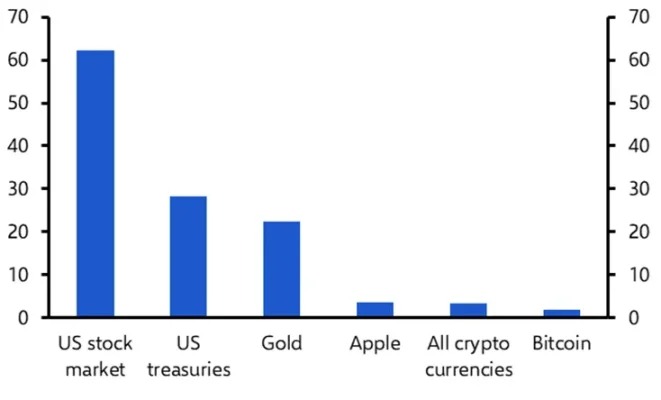
This future is precisely what these emerging trading platforms are targeting—and where blockchain’s real growth potential lies.
If this logic holds and is realized, the impact of blockchain and cryptocurrencies could rival that of "software eating the world."
It's foreseeable that the next 1-2 years will be a period of explosive, unregulated growth in this space, attracting more entrants and forcing traditional financial institutions (TradFi) to adapt. The door to this trend has already opened.
But is stock tokenization the endgame for blockchain? The author believes this is merely a critical step along the way.
At the end of last year, MicroStrategy CEO Michael Saylor released a proposal titled "U.S. Digital Assets Framework, Principles, and Opportunities," in which he projected that the global digital capital market could grow from $2 trillion to $280 trillion, while the digital asset market (excluding Bitcoin) could expand from $1 trillion to $590 trillion.
We now face three pivotal shifts: first, the global surge in stablecoin adoption, both in the West and East; second, the growing tokenization of government bonds and money market funds—commonly known as RWA (Real World Assets); and third, the emergence of stock tokenization.
Saylor’s envisioned endgame is the market formed once all these assets are tokenized—a true realization of the long-discussed concept of "everything on chain." From the STO hype of 2018 to today’s RWA and stock tokenization, we’ve finally reached a tipping point. Though the journey ahead remains long and fraught with challenges, the transformation has already begun.
Today, such projections may seem far-fetched—but wasn't predicting Bitcoin reaching $100,000 a decade ago equally absurd? Yet now it has hit $110,000, continually setting new all-time highs.
In the foreseeable future, blockchain is poised to reshape how assets are represented and how value is transferred—whether it will also transform information transmission remains to be seen. Meanwhile, AI is redefining how we capture information and driving a productivity revolution. At this moment, technological progress appears to be on the verge of explosion.
Interestingly, both technologies have lain dormant for over ten years—moving from obscurity to speculation, and now toward value reconstruction. Perhaps it's time to unleash the "monster."
So, who will be the next major player to enter stock tokenization? We shall see.
Join TechFlow official community to stay tuned
Telegram:https://t.me/TechFlowDaily
X (Twitter):https://x.com/TechFlowPost
X (Twitter) EN:https://x.com/BlockFlow_News