








How Family Restaurant Chains Fight Inflation with Cryptocurrency Against Giants Like McDonald's
TechFlow Selected TechFlow Selected
How Family Restaurant Chains Fight Inflation with Cryptocurrency Against Giants Like McDonald's
"Buy every month, buy every month. Fluctuations don't matter."
 Navigating Web3 tides with focused insights
Author: Juan Galt
Translation: TechFlow
Tahini's, a Canadian fast-food chain, boldly embraced Bitcoin in 2020 as a hedge against inflation and to compete with industry giants like McDonald's. Here’s their Bitcoin treasury strategy.
Tahini's is a Canadian fast-casual restaurant chain specializing in Mediterranean and Middle Eastern cuisine. Since integrating Bitcoin into its operations in 2020, the company has continuously refined its approach. Today, Bitcoin accounts for over 70% of its reserves—a decision that has played a pivotal role in expanding from one location to 62 restaurants across Canada in just over a decade.
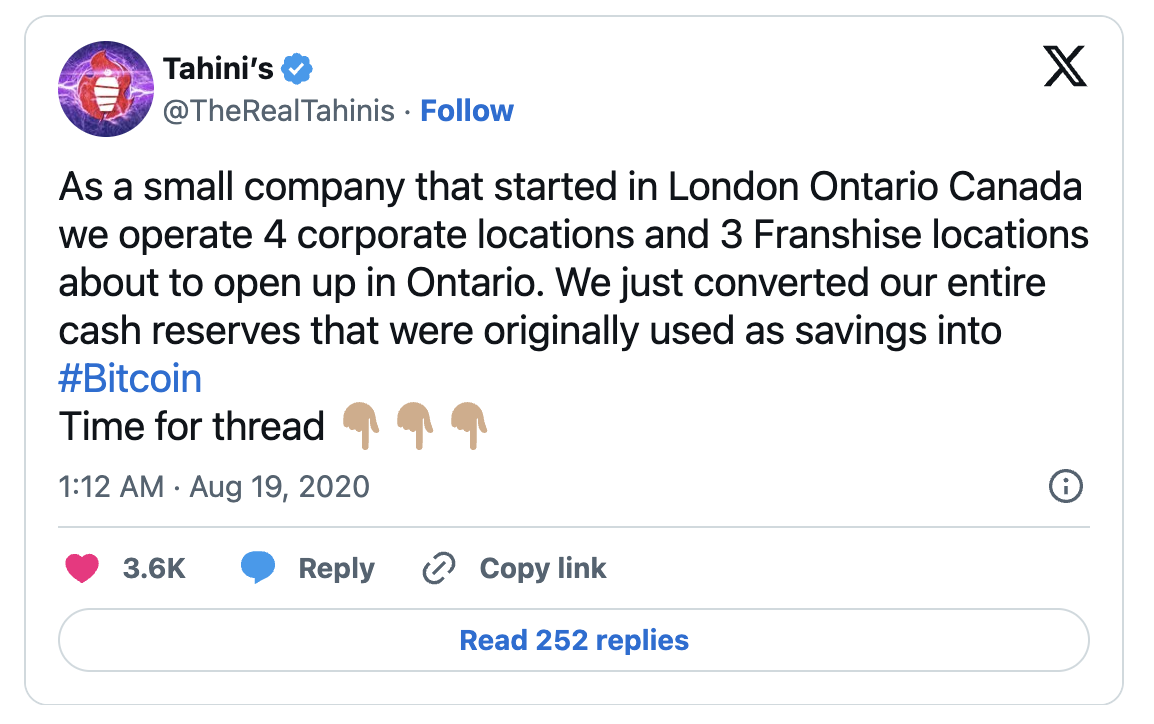
"We keep putting more and more capital into Bitcoin," Omar Hamam, CEO and co-founder of Tahini's, told Bitcoin Magazine. Omar launched the first restaurant in London, Ontario, in 2012 alongside his brother Aly Hamam. Since then, Tahini's has grown to 62 locations nationwide. In 2020, inspired by Michael Saylor, they adopted an early Bitcoin treasury strategy—an audacious move that gave them a financial reserve enabling competition with fast-food titans.
"We're competing with McDonald's and Chipotle," said Omar. "These companies have hundreds of times more capital than Tahini's does. So having this advantage—an asset that strengthens our financial position and preserves wealth across time and space—is the best decision we've ever made for our business."
Along the way, the company implemented several innovative strategies, including deploying Bitcoin ATMs at many franchise locations and launching a new media strategy. According to Aly, this media strategy generated three billion views across all social platforms over the past five years, including a YouTube channel with over 3.2 million subscribers. Of course, their Bitcoin treasury strategy remains a standout element.
Aly’s Bitcoin Obsession: From Egyptian Currency Devaluation to Pandemic-Era Inspiration
Tahini's Bitcoin strategy has been primarily driven by Aly Hamam. His inspiration stems from his family's firsthand experience over the past two decades with the severe devaluation of the Egyptian pound. Persistent hyperinflation took a heavy toll on his family, shaping his perspective and leading him to recognize Bitcoin's potential during the market crash of March 2020.
"I'm from Egypt, and over the last twenty years, I've seen the Egyptian pound lose about 85% of its value. I've watched my family struggle—my parents especially. Their life savings were nearly wiped out over the years in Egypt. Sometimes it happens like a flash crash. The government might devalue the currency by 50% in a single month," recalled Aly.
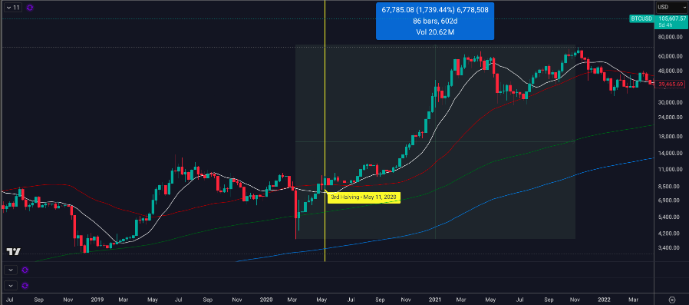
In March 2020, as pandemic-induced panic hit markets, Bitcoin dropped from around $10,000 to $4,000. "I bought a little bit, purely because it had dropped so much—I figured, why not try? ... But as I dug deeper, I fell completely down the Bitcoin rabbit hole. For the next few months, I kept buying more and more. When you first discover Bitcoin, for the first three months it consumes every part of your life—listening to podcasts, reading books, constantly buying," explained Aly.
After the crash, Bitcoin rebounded to around $10,000 and consolidated at that level for several months. Meanwhile, governments began flooding economies with trillions in newly printed money. The U.S. slashed interest rates to zero, while Canada started distributing pandemic relief payments to eligible citizens. Omar recalled, "Governments were just printing money nonstop. Not just Canada—almost every government was doing it. So we knew inflation was coming." Around the same time, Bitcoin underwent its block reward halving, a fundamental event that helped fuel one of the most spectacular bull runs in its history.
This was also when Michael Saylor entered the Bitcoin space and became one of its most prominent advocates. However, his talks and documents outlining how to build corporate Bitcoin strategies and convince boards or business partners were only beginning to circulate on podcasts—Bitcoin treasury strategies were still in their infancy.
Once Aly was fully committed, he began evangelizing Bitcoin within his circle. "I started promoting Bitcoin to my business partners, my brother, my cousins—they started buying individually," Aly said. While personal purchases were straightforward, using corporate treasury funds proved far more difficult. "It wasn’t a quick process. I wanted us to put company capital into Bitcoin, but they hesitated. 'This is crazy,' 'What if this or that?' We went back and forth until Michael Saylor announced his first purchase. I already had all the accounts and preparations ready. So when Saylor bought his first batch, that pushed us over the edge. A week later, we moved all of our corporate capital into Bitcoin."
Purchase Prices, Dollar-Cost Averaging, and Staying the Course Through Bear Markets
Tahini's Bitcoin investment strategy differs from today’s public companies that issue stock (and other financial instruments) to buy Bitcoin and grow their treasuries. As a private company that began accumulating Bitcoin before the U.S. approved Bitcoin ETFs, Tahini's took a simpler path: buy as much Bitcoin as reasonably possible every month—and never stop. According to Omar, Bitcoin now makes up over 70% of the company’s reserves.
Their timing was excellent, starting purchases at around $10,000 per Bitcoin. However, the so-called Dollar-Cost Averaging (DCA) strategy works well at any price—even during bear markets.
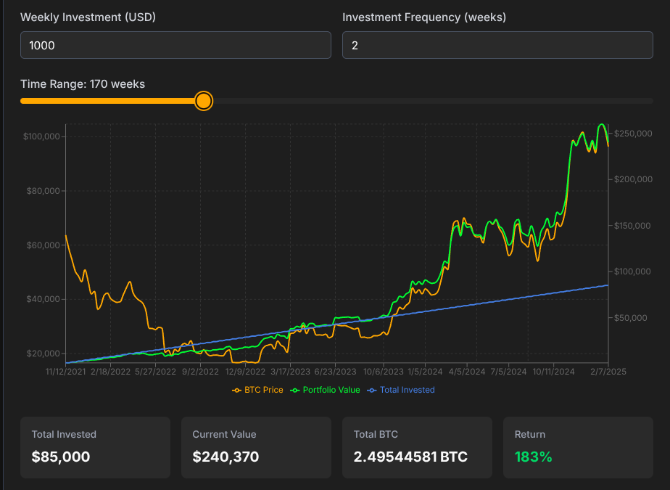
For example, if you invested $1,000 every two weeks at the peak of the 2021 bull market—when Bitcoin neared $70,000—each subsequent purchase at lower prices would reduce your average entry point. By the end of the bear market—say, when Bitcoin surpassed $30,000—you’d be back at breakeven and positioned for the next bull run. The only requirement is a long-term mindset.
"Buy every month, every month. Price doesn’t matter. I know it sounds too simple, but really, it’s the only way. You just buy—don’t try to outsmart the system unless you’re truly skilled. Set aside some capital each month, and it will work. Look back over the past four years, and you’ll see your investment multiplied 20 to 30 times." Omar explained. He added, "I’ve had this conversation with many people—friends, family, everyone. I always tell them: start somewhere. Don’t put in too much—just see what happens. Say you invest $1,000 and watch it go. If next year it becomes $1,200 or $1,500, imagine what could happen with $100,000 or $1 million?"
While there’s no strict rule on the ideal frequency for DCA—whether for individuals or businesses—Tahini's chose monthly purchases to align with their accounting cycle. "Every month, we get our P&L statement. We look at our profits and losses. At month-end, we decide: okay, we’ll set aside this amount," explained Omar.
As for the amount invested, Omar noted they don’t use a fixed or percentage-based figure. "It also depends on whether we’re investing in the business this month? What are our expenses? Any large payments? Sometimes there are big outlays at year-end. So there are monthly highs and lows—but the key is consistent capital deployment. How much you commit each month is something you need to decide."
To Sell or to Lend? Tahini's Treasury Strategy and Payment Challenges
When it comes to realizing value from Bitcoin, Tahini's follows a straightforward approach. When the time is right and business needs arise, they sell a portion of their Bitcoin holdings, then buy back gradually using their standard DCA strategy, incorporating capital gains taxes into their accounting process. Omar explained: "When it’s time to reinvest, you always need cash. Say you want to launch a major marketing campaign as a chain—right? You need to tap into those reserves. Having capital gives you power. The more capital you have, the more freely you can make the right decisions for your company—not just what you can afford."
Accepting Bitcoin Payments and the Challenge of POS Integration
As a first step toward Bitcoin integration, Tahini's explored accepting Bitcoin as payment at its restaurants. However, a series of challenges led them to pivot. Many of these obstacles still exist for businesses globally, rooted in closed-source, walled-garden models of popular payment processing systems.
Omar explained: "Many of these point-of-sale (POS) companies handle payments themselves, and their systems simply aren't capable of accepting Bitcoin." These systems are mostly closed-source, with tightly restricted APIs, making integration with the Bitcoin economy difficult—a persistent barrier to Bitcoin adoption since its inception.
Moreover, merchant adoption friction isn’t limited to POS barriers; the feature requirements for staying competitive are highly complex, and most Bitcoin payment solutions still lag behind:
"A POS system isn’t just about payments. It’s about how menus are structured in the backend. It provides reports, analytics on what you sold, when you sold it, store operations, peak hours, slow periods, and inventory reordering. It’s very complex, right? So payments are just the final piece. When choosing a POS system, it’s not just about payment capabilities—it’s about functionality and overall system quality."
In addition, any POS system integrating Bitcoin must also support fiat currencies to be viable for everyday merchants today—raising the bar even higher for entry and competition.
As a result, Tahini's opted for the next best solution: partnering with Canadian Bitcoin ATM company Bitcoin Well to install Bitcoin ATMs in 10 of its restaurants. They chose to receive all machine profits in Bitcoin, allocating them to individual accounts for each location. Although Aly reported these ATMs generate only about CAD$250 per month, these “sats flows” (as some in the industry call them) have accumulated since 2021. With Bitcoin’s price appreciation, each restaurant now holds over CAD$40,000 worth of Bitcoin—a significant sum.
Still, Omar remains optimistic that these barriers will eventually fall, as interest in Bitcoin payments is stronger than ever. "I think Bitcoin is growing rapidly. More and more companies are adopting it. People understand Bitcoin better, and awareness is rising. So I believe it’s only a matter of time."
Join TechFlow official community to stay tuned
Telegram:https://t.me/TechFlowDaily
X (Twitter):https://x.com/TechFlowPost
X (Twitter) EN:https://x.com/BlockFlow_News
 @BitcoinMagazine


