








From Bombing Iran to TikTok Campaigns: The Rules of Speculation in the Attention Economy
TechFlow Selected TechFlow Selected
From Bombing Iran to TikTok Campaigns: The Rules of Speculation in the Attention Economy
Whoever controls the information flow can shape the future.
 Navigating Web3 tides with focused insights
Author: Kyla Scanlon
Translation: TechFlow
What Trump, Mamdani, and Cluely Tell Us About the Attention Economy
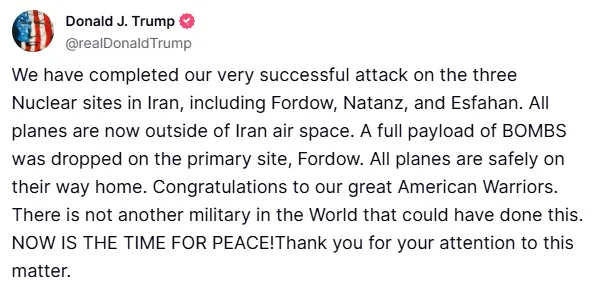
Last weekend, Trump launched a military strike on Iran and announced it via Truth Social. This may not be the first time that “posting equals policy,” but it’s hard to find a more direct example. I was standing in a supermarket picking out bananas when my phone buzzed with a notification—something felt alien, disorienting, surreal.
Yesterday, Zohran Mamdani won the Democratic primary for New York City mayor—a tight race, where victory came through disciplined storytelling and mastery of digital tools. Even if you disagree with his policies (many of which I find unworkable), his campaign strategy is impressive. He walked across all of Manhattan; his presence was everywhere.
And just days before these two events, a startup called Cluely raised $15 million in funding led by a16z (Andreessen Horowitz).
Their business model could be summed up as “scam everything.” That approach isn’t new—but that’s not why a16z invested. What they backed was Cluely’s attention-capturing power. Cluely applies the playbook of consumer-AI "corporate Jake Paul"—gimmicks, virality, nihilism, and narrative-first atmosphere-building—to AI applications. We’ve seen “brain-dead marketing” take over culture; its infiltration into the startup world was inevitable.
Yet these three events—geopolitical conflict, a mayoral primary, a startup funding round—are different facets of the same trend. Here’s how they connect:
-
Attention is infrastructure: It determines what gets funded, elected, or built.
-
Narrative is capital: It drives capital flows, policy, and public opinion.
-
Speculation is the operational layer between them: It’s how beliefs are tested, priced, and turned into outcomes before institutions act.
What we’re witnessing isn’t just a media trend—it’s a shift in power architecture. Attention → Speculation → Allocation forms a new supply chain.
Traditional economic theory assumes information flow serves resource allocation. Now, resource allocation serves attention flow. We’ve moved from an economy where attention supports value creation, to one where attention itself is value creation.
Understanding “Attention”
The foundational elements of traditional economics are land, labor, and capital—the bedrock of production. Today, the true foundational element has become attention.
Trump initially said he’d need about two weeks to consider bombing Iran… then acted immediately? The New York Times later reported that the airstrike decision was partly influenced by Israel’s messaging performance on Fox News—making Trump’s response feel less like military strategy and more like reactive theater. The whole thing played out like drama.
-
Iran clearly anticipated Trump might act, given his frequent social media posts.
-
Fearing his posts might leak operational secrets, military officials ordered a B-2 “feint flight” to distract from the real mission.
-
Iran simply moved their uranium to another location—whose whereabouts remain unknown.
-
The bombs appear to have missed their intended targets?
-
A few days later, Iran retaliated by attacking U.S. military bases in the Gulf, but gave advance warning to the U.S. (I learned this while back in the supermarket).
-
Iran didn’t close the Strait of Hormuz, suggesting the situation might (perhaps?) de-escalate (this was my cautious observation on the morning of June 25).
-
Trump called for a ceasefire, but both Israel and Iran ignored him.
-
He also stated China could continue buying Iranian oil—effectively relaxing sanctions?
-
Later, Trump appeared furious during a live TV broadcast (understandably so).
Trump only informed Republican members of Congress about the strike—not ideal. Intelligence briefings suggest Iran wasn’t actively militarizing its nuclear program, making the bombing potentially illegal. But when Congress functions like a fish flopping on shore, legal concerns matter less than content strategy.
Trump once again overturned the traditional system—replacing conventional information and decision flows. Military strategy and foreign policy now bow to social media dynamics. Yet he treats war like a weekend hobby. As his State Department spokesperson put it:
“I won’t get ahead of the president or try to guess his strategy. Things move fast—I think we’ll know soon.”
This reveals the core problem of the attention economy: grabbing attention is easy, and people do increasingly outrageous things to keep it. But what happens when attention fades? In this case, Iran may continue pursuing nuclear weapons—because they only need to track the information flow to see which narratives gain traction. And that has dangerous consequences.
Zohran Mamdani
There’s already excellent writing on Mamdani (Derek Thompson just joined Substack!), so I won’t belabor the point. But yesterday, Zohran Mamdani won the NYC Democratic mayoral primary. The 33-year-old democratic socialist defeated former Governor Andrew Cuomo, despite being at just 1% support four and a half months ago.
His campaign centered on “affordability”—a message that also helped Trump win young voters. Mamdani excels at short videos and podcasts, while also engaging directly with New Yorkers—walking across the city, meeting people face-to-face. Cuomo ran TV ads and raised $25 million (!) via the largest super PAC in NYC mayoral history, yet none of it mattered.
As many have noted, Mamdani is the left-wing candidate who most closely mimics Trump’s style—highly online, accepting every interview possible, leading a dedicated volunteer army (who knocked on 1.5 million doors!), and delivering a clear message.
Mamdani proved that attention is the key path to breaking institutional barriers—just like Trump, but from the opposite direction.
This shift isn’t surprising—and will grow more common on both ends. People are frustrated with the status quo, and rule-breaking feels exciting—whether it’s JD Vance flipping the bird or Trump cursing on C-Span.
Ideas still matter. People voted for Trump not just because they support deportations and oppose “wokeness,” but because he feels different, novel. Mamdani promises affordability and fresh thinking. In a world where many feel ignored, that offers hope for change.
Connecting the Dots
These three stories—Trump bombing Iran via social media, Mamdani walking Manhattan on TikTok, Cluely’s funding—share a common thread: power stems from attention, and attention stems from narrative discipline.
It operates like a supply chain:
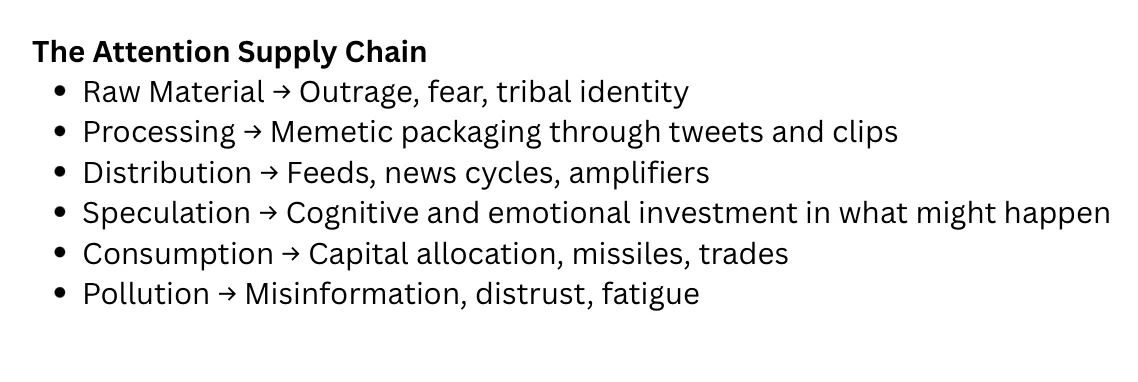
We can trace this “attention pipeline” through each case.
Trump’s Iran Airstrike:
-
Raw materials: Geopolitical resentment, national pride, fear of weakness.
-
Processing: Posting vague threats, sharing Fox clips, hinting at retaliation.
-
Distribution: Amplified through cable news and information echo chambers.
-
Speculation: Judgments shift from strategy to emotion and “vibe.” Prediction markets react accordingly.
-
Consumption: He orders the bombing of Iran.
-
Pollution: Strategic confusion, legal ambiguity, normalization of social-media-driven warfare.
Mamdani’s Campaign:
-
Raw materials: Affordability crisis, wealth inequality, housing despair.
-
Processing: Creating TikTok videos, giving interviews, walking across Manhattan.
-
Distribution: Left-wing podcasts, viral video clips.
-
Speculation: Can he really win? Is free transit feasible? What if NYC goes fully socialist? Young voters, disillusioned moderates, and donors bet time, energy, belief—and even prediction markets place bets.
-
Consumption: He wins the primary; Cuomo concedes.
-
Pollution: Cycles of outrage, factionalization, deepening ideological divides.
Cluely follows the same logic. When a16z invests in Cluely purely based on attention capture, they’re legitimizing attention as an investable asset class. This sends a signal to founders: prioritize virality over utility. This is “American Dynamism”!
Attention is the raw material of economic, political, and military action. But what makes attention function is speculation: the emotional, political, and financial bets people place when a narrative might become real.
In politics, speculation has become the closest thing to agency for those who feel the economy no longer serves them. They speculate on ideas, figures—why not? But when this happens, the system optimizes for speed and virality, not stability or accuracy.
I believe this is why resource allocation is now controlled by an informal coalition: podcasters like Joe Rogan, YouTubers like MrBeast, figures like Steve Bannon and Tucker Carlson. Even Elon Musk, though silent on current events, acts as a “narrative thermostat.” These are masters of speed and virality.
They leverage speculation to decide what captures attention—and attention increasingly dictates resource allocation. The entire world is learning from them: startups, politicians, geopolitical strategists. “Checks and balances” no longer come from Congress or courts, but from social media information flows.
We’ve Seen This Before
The phenomenon I’m describing isn’t unprecedented. Many have discussed similar dynamics. As early as 1971, Herbert Simon wrote in *Designing Organizations for an Information-Rich World*:
In an information-rich world, the abundance of information means a scarcity of something else: what information consumes. What is consumed is obvious: the attention of its recipients. Hence, a wealth of information creates a poverty of attention and requires efficient allocation among competing sources.
Information abundance leads to attention scarcity! By 1997, Michael Goldhaber expanded on this in *The Attention Economy and the Net*, arguing attention is becoming the new currency of the digital age.
The attention economy brings its own forms of wealth, class divisions—celebrities and fans—and property rights, incompatible with the industrial-money-market economy, and seemingly poised to replace it. Success will go to those best adapted to this new reality.
Robert Shiller proposed “narrative economics,” arguing stories drive economic behavior. I believe we’re now in a new iteration—where stories don’t just influence economic activity, they are the economic activity. Attention (in many ways) precedes wealth, and speculation powers it all.
In short… is everything now like cryptocurrency? Cryptocurrency doesn’t represent “real” value (some things in the industry do, but overall it doesn’t), yet it synthesizes value through speculation and belief. Emotion, volatility, mindshare—if you will. We now live in a system where attention dynamics have become the operating system for resource allocation, political decisions, and identity formation.
What Happens Next?
This entanglement of speculation and attention seems overlooked outside market circles. The issue isn’t whether we can build better housing or infrastructure—though we desperately need to. The deeper question is: when the resource allocation system prioritizes attention above all, can we build anything coherent at all?
Because now, whoever can generate the most compelling speculation about the future—regardless of understanding consequences—holds the greatest power to make it real.
There is no neutral vantage point outside these systems. The tools we build reshape us in turn, with cascading effects. Due to management mechanisms, there’s no true “offline” anymore. We’re all participants in a cognitive economy trading attention, belief, and behavior. Control the information flow, and you shape the future. So what happens when everything becomes an attention-speculation machine?
Join TechFlow official community to stay tuned
Telegram:https://t.me/TechFlowDaily
X (Twitter):https://x.com/TechFlowPost
X (Twitter) EN:https://x.com/BlockFlow_News






