What are the differences between Bitcoin miners and gold miners?
TechFlow Selected TechFlow Selected
What are the differences between Bitcoin miners and gold miners?
A more dynamic, unpredictable, and brighter future.
 Navigating Web3 tides with focused insights
Author: James Butterfill
Translation: Aki, Wu Shuo Blockchain
Gold and Bitcoin are often compared as scarce, non-sovereign assets. While there has been extensive discussion about their investment cases as stores of value, far less attention has been paid to comparing them at the production level. Both assets rely on mining—one physical, the other digital—to introduce new supply. The industrial characteristics of both are defined by cyclical economics, capital intensity, and deep ties to energy markets.
However, subtle differences in the mechanisms and incentives of Bitcoin mining versus gold mining ultimately have significant implications for the economic structures and strategic positioning of industry participants. This report will walk you through some of their similarities, but more importantly, highlight their substantial differences.
Asset Scarcity Rooted in Physical and Computational Mining
Gold mining is a centuries-old practice involving the extraction and refining of metal from underground sources. It requires identifying suitable ore deposits, securing permits and land rights, using heavy machinery to extract ore, and then chemically separating the metal for distribution.
In contrast, Bitcoin mining involves repetitive computational processes—competing to solve batches of Bitcoin transactions and earn newly issued Bitcoin along with transaction fees. This process, known as Proof of Work (PoW), requires procuring rack space, electricity, and specialized hardware (ASICs) to efficiently run computations, then broadcasting results across the internet to the Bitcoin network.
In both systems, mining is an inherently high-cost process underpinning each asset's scarcity: Bitcoin’s scarcity is maintained by code and competition; gold’s by physical and geological constraints. Yet, the methods of extracting scarcity, producers’ economic models, and their evolution over time share almost no similarities.
Bitcoin Mining Economics: Competition, Technological Advancement, and Diversified Revenue Streams
The economic model of gold mining is relatively predictable. Companies can generally forecast reserves, ore grades, and extraction timelines with reasonable accuracy, although initial estimates may deviate significantly—only about one-fifth of gold mining projects achieve profitability over their lifetimes. Key costs—labor, energy, equipment, compliance, and reclamation—can be estimated fairly accurately upfront. Depreciation mainly reflects normal equipment wear or reserve depletion. The primary short- to medium-term uncertainty typically lies in the stability of gold prices, which tend to exhibit low volatility. Moreover, nearly all these input costs can be effectively hedged.
By comparison, Bitcoin mining is far more dynamic and unpredictable. Company revenues depend not only on the relative price volatility of Bitcoin but also on their share of global hash rate—that is, global competitive dynamics. If other miners expand operations more aggressively, your relative output may decline even if your own operation remains unchanged. This is a variable that miners must continuously monitor during operations.
Thus, our first key distinction emerges: unlike the relatively stable production forecasts in gold mining, Bitcoin miners face ongoing challenges from production uncertainty driven by the entry and exit of competitors and shifts in their strategies.
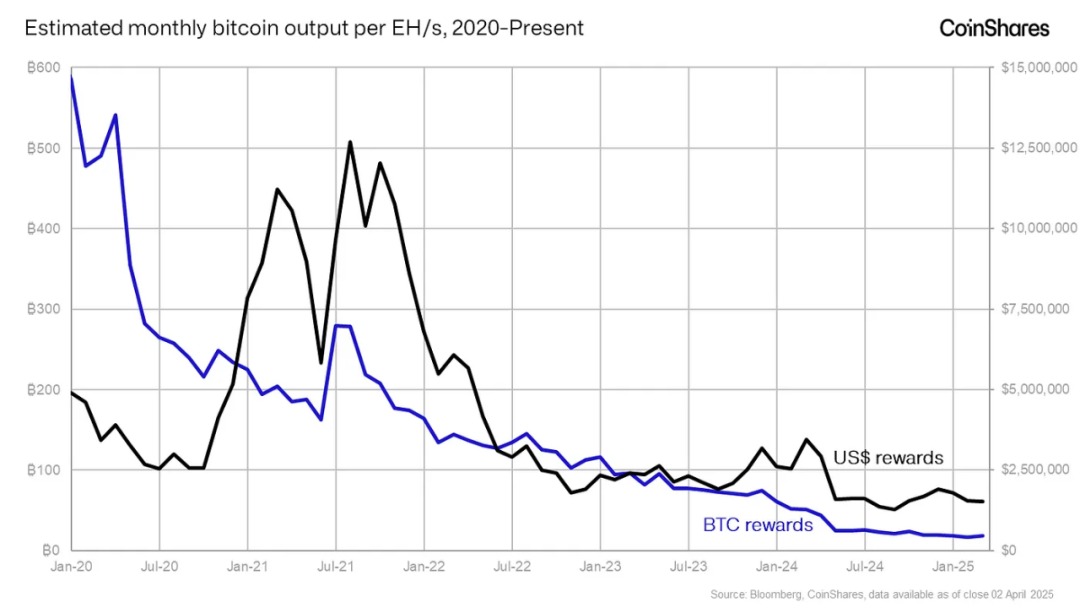
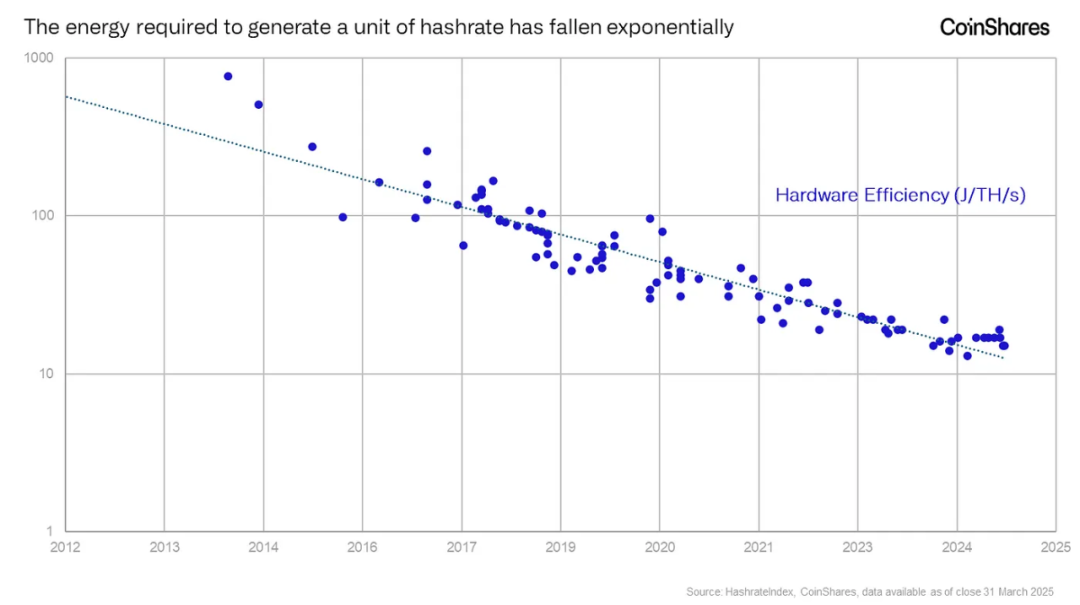
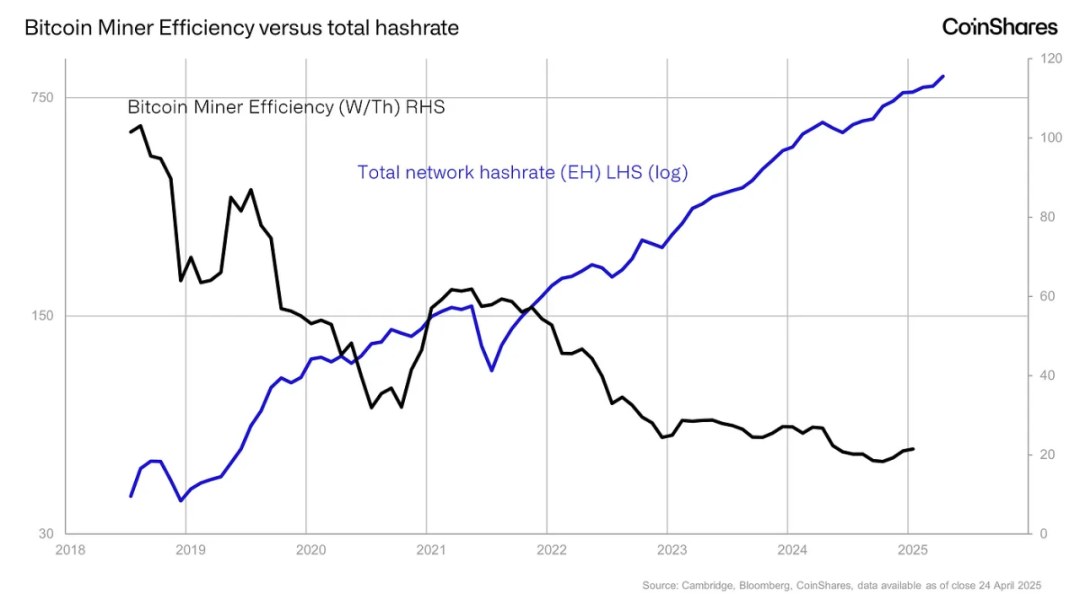
One of the most important costs for Bitcoin mining companies is depreciation, particularly of ASIC equipment. The efficiency of chips within Bitcoin miners improves rapidly, forcing companies to upgrade before physical obsolescence occurs just to remain competitive. This means depreciation happens on a timeline dictated by technological progress rather than physical wear and tear. This is a major expense—even though non-cash—and stands in stark contrast to gold mining, where mining equipment enjoys longer useful lives because much of its efficiency improvement has already plateaued.
Combined with fluctuating industry competition, this leads to constant pressure on miners to reinvest in new hardware to maintain production levels—a phenomenon professionals often refer to as the "ASIC hamster wheel."
Yet, Bitcoin holds a fundamental advantage over gold when it comes to revenue structure. Gold miners profit solely by extracting and selling unissued supply from reserves. In contrast, Bitcoin miners earn both from issuing unissued supply and from transaction fees. Transaction fees provide miners with income derived from already-issued supply, which fluctuates based on demand for transferring Bitcoin. As Bitcoin approaches its 21 million supply cap, transaction fees will become an increasingly critical source of revenue—an element entirely absent in gold mining.
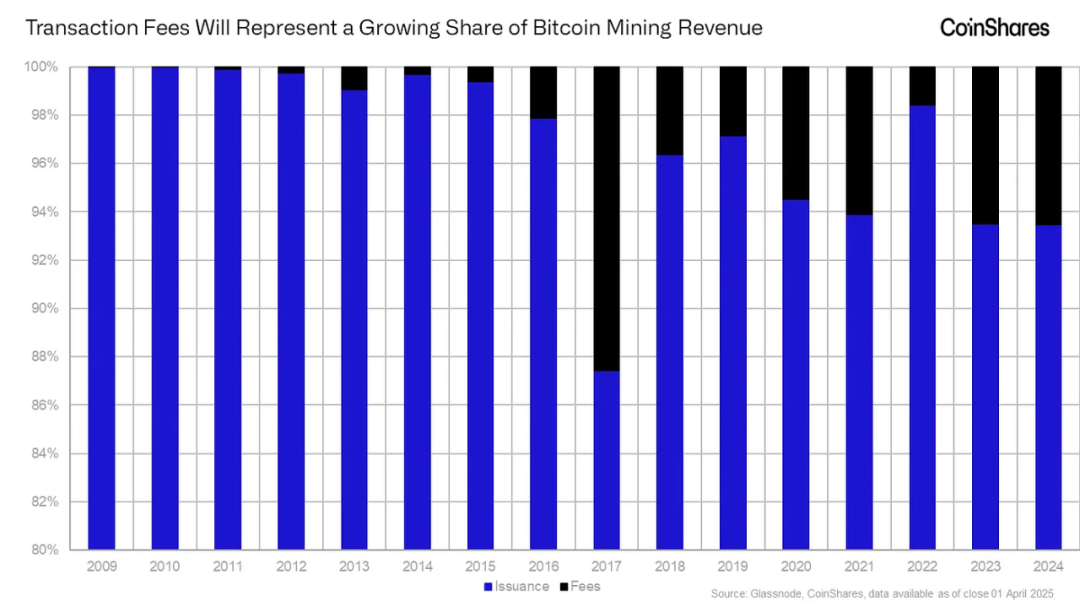
Note: The y-axis shows a bottom range of 80% in certain sections.
Finally, a major long-term advantage of Bitcoin mining is the ability to repurpose a byproduct of operations—heat. When electricity passes through mining rigs, large amounts of thermal energy are generated, which can be captured and redirected for other uses such as industrial processes, greenhouse agriculture, or residential and district heating. This opens up entirely new revenue streams for miners. As mining hardware becomes commoditized and depreciation cycles lengthen, the impact of heat reuse could grow further. Similarly, gold miners can benefit from selling byproducts like silver or zinc, typically identified during project planning and used to offset gold production costs.
Bitcoin Mining Has a Brighter Environmental Future Than Gold Mining
Gold mining is inherently resource-extractive and leaves lasting physical footprints: deforestation, water pollution, tailings ponds, and ecosystem destruction. In many regions, it raises concerns around land rights and worker safety.
Bitcoin mining, by contrast, does not involve physical excavation—it relies entirely on electricity. This creates opportunities for integration with local infrastructure rather than conflict. Because miners are mobile and interruptible, they can act as grid stabilizers and monetize otherwise wasted or stranded energy resources—such as flared gas, excess hydropower, or curtailed wind and solar power.
What many fail to realize is that Bitcoin mining also shows potential as a subsidy for clean energy development and a way to demonstrate grid connectivity. By co-locating with renewable or nuclear power facilities, miners can improve project economics prior to formal grid connection—without relying on public subsidies.
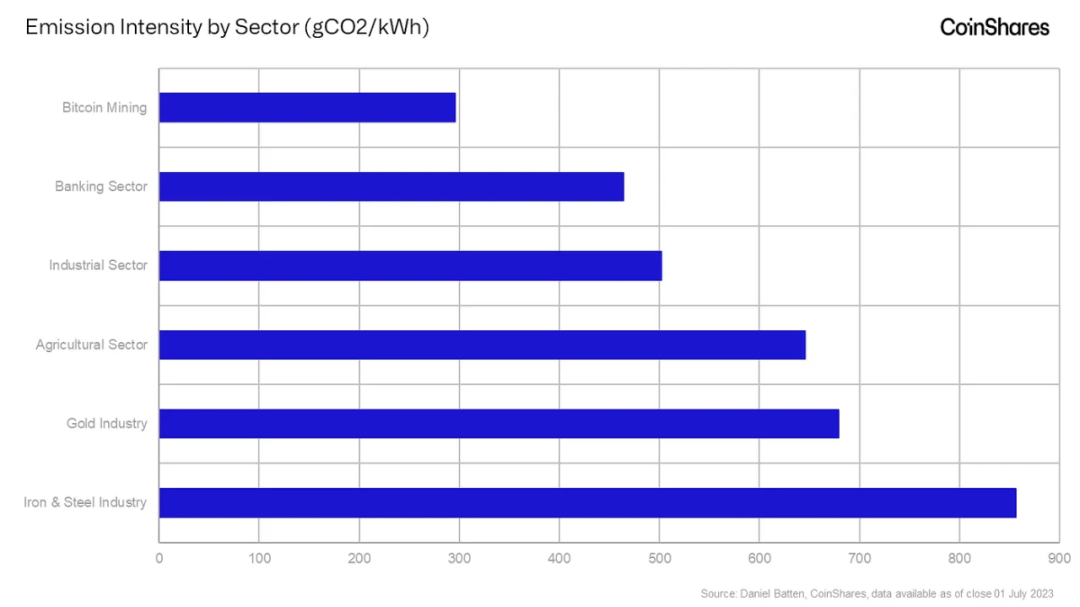
Lastly, while well-documented, it bears emphasizing that Bitcoin’s carbon emissions are, on average, lower and more transparent than those of traditional industries. Arguably, Bitcoin may even be essential in facilitating a smooth transition toward grids dominated by renewable energy.
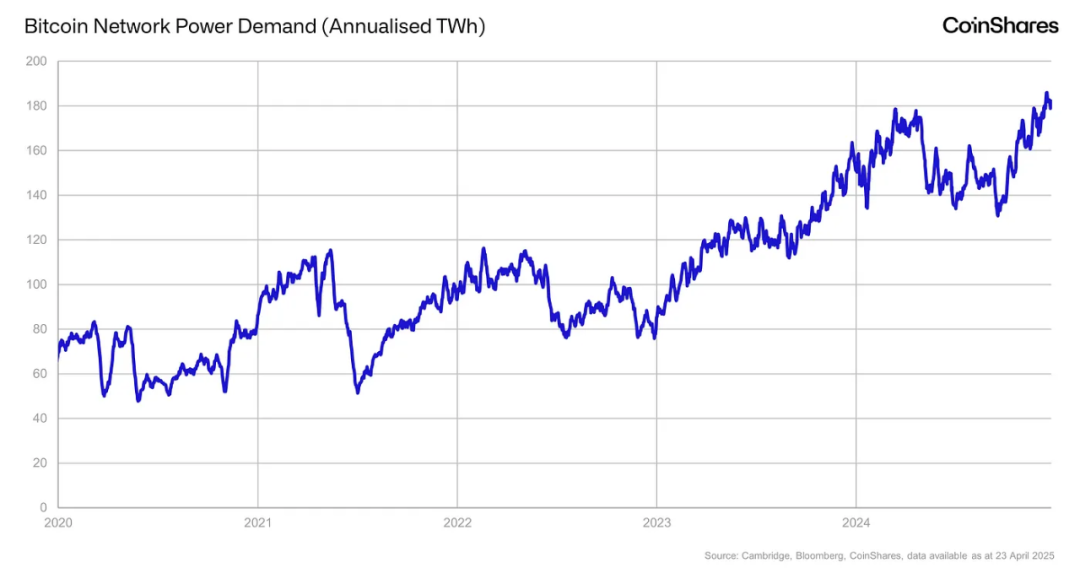
Since peaking in energy consumption in 2024, we’ve seen little increase, thanks to continuous improvements in mining hardware efficiency. Current average power consumption stands at just 20 watts per terahash (W/Th)—five times more efficient than in 2018.
Investment Characteristics of Bitcoin Mining: Fast Cycles and Technology-Driven
Both industries are cyclical and sensitive to the prices of their produced assets. But whereas gold miners typically operate on multi-year timelines, Bitcoin miners can scale operations up or down much faster in response to market conditions. This makes Bitcoin mining more flexible—but also more volatile.
Listed Bitcoin mining companies often trade like high-beta tech stocks, reflecting their sensitivity to Bitcoin prices and broader risk sentiment. Indeed, some market data providers classify publicly traded Bitcoin miners under the technology sector rather than traditional energy or materials sectors.
Gold mining firms, by contrast, have longer histories and frequently hedge future production, reducing sensitivity to gold price fluctuations. They are typically classified under the materials sector and evaluated like conventional commodity producers.
Capital formation also differs. Gold miners usually raise capital based on reserve estimates and long-term mine plans. Bitcoin miners, however, tend to be more opportunistic, often raising funds in recent years through direct or convertible equity offerings to support rapid hardware upgrades or data center expansions. As a result, Bitcoin miners are more dependent on market sentiment and timing, operating with shorter reinvestment cycles.
Bitcoin Mining: An Investment Opportunity in Energy, Computing, and the Future Financial Network
In the long run, gold and Bitcoin may converge toward similar macroeconomic roles, but their production ecosystems are structurally different. Gold mining is slower, physically extractive, environmentally harmful, and resource-intensive. Bitcoin mining is faster, modular, and increasingly integrated with modern energy systems.
For investors, this means Bitcoin miners are imperfect digital analogs to gold miners. Instead, they represent a new class of capital-intensive infrastructure that combines investment opportunities in commodity cycles, energy markets, and technological disruption. Long-term investors should view them as a distinct and novel asset class with unique fundamentals—especially as transaction fees grow in importance and energy partnerships evolve.
In our view, understanding these nuances is essential for making informed investment decisions in an era increasingly shifting toward decentralized financial systems.
As an investment, Bitcoin mining offers not only exposure to scarcity but also to data center infrastructure, growth in energy markets, and the monetization of computing power—a convergence impossible in traditional mining.
Outlook for Bitcoin Mining
Overall, we believe most plausible post-"Liberation Day" macroeconomic scenarios remain favorable for Bitcoin. The introduction of reciprocal tariffs could push the U.S. and its trading partners toward higher inflation. America’s trade partners may face rising inflation alongside growth headwinds. Such dynamics might force them into looser fiscal and monetary policies—measures that typically lead to currency devaluation, enhancing Bitcoin’s appeal as a non-sovereign, inflation-resistant asset.
In the U.S., the outlook is murkier. Both Trump and Bessent have expressed preferences for lower long-term yields, especially on 10-year Treasuries. Though motivations can be speculated—such as reducing debt servicing burdens or boosting asset markets—this stance generally benefits interest-rate-sensitive assets like Bitcoin. However, current conditions reflect the opposite. The U.S. 10-year Treasury yield dropped below 4%, then rebounded to 4.5%, and now sits around 4.3%. This reversal stems from skepticism over underlying trades unwinding, damage to U.S. credibility, and growing doubts about the dollar’s role as the world’s reserve currency. Meanwhile, Trump’s uncompromising tariff stance may further fuel inflation. Yet, this crisis is man-made and could be quickly reversed through tariff concessions and agreements.
Still, these signals may also reflect declining expectations for future stock market earnings, raising concerns about an impending economic slowdown. This presents a key risk to broader markets—and to Bitcoin. If investors continue viewing Bitcoin as a high-beta, risk-on asset, such sentiment could cause Bitcoin to trade in tandem with equities during global downturns, despite its narrative as a long-term store of value.
Nevertheless, since "Liberation Day," Bitcoin has performed relatively well compared to stock markets. This resilience highlights Bitcoin’s unique attributes: it is globally tradable, government-neutral, has a fixed supply, and is accessible 24/7, 365 days a year. Consequently, market participants are increasingly recognizing Bitcoin as a trustworthy long-term store of value.
Join TechFlow official community to stay tuned
Telegram:https://t.me/TechFlowDaily
X (Twitter):https://x.com/TechFlowPost
X (Twitter) EN:https://x.com/BlockFlow_News
 @jbutterfill