After surging 750%, "ARK" trimmed its position as Circle, the so-called "first stablecoin stock," finally plunged
TechFlow Selected TechFlow Selected
After surging 750%, "ARK" trimmed its position as Circle, the so-called "first stablecoin stock," finally plunged
Analysts are skeptical about stablecoins' payment prospects, and Circle's P/E ratio of up to 180 times has raised concerns.
 Navigating Web3 tides with focused insights
By Li Xiaoyin, Wall Street Insights
"Wood's Ark" reduces stake in Circle, cashing out over $300 million.
According to media reports on Wednesday, Cathie Wood, the well-known investor known as "Wood," has sold approximately 1.5 million shares of Circle through her firm ARK Investment Management over the past four trading sessions, amounting to roughly $333 million.
Analysts broadly view this move as a routine profit-taking maneuver by ARK.
As previously noted by Wall Street Insights, ARK has long been renowned for its bold bets on cryptocurrencies and disruptive technologies. As one of the most vocal institutional supporters of Bitcoin, Wood predicted earlier this year that Bitcoin could reach $1.5 million per coin by 2030.
As the issuer of the second-largest stablecoin USDC, Circle’s stock surged from its IPO price of $31 on June 5 to a high of $263.45, an increase of nearly 750%. The company’s market capitalization reached $50 billion, placing it alongside heavyweight players such as Coinbase and Robinhood.
On its first day of trading, ARK made a significant purchase of 4.5 million Circle shares, valued at about $373 million. With the sharp rise in Circle’s share price, this recent sale likely allowed ARK to recoup much of its initial investment.
On Tuesday, Circle’s stock declined by 8.1%, briefly interrupting its upward momentum.
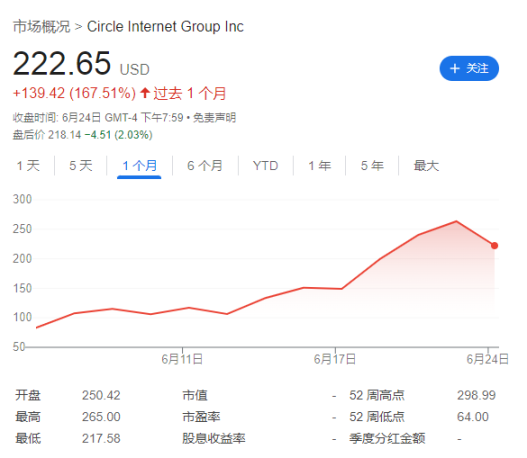
ARK Sells After Significant Gains
Media calculations show that three ETFs managed by ARK Investment collectively reduced their holdings by about 1.5 million Circle shares.
The flagship ARK Innovation ETF (ARKK) sold 1.2 million shares, part of its $6.5 billion in assets under management. The ARK Next Generation Internet ETF (ARKW) and ARK Fintech Innovation ETF (ARKF) followed suit with smaller sales.
Nonetheless, ARK remains Circle’s eighth-largest shareholder.
Athanasios Psarofagis, ETF analyst at Bloomberg Intelligence, said:
“ARK doubled its investment in less than a month. It’s not unusual for them to sell into strength.”
Todd Sohn, senior ETF analyst at Strategas Research, noted:
“Profit-taking is a natural part of ARK’s strategy. The bigger concern would be if they fully exited—this would raise fears of a repeat of the Nvidia scenario.”
In 2023, Wood drew market attention when she completely liquidated ARK’s position in Nvidia during its surge.
Stablecoin Payment Prospects Questioned; High Valuation Raises Concerns
Circle’s stock has continued climbing since its public debut, closing Monday at a record high of $263.45. This makes Circle the most notable crypto-related company to go public since Coinbase’s direct listing in 2021.
However, analysts are divided on Circle’s future upside potential. In a report on Monday, Jefferies analyst Trevor Williams stated:
“We remain highly skeptical that stablecoins will become relevant payment methods in the U.S. The current card-based payment system is convenient, secure, and rich with rewards. Stablecoins may lead to a subpar consumer experience and lack new discounts or incentive mechanisms.”
He added that stablecoins might only appeal to U.S. consumers as gateways for entering and exiting crypto transactions.
Michael Lebowitz, portfolio manager at RIA Advisors, also said stablecoins serve more like money market funds for crypto traders rather than genuine alternatives to Visa or Mastercard.
He believes the threat stablecoins pose to traditional payment giants may be overstated.
Meanwhile, the sharp rise in Circle’s share price has pushed its valuation to elevated levels, with a price-to-earnings ratio approaching 180x—far exceeding the S&P 500’s forward P/E of around 22x.
Miguel Armaza, founding partner at Gilgamesh Ventures, argued that such a high P/E multiple is only sustainable if the company significantly improves net profit margins and earnings growth:
“Any execution hurdles, unexpected regulatory setbacks, or macroeconomic headwinds could easily compress the company’s valuation multiple, bringing Circle’s valuation closer to that of its peers.”
In addition, data shows that only 25% of Circle’s shares are freely tradable, compared to an average of 95% among S&P 500 constituents. Low float increases vulnerability to volatile swings, and any reversal in market sentiment could exert downward pressure on the stock.
Join TechFlow official community to stay tuned
Telegram:https://t.me/TechFlowDaily
X (Twitter):https://x.com/TechFlowPost
X (Twitter) EN:https://x.com/BlockFlow_News