Crypto is becoming more like the U.S. stock market: A look at several types of crypto-equity assets worth watching
TechFlow Selected TechFlow Selected
Crypto is becoming more like the U.S. stock market: A look at several types of crypto-equity assets worth watching
The integration of crypto and stocks is underway, with one side seeing stock assets being tokenized on blockchain, and the other seeing crypto assets listed on traditional exchanges—liquidity between the two markets is becoming bidirectionally connected.
 Navigating Web3 tides with focused insights
By Yue Xiaoyu
The crypto market is gradually becoming more like the U.S. stock market—now you need to understand U.S. stocks to play in crypto.
Initially, only Bitcoin was closely tied to U.S. stocks due to its ETFs. But now, players across the cryptocurrency industry are turning their attention to U.S. equities.
So what exactly are the "crypto-linked stocks" worth watching today?
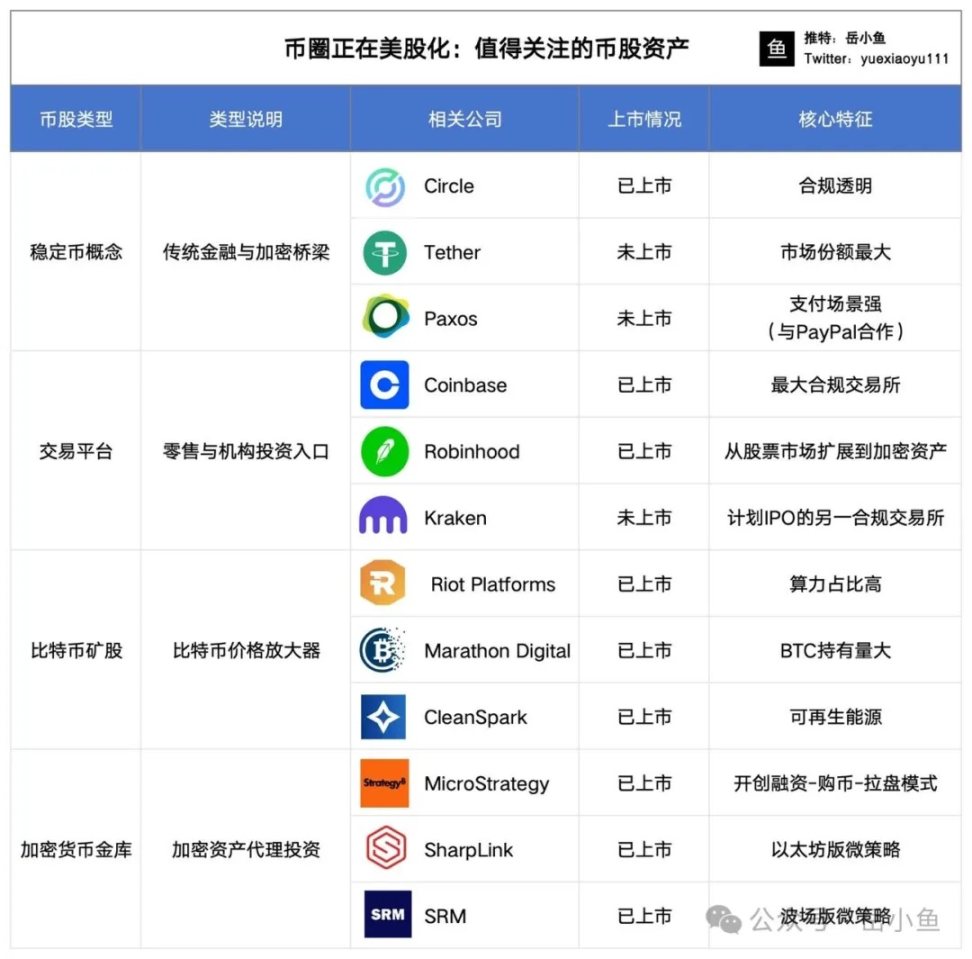
The entire crypto-stock market can currently be divided into four categories:
First: Stablecoin-related stocks, with Circle as the benchmark.
However, Circle is already trading at a very high premium—confusing many in the crypto space—yet traditional finance investors continue to pile in aggressively.
Besides Circle, other notable companies include Tether (a private company, but dominant in the USDT market) and Paxos (issuer of Pax Dollar and PayPal USD).
Second: Exchange platforms, led by Coinbase.
Coinbase, however, is already highly valued, with limited growth potential ahead.
Other noteworthy players include Robinhood and Kraken.
Robinhood is traditionally a stock trading platform but is actively expanding into crypto, having recently acquired Bitstamp.
Kraken is a U.S.-compliant exchange that hasn't gone public yet but is planning an IPO. If successful, it could become a strong competitor to Coinbase.
Third: Mining stocks focused on Bitcoin mining operations.
Key examples include Riot Platforms (RIOT), Marathon Digital Holdings (MARA), and CleanSpark (CLSK).
Mining stocks are cyclical—tending to incur heavy losses during bear markets but delivering high returns in bull markets.
They rely heavily on computing power and energy costs, making them vulnerable to environmental regulations.
In the long run, though, rising recognition of Bitcoin as a reserve asset remains positive for mining stocks.
Fourth: Crypto treasuries, represented by MicroStrategy ("Micro Strategy").
MicroStrategy pioneered the "raise capital - buy crypto - pump" model, leveraging debt and equity financing to accumulate BTC.
Now we’re seeing similar models emerge for Ethereum, Solana, TRON, and others—so-called "Ethereum Micro Strategies" or "Solana Micro Strategies."
Many leading crypto firms are acquiring shell companies listed on U.S. stock exchanges, raising capital from public markets, and then using those funds to buy cryptocurrencies.
This strategy demands strong fundraising capabilities and requires substantial existing capital—like MicroStrategy has.
For example, core members of the Ethereum community invested in SharpLink, while Justin Sun of TRON acquired SRM Entertainment.
But these two cases differ: the former raises money from the market to buy Ethereum, while the latter injects stablecoins and TRX into the U.S. listed entity and then withdraws cash in dollars.
Thus, assets like SRM may carry potential compliance risks.
In summary
Stablecoins and exchange platforms represent investments in "infrastructure," whereas mining stocks and crypto treasuries resemble "high-risk, high-return" speculative assets.
The risk profiles across these four types of crypto stocks vary significantly:
(1) Stablecoin-related stocks carry the lowest risk, but have limited growth potential—ideal for institutional investors seeking stable returns.
(2) Exchange platforms are already highly valued; investors should focus on their ecosystem expansion potential—suited for those bullish on the long-term growth of the crypto market.
(3) Mining stocks are highly cyclical; investors must monitor energy costs and regulatory pressures—best for cyclical traders who can dynamically adjust positions based on Bitcoin prices and energy expenses.
(4) Crypto treasuries offer the highest explosive potential, but also come with the greatest leverage and regulatory risks—ideal for high-risk-tolerant speculators who can deeply evaluate a company’s fundraising strength.
The boundary between crypto and stocks is blurring: on one hand, stock assets are being tokenized; on the other, crypto assets are going public. Liquidity between the two markets is increasingly interconnected.
As retail investors, we must adapt our mindset—and start learning!
Join TechFlow official community to stay tuned
Telegram:https://t.me/TechFlowDaily
X (Twitter):https://x.com/TechFlowPost
X (Twitter) EN:https://x.com/BlockFlow_News