








Forking Solana, Meme Coin Gorbagana Pulls Off the Stunt in Just 48 Hours
TechFlow Selected TechFlow Selected
Forking Solana, Meme Coin Gorbagana Pulls Off the Stunt in Just 48 Hours
In today's dull market, active grassroots movements have never been absent—it's perhaps just a spark that's missing to ignite their passion.
 Navigating Web3 tides with focused insights
Written by: TechFlow
The current crypto market is gradually slipping into fatigue.
Bitcoin and Ethereum prices are struggling amid constant fluctuations. The spotlight has been seized by crypto-linked U.S. stocks and stablecoins, while the once-vibrant grassroots and hacker-driven community spirit of the crypto world—memes, experiments, collective euphoria—seems to have been flattened by market swings and scams.
But over the past two days, that long-lost community energy has made a comeback, carrying with it a faint whiff of a crypto renaissance.
On June 19, a casual social media chat by Solana co-founder Anatoly Yakovenko (Toly) sparked the creation of a meme coin called Gorbagana.
The twist? Just 48 hours later, a namesake Layer 1 blockchain—Gorbagana Chain—launched its testnet, technically forking Solana itself.
To date, Gorbagana has run stably, processing nearly 14 million transactions. The $GOR token has reached a market cap of $30 million in just four days (peaking at $60 million).
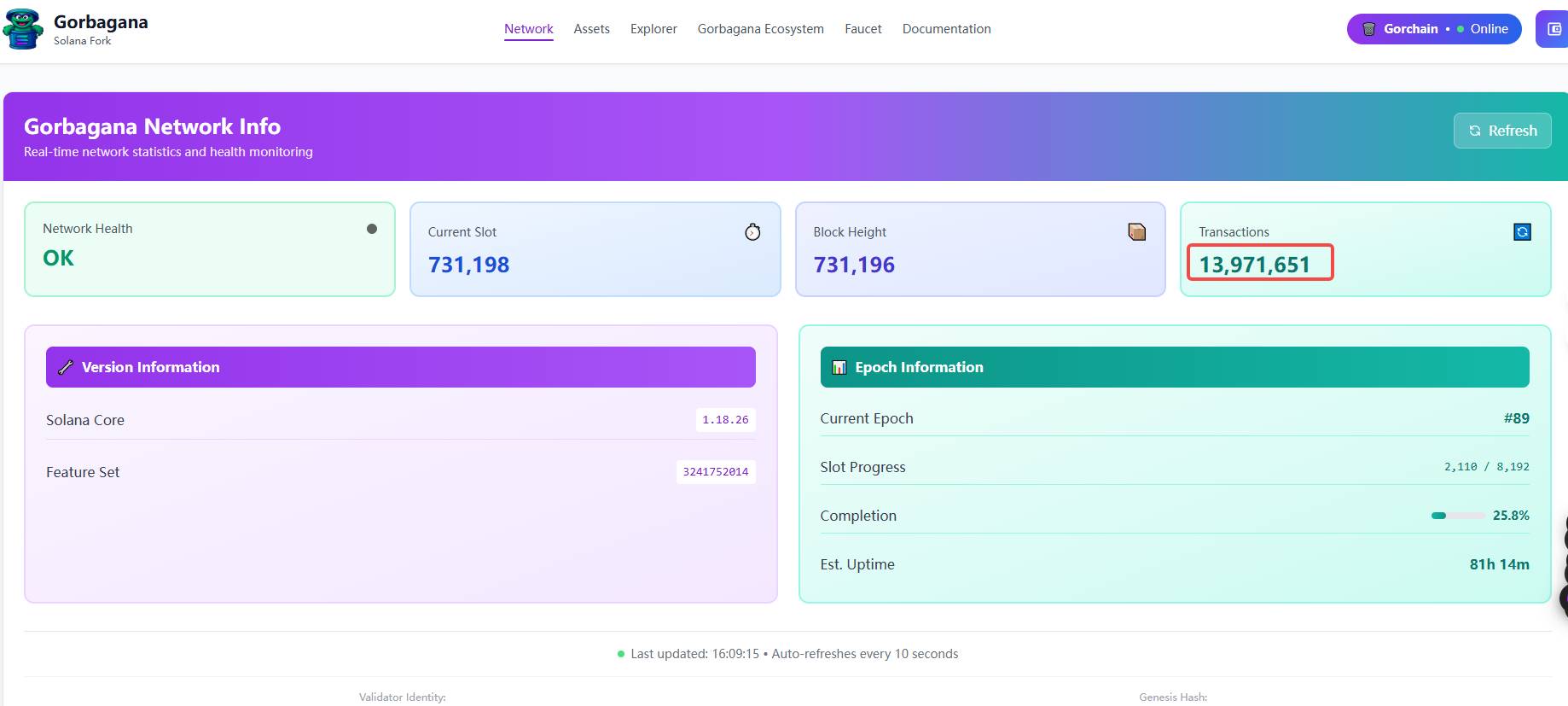
A meme coin alone isn't surprising—but what's fascinating (and ironic) is that it took only two days for a community meme to evolve into an actual blockchain. Compare that to so-called "blue-chip" L1 projects, which can take one or even two years from announcement to testnet launch.
No roadmap, no whitepaper, no marketing blitz—this wasn’t a carefully orchestrated ICO. Instead, it was an impromptu movement driven entirely by degens and developers in Telegram groups.
If you're unfamiliar with this event, we've summarized the full story of Gorbagana below.
48 Hours: From Meme Joke to Real L1
Like many classic memes before it, Gorbagana began as a joke.
On the 19th, during a discussion on X about Solana’s brand identity, user @lex_node playfully challenged Toly’s claim that “brand name doesn’t matter much,” inventing a hypothetical:
What if there were a chain called Solana, and a fork named Gorbagana—same tech, but clearly Solana would be more valuable?
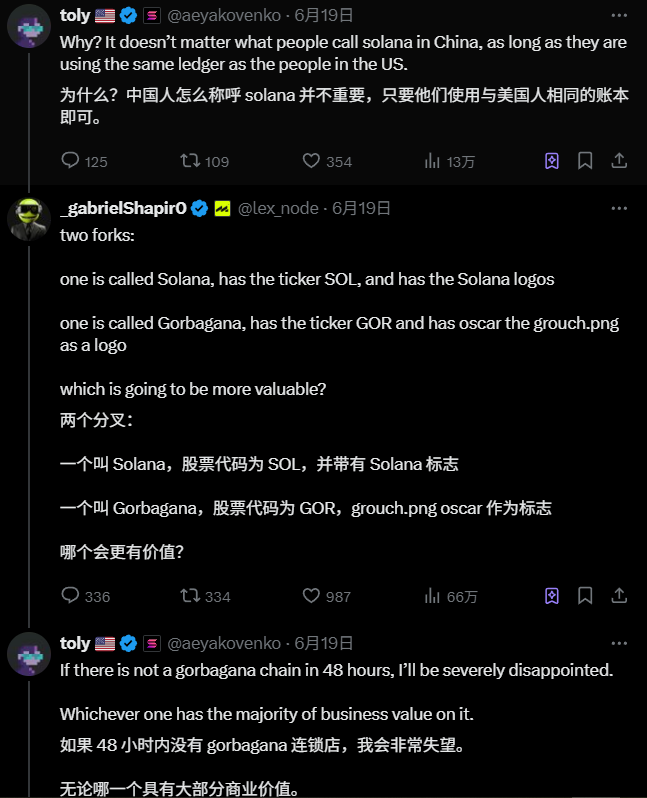
Toly leaned into the joke, replying: “If there isn’t a chain called gorbagana in 48 hours, I’ll be disappointed.”
Gorbagana was clearly meant to be a longer, sillier version of “Solana”—but the community took it seriously.
Six hours after the thread, @lex_node launched the $GOR meme token, explicitly stating it was purely for fun and warning people not to bet big.
At this point, nothing unusual—just another meme drop.
But then came this thought-provoking line in his tweet:
"You never actually get rich炒作 a meme like this—because real wealth comes when people genuinely *create* something and rally around it."
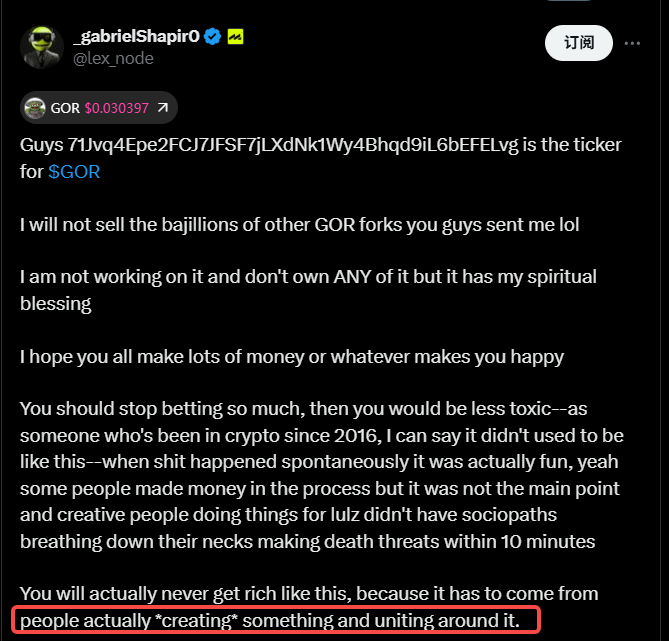
That statement lit a spark.
There had long been an old joke in the Solana community dating back to 2022—“SQL Chain”—a tongue-in-cheek reference to Solana being so fast it felt like a SQL database. There was always a running idea about forking Solana into a “junk” version called SQL Chain.
Now, with the Gorbagana joke, the idea turned into action.
Developer @Sarv_shaktiman, familiar with building on-chain, bought a small amount of $GOR after seeing Toly’s post and the token launch. He then rallied the Milady project’s dev team to turn the old joke into reality.
But the speed was breathtaking:
– 6 hours after the original post: $GOR launched.
– 18 hours: Developers began reverse-engineering Solana’s codebase to fork a new L1.
– 24 hours: Gorbagana Chain testnet went live, complete with custom RPC support and Backpack wallet integration.
– 48 hours: Over 10 million transactions processed on the testnet—a testament to the builders’ technical prowess. $GOR’s market cap peaked at $60 million.
The entire process revived a long-missed crypto spirit—community builders going from buying a meme, to studying blockchain architecture, to launching a Solana fork—all in one seamless, action-driven flow.
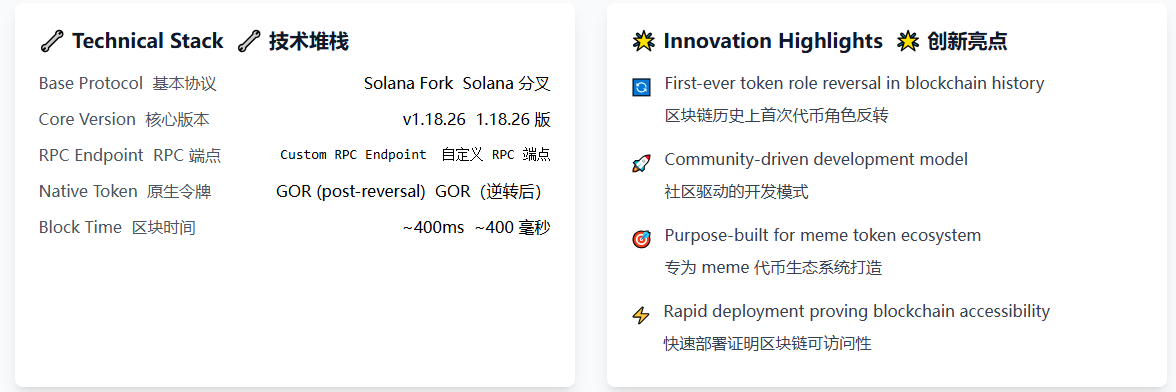
Beyond forking Solana’s entire codebase into a new L1, the chain adopted the meme token $GOR as its native currency, usable for gas fees and transfers.
No VC backing, no marketing campaigns—just pure, spontaneous collaboration among community members. A meme became a native L1 token in under 48 hours.
It’s not a massive achievement in scale, but it’s undeniably interesting.
Interesting in the way things used to be years ago—when on-chain activity thrived and community projects sprang up daily.
Community Collaboration vs. Institutional Incubation
Is forking a chain really that easy?
Forking Solana sounds simple, but it comes with real technical hurdles—wallet compatibility being a major one.
Mainstream Solana wallets like Phantom and Solflare use “hard-coded” settings (pre-programmed to recognize only Solana mainnet and testnet), making them incompatible with Gorbagana’s custom chain features. This effectively isolates the new chain from Solana’s ecosystem.
In other words: You can fork the code, but wallets might not follow.
The community devs weren’t just copying homework—they had to break through these barriers within 48 hours.
One user, @armaniferrante, leveraged Backpack wallet’s custom RPC (Remote Procedure Call) functionality to connect Gorbagana to the Solana ecosystem within 24 hours—enabling custom RPC usage on the new chain.
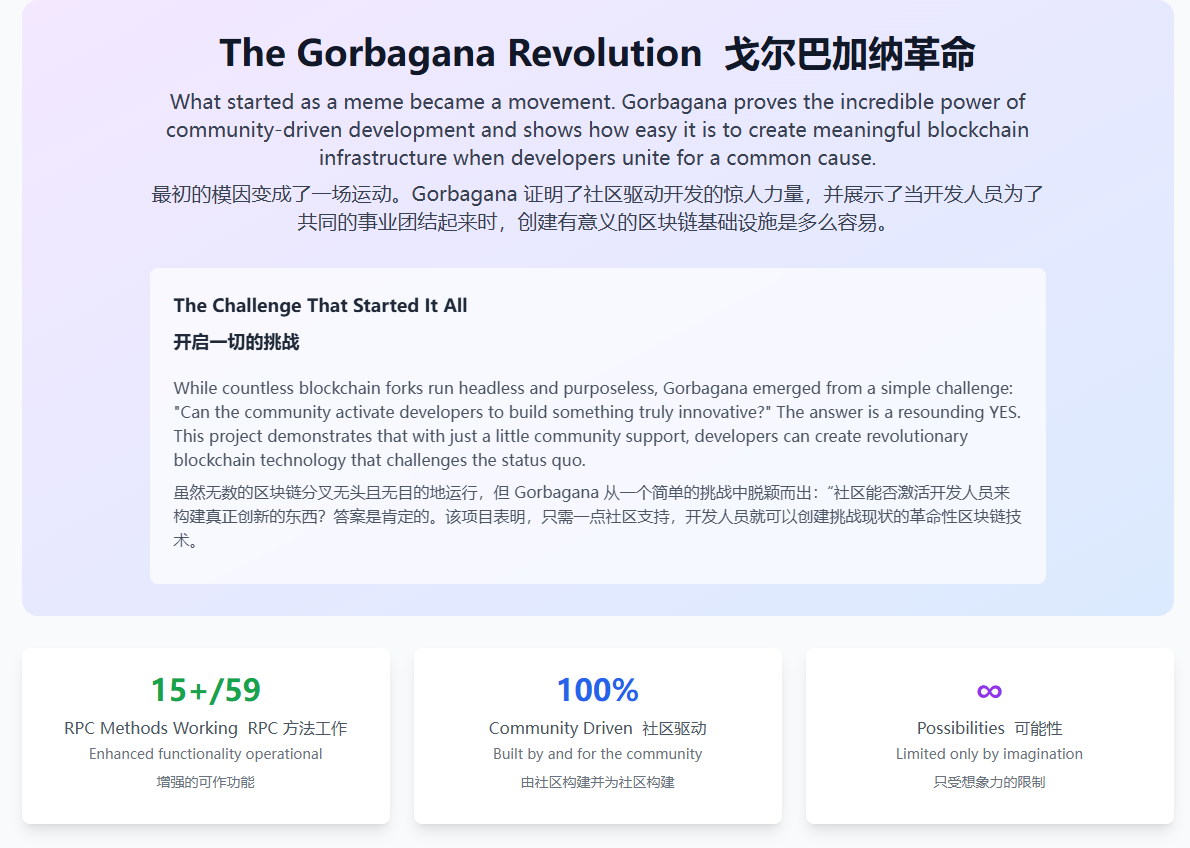
In hindsight, this whole episode resembles a “degen” version of a hackathon—no organizers, no schedule, just real-time brainstorming and problem-solving in group chats.
True, some lead developers may have pushed the project forward because they held $GOR, but the entire effort radiated a long-lost energy of technical hackers:
Fueled by passion, filling technical gaps, solving problems collaboratively—and pulling off a major feat.
Gorbagana only launched a testnet, but even so, 48 hours is lightning-fast. Compared to well-funded, institutionally backed flagship L1 projects that take years to go from concept to testnet, Gorbagana’s community-driven pace feels extraordinary.
This raises a question: If teams go full speed, does launching a full L1 really need to take years?
Grassroots efforts have flexibility. Community collaboration here was driven purely by entertainment—no KPIs, no marketing plans, no TGE timelines. It’s inherently purer.
In contrast, institutional L1 launches involve layers of investor interests. Decisions about testnet release, token generation events (TGE), airdrop schedules, and engagement strategies aren’t just technical—they’re political, financial, and strategic.
Often, whether a flagship project’s token launches at all depends on market sentiment. These infrastructure projects are like massive ships—laden with stakeholders, slow to steer in turbulent waters.
Long ago, what made crypto exciting wasn’t capital stacking—it was grassroots creativity.
Gorbagana may not stay in the spotlight for long, but it proves one thing:
In today’s dull market, vibrant grassroots energy has never disappeared. What’s missing is simply the spark to ignite it.
Join TechFlow official community to stay tuned
Telegram:https://t.me/TechFlowDaily
X (Twitter):https://x.com/TechFlowPost
X (Twitter) EN:https://x.com/BlockFlow_News
 深潮TechFlow


