The Evolution of Token Economics: As Airdrops Lose Effectiveness, Token Buybacks Make a Comeback
TechFlow Selected TechFlow Selected
The Evolution of Token Economics: As Airdrops Lose Effectiveness, Token Buybacks Make a Comeback
The role of tokens has undergone cycles of boom, disillusionment, and iterative advancement.
 Navigating Web3 tides with focused insights
Authors: Stacy Muur & Binance Research
Translation: Felix, PANews
Binance Research released a report on the evolution of token models on June 12. Recently, crypto KOL Stacy Muur summarized this report. This article expands upon those 10 key points to provide a comprehensive overview. Below are the details.
1. ICO Era: Only 15% of Projects Made It to Exchanges
During the ICO era, only 15% of projects successfully listed on exchanges. Among them, 78% were outright scams. The rest either failed or became irrelevant.
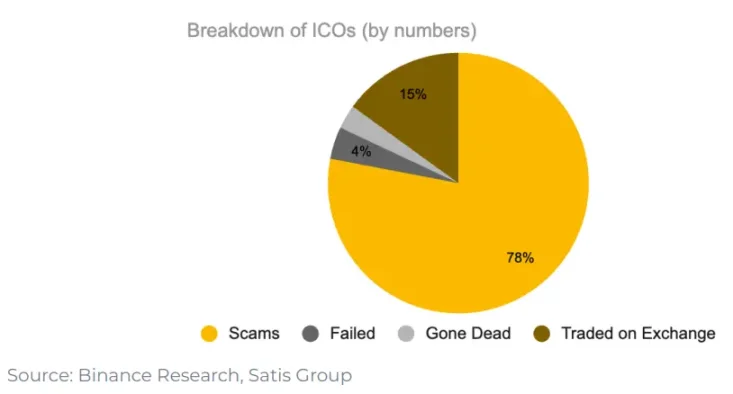
The ICO phenomenon demonstrated strong retail demand for participating in startup financing. It represented a new form of capital formation—functioning like a free market, permissionless and without intermediaries. While many projects failed, it paved the way forward, making surviving investors more discerning and cautious when selecting investments. This ultimately gave rise to more resilient projects such as Aave, 0x, Filecoin, and Cosmos.
Key takeaways:
-
ICOs created incentive misalignments for founders, potentially hindering protocol development
-
ICOs attracted a wave of developers drawn by intense retail interest, though not all projects were built with long-term sustainability in mind
-
Overall, ICOs introduced a new model of capital formation accessible to everyone, revealing strong retail appetite for participation in early-stage project funding
2. Liquidity Mining Proved Effective in Bootstrapping Protocol Growth
Liquidity mining began with Synthetix in July 2019 and quickly gained popularity across DeFi. Compound Finance deepened the concept by linking liquidity mining rewards to governance rights. Yearn Finance, a yield aggregation platform, adopted and iterated on both governance and liquidity mining concepts. Similar to Synthetix and Compound, YFI tokens were distributed via liquidity mining to bootstrap liquidity while also granting governance rights over the protocol. Yearn Finance also used liquidity mining as a fair launch mechanism.
3. Governance as Token Utility Failed to Sustain Demand
However, treating governance as the primary utility of tokens did not generate sustained demand. Take Uniswap as an example: after its airdrop, only 1% of UNI wallets increased their holdings, with most recipients selling their tokens immediately. 98% of wallets never participated in governance (voting).
Despite good intentions behind these experiments—aimed at fair and targeted token distribution—governance rights ultimately failed to give holders sufficient reason to retain their tokens long-term.
Key takeaways:
-
Liquidity mining was the first iteration of token distribution, rewarding users who helped bootstrap protocols, later experimented with as a method for equitable token allocation
-
Retroactive airdrops were introduced as another distribution mechanism, aiming to reward organic usage of protocols and broaden governance participation
-
Governance was the first form of token utility, allowing holders to participate in protocol-level decisions. However, due to reflexive behavior during price declines, governance alone could not sustain long-term demand
4. Multi-Token Models Struggle to Separate Speculation from Native Utility
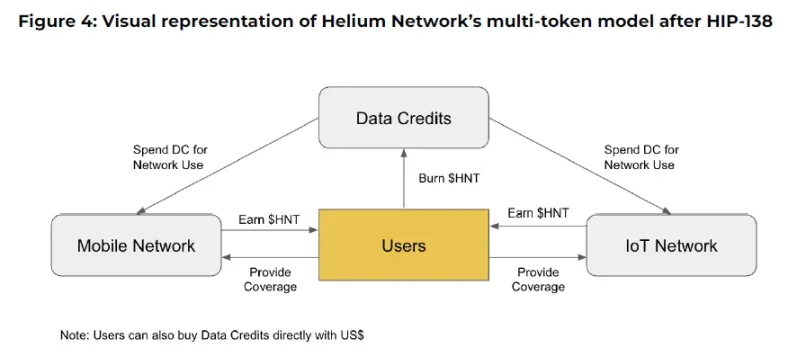
The novelty of liquidity mining extended far beyond the "DeFi summer." The ability to freely use protocol tokens as tools for accessing resources enabled rapid success for Web3 games like Axie Infinity and DePIN networks like Helium. Neither Axie Infinity nor Helium adopted a single-token model; instead, they implemented multi-token systems designed to separate speculation from utility—one token for value accrual, another for network usage. Yet in both cases, this distinction failed. Speculators flocked to the wrong tokens, incentives became misaligned, and value broke down. Ultimately, both reverted to simplified models.
Key takeaways:
-
The concept of liquidity mining expanded further, becoming a bootstrapping tool for other use cases such as gaming and DePIN
-
The idea of using multi-token models to distinguish speculative demand from native economic activity is difficult to execute and often fails when one token lacks real utility
-
Tokenomics is an iterative process—only when a product gains traction do stakeholder interests and needs become clearer
5. Surge in Private Funding: Shift Toward Valuation Games
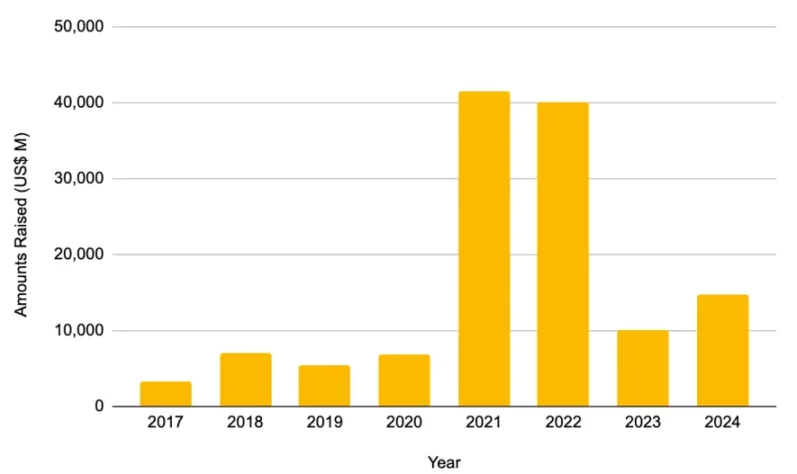
The years 2021–2022 saw explosive growth in private fundraising, raising $41.46 billion and $40.12 billion respectively. To put this in perspective, funding in 2021 alone was nearly double the total raised between 2017–2020 ($22.6 billion). This level of growth has not been repeated since.
To accommodate increasing capital inflows, projects conducted multiple funding rounds to include more investors and extend development timelines. With more pre-TGE (Token Generation Event) rounds, private investors typically negotiated longer vesting periods, reducing the proportion of circulating supply at launch. Combined with airdrops and points farming, this led to inflated metrics that helped boost initial FDV (Fully Diluted Valuation). Private funding inadvertently shifted focus from token utility to optimizing valuation.
6. Bridge Activity Declines Across All Major L2s After Airdrop Snapshots
Yet following airdrop distributions, protocol metrics (see chart below) and market valuations typically decline. This has contributed to negative perceptions of the common "low circulation, high FDV" issuance model seen over the past two to three years.

All major L2 platforms experienced declining bridge activity after completing airdrop snapshots
7. Tokens with Higher Circulating Supply and Lower FDV Perform Better Post-Launch
Compared to the May 2024 analysis (gray), recently launched tokens (yellow) show steadily increasing circulating supply. This suggests users can "vote with their wallets," abandoning tokens with poor tokenomics. As a result, projects must adapt to community expectations, leading to healthier circulation levels across the board.
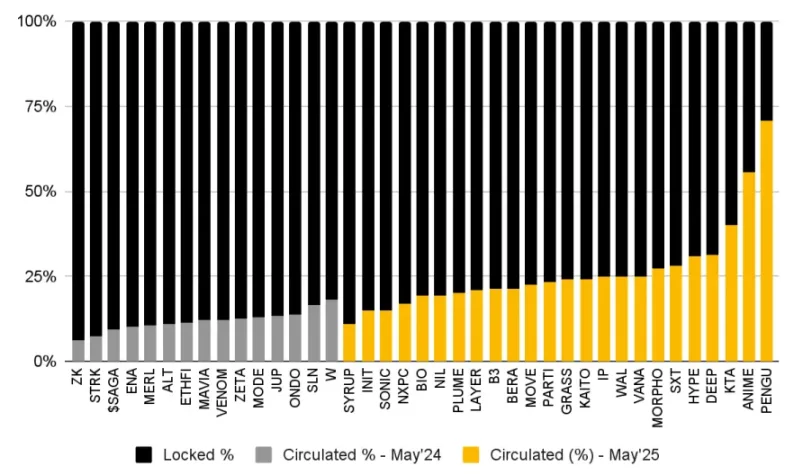
Recently issued tokens show an upward trend in circulation compared to last year
Similarly, comparing recent token launches to earlier data reveals a drop in fully diluted valuation at issuance. The average FDV of recently launched tokens is $1.94 billion, down from $5.5 billion in previous analyses.
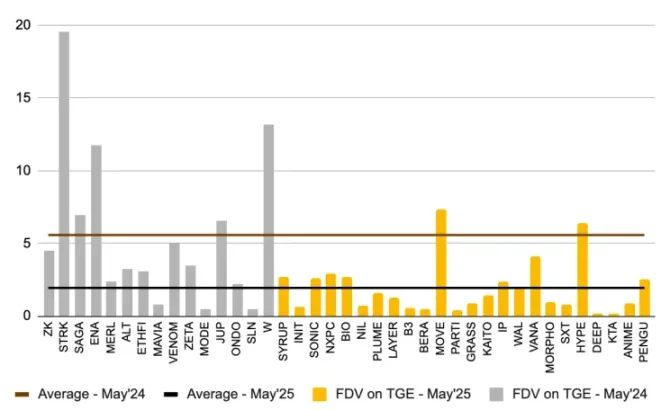
Average FDV at TGE has dropped by over 50% compared to a year ago
Compared to tokens analyzed in May 2024, those recently launched with higher circulation and lower FDV have shown stronger price performance (see chart below).
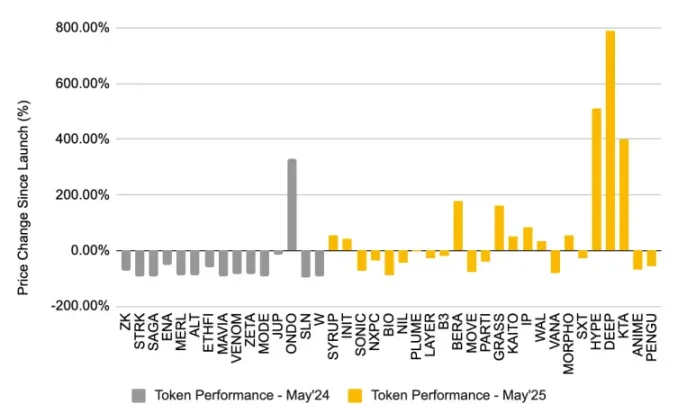
8. Token Buybacks Are Making a Comeback
In 2025, token buybacks are on the rise, with projects including Aave, dYdX, Jupiter, and Hyperliquid implementing programs to purchase and burn tokens using protocol revenue.
Projects capable of executing successful buybacks should be viewed positively, as only financially robust protocols can afford them. The reality is that many crypto projects fail to achieve product-market fit, and even those that succeed still need optimal strategies to drive organic token demand. Buybacks may serve as a transitional measure, allowing teams to focus on growth without being overly distracted by token price volatility.
9. Hyperliquid Leads the Buyback Trend
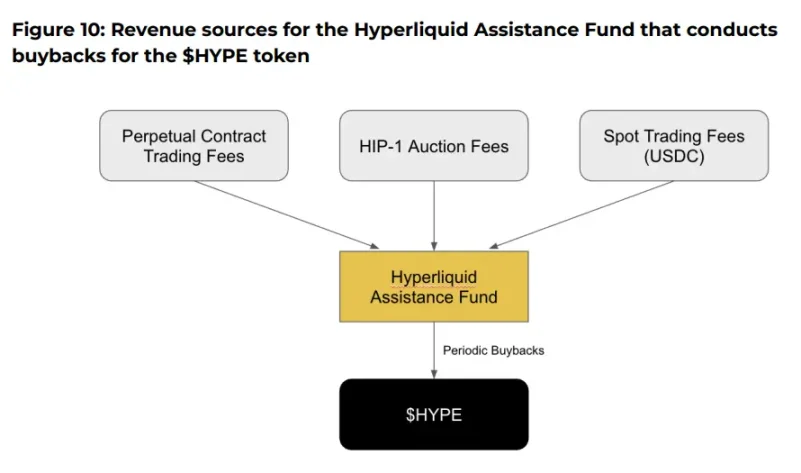
Hyperliquid currently leads the token buyback movement, having burned over $8 million worth of $HYPE tokens. What sets Hyperliquid apart is that buybacks are embedded into its core economic model: 54% of perpetual trading fees, spot trading fees, and HIP-1 auction proceeds are allocated exclusively to token repurchases. As of May 28, 2025, the Hyperliquid Assistance Fund holds 23,635,530.65 $HYPE tokens, valued at approximately $786 million.
However, no direct returns flow to token holders—buybacks primarily support price. Critics argue these funds could be better utilized beyond artificially manufactured scarcity. For instance, Hyperliquid could consider distributing USDC trading fees as rewards to $HYPE stakers. In that scenario, the $HYPE token would have a tighter linkage to protocol growth (and fee generation). Income-generating tokens better align incentives.
10. ICM Remains Predominantly Speculative—Most Issued Tokens Resemble Memecoins
Believe is an emerging player in the ICM (Internet-Centric Monetary) movement, enabling users to easily create tokens on the Solana blockchain by posting specific formats (e.g., "$TICKER + @launchcoin") on X, triggering automatic token deployment via bonding curves.
This streamlined process allows creators and founders to launch tokens without technical expertise or traditional fundraising barriers. The platform then splits transaction fees equally between creators and itself. Tokens reaching a $100,000 market cap are migrated to deeper liquidity pools on platforms like Meteora.
Launchcoin has since grown rapidly, issuing over 27,495 tokens with $3.4 billion in total trading volume as of May 29, 2025. While the sample size remains small, the potential for transaction fees to serve as direct income for creators is significant, enabling founders to fund development without equity dilution. At its peak, Believe generated over $7 million in daily trading fees, with 50% going to creators. In contrast, Virtuals peaked at $350,000 in daily fees.
Nevertheless, ICM remains largely speculative today, with most issued tokens resembling memecoins. Due to the permissionless nature of these platforms, over 27,000 tokens have been created on Believe alone, causing market saturation, liquidity fragmentation, and diverting investor attention from legitimate startups. Other issues include sniper bots, highlighting technical challenges that may undermine the success of genuine projects.
Overall, the ICM movement shares many similarities with the ICO investment era. It upholds the same ideal—democratizing access to capital—but offers even greater accessibility for founders.
Join TechFlow official community to stay tuned
Telegram:https://t.me/TechFlowDaily
X (Twitter):https://x.com/TechFlowPost
X (Twitter) EN:https://x.com/BlockFlow_News
 Binance Research